


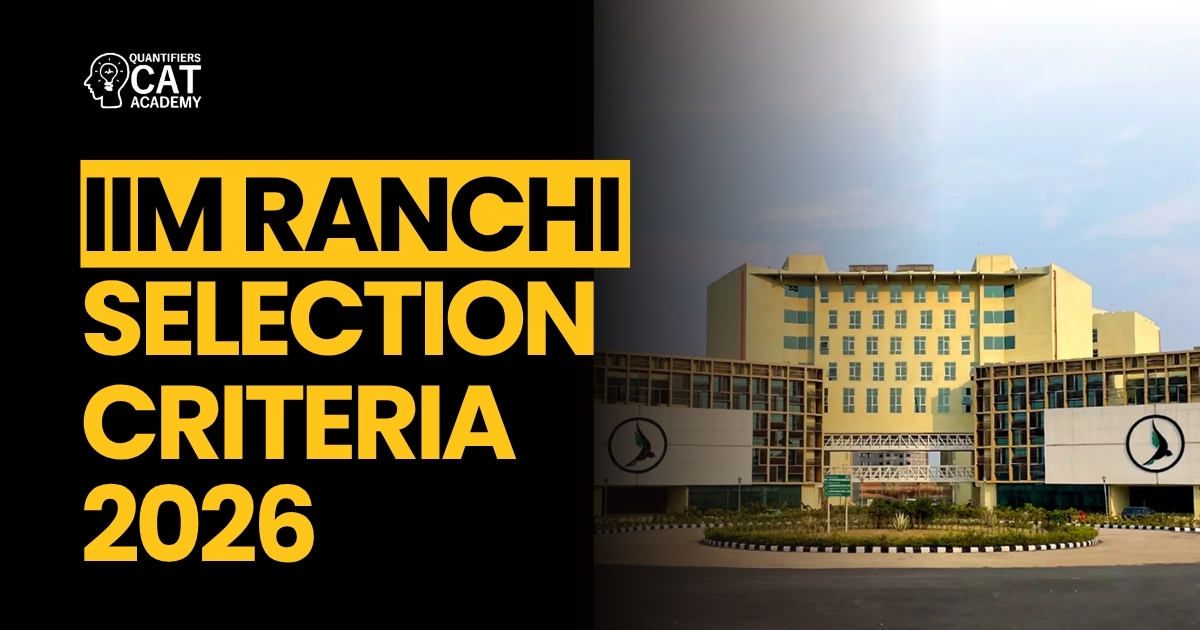

IIM Ranchi Selection Criteria 2026 — JAP Cutoffs, the CML Formula & Bonus Marks Explained
The IIM Ranchi selection criteria run through a shared Joint Admission Process with three other IIMs, an offline WAT and PI, and a Consolidated Merit List that stacks work-experience and diversity bonus marks on top of an already CAT-heavy base score. Here’s the complete two-stage process, decoded.
- What Makes the IIM Ranchi Selection Criteria Different
- IIM Ranchi Eligibility Criteria 2026
- IIM Ranchi CAT Cutoffs: Eligibility vs Actual PI Calls
- The Two-Stage IIM Ranchi Selection Criteria Process (JAP 2026)
- IIM Ranchi Selection Criteria: The CML & Bonus Marks
- IIM Ranchi WAT & Personal Interview
- IIM Ranchi Reservation Policy 2026
- IIM Ranchi Selection Criteria vs the Other IIMs
- What a Strong IIM Ranchi Profile Looks Like in 2026
1. What Makes the IIM Ranchi Selection Criteria Different
IIM Ranchi is the only IIM in this series that doesn’t run its own standalone admission process — it shortlists, WATs, and PI’s candidates jointly with three other IIMs under the Joint Admission Process (JAP 2026), alongside IIM Kashipur, IIM Raipur, and IIM Tiruchirappalli, with IIM Raipur acting as coordinator. Clear the shared CAT cutoff, and you’re in the combined shortlist pool for all four institutes at once.
The other distinctive piece is how the final score is built. Most IIMs in this series — Mumbai, Rohtak, Shillong — fold work experience or diversity directly into a 100%-weighted formula. IIM Ranchi instead builds a base Consolidated Merit List (CML) that already sums to 100%, and then adds bonus marks for work experience and diversity on top of that base rather than inside it. It’s also the only one of these IIMs whose WAT and PI are conducted offline, in person.
2. IIM Ranchi Eligibility Criteria 2026
To apply for IIM Ranchi’s MBA, MBA-HR, or MBA-BA programmes, you need:
- A bachelor’s degree in any discipline from a recognised university.
- A minimum of 50% aggregate marks (or equivalent CGPA) for General, EWS, and NC-OBC candidates.
- A minimum of 45% aggregate marks for SC, ST, and DAP (Differently Abled Persons) candidates.
- A valid CAT 2025 score — mandatory for all three MBA programmes.
- Final-year graduation students can also apply; admission is provisional pending completion of degree requirements.
3. IIM Ranchi CAT Cutoffs: Eligibility vs Actual PI Calls
IIM Ranchi runs a two-tier cutoff system, and the gap between the two tiers is wider here than at most other IIMs covered in this series. The first tier is simply the floor percentile needed to register for JAP 2026 — it does not mean you’ll get a PI call.
Table 1 — Minimum Eligibility Cutoffs (CAT 2025)
| Category | VARC | DILR | QA | Overall |
|---|---|---|---|---|
| General | 75 | 75 | 75 | 90 |
| EWS | 60 | 60 | 60 | 75 |
| NC-OBC | 60 | 60 | 60 | 75 |
| SC | 45 | 45 | 45 | 50 |
| ST | 25 | 25 | 25 | 30 |
| DAP (PwD) | 25 | 25 | 25 | 30 |
The second tier is the cutoff that actually produced a PI call — released by IIM Raipur as JAP 2026 coordinator, and common across all four participating institutes.
Table 2 — Actual JAP 2026 PI Shortlisting Cutoff (Overall CAT Percentile)
| Category | PI Shortlisting Cutoff |
|---|---|
| General | 96.25 |
| EWS | 89 |
| NC-OBC | 88.5 |
| SC | 75 |
| ST | 44 |
| DAP (PwD) | 30 |
⚠ The Eligibility Cutoff Is Not the Real Cutoff
A General-category candidate at 90 overall percentile is technically eligible to register for JAP 2026 — but the actual PI call cutoff that year was 96.25. That’s a 6+ point gap, larger than the buffer most candidates plan for. Treat the eligibility table as a floor, and benchmark your prep against the PI-shortlisting table instead.
4. The Two-Stage IIM Ranchi Selection Criteria Process (JAP 2026)
The IIM Ranchi selection criteria run in two stages, both shared with the other JAP 2026 institutes:
- Stage 1 — CAT-based shortlisting. An initial shortlist is prepared purely on CAT 2025 performance, against both sectional and overall cutoffs. Shortlisted candidates across all four JAP IIMs are merged into one combined pool.
- Stage 2 — WAT, PI & final selection. Shortlisted candidates sit an offline Written Ability Test and Personal Interview. IIM Ranchi then builds a separate Consolidated Merit List (CML) for each of its programmes — MBA, MBA-HR, and MBA-BA — and makes offers by category-wise rank on that list.
5. IIM Ranchi Selection Criteria: The CML & Bonus Marks
The Consolidated Merit List has two layers. The base layer sums to 100%:
Table 3 — CML Base Weightage
| Component | Weightage |
|---|---|
| CAT Scaled Score | 65% |
| Academic Profile (10th + 12th + Graduation) | 20% |
| Personal Interview | 12.5% |
| Written Ability Test | 2.5% |
On top of that 100% base, IIM Ranchi then adds bonus marks that aren’t normalised into the percentages above:
Table 4 — Bonus Marks Added to the CML
| Bonus Component | Marks | Notes |
|---|---|---|
| Work Experience | Up to 7 | 24–60 months earns the highest points |
| Gender Diversity | +5 | Female / transgender candidates |
| Academic Diversity | +5 | Non-engineering undergraduate background |
💡 Bonus Marks Sit on Top, Not Inside the 100%
This is the structural quirk that makes the IIM Ranchi selection criteria different from every other IIM in this series. Mumbai, Rohtak, and Shillong all bake work experience or diversity directly into a 100%-weighted formula. IIM Ranchi instead lets the base CML sum to 100% on CAT, academics, PI, and WAT alone — then layers up to 17 additional bonus marks (7 + 5 + 5) on top for work experience, gender, and academic diversity. A candidate with ideal work tenure and a non-engineering background can meaningfully out-rank a stronger raw-CAT peer who has neither.
6. IIM Ranchi WAT & Personal Interview
Both rounds are conducted offline, in person, as part of the shared JAP 2026 process:
- Written Ability Test (2.5% weight): a short written component, typically a current-affairs or opinion-based prompt, assessed for structure and clarity of argument.
- Personal Interview (12.5% weight): covers academic background, current affairs, work experience (where applicable), and your specific reasons for choosing IIM Ranchi’s MBA, MBA-HR, or MBA-BA track.
Because PI carries a comparatively small 12.5% weight here against CAT’s 65%, a strong interview can lift your rank — but it’s unlikely to rescue a CAT score that missed the real shortlisting cutoff in the first place.
7. IIM Ranchi Reservation Policy 2026
Seats follow the Government of India’s reservation norms for Central Educational Institutions, applied across MBA, MBA-HR, MBA-BA, and IPM:
Table 5 — Reservation by Category
| Category | Reservation |
|---|---|
| NC-OBC | 27% |
| SC | 15% |
| ST | 7.5% |
| EWS | 10% |
| DAP (PwD) | 5% (horizontal) |

8. IIM Ranchi Selection Criteria vs the Other IIMs
Set alongside Mumbai, Rohtak, Ahmedabad, Bangalore, Calcutta, and Shillong, IIM Ranchi has both the heaviest CAT weight at the base layer and the lowest standalone PI weight of the group — before its bonus marks are even added.
Table 6 — IIM Ranchi vs the Other IIMs
| IIM | Shortlist Basis | Final — CAT | Final — PI |
|---|---|---|---|
| Ranchi | CAT (sectional + overall, via JAP 2026) | 65% | 12.5% |
| Rohtak | Overall CAT percentile + diversity (no sectional cutoffs) | 60% | 20% |
| Mumbai | CAT score only (sectional cutoff + rank) | 60% | 20% |
| Ahmedabad | CAT + Application Rating | 25% | 50% |
| Bangalore | CAT 55% + academics 30% + work-ex + gender | 25% | 40% |
| Calcutta | CAT 56/85 + Class 10 + Class 12 + gender | 30% | 48% |
| Shillong | CAT 65% + NARS 35% (discipline-wise) | 40% | 40% |
💡 Highest Base CAT Weight, Lowest Standalone PI Weight
Among all seven IIMs compared across this series, IIM Ranchi’s base CML leans hardest on CAT (65%) and lightest on the interview (12.5%) — a sharper tilt toward the written exam than even Mumbai or Rohtak. The bonus-marks layer is what gives candidates with strong work experience or a non-engineering background a real way to claw back rank without needing a flawless interview.
9. What a Strong IIM Ranchi Profile Looks Like in 2026
- Treat the published eligibility cutoff as a floor, not a target. Benchmark your prep against the actual PI-shortlisting percentile (Table 2), which runs meaningfully higher across every category.
- Clear every sectional cutoff with room to spare. JAP 2026’s combined shortlist pulls from four IIMs at once, so the competition per seat is steep even after you clear the floor.
- If you have 24–60 months of work experience, you’re sitting in the band that earns the highest bonus marks — factor that into your overall rank expectations.
- Non-engineering graduates get a genuine bonus here. The +5 academic-diversity marks reward exactly that background, on top of whatever the base CML already gives you.
- Prepare for an offline WAT. Practice structuring a short written argument under time pressure — it’s a different muscle than online sectional tests.
- Don’t over-invest prep time in PI at the expense of CAT. At 12.5% weight, the interview matters, but nowhere near as much as the CAT score that gets you there.
With CAT carrying 65% of the base score and the real shortlisting bar sitting well above the published minimum, consistent full-syllabus accuracy is what the IIM Ranchi selection criteria reward most. Start with free CAT study material, build a daily habit with the Daily Targets on the Quantifiers homepage, and benchmark your sectional and overall percentile on the TruCAT free mock series well before results day.