
- Our Courses
- Video Resources
Video Resources
...
- Daily Targets
- All India Free Mocks
...
- Free Study Material
- Blogs
Discover the most common DILR question patterns in CAT. Learn repetitive topics, preparation strategies, and expert tips to improve your CAT DILR score.
While the CAT DILR section appears unpredictable, previous year papers reveal clear recurring patterns. The most frequently repeated topic combinations include Scheduling + Ranking, Tables + Venn Diagrams, Games & Tournaments + Logical Conditions, and Data Interpretation + Mathematical Reasoning. The section typically carries 20–22 questions across 4–5 sets, and each set blends logical thinking with data analysis. Aspirants who recognise and practice these patterns can select the right sets faster, solve them more accurately, and significantly improve their CAT DILR percentile — without attempting every set in the exam.
We hope you find this blog informational. If you want a FREE DEMO, click here.

Quantifiers CAT Academy, Chandigarh
The Data Interpretation and Logical Reasoning (DILR) section of the CAT exam is often considered one of the most unpredictable parts of the paper. However, if you carefully analyse previous years’ CAT papers, you will notice that certain patterns and topic combinations appear repeatedly.
Understanding these repetitive question types can help aspirants prepare more effectively and improve their chances of solving sets faster during the exam. At Quantifiers, students are trained to recognise these patterns and develop the right strategies to tackle complex DILR sets under time pressure.
If you are targeting a high percentile in CAT, focusing on frequently appearing DILR topics can significantly strengthen your preparation.
📌 DILR isn't fully random — analyse past CAT papers and you'll spot the same topic combinations appearing year after year.
📊 The section has 4–5 sets, 20–22 questions — each set blends data interpretation with logical reasoning, not just one skill.
🔁 Most repeated topic combos to practise: Scheduling + Ranking / Distribution, Tables + Venn Diagrams, Games & Tournaments + Logical Conditions, Bar Graph + Pie Chart, Seating Arrangement + Distribution, Mathematical Reasoning + Ratios, Routes & Networks + Logical Constraints
⚠️ What makes DILR hard: unpredictable set structures + mixed concepts + brutal time pressure — not the individual topics themselves.
🎯 Don't attempt all sets — the smartest strategy is identifying 2–3 doable sets in the first few minutes and solving those accurately.
🗂️ Use structure while solving — diagrams, quick tables, and organised notes are faster than solving mentally under pressure.
📅 3–4 months of focused practice is enough to build strong DILR skills if you're working on the right patterns consistently.
✅ The bottom line: Pattern recognition + set selection + time discipline = high DILR score. Raw logic alone won't get you there.
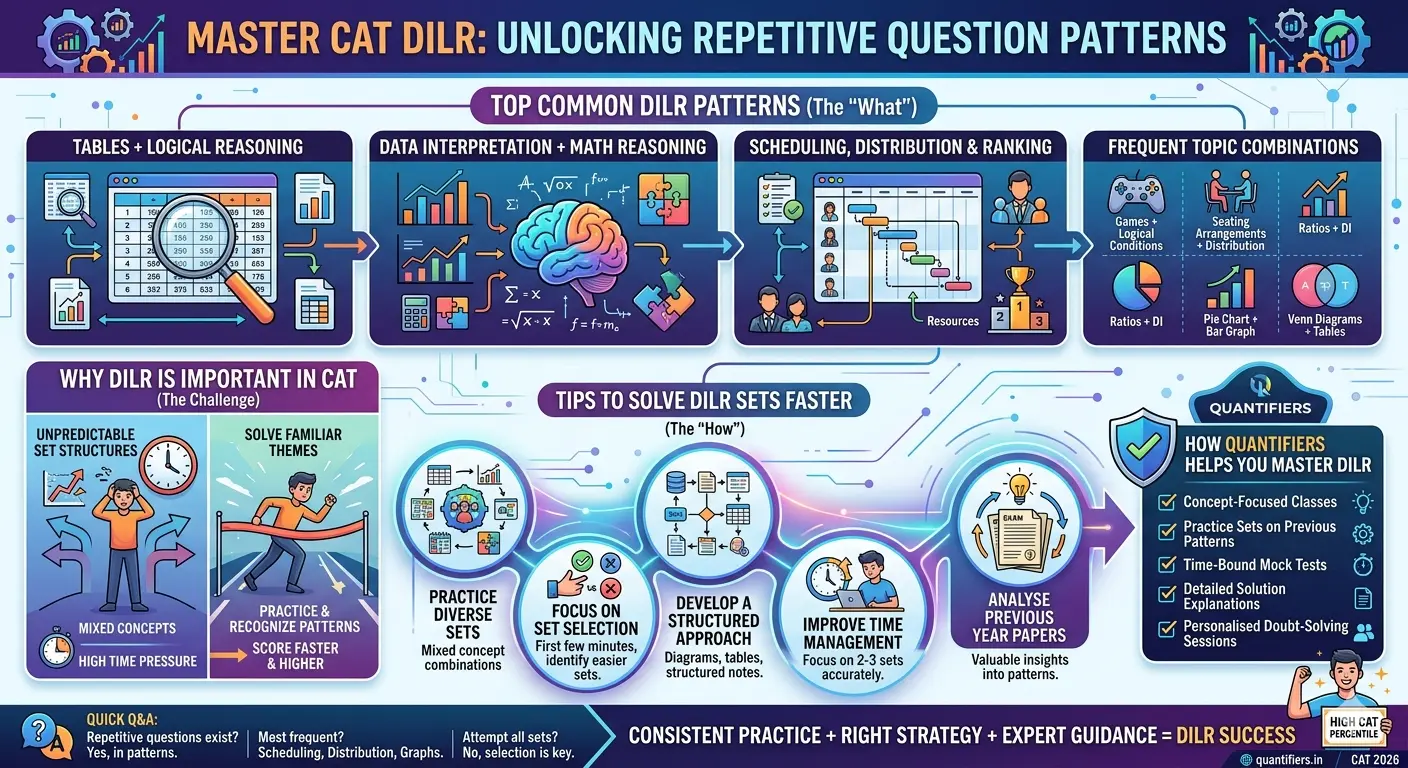
The DILR section typically contains 4–5 sets with 20–22 questions, and each set tests a combination of logical thinking, data interpretation, and analytical reasoning.
What makes this section challenging is:
However, the good news is that many CAT sets are built around familiar themes, which means aspirants who practice these combinations regularly can solve them more efficiently.
Based on previous CAT exams, several topic combinations repeatedly appear in the DILR section. Here are some of the most common patterns.
Many CAT sets include numerical data presented in tables or bar graphs, but solving them requires logical reasoning rather than simple calculations.
Students must:
This combination tests both data analysis and reasoning skills simultaneously.

Another common pattern involves data interpretation mixed with mathematical logic.
Instead of direct calculations, aspirants must:
Such sets are designed to test analytical thinking and structured problem solving.
These types of sets require students to arrange elements based on given constraints.
Typical questions may involve:
These sets often require step-by-step logical deductions, making them challenging but highly scoring if approached correctly.
Over the years, CAT examiners have used various topic combinations to design complex sets. Practicing these combinations can help aspirants become comfortable with CAT-level difficulty.
Some of the most frequently seen combinations include:
These combinations train aspirants to think flexibly and approach problems from multiple perspectives.

Consistency plays a crucial role in CAT 2026 preparation. To help aspirants stay disciplined and exam-ready, we post daily study targets covering Quant, DILR, and VARC practice.
Mastering repetitive DILR questions requires the right preparation strategy.
Instead of solving only one type of problem, practice mixed concept sets similar to those seen in CAT.
Not every set needs to be attempted. Identifying easier sets within the first few minutes is crucial for scoring high.
Use diagrams, tables, or structured notes to organise information clearly while solving a set.
The key to cracking DILR is solving 2–3 sets accurately within the time limit rather than attempting all sets.
Past CAT papers provide valuable insights into question patterns and topic combinations.
At Quantifiers, students practice a wide range of CAT-level DILR sets that help them build speed, accuracy, and confidence.

Preparing for the DILR section requires concept clarity, extensive practice, and expert guidance. Quantifiers offers a structured preparation approach designed specifically for CAT aspirants.
Students benefit from:
This comprehensive approach helps aspirants develop strong problem-solving skills and achieve higher percentiles in CAT.
Although the DILR section of CAT may seem unpredictable, analysing previous exam papers reveals that certain question patterns appear repeatedly.
By practising these common DILR topic combinations and improving logical reasoning skills, aspirants can significantly increase their chances of solving sets efficiently during the exam.
With consistent practice, the right strategy, and expert guidance from Quantifiers, cracking the DILR section and achieving a high CAT percentile becomes much more achievable.

Discover the most complete list of free resources for CAT 2026 — from free CAT mock tests and CAT previous year questions to DILR sets, VARC practice, quant formula book, and GDPI handbooks. All curated by Quantifiers. All free. All updated.

The DILR section in CAT includes Data Interpretation and Logical Reasoning questions that test analytical thinking, decision making, and problem-solving skills.
Yes, although the exact questions change every year, certain topic combinations and logical structures frequently appear in the CAT DILR section.
Commonly repeated topics include scheduling, distribution, ranking, tables, bar graphs, seating arrangements, games and tournaments, and Venn diagrams.
The DILR section usually contains 20–22 questions divided into 4–5 sets, each testing different logical and data interpretation skills.
Many students consider DILR challenging because of complex logical conditions and time pressure, but consistent practice can significantly improve performance.
You can improve speed by practicing diverse sets, analysing previous CAT papers, and solving timed mock tests regularly.
No. It is better to identify easier sets and solve them accurately rather than attempting every set and making mistakes.
Yes, analysing previous CAT papers helps students understand question patterns, difficulty levels, and frequently tested concepts.
With consistent practice and proper guidance, most aspirants can build strong DILR skills within 3–4 months of focused preparation.
Quantifiers provides structured DILR practice sets, expert mentorship, and CAT-level mock tests to help students improve their logical reasoning and data interpretation skills.

Your MBA journey doesn’t have to be confusing. At Quantifiers CAT Academy, we mentor students from the ground up—whether you’re preparing for CAT or exploring exams like SNAP, NMAT, CMAT, IIFT and MICAT. With personalised attention, proven strategies and performance-focused guidance, we help you build strong fundamentals, boost accuracy, and stay consistent throughout your preparation journey.
Yes, CAT DILR has repetitive patterns. While exact questions change, certain
topic combinations and logical structures appear consistently across years.
Recognising them is a key preparation advantage.
SECTION STRUCTURE:
– Total questions: 20–22 | Sets: 4–5
– Each set blends Data Interpretation + Logical Reasoning
– What’s tested: analytical thinking, structured deduction, time management
TOP RECURRING TOPIC COMBINATIONS:
1. Scheduling + Ranking
2. Scheduling + Distribution
3. Tables + Venn Diagrams
4. Data Interpretation + Logical Reasoning
5. Games & Tournaments + Logical Conditions
6. Seating Arrangement + Distribution
7. Mathematical Reasoning + Ratios
8. Bar Graph + Pie Chart
9. Routes & Networks + Logical Constraints
10. Selection + Distribution
COMMON QUESTION PATTERNS:
– Tables/Bar Graphs requiring logical deduction (not just calculation)
– DI sets with hidden patterns and missing values
– Scheduling/Distribution sets with multi-condition constraints
– Ranking sets built on step-by-step logical elimination
EXAM STRATEGY — KEY FACTS:
– Do NOT attempt all sets — attempt 2–3 sets accurately instead.
– First 2–3 minutes: scan all sets and identify the easiest ones.
– Use structured notes/diagrams while solving, not mental tracking.
– Time target: solve each chosen set within 10–12 minutes.
PREPARATION TIMELINE:
– 3–4 months of focused, pattern-based practice builds strong DILR skills.
– Analysing previous CAT papers is essential for pattern recognition.
– Timed mock tests are critical for building exam-day speed.
BOTTOM LINE:
DILR rewards pattern recognition + smart set selection + structured solving.
Consistent practice on these recurring combinations is the most effective
strategy to improve your CAT DILR score.
To connect with us, for mentorship and daily test practice
DM us on Instagram or WhatsApp. We reply back 24/7. Get your CAT prep started









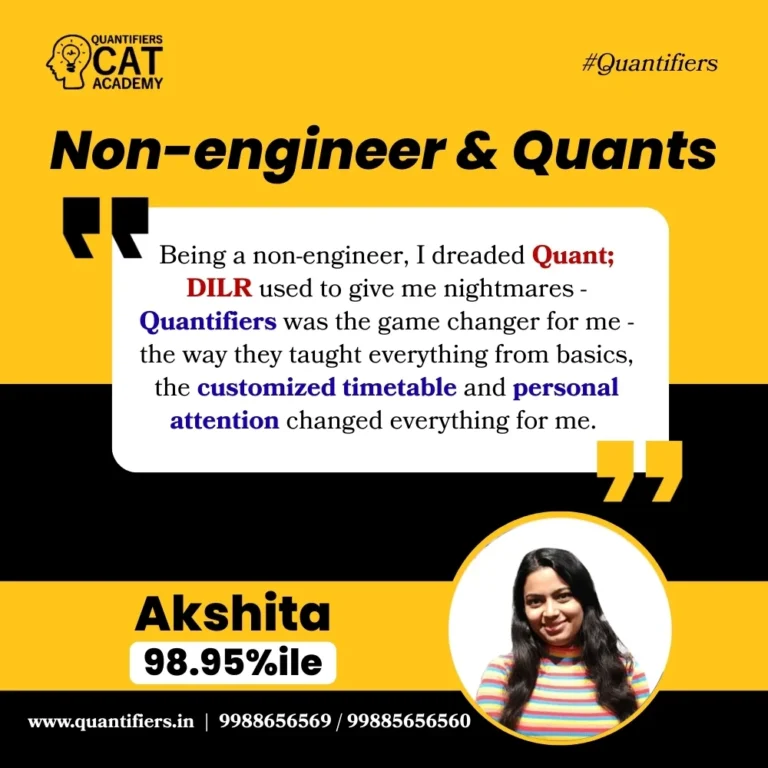

















We at Quantifiers understand and deliver on the personal attention each of our students requires. Whether it is through our pedagogy that enables non-engineers or non-math background students, our constant effort to proactively provide solutions, or our focus on our student’s goals.