

IIM Calcutta Selection Criteria 2026 — CAT 2025 Cutoff, Pre-PI Weightage & the WAT-PI Final Selection Explained
The IIM Calcutta selection criteria for PGP 2026–28 stand apart from every other top IIM in two big ways: the Personal Interview alone carries 48% of the final call, and the shortlist is built almost entirely on your CAT score plus your Class 10 and Class 12 boards — with academic-diversity points that quietly reward non-engineers. Here is the complete three-stage process, decoded.
-
- What Defines the IIM Calcutta Selection Criteria for 2026
- Eligibility & CAT 2025 Minimum Cutoffs
- Stage 1 of the IIM Calcutta Selection Criteria: Pre-PI Shortlist
- Stage 2: The WAT & Personal Interview Round
- Stage 3 of the IIM Calcutta Selection Criteria: Final Composite Score
- Academic Diversity & Work Experience Scoring
- IIM Calcutta Selection Criteria vs IIM Ahmedabad & IIM Bangalore
- What a Strong IIM Calcutta Profile Looks Like in 2026
1. What Defines the IIM Calcutta Selection Criteria for 2026
IIM Calcutta runs a three-stage process: a Pre-PI shortlist, a WAT and Personal Interview round, and a final composite score that decides the merit list. What makes the IIM Calcutta selection criteria distinctive is the balance of those stages. The shortlist leans heavily on CAT and your school boards, but the final call is dominated by the interview — at 48%, the PI is the single highest-weighted component of any top-three IIM.
The headline numbers of the final stage are worth memorising before anything else, because they tell you exactly where to spend your effort.
Table 1 — IIM Calcutta Final Selection Weightage (out of 100)
| Component | Weight | What It Rewards |
|---|---|---|
| Personal Interview (PI) | 48 | Clarity, depth, awareness, fit — the deciding factor |
| CAT 2025 Score | 30 | Aptitude (weight roughly halves from the shortlist stage) |
| WAT | 8 | Structured written argument |
| Work Experience | 8 | Peaks at 2–3 years, then declines |
| Academic Diversity | 6 | Non-engineering, law and professional backgrounds |
| Total | 100 | Decides the final merit list |
⚠ The Interview Is Not a Formality Here
At many schools the CAT score does most of the heavy lifting. At IIM Calcutta it does not. Once you are shortlisted, your CAT weight drops to 30 and the PI jumps to 48 — meaning two candidates with identical CAT scores can finish a long way apart based purely on the interview room. Treat WAT-PI preparation as half the battle, not an afterthought.
2. Eligibility & CAT 2025 Minimum Cutoffs
To be eligible for IIM Calcutta you need a bachelor’s degree of at least three years with a minimum of 50% marks (45% for SC/ST/PwD) and a valid CAT 2025 score. Candidates holding CA, ICWA or CS qualifications after Class XII are also eligible. Final-year students may apply, subject to completing their degree before joining.
At the first stage you must clear the overall percentile and all three sectional percentiles. Miss any one and you fall out of the process, however strong your overall score.
Table 2 — IIM Calcutta CAT 2025 Minimum Cutoffs (Pre-PI, PGP 2026–28)
| Category | Overall | VARC | DILR | QA |
|---|---|---|---|---|
| General | 85 | 80 | 80 | 75 |
| NC-OBC / EWS | 75 | 70 | 65 | 65 |
| SC | 70 | 65 | 60 | 60 |
| ST | 65 | 55 | 55 | 55 |
| PwD | 55 | 45 | 45 | 45 |
3. Stage 1 of the IIM Calcutta Selection Criteria: Pre-PI Shortlist
Candidates who clear the cutoffs are ranked on a Pre-PI composite scored out of 85. This is where the IIM Calcutta selection criteria differ most from peer institutes: graduation marks and work experience play no part at this stage. Your shortlist score is built almost entirely from your CAT scaled score and your two board exams.
Table 3 — Pre-PI (Stage 1) Composite Score Breakdown
| Parameter | Weight | Detail |
|---|---|---|
| CAT 2025 Score | 56 | Scaled-score formula (see below) |
| Class 10 Board | 10 | Slab-based on marks % |
| Class 12 Board | 15 | Slab-based on marks % (weighted higher than 10th) |
| Gender Diversity | 4 | Female and transgender candidates only |
| Total | 85 | Determines the WAT-PI shortlist |
How your CAT score is converted
IIM Calcutta uses your scaled CAT score, not your percentile, to award the 56 points:
How your board marks convert to points
Class 10 and Class 12 are scored on fixed slabs — and notice that Class 12 is worth half-again as much as Class 10:
Table 4 — Class 10 & Class 12 Points by Marks Slab
| Board Marks (%) | Class 10 Points (max 10) | Class 12 Points (max 15) |
|---|---|---|
| 80 and above | 10 | 15 |
| 75 – 79.99 | 8 | 12 |
| 70 – 74.99 | 6 | 9 |
| 65 – 69.99 | 4 | 6 |
| 60 – 64.99 | 2 | 3 |
| Below 60 | 0 | 0 |
💡 Your Boards Can Win or Lose You the Call
School academics are 25 of the 85 shortlist points — and they are completely fixed before you ever start CAT prep. A candidate at 80%+ in both boards banks the full 25; a candidate at 65% banks just 10. That 15-point gap is enormous on an 85-point scale. If your boards are strong, the IIM Calcutta selection criteria are firmly in your favour; if they are weak, your CAT score has to carry almost all the load.

4. Stage 2: The WAT & Personal Interview Round
Candidates who make the shortlist are called for the Writing Ability Test (WAT) and the Personal Interview (PI). The WAT is a written exercise assessed on the quality and structure of your argument; the PI is conducted by a panel that probes your background, your motivation for an MBA, your awareness of current affairs, and how you think on your feet.
Neither round “passes or fails” you on its own — both feed directly into the Stage-3 composite, where the PI carries 48% and the WAT 8%. In practice, the months between the shortlist and your interview date are the highest-leverage period in the entire IIM Calcutta selection criteria, because more than half of your final score is still undecided when you walk into that room.
5. Stage 3 of the IIM Calcutta Selection Criteria: Final Composite Score
The final merit list is built on a fresh 100-point composite. CAT’s weight roughly halves from the shortlist stage, and the interview takes over.
For context, recent RTI disclosures put the final composite cutoff for selected General candidates in the high-50s out of 100 — a reminder that a strong CAT alone (worth only 30 here) cannot get you across the line without a commanding interview and a well-rounded profile.
💡 Where the Final Stage Is Won
PI plus WAT together make up 56% of the final score. CAT is 30. Everything else — work experience and academic diversity — is 14. If you reach the interview, your single biggest lever is no longer your aptitude score; it is how well you communicate, reason and present under pressure.
6. Academic Diversity & Work Experience Scoring
Two of the final-stage components work very differently from what most aspirants expect — and both can reshape who actually gets in.
Academic diversity (up to 6 points)
IIM Calcutta deliberately rewards profiles that broaden the classroom. The points hinge on your degree stream — and pure engineering backgrounds score zero:
Table 5 — Academic Diversity Points
| Academic Background | Points |
|---|---|
| Engineering bachelor’s, master’s or integrated master’s | 0 |
| Engineering bachelor’s + non-engineering master’s (dual / integrated) | 1 |
| Engineering bachelor’s + non-engineering master’s | 2 |
| Non-engineering bachelor’s | 4 |
| Non-engineering bachelor’s + non-engineering master’s | 5 |
| Dual bachelor’s in Law (BA/BSc/B.Com/BBA LLB) | 5 |
| CA / ICWA / CS / FIAI without a bachelor’s degree | 5 |
| CA / ICWA / CS / FIAI with a bachelor’s degree | 6 |
| CA / ICWA / CS / FIAI + non-engineering master’s | 6 |
| Integrated Law bachelor’s + non-engineering master’s | 6 |
Work experience (up to 8 points)
The work-experience curve is unusual: it rises, plateaus, and then falls again. More experience is not always better at IIM Calcutta.
6 < X ≤ 24 → X ÷ 3 points
24 < X ≤ 36 → 8 points (maximum)
36 < X ≤ 48 → 26 − (X ÷ 2) points (declining)
X > 48 → 2 points
The score maxes out at 8 points for 24–36 months of experience, then slides down for anyone with more than four years, bottoming out at just 2 points beyond 48 months. Freshers with six months or less score zero here.
💡 IIM Calcutta Quietly Favours a Specific Profile
Stack the diversity and work-ex rules together and a clear pattern emerges: IIM Calcutta structurally rewards a non-engineer with roughly two to three years of work experience. Engineers start six points behind on diversity, and very long work tenures actively lose points. If that describes you, the IIM Calcutta selection criteria are unusually generous — and if it doesn’t, a sharp CAT score and a standout interview are how you close the gap.
7. IIM Calcutta Selection Criteria vs IIM Ahmedabad & IIM Bangalore
If you are chasing all three of the original IIMs, the same profile can rank very differently at each. Here is how the criteria diverge across the key stages.
Table 6 — IIM Calcutta vs IIM Bangalore vs IIM Ahmedabad
| Parameter | IIM Calcutta | IIM Bangalore | IIM Ahmedabad |
|---|---|---|---|
| Shortlist — CAT weight | 56 of 85 (~66%) | 55 of 100 | ~65% of the rating |
| Shortlist — academics | 10th + 12th = 25 of 85; no graduation/work-ex | 10th + 12th + grad = 30 of 100 | Folded into Application Rating |
| Final — Personal Interview | 48% | 40% | 50% |
| Final — CAT | 30% | 25% | 25% |
| Final — written test | WAT 8% | WAT 10% | AWT 10% |
| Final — work experience | 8% (peaks 24–36 mo, then falls) | 10% (caps at 36 mo) | Within the rating |
| Academic diversity | 6% (engineers score 0) | — | Via academic-category system |
💡 Which School Fits Your Profile?
IIM Calcutta is the most interview-driven of the three at the final stage, the most board-marks-driven at shortlist (Class 12 alone is worth 15), and the most diversity-driven (engineers forfeit six points). A non-engineer with strong boards and two to three years of work fits the IIM Calcutta selection criteria unusually well. An engineer with a towering CAT score may find IIM Bangalore’s explicit, linear composite easier to optimise. Across all three, a 99+ percentile with no weak section keeps every door open.
8. What a Strong IIM Calcutta Profile Looks Like in 2026
Pulling the rules together, here is what a profile that converts an IIM Calcutta call tends to look like:
- CAT: aim for 99%ile+ overall: The minimum is 85, but RTI data shows selected General candidates well above the 98th percentile. CAT is 56 of 85 at shortlist and 30 of 100 at the final stage, so it remains your foundation even though the interview decides the outcome.
- Class 12 of 80%+ is worth a full 15 points: No other top IIM rewards board marks this directly. Strong 10th and 12th scores can bank you 25 of the 85 shortlist points before CAT is even counted.
- Non-engineers carry a built-in edge: Academic diversity hands 4–6 points to non-engineering, law and professional backgrounds, while engineers start at zero. Akshita — a Quantifiers non-engineer who tamed the dreaded QA to score 98.95%ile — is exactly the kind of profile IIM Calcutta is designed to attract.
- Two to three years of work experience is the sweet spot: The 8-point work-ex score peaks at 24–36 months and then declines, so there is no reason to delay your attempt for a longer tenure.
- The interview is 48% — prepare like it: WAT and PI together are 56% of the final score. Mock interviews, current affairs and structured WAT practice are not optional. Quantifiers’ GDPI preparation covers all three and is included with enrolled courses.
- Female and transgender candidates gain 4 shortlist points: On an 85-point scale, that gender-diversity factor can be decisive at the margin.
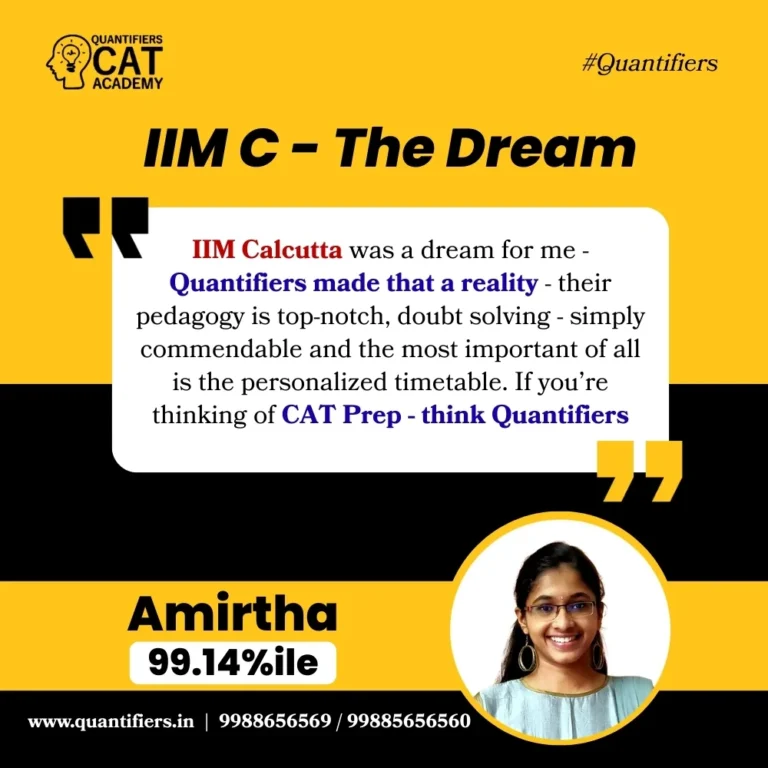
This is the profile Quantifiers builds students toward every year. Mridul (99.98%ile, IIM Calcutta) and Amirtha (99.14%ile, IIM Calcutta) are proof that the right plan converts the toughest calls. You can begin with free CAT study material, build exam temperament on the TruCAT free mock series, and stay consistent with the Daily Targets on the Quantifiers homepage.