


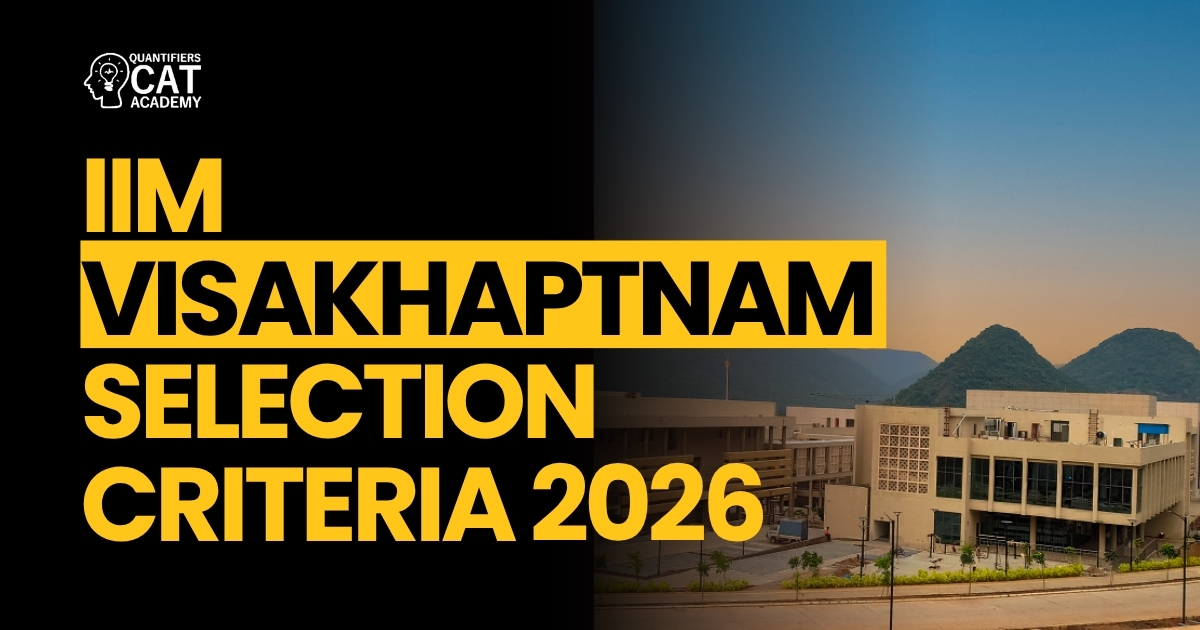

IIM Visakhapatnam Selection Criteria 2026 — Why This Is One of the Few IIMs Where Class 10 Marks Still Matter
IIM Visakhapatnam runs a three-phase process where academics enter the picture right from the shortlisting stage — not just at the final merit list, like at several newer IIMs. Class 10, Class 12, and graduation scores together carry 30% weight even before you reach the interview room. Here’s the full breakdown of cutoffs, composite score formulas, and what it takes to convert a call in 2026.
- What Makes IIM Visakhapatnam’s Selection Process Different
- IIM Visakhapatnam Eligibility Criteria 2026
- IIM Visakhapatnam CAT Cutoffs 2026
- The Three-Phase Selection Process
- Phase 2: Pre-Interview Composite Score Weightage
- How Class 10 and Class 12 Marks Are Normalised
- How Work Experience Is Scored
- Phase 3: Final Merit List Weightage
- Expected Final Composite Score Cutoffs 2026
- Documents You’ll Need
- What a Strong IIM Visakhapatnam Profile Looks Like in 2026
1. What Makes IIM Visakhapatnam’s Selection Process Different
Most applicants assume a strong CAT percentile is the main hurdle at any IIM. At IIM Visakhapatnam, that’s only half the story. The institute runs a genuinely three-phase process, and unlike IIMs where board marks only start counting at the final-merit stage, IIM Visakhapatnam folds Class 10, Class 12, and graduation scores into the composite score used for Phase 2 shortlisting itself — the stage that decides who even gets a Personal Interview call.
That means two candidates with an identical CAT percentile can land very different PI outcomes purely based on how consistent their academic record has been since school. This is the single biggest thing to internalise about IIMV’s process before you start benchmarking your own chances.
💡 Three Distinct Filters, Not One
Phase 1 filters purely on CAT cutoff. Phase 2 re-ranks that qualified pool using a composite score that blends CAT, academics, work experience, and gender diversity — and only the top scorers here get an interview call. Phase 3 then recalculates everything with a completely different set of weights, where the Personal Interview alone outweighs every other factor combined.
2. IIM Visakhapatnam Eligibility Criteria 2026
- A bachelor’s degree in any discipline with a minimum of 50% marks or equivalent CGPA for General, EWS, and NC-OBC candidates.
- A relaxed minimum of 45% marks for SC, ST, and PwD candidates.
- Candidates holding a professional qualification — CA, CS, ICWA (CMA), or FIAI — can use that in place of the standard graduation percentage requirement.
- A valid CAT 2025 score with IIM Visakhapatnam listed as a preference.
- Final-year students can apply with a bona fide certificate at the time of application, followed by the actual degree certificate once available.
3. IIM Visakhapatnam CAT Cutoffs 2026
These are the minimum sectional and overall CAT 2025 percentiles needed to even qualify for Phase 1. Falling short on any single section — even with a strong overall percentile — disqualifies a candidate at this stage.
Table 1 — IIM Visakhapatnam Minimum CAT Cutoffs by Category (CAT 2025)
| Category | VARC | DILR | QA | Overall Percentile |
|---|---|---|---|---|
| General | 70 | 70 | 70 | 82 |
| EWS | 63 | 63 | 63 | 72 |
| NC-OBC | 63 | 63 | 63 | 72 |
| SC | 40 | 40 | 40 | 50 |
| ST | 30 | 30 | 30 | 40 |
| PwD | 30 | 30 | 30 | 40 |
4. The Three-Phase Selection Process
Table 2 — IIM Visakhapatnam Admission Process Overview
| Phase | What Happens | What Decides It |
|---|---|---|
| Phase 1 | Candidates meeting minimum CAT 2025 percentile requirements qualify to submit a detailed online application | CAT sectional + overall cutoff |
| Phase 2 | A composite score is calculated using CAT score, Class 10/12/graduation marks, work experience, and gender diversity; top scorers get a PI call | Weighted composite score (see Table 3) |
| Phase 3 | Personal Interviews are conducted; a fresh composite score with different weights produces the Final Merit List | Weighted composite score, PI-heavy (see Table 6) |
5. Phase 2: Pre-Interview Composite Score Weightage
This is the formula that actually decides who gets an interview call — and it’s where IIM Visakhapatnam diverges most from IIMs that shortlist on CAT score alone.
Table 3 — Phase 2 Composite Score Weightage (Pre-Interview Shortlisting)
| Component | Weight | Breakdown |
|---|---|---|
| CAT Score | 50 | VARC: 18, DILR: 14, QA: 18 |
| Class 10 Marks | 10 | Normalised to the board’s 90th percentile score |
| Class 12 Marks | 10 | Normalised to the board’s 90th percentile score |
| Bachelor’s Degree | 10 | Normalised within stream |
| Gender Diversity | 10 | Applies to female and transgender candidates |
| Work Experience | 10 | Calculated using a specific formula (see Table 5) |
⚠ A Strong CAT Score Alone Won’t Guarantee a PI Call Here
Because academics make up 30% of the Phase 2 composite score, a candidate at the CAT cutoff with a weak Class 10/12 record can be outranked in shortlisting by someone with a slightly lower CAT percentile but stronger, more consistent academics. If your school-level scores are on the lower side, don’t assume a high CAT percentile alone will offset that at IIM Visakhapatnam — plan your target percentile with some margin above the minimum cutoff.
6. How Class 10 and Class 12 Marks Are Normalised
Rather than using raw percentages, IIM Visakhapatnam normalises Class 10 and Class 12 marks against each board’s own 90th percentile score. This is meant to level the field across boards that grade differently — a CBSE topper’s marks and a state-board topper’s marks aren’t directly comparable otherwise, so normalisation puts every candidate’s score in context of their own board’s distribution.
💡 Normalisation Works in Your Favour If Your Board Grades Tough
If you’re from a board known for stricter grading (where even top performers rarely cross 95%), normalisation against that board’s own 90th percentile can work to your advantage compared to a flat percentage comparison. Candidates unsure how their board’s grading compares should focus on where they stood relative to peers, not just the raw percentage on their marksheet.
7. How Work Experience Is Scored
Work experience contributes up to 10 points in the Phase 2 composite score, calculated in completed months as of December 31, 2025. Unlike a simple slab system, IIMV uses a graduated formula on either side of the peak band, so the score moves smoothly rather than jumping in fixed steps.
Table 4 — Work Experience Scoring Formula
| Experience (as of Dec 31, 2025) | Score | How It’s Calculated |
|---|---|---|
| Less than 12 months | 0 | — |
| 12 to 24 months | 2.5 → 10 (rising) | 10 − 0.625 × (24 − x) |
| 24 to 36 months | 10 (maximum) | — |
| 36 to 48 months | 10 → 2.5 (falling) | 10 − 0.625 × (x − 36) |
| More than 48 months | 2.5 | Flat, regardless of how much beyond 48 months |
💡 24–36 Months Is the Sweet Spot — And the Formula Is Symmetric Around It
The scoring curve rises and falls at exactly the same rate (0.625 points per month) on either side of the 24–36 month peak band. A candidate at 20 months and a candidate at 40 months score identically. If you’re close to a boundary and have some flexibility on your application timeline, even a few months’ difference can measurably change this component of your score.
8. Phase 3: Final Merit List Weightage
Once shortlisted and interviewed, the formula changes completely. The Personal Interview becomes by far the dominant factor, while CAT score and academics are scaled down significantly compared to their Phase 2 weights.
Table 5 — Phase 3 Final Selection Weightage
| Component | Weight in Final Selection |
|---|---|
| Personal Interview | 48 |
| CAT Score | 25 |
| Work Experience | 10 |
| Gender Diversity | 5 |
| Class 10 Marks | 4 |
| Class 12 Marks | 4 |
| Bachelor’s Degree | 4 |
| Total | 100 |
💡 Academics Get You Shortlisted; the Interview Gets You Admitted
This is the mirror image of how some other IIMs run their process. At IIM Visakhapatnam, strong Class 10/12/graduation scores are what help you clear Phase 2 and earn a PI call in the first place — but once you’re in the interview room, that same academic record only accounts for 12% of your final outcome. Nearly half the final merit list is decided by interview performance alone, so PI preparation deserves as much attention as your CAT prep once you’ve secured a call.
9. Expected Final Composite Score Cutoffs 2026
Based on recent-cycle trends, here are the expected final composite score ranges by category — a more realistic benchmark of where the actual admission bar lands, since it reflects the combined CAT + PI + academic + diversity score rather than the CAT percentile alone.
Table 6 — IIM Visakhapatnam Expected Final Composite Score Cutoffs, 2026 Batch
| Category | Expected Composite Score Range |
|---|---|
| General | 70 – 75 |
| EWS | 60 – 65 |
| NC-OBC | 57 – 62 |
| SC | 50 – 55 |
| ST | 35 – 40 |
| PwD | 28 – 33 |
10. Documents You’ll Need
- Class 10 and Class 12 mark sheets / transcripts
- Bachelor’s degree certificate, or provisional certificate for final-year applicants
- Professional qualification documents, where applicable (CA/CS/ICWA/FIAI)
- Proof of work experience: appointment letters, first and last two salary slips, and relieving letters where relevant
- Category certificates (SC/ST/NC-OBC/EWS) in the prescribed format
- PwD certificate and UDID card, if applicable
11. What a Strong IIM Visakhapatnam Profile Looks Like in 2026
- Don’t stop at the minimum CAT cutoff. Since academics make up 30% of Phase 2 shortlisting, candidates right at the cutoff with an average academic record are at real risk of missing the PI call entirely — build in a percentile buffer.
- Consistency across Class 10, Class 12, and graduation compounds. Because all three feed into the same composite score, a candidate strong throughout their academic journey has a structural edge over one with an equally strong CAT score but patchy school-level marks.
- Time your work experience deliberately if you can. The 24–36 month band scores the maximum 10 points on a formula that falls off symmetrically on either side — worth factoring into when you choose to apply.
- Once shortlisted, shift gears toward the PI. At 48% of the final merit list, the interview outweighs every other factor combined at the final-selection stage — treat PI preparation as seriously as CAT prep once your call comes through.
- Section-wise consistency in CAT still matters early. Missing even one sectional cutoff disqualifies a candidate at Phase 1, regardless of overall percentile strength.
Given how much weight IIM Visakhapatnam places on consistent academic performance from Phase 2 onward, it’s worth pairing your CAT prep with a clear-eyed view of your own academic profile early. Start with free CAT study material, build a daily habit with the Daily Targets on the Quantifiers homepage, and benchmark your percentile on the TruCAT free mock series before results day. Frequently Asked Questions
What is the CAT cutoff for IIM Visakhapatnam 2026?
The overall CAT cutoff for General category is 82 percentile, with a 70 percentile minimum in each section (VARC, DILR, QA). Category-wise cutoffs are lower for EWS, NC-OBC, SC, ST, and PwD candidates.
How is the composite score calculated for IIM Visakhapatnam shortlisting?
The Phase 2 composite score is calculated as CAT score (50%), Class 10 marks (10%), Class 12 marks (10%), Bachelor’s degree marks (10%), Work Experience (10%), and Gender Diversity (10%).
Does IIM Visakhapatnam give importance to academic consistency?
Yes. Academic performance in Class 10, Class 12, and graduation carries significant weight at both the Phase 2 shortlisting stage (30% combined) and the Phase 3 final selection stage (12% combined).
How much weightage does the Personal Interview carry in final selection?
The Personal Interview carries the highest weightage of 48% in the Phase 3 final merit list — more than every other component combined.
How is work experience calculated at IIM Visakhapatnam?
Work experience is calculated in completed months as of December 31, 2025, with a maximum of 10 points awarded for 24–36 months of full-time, paid, post-graduation work experience. The score rises and falls gradually on either side of this peak band.
Can final-year students apply to IIM Visakhapatnam?
Yes, final-year students can apply, provided they submit a bona fide certificate initially and meet all other eligibility requirements, followed by their degree certificate once available.
What is the minimum graduation percentage required for IIM Visakhapatnam?
General, EWS, and NC-OBC candidates need a minimum of 50% marks or equivalent CGPA, while SC, ST, and PwD candidates need a minimum of 45%. CA/CS/ICWA(CMA)/FIAI qualification holders can substitute this requirement.