

How Many CAT 2026 Mocks Should You Take — And How to Analyze Every One of Them
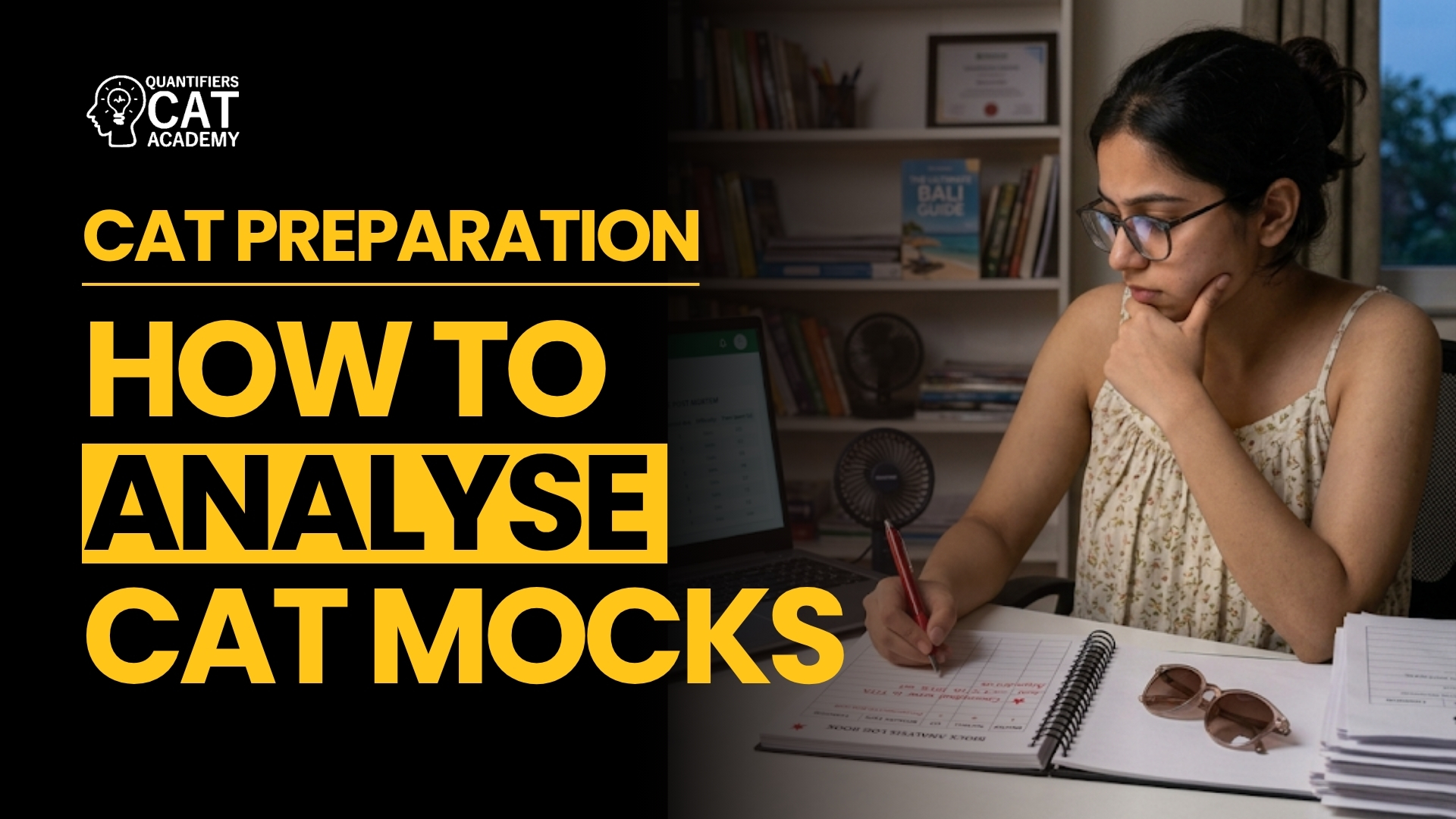
“When should I start mocks” gets asked constantly. “How many is enough, and what do I actually do after each one” gets asked far less — and it’s the harder, more useful question. Here’s a number-of-mocks framework built around who you are as an aspirant, plus the analysis system that turns a mock score into an actual percentile gain, from the Quantifiers team.
- The “More Mocks = Higher Percentile” Myth
- How Many Mocks You Need, By Aspirant Type
- Choosing a Mock Test Series That Won’t Waste Your Time
- The Four-Layer Mock Analysis Framework
- Building an Error Log That Actually Gets Used
- When More Mocks Stop Helping
- A Sample Weekly Rhythm, Not a Month-by-Month Calendar
- Frequently Asked Questions
1. The “More Mocks = Higher Percentile” Myth
Somewhere in every CAT WhatsApp group, someone posts that they’ve taken 70 mocks and still can’t crack 90 percentile — right next to someone who took 22 and landed 99. Both numbers are real. Neither number, on its own, tells you anything useful.
Mock count is a proxy for two things people conflate: exposure to exam-like pressure, and the quality of feedback loop you build from each attempt. Past a certain point, taking mock #45 without having properly reviewed mocks #30 through #44 doesn’t add exposure — it just repeats the same unexamined mistakes at a slightly faster pace. The number that actually predicts your percentile trajectory isn’t “mocks taken.” It’s “mocks taken and thoroughly reviewed.”
2. How Many Mocks You Need, By Aspirant Type
Different starting points call for different mock loads. Here’s a working framework based on where you’re starting from.
Table 1 — Recommended Mock Volume by Aspirant Type
| Aspirant Type | Full-Length Mocks | Sectional Tests | Why This Volume |
|---|---|---|---|
| First-Time Aspirant | 40–50 | 30+ (across all three sections) | Everything is being built from scratch — exam stamina, time-allocation instincts, and section-specific pattern recognition all need repeated exposure to solidify. |
| Repeater | 30–35 | 15+ (concentrated on last year’s weak sections) | The foundational skills already exist from the previous attempt. The job now is targeted correction, not rebuilding — which needs fewer but sharper mocks. |
| Working Professional | 20–25 | 40+ (short, frequent, fits around work hours) | Time is the binding constraint, not knowledge. Fewer full 2-hour mocks, but more frequent short sectional drills that fit into a lunch break or a commute, keep the muscle warm without demanding a free evening every time. |
💡 One Deeply Reviewed Mock Beats Five Mocks You Never Look At Again
If you had to choose between taking five mocks this month and reviewing none of them properly, or taking one mock and spending real time understanding every wrong answer, the second option builds more percentile. Mocks generate data. Review is where that data becomes a skill. Protect the review time before you protect the mock-taking time.
3. Choosing a Mock Test Series That Won’t Waste Your Time
Not all mock series are built equally, and a mismatched series can quietly waste months of prep. Before committing to one, check it against these criteria:
- Difficulty calibration. A series that’s consistently easier than real CAT builds false confidence; one that’s consistently harder can demoralise you into under-attempting on the actual exam day. Cross-check a sample mock’s difficulty against a recent official CAT paper before committing to a full series.
- Sectional analytics depth. A single overall score tells you almost nothing actionable. Look for a series that breaks performance down by sub-topic (not just by section) — “weak in QA” is far less useful than “weak in Time-Speed-Distance specifically.”
- Video or written solutions for every question. Not just the ones you got wrong — reviewing the ones you got right slowly or through a lucky guess is often where the biggest hidden leaks show up.
- National-level benchmarking. A percentile score only means something if it’s computed against a large, representative pool of test-takers, not just the a few hundred people who happened to take that specific mock in your batch.
- Consistent question-pattern updates. CAT’s format has stayed broadly stable in recent years, but sub-patterns within DILR and VARC shift. A series still running five-year-old question styles won’t train you for what actually shows up.

4. The Four-Layer Mock Analysis Framework
Most students review a mock by looking at their score and moving on, or at best skimming the questions they got wrong. That’s a shallow pass. A genuinely useful review works through four distinct layers, each answering a different question.
- Layer 1 — Attempt Audit. Before touching correctness at all, look purely at what you chose to attempt versus skip. Did you spend six minutes on a question that, in hindsight, should have been abandoned in 40 seconds? Did you skip something you could have solved with a calmer read? This layer is about your decision-making, not your knowledge.
- Layer 2 — Error Classification. For every wrong answer, sort it into one of three buckets: a genuine concept gap (you didn’t know how to solve it), a time-trap error (you knew the method but rushed or ran out of time), or a silly mistake (a calculation slip, a misread question, an careless option selection). Each bucket demands a completely different fix.
- Layer 3 — The “Right for the Wrong Reason” Check. Go back through your correct answers too, especially ones that took longer than they should have or where you weren’t fully confident. A lucky guess that landed right is a hidden gap dressed up as a correct answer — if you don’t catch it now, it resurfaces on exam day when luck doesn’t cooperate.
- Layer 4 — Pattern Tracking Across Mocks. A single mock’s errors can be noise. The same error type showing up across three or four consecutive mocks is a pattern — and patterns are what your next week of practice should target directly.
💡 Layer 2 Is Where Most Students Stop — Don’t
Classifying wrong answers into concept gap, time-trap, or silly mistake feels like a complete review, and for a lot of students it’s where the process ends. But Layer 3 — auditing your correct answers for near-misses and lucky guesses — is where the analysis that actually moves your score tends to hide. A student who “got it right” through a 50-50 guess has the exact same underlying gap as one who got it wrong, just with worse visibility into the problem.
5. Building an Error Log That Actually Gets Used
A review process only compounds if it’s captured somewhere you’ll actually revisit — not scattered across the margins of ten different mock printouts. A simple running log works better than any elaborate system, as long as you keep it consistent.
- Log every error with four fields: the topic, the error type (from Layer 2 above), a one-line note on what went wrong, and the fix you’ll apply next time you see a similar question.
- Review the log before each new mock, not just after. A 5-minute skim of your last 10–15 logged errors, right before you start a fresh mock, primes you to actually catch the same trap when it reappears.
- Tally by topic every 8–10 mocks. If “Time-Speed-Distance” or “Para Jumbles” keeps appearing at the top of your error log across multiple tally periods, that’s no longer a mock-specific mistake — it’s a syllabus gap that needs dedicated study time outside the mock cycle.
- Retire entries once they stop recurring. An error you haven’t repeated in your last 5 mocks has likely been fixed — archive it so your active log stays focused on what’s still costing you marks right now.
6. When More Mocks Stop Helping
There’s a point in every aspirant’s prep where taking another mock stops producing new information. Recognising that point matters as much as recognising when to start.
- Your score has been flat across your last 4–5 mocks despite reviewing them properly. This usually means the issue isn’t more exposure — it’s a specific, unaddressed skill gap that needs isolated practice outside the mock format.
- Your error log’s top three recurring issues haven’t changed in a month. If the same three problems keep showing up mock after mock, another 10 mocks of exposure to those same problems won’t fix them — dedicated topic-level correction will.
- You’re taking mocks out of anxiety, not strategy. Some aspirants take a mock every single day in the final stretch simply to feel like they’re “doing something.” This burns out focus faster than it builds skill, and it eats into the review time that actually drives improvement.
In any of these situations, the fix is usually to pause full-length mocks for a short stretch — often just a week to ten days — and switch entirely to targeted topic practice on the specific gaps your error log has surfaced. Resume full mocks once that gap has closed, and the plateau usually breaks.
7. A Sample Weekly Rhythm, Not a Month-by-Month Calendar
Rather than a fixed month-by-month calendar (which can turn into a checklist you follow blindly regardless of how you’re actually performing), here’s a weekly rhythm you can repeat and adjust based on your own error log data.
Table 2 — A Repeatable Weekly Mock Rhythm
| Day | Activity |
|---|---|
| Day 1 | Full-length mock or sectional test (depending on your current phase) |
| Day 2 | Layer 1–3 analysis of Day 1’s mock — attempt audit, error classification, right-for-wrong-reason check |
| Day 3 | Targeted practice on the top 1–2 error types surfaced from Day 2 |
| Day 4 | Light review — skim your error log, revisit any topic you’re still shaky on |
| Day 5 | Sectional test on your currently weakest section |
| Day 6 | Analysis of Day 5’s sectional + error log update |
| Day 7 | Rest, or light conceptual reading — no timed testing |

Frequently Asked Questions
How many full-length mocks should I take for CAT 2026?
It depends on your aspirant type — first-timers generally benefit from 40–50, repeaters from 30–35, and working professionals from 20–25 taken with full focus. The exact number matters less than whether each one gets reviewed properly.
Is taking more mocks always better for my percentile?
No. Past a certain point, unreviewed mocks just repeat the same unexamined mistakes. A smaller number of thoroughly analysed mocks consistently outperforms a larger number taken without proper review.
What should I actually do after taking a mock?
Work through four layers: audit which questions you attempted versus skipped, classify every wrong answer by error type, check your correct answers for lucky guesses or near-misses, and track recurring patterns across multiple mocks rather than reacting to a single test in isolation.
How do I know if a mock test series is worth buying?
Check its difficulty against a recent official CAT paper, confirm it offers sub-topic-level (not just section-level) analytics, includes solutions for every question, and benchmarks you against a large national pool — most credible series let you try a free sample mock before you commit.
What does it mean if my mock scores have plateaued?
A flat score across 4–5 consecutive mocks despite proper review usually signals a specific, unaddressed skill gap. The fix is typically to pause full mocks briefly and switch to focused topic-level practice on whatever your error log shows is recurring.
Should I take a mock every single day close to the exam?
Not recommended. Daily mocks close to exam day often stem from anxiety rather than strategy, and they crowd out the review time that actually drives improvement. A few well-spaced mocks with thorough analysis beat daily testing without reflection.