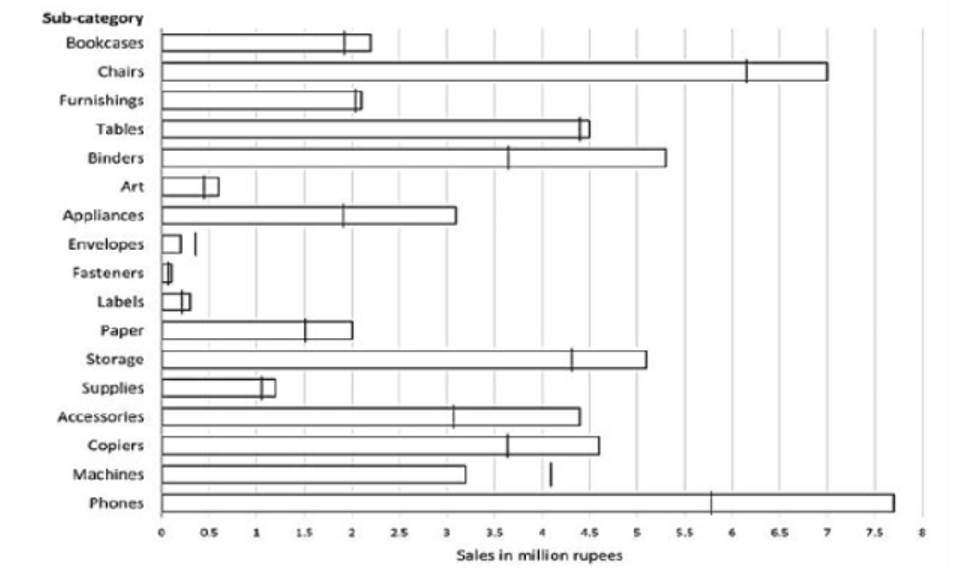
The horizontal bars in the above diagram represent 2020 aggregate sales (in ₹ million) of accompany for the different subcategories of its products. The top four product subcategories (Bookcases, Chairs, Furnishings, Tables) belong to furniture product category; the bottom four product subcategories (Accessories, Copiers, Machines, Phones) belong to the technology product category while all other product subcategories belong to the office supply product category. For each of the product subcategories, there is a vertical line indicating the sales of the corresponding subcategory in 2019.
1. The total sales (in ₹ million) in 2019 from products in office supplies category is closest to
18.0
12.5
16.5
13.5
Total sales in 2019 of office supply
= 3.65 + 0.4 + 1.8 + 0.3 + 0.1 + 0.3 + 1.5 + 4.3 + 1.1 = 13.5 million
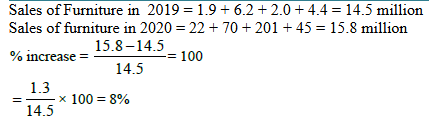
2. The percentage increase in sales in Furniture category from 2019 to 2020 is closest to
20%
1%
8%
25%
3. How many subcategories had sales of ₹4 million or more in 2019 and registered an increase in sales in excess of 25% in 2020?
By Visualisation
The increase should be 1/4 of Bar
It is only of Phones. Hence only 1
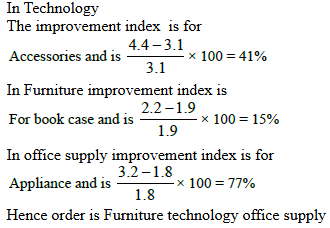
4. The improvement index for a category is the maximum percentage increase in sales from 2019 to 2020 among any of its subcategories. The correct order of categories in increasing order of this improvement index is
DIRECTIONS for the question: Read the information given below and answer the question that follows.
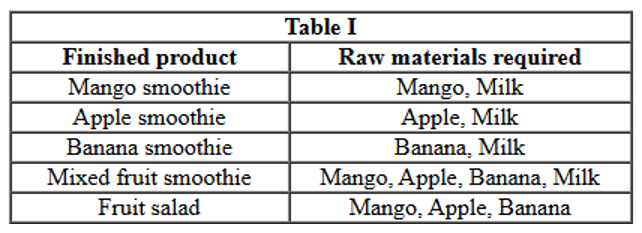
Ganga, Kaveri, and Narmada are three women who buy four raw materials (Mango, Apple, Banana and Milk) and sell five finished products (Mango smoothie, Apple smoothie, Banana smoothie, Mixed fruit smoothie and Fruit salad). Table-1 gives information about the raw materials required to produce the five finished products. One unit of a finished product requires one unit of each of the raw materials mentioned in the second column of the table.
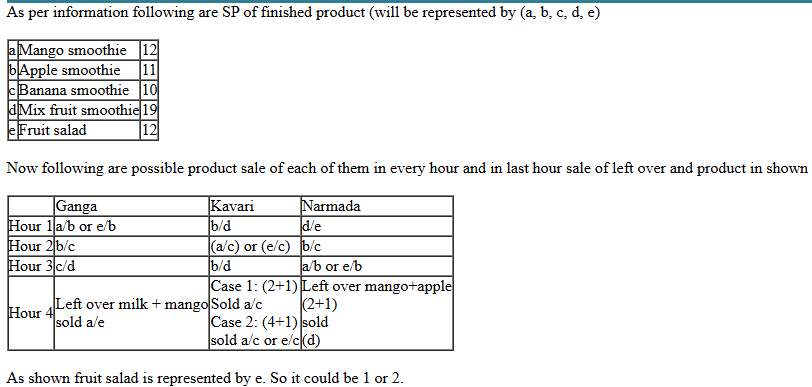
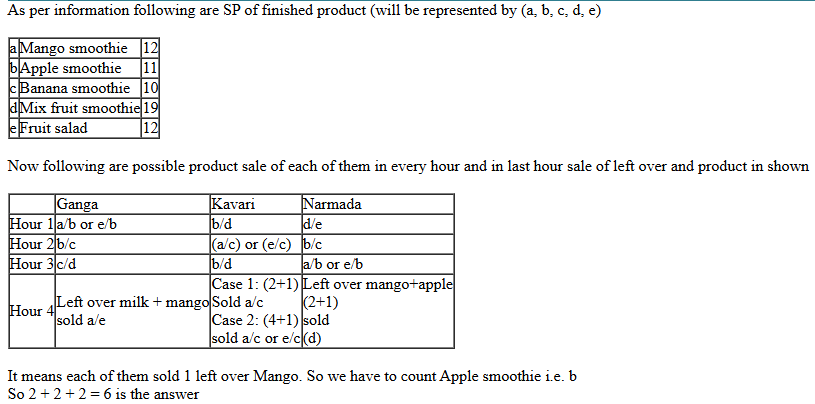
One unit of milk, mango, apple, and banana cost ₹5, ₹3, ₹2, and ₹1 respectively. Each unit of a finished product is sold for a profit equal to two times the number of raw materials used to make that product. For example, apple smoothie is made with two raw materials (apple and milk) and will be sold for a profit of ₹4 per unit. Leftover raw materials are sold during the last business hour of the day for a loss of ₹1 per unit.
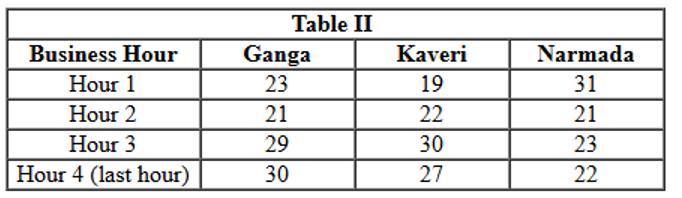
The amount, in rupees, received from sales (revenue) for each woman in each of the four business hours of the day is given in Table-2.
The following additional facts are known.
No one except possibly Ganga sold any Mango smoothie.
Each woman sold either zero or one unit of any single finished product in any hour.
Each woman had exactly one unit each of two different raw materials as leftovers.
No one had any banana leftover.
5. What BEST can be concluded about the number of units of fruit salad sold in the first hour?
Exactly 2
Either 0 or 1 or 2
Either 1 or 2
Exactly 1
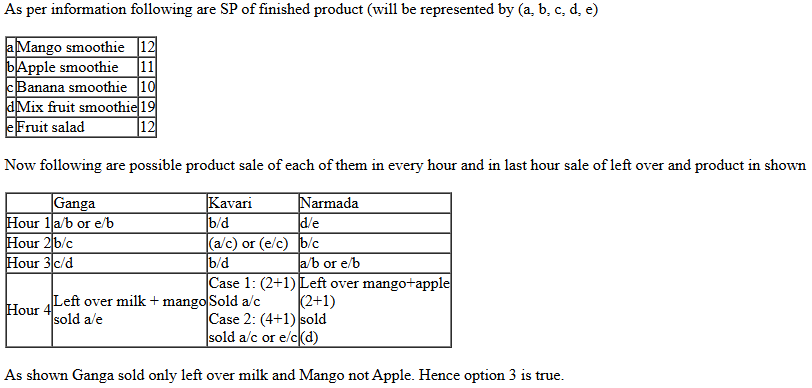
6. Which of the following is NECESSARILY true?
Narmada sold one unit of leftover milk.
Ganga did not sell any leftover mangoes.
Ganga did not sell any leftover apples.
Kaveri sold one unit of leftover mangoes
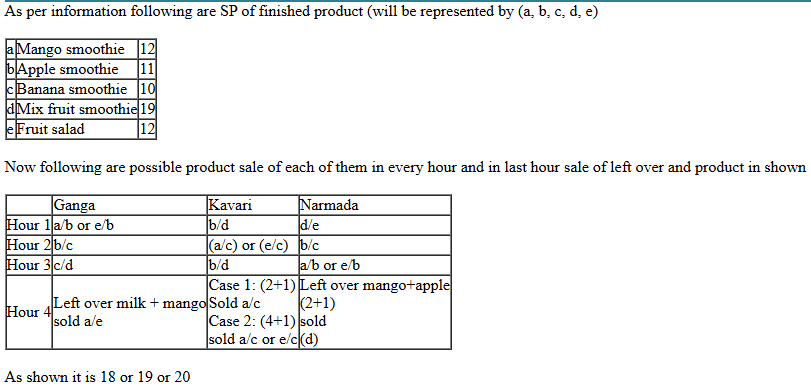
7. What BEST can be concluded about the total number of units of milk the three women had in the beginning?
Either 17 or 18 or 19 units.
Either 19 or 20 units.
Either 18 or 19 units.
Either 18 or 19 or 20 units.
8. If it is known that three leftover units of mangoes were sold during the last business hour of the day, how many apple smoothies were sold during the day?
DIRECTIONS for the question: Read the information given below and answer the question that follows.
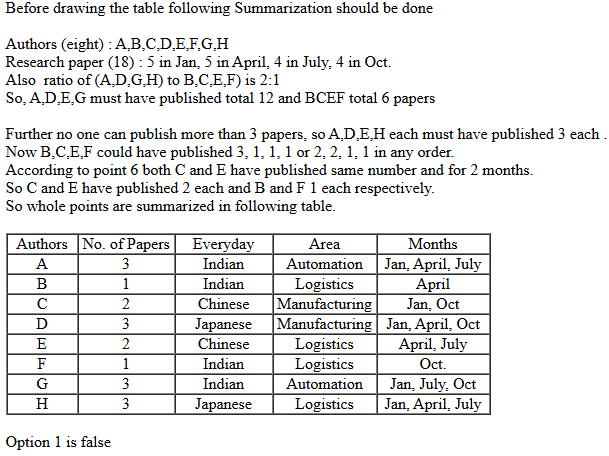
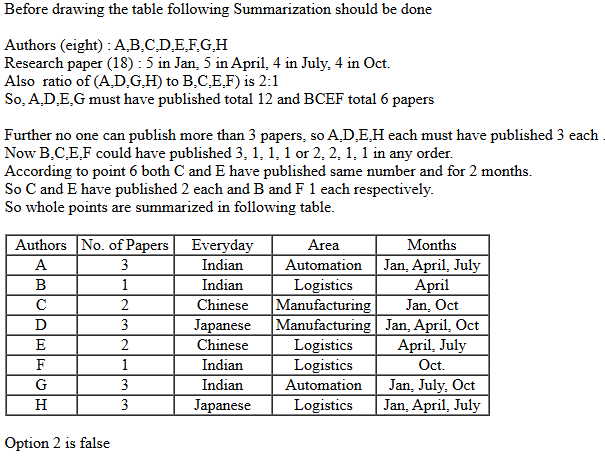
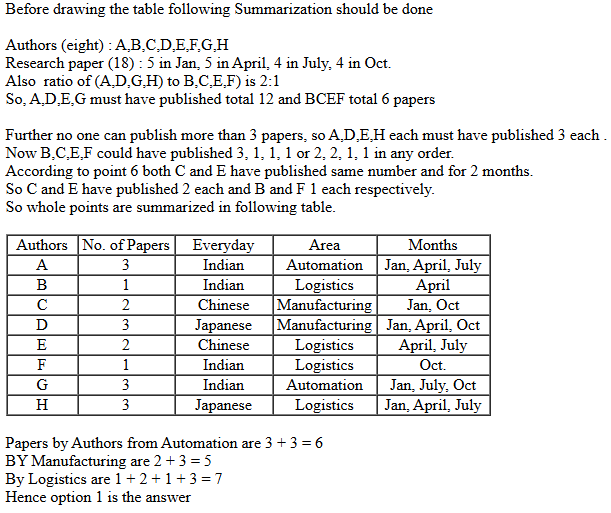
A journal plans to publish 18 research papers, written by eight authors (A, B, C, D, E, F, G, and H) in four issues of the journal scheduled in January, April, July and October. Each of the research papers was written by exactly one of the eight authors. Five papers were scheduled in each of the first two issues, while four were scheduled in each of the last two issues. Every author wrote at least one paper and at most three papers. The total number of papers written by A, D, G and H was double the total number of papers written by the other four authors.
Four of the authors were from India and two each were from Japan and China. Each author belonged to exactly one of the three areas — Manufacturing, Automation and Logistics. Four of the authors were from the Logistics area and two were from the Automation area. As per the journal policy, none of the authors could have more than one paper in any issue of the journal.
The following facts are also known.
F, an Indian author from the Logistics area, wrote only one paper. It was scheduled in the October issue.
A was from the Automation area and did not have a paper scheduled in the October issue.
None of the Indian authors were from the Manufacturing area and none of the Japanese or Chinese authors were from the Automation area.
A and H were from different countries, but had their papers scheduled in exactly the same issues.
C and E, both Chinese authors from different areas, had the same number of papers scheduled. Further, E had papers scheduled in consecutive issues of the journal but C did not.
B, from the Logistics area, had a paper scheduled in the April issue of the journal.
B and G belonged to the same country. None of their papers were scheduled in the same issue of the journal.
D, a Japanese author from the Manufacturing area, did not have a paper scheduled in the July issue.
C and H belonged to different areas.
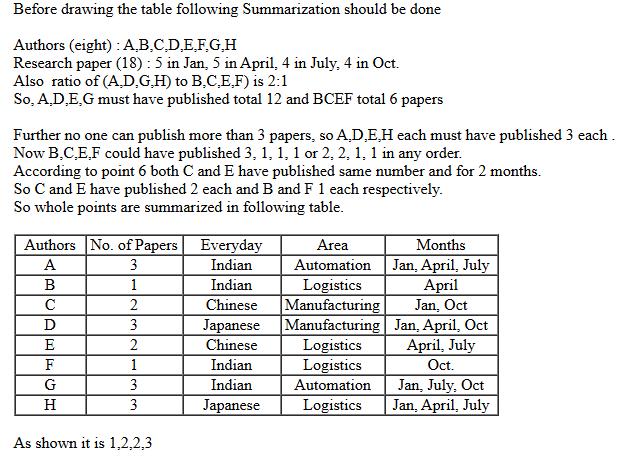
9. What is the correct sequence of number of papers written by B, C, E and G, respectively?
3, 1, 1, 3
1, 3, 3, 1
1, 2, 2, 3
1, 2, 2, 1
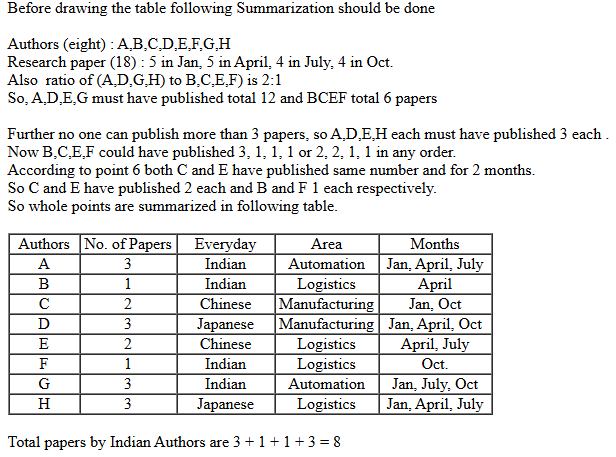
10. How many papers were written by Indian authors?
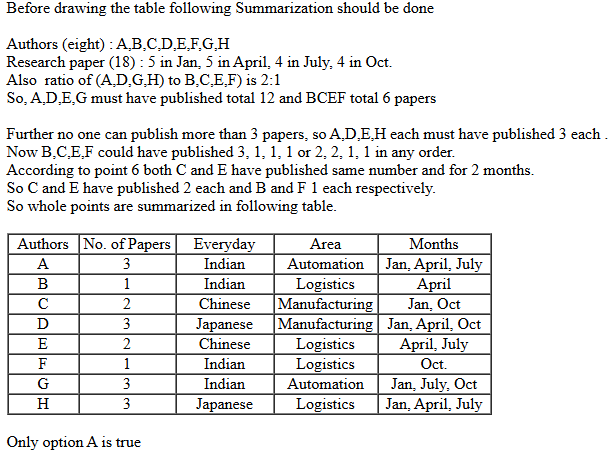
11. Which of the following statement(s) MUST be true?
Statement A: Every issue had at least one paper by author(s) from each country.
Statement B: Every issue had at most two papers by author(s) from each area.
Both the statements
Neither of the statements
Only Statement A
Only Statement B
12. Which of the following statements is FALSE?
Every issue had exactly two papers by authors from Logistics area.
Every issue had at least one paper by author(s) from Automation area.
Every issue had exactly two papers by Indian authors
Every issue had exactly one paper by a Chinese author
13. Which of the following statements is FALSE?
There were exactly two papers by authors from Manufacturing area in the January issue.
There were exactly two papers by authors from Manufacturing area in the July issue.
There was exactly one paper by an author from Logistics area in the October issue.
There was exactly one paper by an author from Manufacturing area in the April issue
14. Which of the following is the correct sequence of number of papers by authors from Automation, Manufacturing and Logistics areas, respectively?
DIRECTIONS for the question: Study the following information carefully and answer the given question.
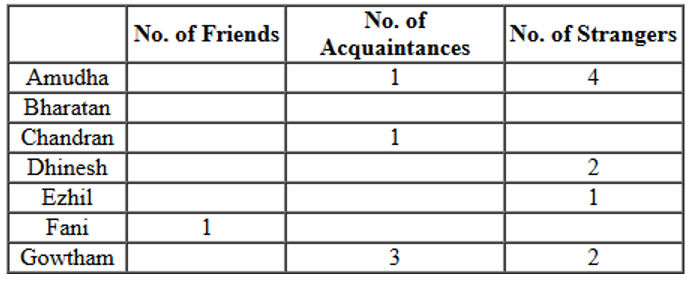
Amudha, Bharatan, Chandran, Dhinesh, Ezhil, Fani and Gowtham are seven people in a town. Any pair of them could either be strangers, acquaintances, or friends. All relationships are mutual. For example, if Amudha is a friend of Bharatan, then Bharatan is also a friend of Amudha. Similarly, if Amudha is a stranger to Bharatan, then Bharatan is also a stranger to Amudha.
Partial information about the number of friends, acquaintances, and strangers of each of these people among them is given in the table below.
The following additional facts are also known.
Amudha, Bharatan, and Chandran are mutual strangers.
Amudha, Dhinesh, and Fani are Ezil’s friends.
Chandran and Gowtham are friends.
Every friend of Amudha is an acquaintance of Bharatan, and every acquaintance of Bharatan is a friend of Amudha.
Every friend of Bharatan is an acquaintance of Amudha, and every acquaintance of Amudha is a friend of Bharatan.
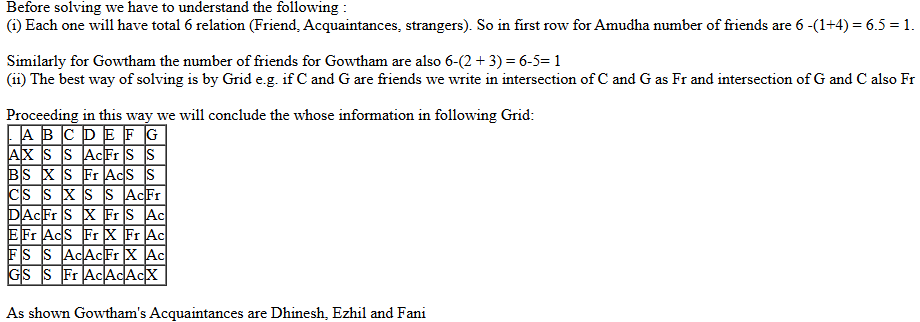
15. Who are Gowtham’s acquaintances?
Bharatan, Dhinesh and Ezhil
Dhinesh, Ezhil and Fani
Amudha, Dhinesh and Fani
Amudha, Bharatan and Fani
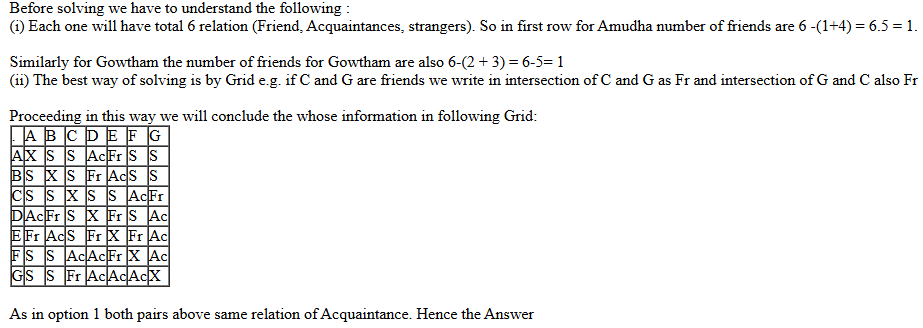
16. Which of these pairs share the same type of relationship?
(Bharatan, Ezhil) and (Fani, Gowtham)
(Amudha, Gowtham) and (Ezhil, Fani)
(Chandran, Ezhil) and (Dhinesh, Gowtham)
(Bharatan, Chandran) and (Dhinesh, Ezhil)
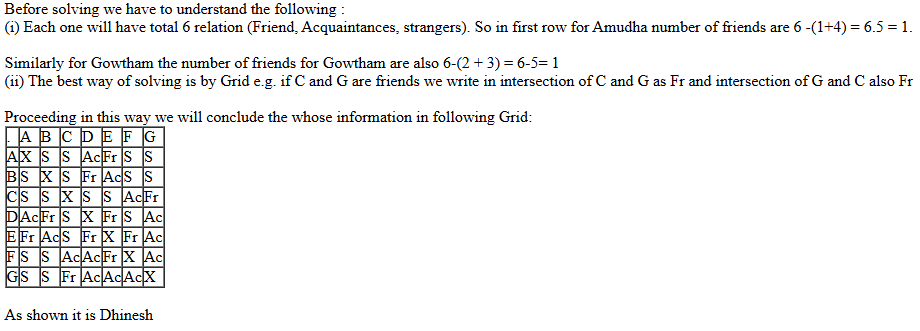
17. Who is an acquaintance of Amudha?
Fani
Ezhil
Dhinesh
Gowtham
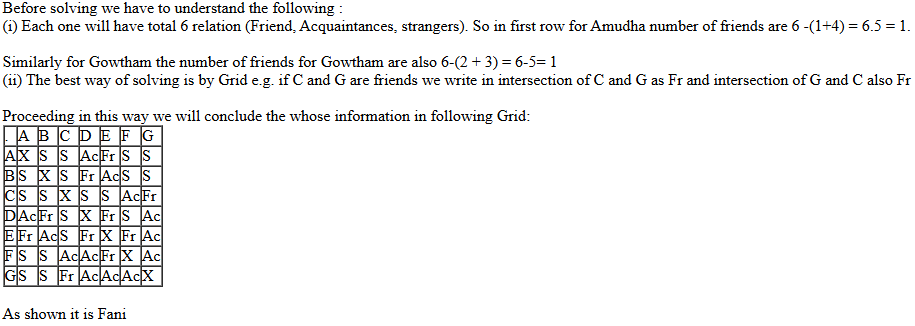
18. Who is an acquaintance of Chandran?
Fani
Ezhil
Dhinesh
Bharatan
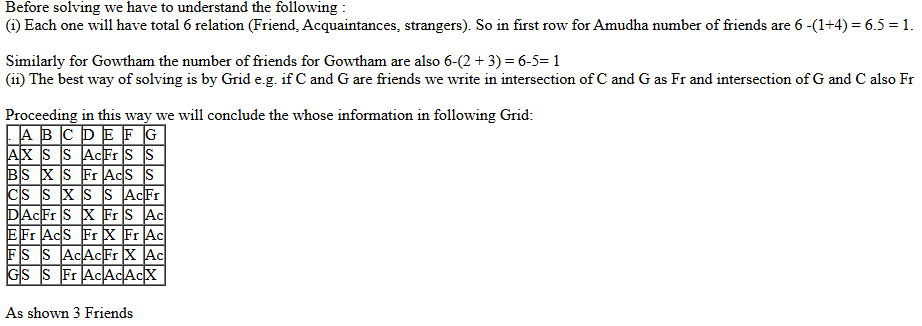
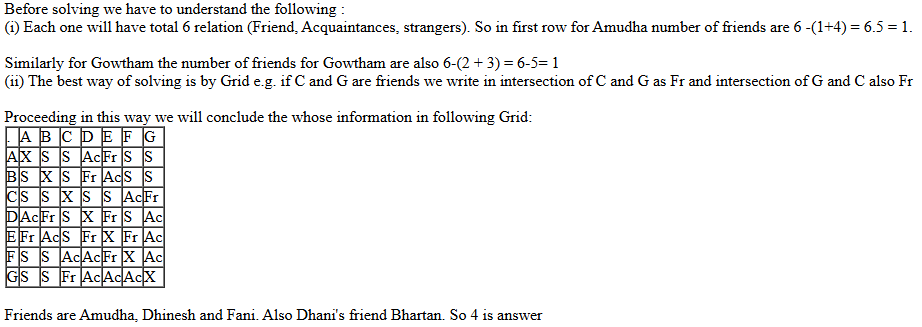
19. How many friends does Ezhil have?
20. How many people are either a friend or a friend-of-a-friend of Ezhil?
We at Quantifiers understand and deliver on the personal attention each of our students requires. Whether it is through our pedagogy that enables non-engineers or non-math background students, our constant effort to proactively provide solutions, or our focus on our student’s goals.