Learn the CAT exam pattern 2026 including sections, question types, marking scheme, and time limits. Understand VARC, DILR, and QA structure for better CAT preparation.
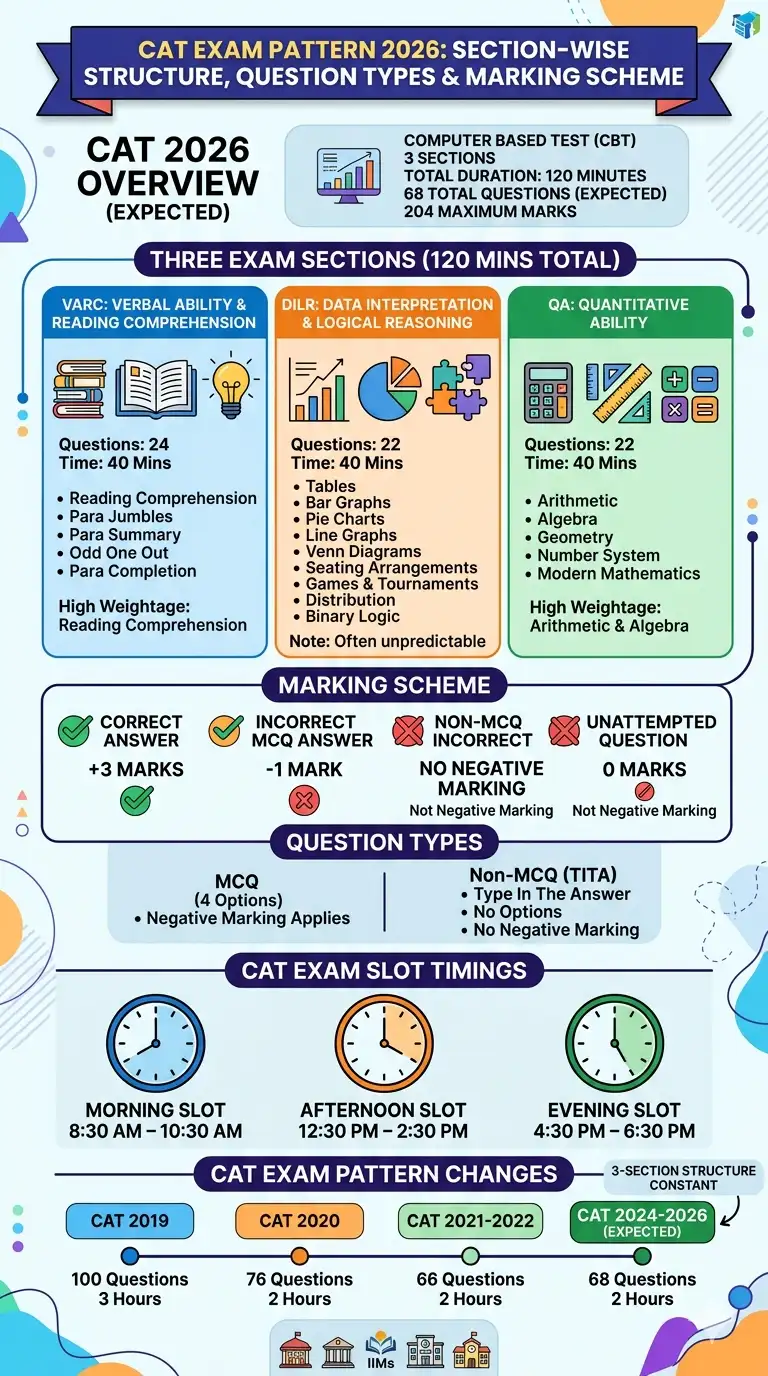
CAT Exam Pattern 2026 consists of three sections — Verbal Ability & Reading Comprehension (VARC), Data Interpretation & Logical Reasoning (DILR), and Quantitative Ability (QA) — with a total of 68 expected questions to be attempted in 120 minutes. Each section carries a 40-minute time limit and is attempted in a fixed order. The exam is conducted as a Computer Based Test (CBT) with two types of questions: MCQs (with -1 negative marking) and TITA non-MCQs (no negative marking). Correct answers earn +3 marks, making the maximum possible score 204.
We hope you find this blog informational. If you want a FREE DEMO, click here.
Preparing for the Common Admission Test without understanding its exam pattern is like entering a game without knowing the rules. Before solving hundreds of practice questions or attempting mock tests, it is important to understand how the CAT exam is structured.
The CAT exam is designed to test analytical thinking, logical reasoning, and problem-solving ability rather than just memorization. Over the years, the structure of the exam has changed slightly in terms of the number of questions and time duration, but the core pattern has remained quite consistent.
If you are targeting CAT 2026, understanding the exam pattern will help you build a smarter preparation strategy. In this guide, we will break down the CAT exam pattern, question types, marking scheme, and section-wise structure.
📌TL;DR - CAT Exam Pattern 2026
The exam has 3 sections: VARC (24 Qs), DILR (22 Qs), and QA (22 Qs) — totalling 68 questions.
You get exactly 40 minutes per section; once done, the system locks it — no going back.
Scoring is +3 for correct, −1 for wrong MCQs, and zero penalty for TITA (type-in) answers.
The maximum score is 204; the exam is fully online (CBT) across three slots on one day.
VARC is reading-heavy (RC passages dominate); DILR is unpredictable; QA focuses on Arithmetic and Algebra most.
The pattern has been stable since CAT 2024 — 68 questions, 120 minutes — no major changes expected for 2026.
Skipping TITA questions is a safer bet than guessing on MCQs — use negative marking strategically.
What is the CAT Exam Pattern?
The Common Admission Test is conducted as a Computer Based Test (CBT) and consists of three major sections. Each section focuses on a different skill set required for management education.
Here is a quick overview of the expected CAT 2026 exam pattern.
CAT Exam Component
Details
Total Sections
3
Sections
VARC, DILR, QA
Mode of Exam
Computer Based Test
Total Duration
120 Minutes
Sectional Time Limit
40 Minutes per section
Total Questions (Expected)
68
Maximum Marks
204
Question Types
MCQ & Non-MCQ
Medium of Exam
English
The exam is conducted in three different slots on the same day to accommodate thousands of candidates across India.
CAT Exam Slot Timings
Slot
Timing
Morning Slot
8:30 AM – 10:30 AM
Afternoon Slot
12:30 PM – 2:30 PM
Evening Slot
4:30 PM – 6:30 PM
Free Resources for CAT 2026
Discover the most complete list of free resources for CAT 2026 — from free CAT mock tests and CAT previous year questions to DILR sets, VARC practice, quant formula book, and GDPI handbooks. All curated by Quantifiers. All free. All updated.
The DILR section tests your ability to analyze data and solve logical puzzles.
Key Details
Component
Details
Time Limit
40 Minutes
Questions
22
Important Topics
Tables
Bar Graphs
Pie Charts
Line Graphs
Venn Diagrams
Seating Arrangements
Games & Tournaments
Distribution problems
Binary logic
This section is often considered the most unpredictable part of the CAT exam.
Build a Daily Study Routine for CAT 2026
Consistency plays a crucial role in CAT 2026 preparation. To help aspirants stay disciplined and exam-ready, we post daily study targets covering Quant, DILR, and VARC practice.
The Quantitative Ability section evaluates your mathematical and analytical skills.
Key Details
Component
Details
Time Limit
40 Minutes
Questions
22
Important Topics
Arithmetic
Algebra
Geometry
Number System
Modern Mathematics
Among these, Arithmetic and Algebra usually carry the highest weightage.
CAT Exam Pattern Changes Over the Years
The CAT exam pattern has evolved over time. Earlier, the exam used to have 100 questions and a duration of 3 hours, but the structure has gradually changed.
Here is a quick comparison:
Year
Total Questions
Duration
CAT 2026 (Expected)
68
2 Hours
CAT 2025
68
2 Hours
CAT 2024
68
2 Hours
CAT 2022
66
2 Hours
CAT 2021
66
2 Hours
CAT 2020
76
2 Hours
CAT 2019
100
3 Hours
Even though the number of questions has changed over the years, the three-section structure has remained constant.
Final Thoughts
Understanding the Common Admission Test exam pattern is one of the first and most important steps in your CAT preparation journey.
Knowing the sections, time limits, question types, and marking scheme allows you to prepare strategically instead of randomly solving questions.
A well-planned preparation strategy, regular mock tests, and strong conceptual clarity can significantly improve your chances of scoring well in CAT.
With the right preparation approach and consistent practice, aspirants can confidently target top management institutes such as Indian Institute of Management Ahmedabad, Indian Institute of Management Bangalore, and Indian Institute of Management Calcutta.
The Common Admission Test 2026 is expected to include three sections: VARC, DILR, and QA. The exam will likely have 68 questions and a total duration of 120 minutes, with 40 minutes allocated to each section.
In the CAT exam, candidates receive +3 marks for every correct answer and -1 mark for incorrect MCQs. There is no negative marking for non-MCQ questions, and unattempted questions receive zero marks.
Yes, the number of questions in the CAT exam has changed over time. Earlier exams had 100 questions with a 3-hour duration, but the recent pattern includes around 68 questions with a 2-hour duration.
Understanding the CAT exam pattern helps candidates plan their preparation strategy, manage time effectively during the exam, and focus on high-weightage topics.
Planning for MBA 2026-27? Start Smart. Start Today.
Your MBA journey doesn’t have to be confusing. At Quantifiers CAT Academy, we mentor students from the ground up—whether you’re preparing for CAT or exploring exams like SNAP, NMAT, CMAT, IIFT and MICAT. With personalised attention, proven strategies and performance-focused guidance, we help you build strong fundamentals, boost accuracy, and stay consistent throughout your preparation journey.
CAT Exam Pattern 2026 is expected to follow the same structure as the past two years. The exam is a 120-minute Computer Based Test (CBT) divided into three fixed sections attempted in a set order.
Section
Questions
Time
VARC
24
40 min
DILR
22
40 min
QA
22
40 min
Total
68
120 min
Questions are of two types — MCQs (carry −1 negative marking) and TITA or Type In The Answer questions (no negative marking). A correct answer awards +3 marks, making the total possible score 204.
The exam is held in three slots on a single day: 8:30–10:30 AM, 12:30–2:30 PM, and 4:30–6:30 PM. Candidates cannot switch between sections once a section’s timer ends.
To connect with us, for mentorship and daily test practice DM us on Instagram or WhatsApp. We reply back 24/7. Get your CAT prep started
We at Quantifiers understand and deliver on the personal attention each of our students requires. Whether it is through our pedagogy that enables non-engineers or non-math background students, our constant effort to proactively provide solutions, or our focus on our student’s goals.