DILR Strategy

CAT LRDI Strategy 2026: How to Survive the Section That Humiliates Everyone

CAT LRDI giving you nightmares? Learn a realistic CAT LRDI strategy for 2026 focused on set selection, calm decision-making, mock analysis, and solving just 2–3 sets accurately.

What is the best CAT DILR strategy for 2026? The best CAT DILR strategy for 2026 is to prioritise set selection over brute-force solving. In the exam, you should spend 2–3 minutes scanning all sets, then attempt only 2–3 that look familiar and solvable. A score of 2–3 accurately solved sets with minimal negative marking outperforms attempting everything and failing halfway. Daily practice of 3–4 sets, weekly mock exposure, and honest post-mock analysis are the three habits that consistently improve DILR performance. Panic management and the discipline to skip traps are what separate high scorers from the rest.

We hope you find this blog informational. If you want a FREE DEMO, click here.

CAT Geometry Number System Permutation and combination probability quantitative aptitude tests Verbal Ability Tests XAT English Verbal Tests OMETS Verbal Tests Simple Interest and Compound Interest Time and work Privacy Policy General Knowledge Tests DILR

Quantifiers CAT Academy, Chandigarh

Let’s not pretend.

LRDI (Logical Reasoning & Data Interpretation) is the section where:

  • Confidence goes to die
  • Mock scores collapse unexpectedly
  • Smart people stare at tables like they’re ancient scriptures

If you’ve ever thought:

“I understood this set at home… why is it impossible in mocks?”

Congratulations. You’re normal.

LRDI is not about intelligence.

It’s about calm thinking, smart selection, and not panicking like the exam personally insulted you.

This blog breaks down a real CAT LRDI strategy for 2026—no hype, no “solve 1000 sets” nonsense, just what actually works.

📌 TL;DR - CAT DILR 2026 

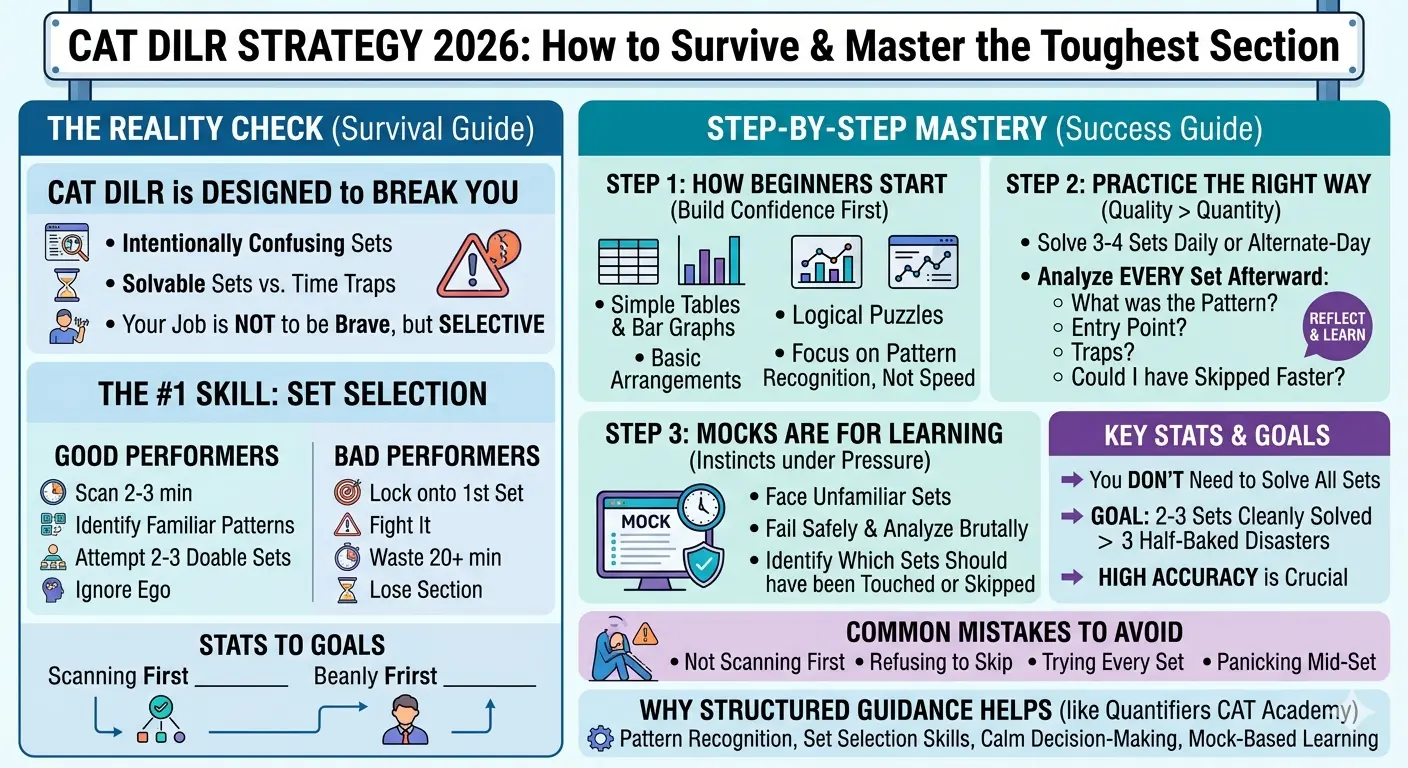
  • DILR is a selection game, not a solving game. Attempting 2–3 right sets accurately beats attempting all sets randomly.

  • Scan before you solve. Use the first 2–3 minutes to read all sets and identify the 2–3 most approachable ones.

  • Ego is your biggest enemy. Refusing to skip a stuck set costs you the entire section — walk away early.

  • Beginners: start simple. Basic tables, bar graphs, and arrangement puzzles first. Difficulty comes only after confidence is built.

  • Mocks are where DILR is actually learned. Comfort-zone practice teaches nothing; mock pressure teaches everything.

  • Analyse every mock, every time. Ask: which set should I not have touched? Which solvable one did I skip?

  • Quality over quantity in practice. 3–4 sets daily with reflection beats 20 sets solved mindlessly.

  • A raw score of ~20–25 is strong. You don't need perfection — you need precision.

CAT DILR Strategy 2026

First Reality Check: CAT LRDI Is Designed to Break You

CAT does not expect you to:

  • Solve all sets
  • Even attempt all sets

LRDI is intentionally designed so that:

  • Some sets are solvable
  • Some are time traps

Some are there purely to mess with your head

Your job is not to be brave.

Your job is to be selective.

Why LRDI Feels Impossible (Even If You’re “Good at Logic”)

Because most aspirants do this:

  1. Start with the first set
  2. Get stuck
  3. Refuse to leave because “I’ve already invested time”
  4. Panic
  5. Waste 20 minutes
  6. Lose the section

LRDI punishes emotional attachment.

Hard.

Free Resources for CAT 2026

Free Resources for CAT 2026

Discover the most complete list of free resources for CAT 2026 — from free CAT mock tests and CAT previous year questions to DILR sets, VARC practice, quant formula book, and GDPI handbooks. All curated by Quantifiers. All free. All updated.

The #1 LRDI Skill CAT Actually Tests: Set Selection

Say it with me slowly:

  • LRDI is not about solving.
  • LRDI is about choosing

Good LRDI performers:

  • Scan all sets in 2–3 minutes
  • Identify familiar patterns
  • Attempt only 2–3 doable sets

Ignore ego

Bad performers:

  • Lock onto the first set
  • Fight it like it’s personal
  • Lose time
  • Blame luck

CAT rewards the first group. Every year.

Step 1: How Beginners Should Start LRDI (Without Crying)

CAT DILR Strategy 2026 CAT LRDI Strategy 2026

If you’re new or weak in LRDI, start small.

Begin with:

  • Simple tables
  • Bar graphs
  • Basic arrangements
  • Logical puzzles

You’re building pattern recognition, not solving speed.

Confidence comes first. Difficulty comes later.

Step 2: Practice LRDI the Right Way (Not Randomly)

Solving random sets without reflection is useless.

After every set, ask:

  • What was the pattern?
  • What was the entry point?
  • Where did people usually get stuck?
  • Could I have skipped this faster?

LRDI improves when your decision-making improves—not just accuracy.

Step 3: Mocks Are Where LRDI Is Actually Learned

LRDI cannot be “studied” theoretically.

You must:

  • Face unfamiliar sets
  • Fail safely in mocks
  • Analyse mistakes brutally

After every mock:

  • Which set should I NOT have touched?
  • Which one was solvable but I skipped?
  • Did panic affect my choices?

LRDI instincts are built under pressure, not comfort.

How Many Sets Do You Need to Solve in CAT LRDI?

Here’s the ego check.

You do not need to solve all sets.

A strong LRDI performance usually means:

  • 2–3 sets solved correctly
  • High accuracy
  • Minimal wasted time

One cleanly solved set > three half-baked disasters.

Common LRDI Mistakes That Destroy Scores

CAT DILR Strategy 2026 CAT LRDI Strategy 2026

If LRDI feels chaotic, you’re likely:

  • Trying every set
  • Not scanning first
  • Refusing to skip
  • Practicing without analysis
  • Panicking mid-set

LRDI punishes impatience and ego equally.

How Much Should You Practice LRDI Daily?

Quality > quantity.

Ideal:

  • 3–4 sets daily
  • Or alternate-day intensive practice
  • Plus mock exposure weekly

More sets don’t guarantee improvement.

Better decisions do.

CAT Coaching in Chandigarh CAT 2025 Preparation Plan for Working Professionals

Quantifiers can help you crack
CAT in 1st Attempt

Why Structured Guidance Matters So Much in LRDI

LRDI is confusing because aspirants don’t know:

  • Which sets are worth attempting
  • How to spot traps early
  • When to walk away

That’s where guidance helps.

At Quantifiers CAT Academy, LRDI prep focuses on:

  • Pattern recognition
  • Set selection skills
  • Calm decision-making
  • Mock-based learning

Which is exactly how CAT tests LRDI.

Final Truth (No Comfort, Just Facts)

LRDI is not unbeatable.

But it is unforgiving.

If you:

  • Learn to select sets
  • Control panic
  • Practice under pressure
  • Analyse honestly

LRDI stops feeling random—and starts feeling manageable.

That’s when scores stabilise.

CAT GDPI 2026

Udhyam GDPI 2026 | India's most
personalized GDPI program

🔗 Ready to Start?

FAQs - CAT LRDI Strategy 2026

Because it tests logic, decision-making, and calmness under time pressure rather than direct formulas.

Solving 2–3 sets accurately is usually enough for a good score.

Start with simple tables, graphs, and basic puzzles before moving to complex sets.

Yes. LRDI improves mainly through regular practice and mock exposure.

Extremely important. Choosing the right sets matters more than solving speed.

Yes, but structured guidance speeds up pattern recognition and decision-making skills.

3–4 sets daily or alternate-day focused practice is ideal.

A raw score of around 20–25+ is considered strong in most CAT papers.
Because LRDI is unfamiliar and time-pressured. Panic reduces with mock exposure and analysis.

By focusing on set selection, mock-based learning, and calm problem-solving strategies.

What is the CAT DILR strategy for 2026?

CAT DILR (Data Interpretation & Logical Reasoning) rewards set selection over speed. The recommended 2026 strategy is: scan all sets in the first 2–3 minutes, attempt only 2–3 solvable sets, and exit traps early. Accuracy on fewer sets consistently outscores low-accuracy attempts across all sets.
How many DILR sets should I solve in CAT?
Most high-scorers solve 2–3 sets completely. A raw score of 20–25+ is considered strong. Attempting more sets without accuracy typically results in negative marking and lower net scores.
How should beginners prepare for CAT DILR?
Beginners should start with simple tables, basic bar graphs, and easy arrangement puzzles to build pattern recognition. Confidence must precede difficulty. Move to complex sets only after basic sets feel manageable.
Key facts:
  • Section name: DILR (Data Interpretation & Logical Reasoning)
  • Best approach: set selection over brute-force solving
  • Ideal daily practice: 3–4 sets with post-practice reflection
  • Good raw score target: 20–25+
  • Primary skill tested: calm decision-making under time pressure
  • Common mistake: staying on a stuck set due to sunk-cost bias

To connect with us, for mentorship and daily test practice
DM us on Instagram or WhatsApp. We reply back 24/7. Get your CAT prep started

Share this post :

Be a part of Quantifiers Family of 99%ilers

best CAT Coaching

We at Quantifiers understand and deliver on the personal attention each of our students requires. Whether it is through our pedagogy that enables non-engineers or non-math background students, our constant effort to proactively provide solutions, or our focus on our student’s goals.