Home » CAT Preparation for Engineers: Smart Strategy to Score 99+ Percentile
CAT 2026
CAT Prep Strategy for Engineers: Score 99+ Percentile Smartly
Smart CAT prep strategy for engineers covering QA, DILR, VARC, mocks, time management and MBA admission tips.
CAT preparation for engineers requires a balanced strategy that goes beyond Quant strength. While engineers usually excel in QA and parts of DILR, achieving a 99+ percentile depends on strengthening VARC, mastering DILR set selection, managing time smartly, and rigorously analysing mock tests. A focused, section-balanced approach aligned with the latest CAT exam pattern helps engineers stand out in an intensely competitive applicant pool.
We hope you find this blog informational. If you want a FREE DEMO, click here.
CAT has long been considered an exam where engineers dominate the percentile charts. Nearly 65–70% of CAT aspirants come from engineering backgrounds, making competition within the same category extremely intense. While engineers naturally enjoy an advantage in Quantitative Ability and parts of DILR, cracking CAT with a top percentile and strong profile shortlist demands much more than just technical strength.
The real challenge for engineers is standing out among engineers themselves. This requires a focused, balanced, and highly strategic preparation plan that strengthens weak areas, especially VARC, while maximizing scoring potential in QA and DILR. This blog explains a step-by-step CAT preparation strategy for engineers, aligned with the latest CAT exam pattern and MBA admission trends.
📌 TL;DR - CAT Preparation for Engineers
Engineers form ~65–70% of CAT aspirants, so competition is highest within the same background
QA & DILR are strengths, but VARC is the real differentiator
CAT rewards question selection, accuracy & balance, not brute calculation
DILR success depends on choosing doable sets quickly, not solving everything
Daily reading + RC practice is essential to fix VARC
Time management failures cost more percentiles than lack of concepts
Mock tests + deep analysis decide the final score
Balanced prep > overconfidence in Quant
99+ percentile comes from strategy, not just intelligence
Why Engineers Perform Well in CAT
Engineers possess certain academic and cognitive skills that align closely with CAT’s testing style. However, relying only on this advantage is risky in a highly competitive exam.
Natural strengths engineers bring to CAT include:
Strong numerical aptitude and mathematical reasoning
Familiarity with data handling and logical frameworks
Analytical thinking developed through technical education
Comfort with time-bound problem solving
Despite these strengths, many engineers struggle to convert attempts into percentile because of poor section balance, overconfidence in QA, and neglect of VARC.
Understanding the CAT Exam Pattern
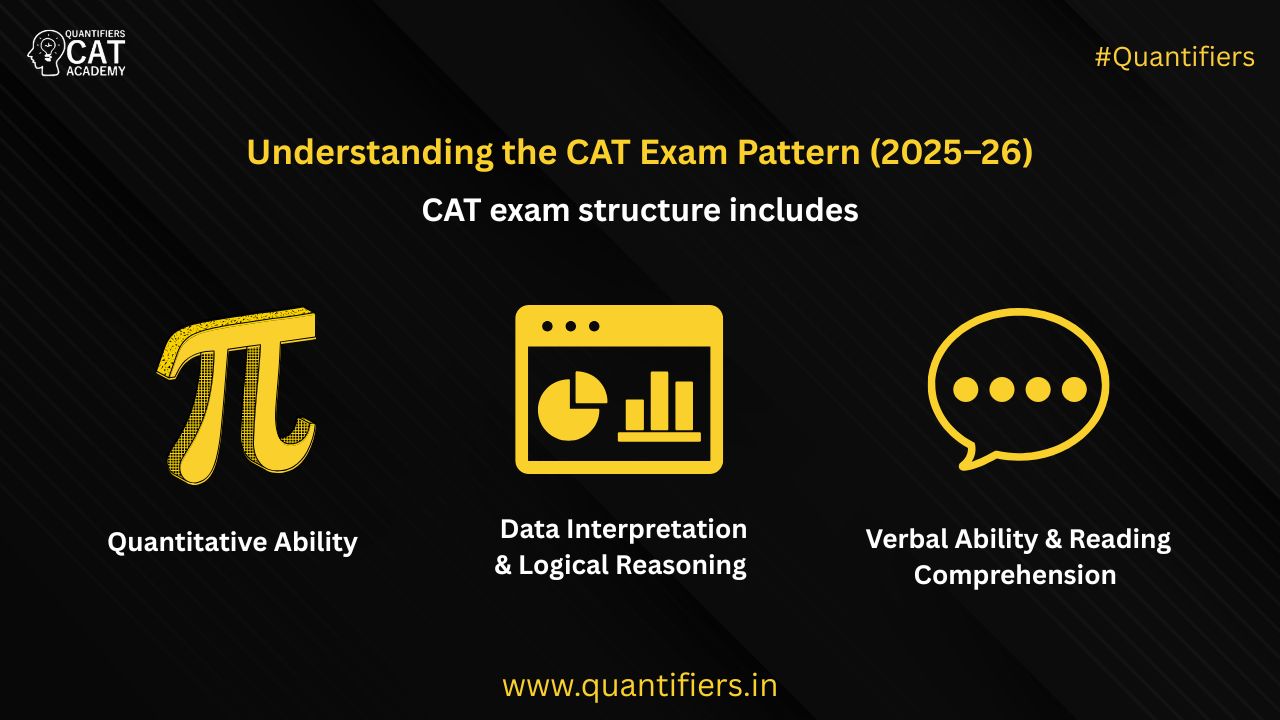
Before building a strategy, engineers must understand how CAT actually works. CAT is not a syllabus-heavy exam; it is a decision-making and prioritization test.
CAT exam structure includes:
Quantitative Ability (QA) – Arithmetic, Algebra, Geometry, Modern Math
Data Interpretation & Logical Reasoning (DILR) – Mixed analytical sets
Each section is individually timed, and sectional cut-offs are mandatory for IIMs and top MBA colleges. Engineers often make the mistake of over-attempting one section while underperforming in another.
Quantitative Ability Strategy for Engineers
QA is where engineers must maximize accuracy, not ego. CAT QA is not engineering math; it is concept-driven arithmetic and logical application.
High-impact QA focus areas:
Arithmetic: Percentages, ratios, averages, time & work, time-speed-distance
Engineers should avoid solving every question mechanically. CAT rewards selection, approximation, and elimination techniques more than lengthy calculations.
DILR Strategy: Turning Unpredictability into Strength
DILR is the most volatile CAT section and often decides the final percentile. Engineers usually understand DI concepts quickly but struggle with complex logical reasoning sets.
Effective DILR preparation tips:
Practice mixed DI-LR sets instead of isolated topics
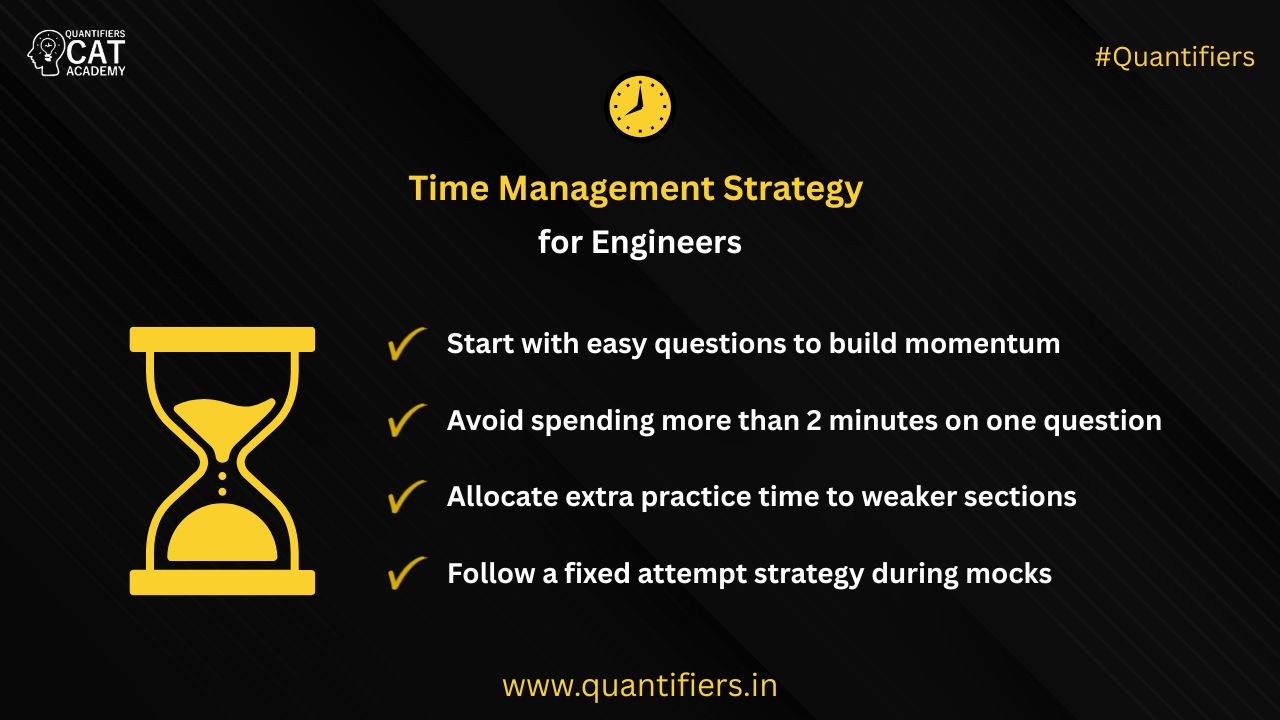
Learn to identify “doable” sets within 2–3 minutes
Avoid getting emotionally stuck on one puzzle
Focus on accuracy rather than number of sets attempted
Consistent practice across tables, graphs, arrangements, games, and reasoning-based cases is critical for engineers aiming at 99+ percentile.
Planning for MBA 2026-27? Start Smart. Start Today.
Your MBA journey doesn’t have to be confusing. At Quantifiers CAT Academy, we mentor students from the ground up—whether you’re preparing for CAT or exploring exams like SNAP, NMAT, CMAT, IIFT and MICAT. With personalised attention, proven strategies and performance-focused guidance, we help you build strong fundamentals, boost accuracy, and stay consistent throughout your preparation journey.
Engineers already have the raw material needed to crack CAT. What separates a 95 percentile from a 99+ percentile is strategy, balance, and execution. By strengthening VARC, optimizing QA attempts, mastering DILR selection, and rigorously analyzing mocks, engineers can convert their technical edge into MBA admission success.
For personalized CAT strategy, mock analysis, and MBA counseling, aspirants can take free expert guidance through the Quantifiers platform.
CAT is not easier for engineers, but engineers often have an advantage in Quantitative Ability and DILR due to their academic background. However, high competition among engineers and challenges in VARC make CAT equally demanding for them.
Engineers should ideally target 98+ percentile for old IIMs and 95+ percentile for new IIMs. Due to intense competition, a higher percentile improves shortlisting chances significantly.
Engineers should focus on daily reading, regular RC practice, understanding passage tone, and improving verbal question types like para jumbles and summaries. Consistency is key to improving VARC scores.
Engineers usually need 8–10 months of focused preparation if starting from scratch. Working professionals may need a longer duration with a structured study plan and regular mock tests.
Engineers should take at least 30–40 full-length CAT mock tests before the exam. The real improvement comes from detailed analysis rather than just attempting mocks.
All sections are equally important due to sectional cut-offs. However, VARC often becomes the deciding factor for engineers, as QA and DILR are relatively stronger areas for most.
Yes, CAT does not test direct grammar rules. Engineers should focus more on reading comprehension, context-based vocabulary, and logical understanding of sentences rather than memorizing grammar.
Engineers should practice approximations, learn shortcut methods, avoid lengthy calculations, and focus on question selection. Solving previous year CAT questions is extremely helpful.
Quantifiers provides expert-led CAT coaching, personalized study plans, mock test analysis, VARC-focused mentoring, and free MBA counseling, helping engineers convert their strengths into top percentiles.
Udhyam GDPI 2026 | India's most personalized GDPI program
We at Quantifiers understand and deliver on the personal attention each of our students requires. Whether it is through our pedagogy that enables non-engineers or non-math background students, our constant effort to proactively provide solutions, or our focus on our student’s goals.