CAT 2026

CAT Vocabulary Preparation: Smart VARC Strategy for 99+ %ile

Master CAT vocabulary with smart VARC strategies, word-building techniques, and reading tips to boost accuracy in CAT & XAT exams.

CAT vocabulary preparation is about understanding words in context, not memorising long word lists. A strong CAT vocabulary improves VARC accuracy by helping aspirants read faster, avoid misinterpretation in RCs, and choose correct options in para-summary and inference questions. The smartest way to build CAT vocabulary is through contextual reading, mock test analysis, and repeated exposure to CAT-level language used in exams like CAT and XAT.

We hope you find this blog informational. If you want a FREE DEMO, click here.

CAT Geometry Number System Permutation and combination probability quantitative aptitude tests Verbal Ability Tests XAT English Verbal Tests OMETS Verbal Tests Simple Interest and Compound Interest Time and work Privacy Policy General Knowledge Tests DILR

Quantifiers CAT Academy, Chandigarh

The Common Admission Test (CAT) is not an exam of fancy English or obscure grammar rules—it is an exam of clarity, logic, and accuracy. One of the biggest misconceptions among CAT aspirants is that VARC (Verbal Ability & Reading Comprehension) is only about language proficiency. In reality, VARC is designed to evaluate how well you understand ideas, arguments, tone, and context, and vocabulary plays a silent but powerful role in this process.

A strong CAT vocabulary does not mean memorizing the dictionary. It means being comfortable with words in context, understanding subtle differences in meaning, and avoiding confusion while answering RCs and verbal questions. This is where many aspirants lose easy marks—often due to unfamiliar words triggering panic and leading to incorrect choices with negative marking.

In this blog by Quantifiers, we will break down:

    • Why vocabulary matters for CAT VARC
    • How to build CAT-focused vocabulary smartly
    • Practical techniques for readers and non-readers
    • How to integrate vocabulary learning with mock tests
    • A structured approach that works for CAT, XAT, and other MBA exams

📌 TL;DR - CAT Vocabulary

  • CAT vocabulary ≠ mugging dictionary words

  • Focus is on context, tone, and inference

  • Unfamiliar words cause panic → wrong answers → negative marking

  • Vocabulary helps most in RCs, para summaries & inference questions

  • Learn 10–15 words daily, but revise smartly

  • Build a personal vocabulary bank (Notion / Google Doc)

  • Learn words from RCs, editorials & mock tests, not random lists

  • Visual memory + repeated exposure = better retention

  • Mock test analysis is the biggest vocabulary booster

  • Strong CAT vocabulary also helps in XAT, SNAP, NMAT & GD-PI

Why Vocabulary Matters in CAT VARC

CAT VARC is less about knowing words and more about interpreting meaning accurately. However, vocabulary acts as the foundation of comprehension. When you encounter unfamiliar words in passages or questions, it disrupts your reading flow and increases the chance of misinterpretation.

Here’s why vocabulary cannot be ignored:

    • CAT passages often come from philosophy, economics, sociology, science, and psychology
    • Options in verbal questions use close synonyms and nuanced meanings
    • One misunderstood word can change the entire inference
    • Stress + unfamiliar words = wrong answers + negative marking

A decent vocabulary acts as a confidence booster, helping you stay calm and logical during the exam.

CAT GDPI 2026

Udhyam GDPI 2026 | India's most

personalized GDPI program

📌 Important CAT Vocabulary for VARC (With Meaning & Usage)

Word

Meaning (Simple)

Usage in CAT Context

Abate

To reduce or lessen

Public criticism did not abate after the policy change.

Abstruse

Difficult to understand

The theory is abstruse for lay readers.

Alleviate

Reduce pain or difficulty

The reform aims to alleviate poverty.

Ambiguous

Having multiple meanings

The author’s opinion remains ambiguous throughout the passage.

Anomaly

Something unusual or abnormal

The data reveals an unexpected anomaly.

Antithetical

Completely opposite

This view is antithetical to common belief.

Arduous

Very difficult

The transition was an arduous process.

Assuage

Reduce fear or anxiety

The statement failed to assuage concerns.

Austere

Plain, strict, severe

The author adopts an austere writing style.

Belligerent

Aggressive or hostile

The article criticizes a belligerent political stance.

Candid

Honest and direct

The writer gives a candid view of market failures.

Capricious

Unpredictable

Policy decisions appear capricious.

Clandestine

Secret or hidden

A clandestine operation was exposed.

Cogent

Clear and convincing

The argument is cogent and persuasive.

Coherent

Logical and consistent

The argument lacks a coherent flow of ideas.

Conspicuous

Clearly noticeable

There is a conspicuous lack of evidence.

Contend

Argue or claim

The author contends that growth is uneven.

Corroborate

Confirm with evidence

The data corroborates the hypothesis.

Deference

Respectful submission

The author shows deference to traditional economists.

Deplete

Reduce significantly

Natural resources continue to deplete rapidly.

Detrimental

Harmful

Pollution has detrimental effects on health.

Dichotomy

Division into two opposite parts

The passage presents a false dichotomy.

Disparity

Inequality or difference

The passage highlights income disparity.

Egregious

Extremely bad

The policy failure was egregious.

Elusive

Difficult to grasp or define

A clear solution remains elusive.

Empirical

Based on data or observation

The claim lacks empirical backing.

Enigma

Mystery

Human consciousness remains an enigma.

Ephemeral

Short-lived

The benefits proved ephemeral.

Exacerbate

To make worse

Inflation may exacerbate inequality.

Exonerate

Clear from blame

The report seeks to exonerate officials.

Fallacy

False belief

The argument rests on a logical fallacy.

Feasible

Practically possible

The proposal is financially feasible.

Frugal

Economical, avoiding waste

The policy promotes frugal consumption habits.

Implicit

Implied, not stated

There is implicit criticism of globalization.

Inadvertent

Unintentional

The omission was inadvertent.

Incisive

Sharp and insightful

The article offers incisive commentary.

Incongruous

Out of place or inconsistent

The tone is incongruous with the topic.

Inevitable

Certain to happen

Economic slowdown seems inevitable.

Juxtapose

Place side by side for contrast

The author juxtaposes theory and practice.

Lament

Express regret

The writer laments policy failures.

Meticulous

Very careful and detailed

The study is meticulous but limited in scope.

Mitigate

Reduce severity

Steps were taken to mitigate risks.

Myriad

Very many

The passage explores myriad challenges.

Notion

An idea or belief

The passage challenges the notion of free markets.

Obscure

Unclear or unknown

The cause remains obscure.

Ostensibly

Apparently but not actually

Ostensibly neutral, the report favors one side.

Paradox

Seeming contradiction

The policy creates a paradox.

Pervasive

Widespread

Corruption is pervasive across sectors.

Plausible

Reasonable or believable

The explanation sounds plausible.

Pragmatic

Practical and realistic

The author suggests a pragmatic solution.

Precarious

Unstable or risky

Jobs in the gig economy are precarious.

Prolific

Highly productive

The author is a prolific researcher.

Ramification

Consequence

The decision has serious ramifications.

Redundant

Unnecessary

The paragraph seems redundant.

Rebut

To argue against

The passage fails to rebut counterarguments.

Resilient

Able to recover quickly

The economy proved resilient.

Scrutinize

Examine carefully

The claims must be scrutinized.

Sporadic

Irregular

Violence has been sporadic.

Stagnant

Not growing

Wages have remained stagnant.

Subtle

Not obvious

A subtle change in tone is noticeable.

Superficial

Lacking depth

The analysis is superficial.

Tangential

Only slightly related

The example is tangential to the issue.

Tenable

Logically defensible

The assumption is no longer tenable.

Ubiquitous

Found everywhere

Technology is now ubiquitous.

Unwarranted

Not justified

The criticism is unwarranted.

Viable

Capable of working

The model is economically viable.

Vindicate

Prove right

Later evidence vindicated the author’s claim.

Vindictive

Seeking revenge

The tone appears vindictive.

Volatile

Unstable, changing quickly

Markets remain volatile.

Wary

Cautious

Investors remain wary of sudden reforms.

Withstand

Resist or endure

Small firms struggled to withstand pressure.

Zealous

Excessively enthusiastic

Zealous policies may backfire.

Zealotry

Excessive fanaticism

The passage warns against ideological zealotry.

🔑 How to Use This Table for CAT & XAT

CAT Vocabulary
    • Focus on usage, not just meanings
    • Observe how words affect tone & inference
    • Revise before VARC mock tests
    • Add new words from RCs into this table

📌 Quantifiers Tip:

CAT doesn’t ask vocabulary directly — it tests comprehension accuracy. Familiar words = faster reading + fewer mistakes.

Key Benefits of Improving Vocabulary for CAT Preparation

Building vocabulary helps you far beyond just VARC marks. Here’s how:

    • Improves reading speed and comprehension
    • Enhances logical interpretation of arguments
    • Builds confidence during RC-heavy sections
    • Strengthens para-jumbles, summary, and inference questions
    • Helps in XAT Decision Making and GD-PI stages
    • Improves written communication and interview articulation

In short, vocabulary is a long-term MBA skill, not just an exam requirement.

CAT Vocabulary Is Built Through Context, Not Rote Learning

CAT Vocabulary

Trying to memorize word lists blindly is one of the biggest mistakes aspirants make. CAT does not test direct word meanings. It tests how words behave inside a sentence or argument.

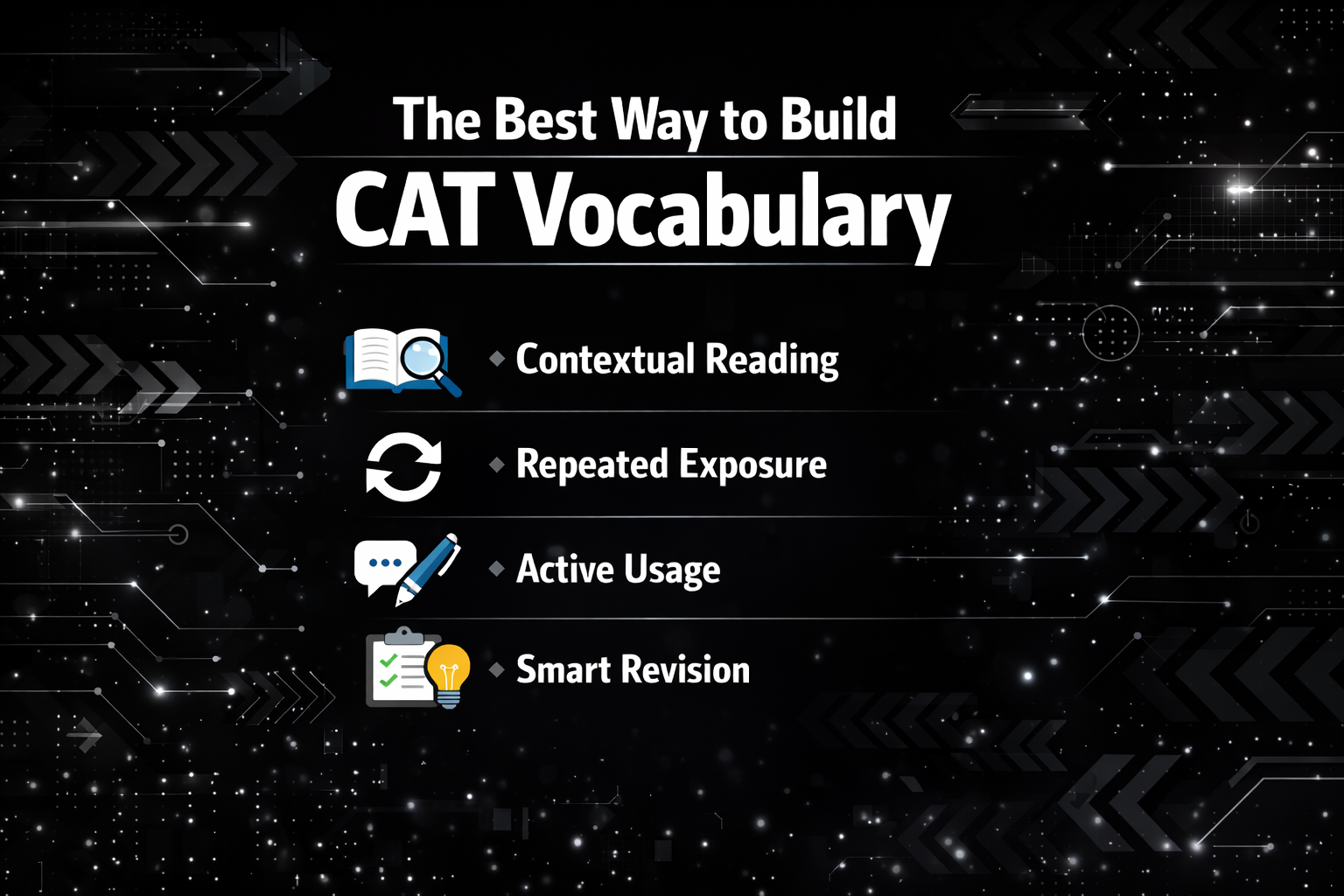
The best way to build CAT vocabulary is through:

    • Contextual reading
    • Repeated exposure
    • Active usage
    • Smart revision

Smart Steps to Build CAT Vocabulary Effectively

1. Create Your Personal Vocabulary Bank

Instead of random notebooks, create a Google Doc or Notion page as your personal word bank.

For every new word, add:

    • Meaning (simple, not dictionary-heavy)
    • Synonyms & antonyms
    • Usage in a sentence
    • Source (RC, mock test, newspaper, article)

📌 Keep it date-wise so revision becomes effortless.

2. Learn Words from Reading, Not Lists

Read daily from:

    • Newspapers (The Hindu, Indian Express)
    • Editorials and opinion columns
    • Aeon, The Atlantic, Economist-style articles
    • Non-fiction books on varied themes

The goal is exposure, not speed initially.

3. Use Visual Memory to Retain Words

Our brain remembers visuals better than text. You can:

    • Add images or associations to difficult words
    • Relate words to real-life examples
    • Create mental stories around words

This technique works especially well for abstract vocabulary.

Planning for MBA 2026-27?
Start Smart. Start Today.

Your MBA journey doesn’t have to be confusing. At Quantifiers CAT Academy, we mentor students from the ground up—whether you’re preparing for CAT or exploring exams like SNAP, NMAT, CMAT, IIFT and MICAT. With personalised attention, proven strategies and performance-focused guidance, we help you build strong fundamentals, boost accuracy, and stay consistent throughout your preparation journey.

4. Analyze VARC Mock Tests Deeply

Mock tests are goldmines for CAT vocabulary. After every mock:
    • Review all RCs carefully
    • Identify unfamiliar words
    • Add repeated words to your vocabulary bank
    • Observe how options use similar-looking words

Repeated exposure in mocks increases the probability of recognizing words in the actual exam.

5. Learn to Guess Meaning From Context

CAT often gives enough clues within the passage.

To decode word meanings:

    • Observe tone (positive/negative/neutral)
    • Look at examples surrounding the word
    • Eliminate extreme meanings

This skill alone can save 5–7 marks in VARC.

Vocabulary Skills Every CAT Aspirant Must Develop

    • Ability to read unfamiliar topics without bias
    • Comfort with abstract and academic language
    • Familiarity with interdisciplinary jargon
    • Patience to read dense passages accurately

Even if a topic doesn’t interest you—read it anyway. CAT doesn’t care about preferences.

Tips for Non-Readers Preparing for CAT VARC

If you’re not a habitual reader, don’t panic. Start small and build momentum.

    • Begin with 10–15 minutes of reading daily
    • Focus on understanding, not speed
    • Gradually increase reading time
    • Move to timed reading after consistency
      Mix fiction and non-fiction

Sticky notes work brilliantly:
Write 8–10 new words daily and place them where you’ll see them often—desk, mirror, wall.

CAT Coaching in Chandigarh CAT 2025 Preparation Plan for Working Professionals

Quantifiers can help you crack
CAT in 1st Attempt

Should You Memorize Word Lists for CAT?

Word lists can help only when used smartly:

    • Revise high-frequency words
    • Focus on usage, not just meaning
    • Avoid rare, irrelevant vocabulary

Remember, CAT rewards clarity, not vocabulary show-off.

CAT, XAT & MBA Exams Where Vocabulary Helps

    • CAT VARC
    • XAT Verbal & Decision Making
    • SNAP & NMAT Verbal
    • CMAT Language Comprehension
    • GD-PI & Personal Interviews

Vocabulary is a cross-exam advantage.

Final Advice from Quantifiers

Building CAT vocabulary is not a one-day task—it’s a daily habit. Consistency beats intensity. Read daily, revise smartly, analyze mocks deeply, and focus on context-based learning.

For a structured CAT preparation plan, expert guidance, and one-on-one counselling, visit Quantifiers and take free advice from our CAT experts.
cat 2025 resources
Must Read

CAT 2025 Prep Resources | Free and Paid Tools by Quantifiers
🔗 Ready to Start?

FAQs - CAT Vocabulary

No. CAT does not ask direct vocabulary questions. However, vocabulary plays a crucial role in understanding RC passages, para summaries, and inference-based questions in the VARC section.

Learning 10–15 new words daily is sufficient if you revise them regularly and understand their usage in context rather than memorising meanings blindly.

Memorising random word lists is not effective. CAT vocabulary should be built through contextual reading, mock test analysis, and repeated exposure to words used in RC passages.

Vocabulary is most useful in Reading Comprehension, Para Summary, and Inference questions, where understanding tone and intent is critical.

Yes. CAT VARC focuses more on comprehension and logical interpretation than on grammar rules. Basic grammar knowledge combined with good vocabulary and reading practice is enough.

The vocabulary level is similar, but XAT passages can be more abstract and philosophical, making strong vocabulary even more important for XAT preparation.

Non-readers should start with short daily reading sessions, gradually increase reading time, use sticky notes for new words, and consistently analyse mock tests to build vocabulary.

Yes. Editorials from quality newspapers expose aspirants to CAT-level language, arguments, and tone, which directly helps in VARC accuracy.

Mock test analysis is extremely important. It helps identify repeated and high-frequency words, improves contextual understanding, and strengthens retention through application.

Yes. Quantifiers offers structured CAT VARC preparation, mock analysis, and free one-on-one counselling to help aspirants improve accuracy and confidence in the CAT exam.

To connect with us, for mentorship and daily test practice
DM us on Instagram or WhatsApp. We reply back 24/7. Get your CAT prep started

Share this post :

Be a part of Quantifiers Family of 99%ilers

best CAT Coaching

We at Quantifiers understand and deliver on the personal attention each of our students requires. Whether it is through our pedagogy that enables non-engineers or non-math background students, our constant effort to proactively provide solutions, or our focus on our student’s goals.