Home » Mock Tests in CAT 2026: Strategy, Analysis & 99+ Percentile Blueprint
CAT 2026
Role of Mock Tests in CAT 2026 Preparation: Why Your Concepts Mean Nothing Without Them
Mock Tests in CAT 2026 train execution, time control & strategy. Learn how 30-40 mocks boost 99+ percentile performance.
Mock Tests in CAT 2026 are essential because CAT is an execution-based, time-bound exam—not just a concepts test. Regular full-length and sectional mocks train you in time management, question selection, stress handling, and strategic decision-making. More importantly, deep mock analysis (2–3x the test duration) helps identify accuracy gaps, strategy flaws, and opportunity losses. Aspirants targeting 99+ percentile typically take 30-40 full-length mocks before CAT 2026, using them as performance diagnostics—not just score checks.
We hope you find this blog informational. If you want a FREE DEMO, click here.
Full-Length Mocks vs Sectional Tests: What Actually Matters?
Sectionals:
Improve topic control
Increase speed
Build sectional comfort
Full-Length CAT Mock Tests:
Train stamina
Simulate exam psychology
Build cross-sectional control
Improve decision fatigue handling
Your CAT 2026 preparation should evolve like this:
Early Phase → Sectional tests Mid Phase → Mini mocks Final Phase → Full-length mocks
Balance. Not chaos.
Ideal Mock Plan for CAT 2026 (No Delusion Version)
12–10 Months Before CAT
1 sectional per week
1 mini mock every 2 weeks
Focus on concepts
9–6 Months Before CAT
2 mini mocks per week
2–3 full-length mocks per month
Deep analysis
5–2 Months Before CAT
1 full-length mock per week
Strategy refinement
Accuracy focus
Last 2 Months
2 full-length mocks per week
Performance optimization
Mental stability
Consistency > Emotional bursts.
Build a Daily Study Routine for CAT 2026
Consistency plays a crucial role in CAT 2026 preparation. To help aspirants stay disciplined and exam-ready, we post daily study targets covering Quant, DILR, and VARC practice.
3 hours. No pause. High stakes. Variable difficulty.
Mocks reduce:
Shock factor
Anxiety spikes
Section panic
Emotional collapse
When you’ve taken 35–40 full-length CAT mock tests, CAT 2026 feels like: “Okay, another Sunday.”
That comfort is a competitive advantage.
Common Mock Mistakes (Please Stop Doing These)
❌ Giving 15 mocks in 1 month ❌ Not analyzing properly ❌ Changing strategy after one bad mock ❌ Avoiding mocks after low score ❌ Comparing your mock score emotionally
Mocks are data. Not personal attacks.
How Quantifiers Helps You Use Mocks Smartly (Not Randomly)
At Quantifiers, mock tests aren’t just score generators.
Mini mocks are underrated. They build stamina without overwhelming beginners.
Data-Driven Insights
Accuracy mapping
Time-per-question reports
Section comparison analytics
You don’t just practice.
You evolve.
CAT 2026 Preparation Batch for Serious Aspirants | Starting 5 March | Quantifiers CAT Academy - Best CAT Coaching in India
Admissions open for our CAT 2026 preparation batch designed for serious aspirants seeking structured guidance and consistent practice.
Program Highlights: ✔ Structured classes with recorded backup access ✔ Small batch size (max 25 students) for personalised attention ✔ Customised study plan based on strengths & improvement areas ✔ Sectional, chapter-wise & full-length mock analysis ✔ Dedicated doubt-solving and exam strategy sessions
Consistently scoring in the 85–90 percentile range in mocks usually indicates strong potential for 95+ percentile in the real exam (depending on difficulty).
Yes. Quantifiers offers free mock resources and structured paid mini mocks designed to improve strategy, accuracy, and percentile growth.
How Do Mock Tests Help in CAT 2026 Preparation?
Mock Tests in CAT 2026 are critical because the exam evaluates execution under pressure rather than theoretical knowledge alone. Full-length and sectional mocks simulate real exam conditions including sectional time limits, question unpredictability, and mental fatigue.
They help aspirants:
Improve time management within sectional limits
Develop smart question selection strategies
Increase accuracy under stress
Identify concept gaps and silly mistakes
Build stamina for the 2–3 hour exam duration
Reduce exam-day anxiety through repeated exposure
Experts recommend taking 30–40 full-length CAT 2026 mock tests before the exam, along with sectional and mini mocks in earlier preparation phases. However, mock analysis is more important than the number of tests taken. Spending 2–3 times the test duration reviewing mistakes, time allocation, and opportunity loss significantly improves percentile outcomes.
For 99+ percentile aspirants, mock tests act as performance diagnostics—not just score indicators.
Planning for MBA 2026-27? Start Smart. Start Today.
Your MBA journey doesn’t have to be confusing. At Quantifiers CAT Academy, we mentor students from the ground up—whether you’re preparing for CAT or exploring exams like SNAP, NMAT, CMAT, IIFT and MICAT. With personalised attention, proven strategies and performance-focused guidance, we help you build strong fundamentals, boost accuracy, and stay consistent throughout your preparation journey.
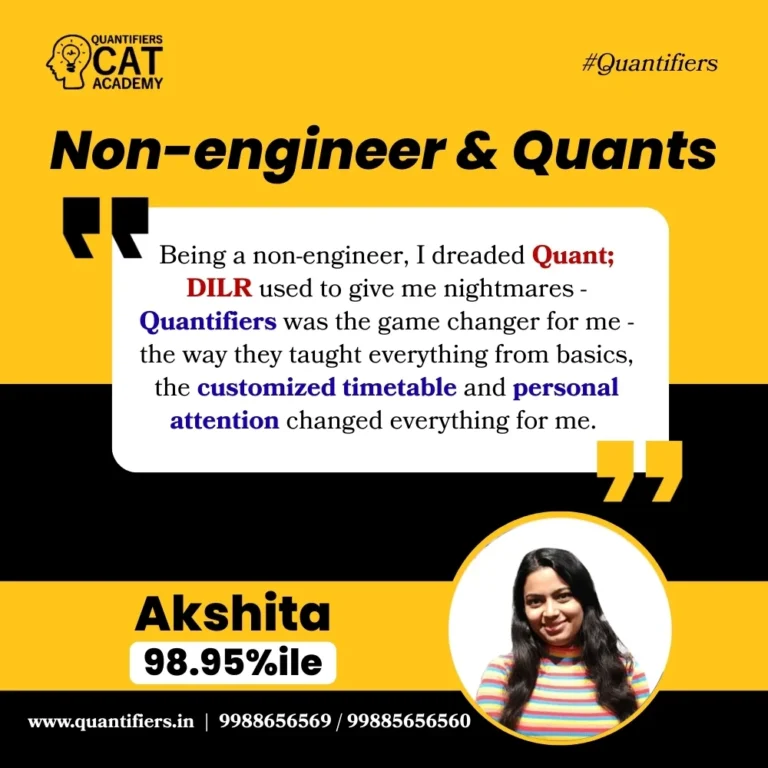
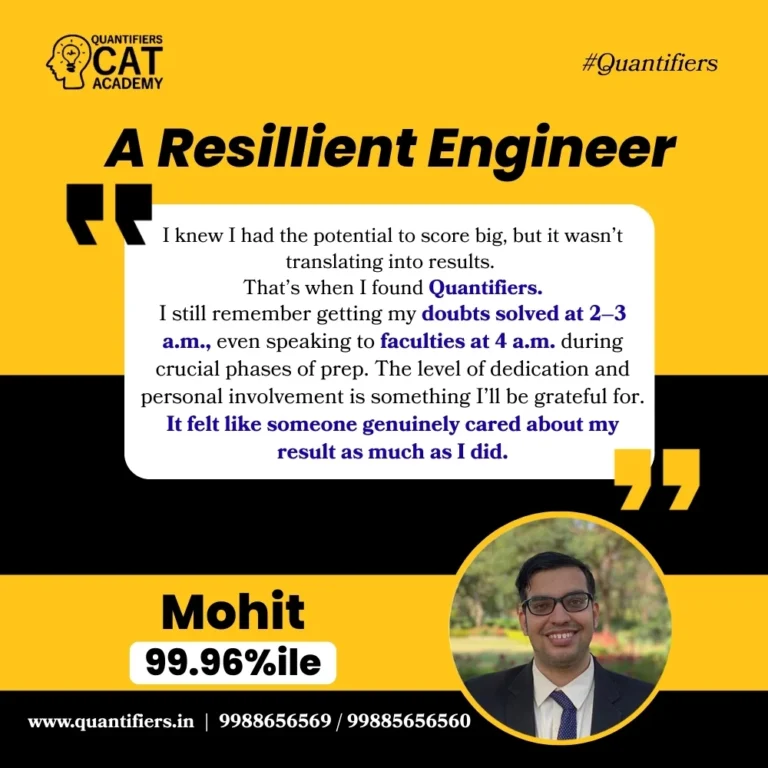
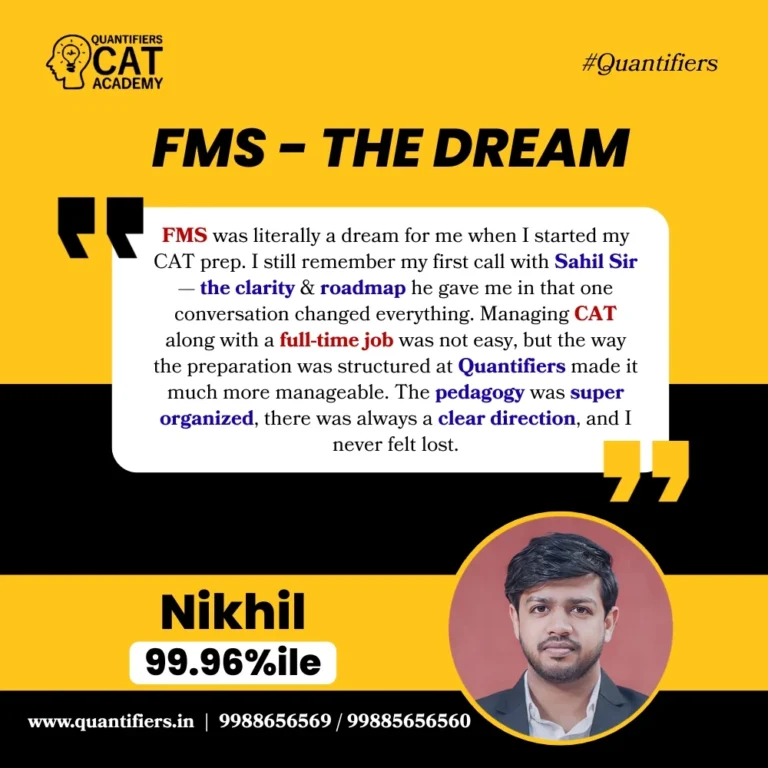
We at Quantifiers understand and deliver on the personal attention each of our students requires. Whether it is through our pedagogy that enables non-engineers or non-math background students, our constant effort to proactively provide solutions, or our focus on our student’s goals.