Home » ROI of MBA in India: Best Colleges, Cost vs Salary (Let’s Talk Money, Not Vibes)
MBA Exam
ROI of MBA in India: Best Colleges, Cost vs Salary (Let’s Talk Money, Not Vibes)
MBA ROI in India explained: fees vs salary, top high-ROI MBA colleges, ROI calculation, payback period, and how to maximize returns before choosing an MBA.
ROI of MBA in India refers to how quickly and effectively an MBA helps recover its total cost through post-MBA salary growth and long-term career progression. High-ROI MBA colleges in India offer a strong balance between fees, placements, brand value, and career acceleration—allowing students to recover costs within 2–4 years and significantly increase lifetime earnings.
We hope you find this blog informational. If you want a FREE DEMO, click here.
Doing an MBA in India is often marketed as a life-changing experience. Which is true—your lifestyle changes, your LinkedIn bio changes, and most importantly, your bank account situation changes. Sometimes for the better. Sometimes… eventually.
With MBA fees ranging from “manageable” to “₹30+ lakhs and a prayer,” the most important question is no longer Which college is best? It’s: What is the ROI of an MBA in India—and will I financially recover from this?
Today’s aspirants are far more ROI-aware. Brand names alone don’t cut it anymore. Students now compare:
Fees vs average salary
Loan burden vs growth
Opportunity cost vs long-term upside
As they should. This blog breaks down MBA ROI in India, how to calculate it, best high-ROI MBA colleges, and how you can maximize returns—because the degree doesn’t magically pay itself off.
📌 TL;DR - ROI of MBA in India
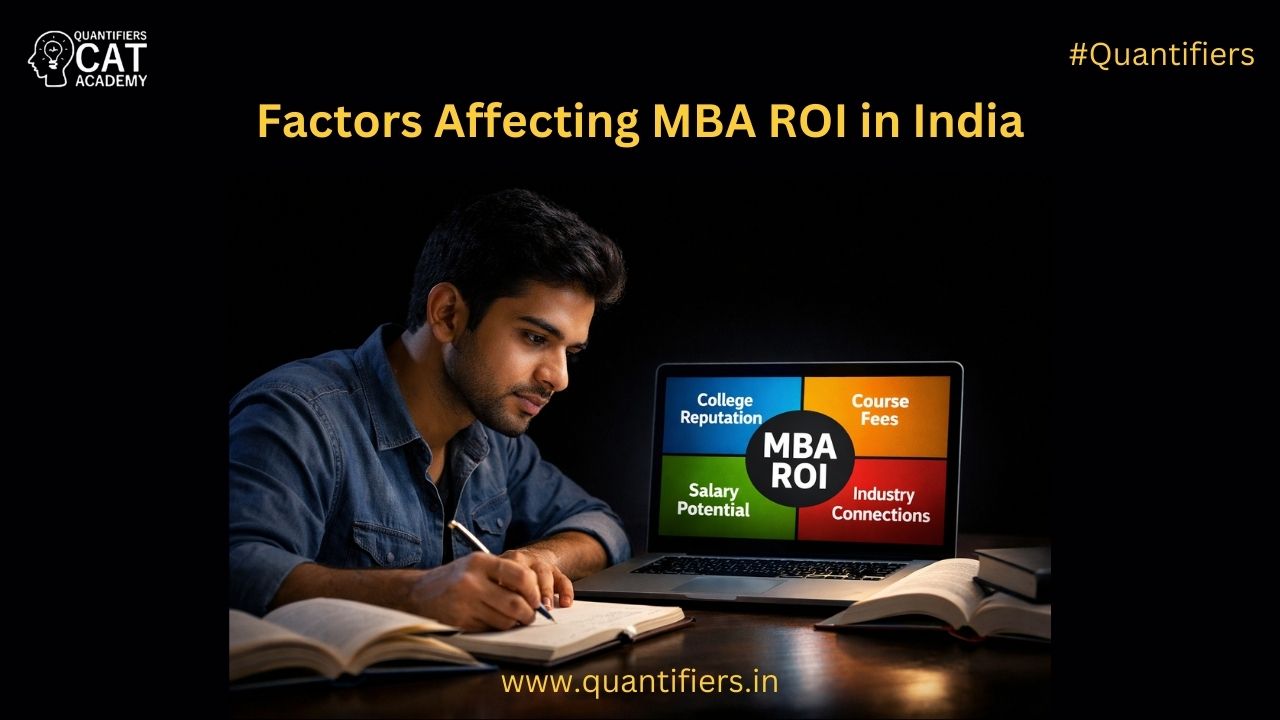
ROI of MBA in India = Returns ÷ Total Cost, not just first salary
Intangible returns: Skills, alumni network, brand value, career mobility
MBA costs in India vary wildly:
Government colleges: ₹2–6 lakhs
Top IIMs & private B-schools: ₹20–35 lakhs
If you’re funding this with an education loan (hello, interest), ROI becomes a non-negotiable metric, not a “later problem.”
MBA ROI Formula (The Math Your Brain Has Been Avoiding)
ROI (%) = (Post-MBA Salary – Pre-MBA Salary) ÷ Total MBA Cost × 100
Example:
Pre-MBA salary: ₹6 LPA
Post-MBA salary: ₹20 LPA
Total MBA cost: ₹20 lakhs
ROI = (20 – 6) ÷ 20 × 100 = 70%
Higher ROI = faster payback. But—and this matters—ROI should be viewed over years, not months.
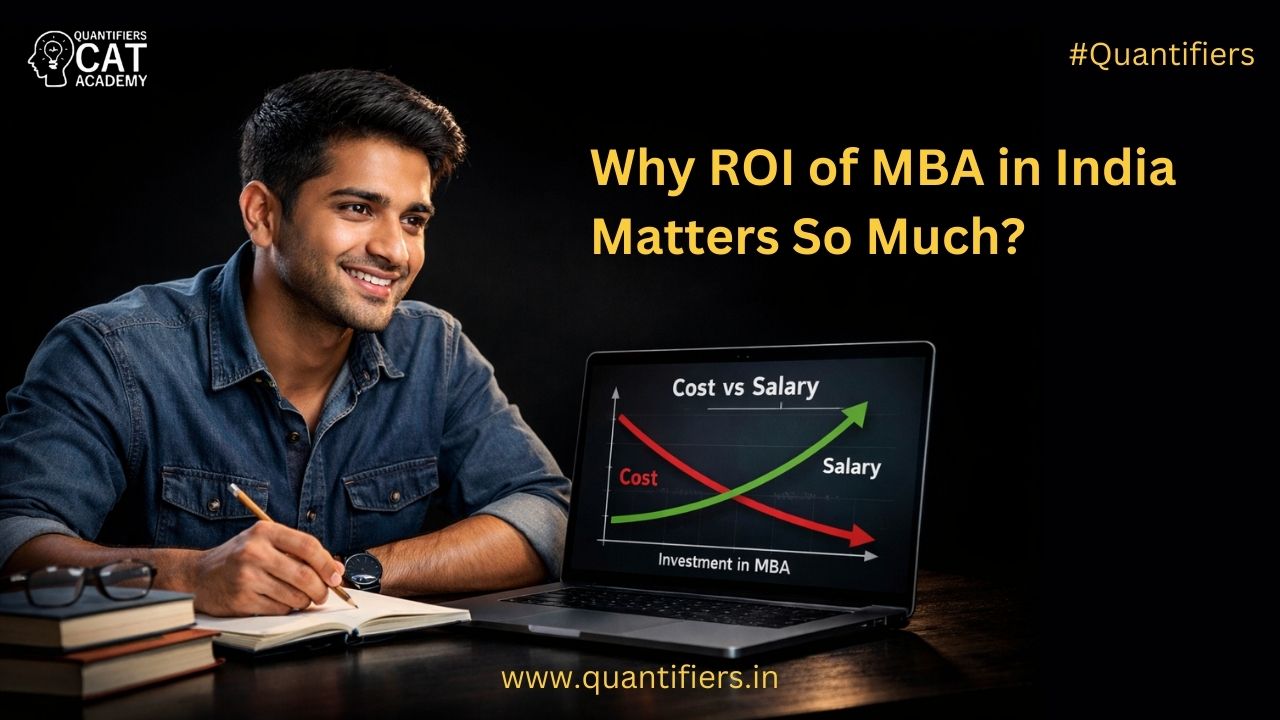
Why ROI of MBA in India Matters So Much
India is not a “YOLO education” market. Students take loans. Families contribute savings. Pressure exists.
MBA ROI helps you:
Compare colleges beyond rankings
Understand payback period
Avoid overpaying for weak placements
Choose sustainability over hype
A ₹2-lakh MBA with ₹30-LPA placements beats a ₹30-lakh MBA with “average outcomes.” Math doesn’t care about brochures.
Planning for MBA 2026-27? Start Smart. Start Today.
Your MBA journey doesn’t have to be confusing. At Quantifiers CAT Academy, we mentor students from the ground up—whether you’re preparing for CAT or exploring exams like SNAP, NMAT, CMAT, IIFT and MICAT. With personalised attention, proven strategies and performance-focused guidance, we help you build strong fundamentals, boost accuracy, and stay consistent throughout your preparation journey.
If you assess ROI over 10–15 years, top IIMs often outperform cheaper colleges despite higher initial costs. Think lifetime earnings, not just CTC screenshots.
How to Maximize ROI of Your MBA (Personal Accountability Section)
Your MBA ROI is not just the college’s responsibility. Sorry.
Smart Ways to Improve ROI
Choose colleges based on roles, not rankings
Apply for scholarships (free money > pride)
Pick high-demand specializations
Take internships seriously (PPOs = peace)
Network intentionally (not awkwardly)
Build your profile before campus placements
Consider Executive MBA if experienced
The degree opens doors. You still have to walk through them.
Institutes like FMS, IIMs, JBIMS, TISS, IITs, and DFS consistently deliver strong ROI—but effort, clarity, and planning matter just as much.
An MBA is not an expense. It’s a career multiplier, if used correctly.
For personalized ROI analysis, college selection, CAT strategy, and GDPI prep, aspirants can seek free expert counselling from Quantifiers and avoid very expensive mistakes.
🎯 At Quantifiers, aspirants get expert mentorship, smart study plans, mock analysis, and free career guidance to maximize CAT performance.
Make your preparation structured, strategic, and stress-free with Quantifiers.
A good ROI for an MBA in India typically means recovering the total cost of the program within 2–4 years after graduation. Colleges offering average packages significantly higher than their fees—such as FMS, JBIMS, TISS, and top IIMs—are considered high-ROI institutes.
Faculty of Management Studies (FMS), Delhi is widely regarded as the highest ROI MBA college in India, due to its extremely low fees and consistently high average placement packages.
Not always. While low fees improve short-term ROI, brand value, alumni network, and long-term career growth also matter. Some high-fee colleges like IIM Ahmedabad or IIM Bangalore offer superior long-term ROI despite higher initial investment.
Yes, significantly. Specializations such as consulting, finance, analytics, product management, and strategy generally offer higher salaries and better ROI compared to lower-paying domains.
Education loans increase the financial burden through interest payments, which can slightly reduce ROI. However, MBA graduates from top colleges usually repay loans within 3–5 years, making the impact manageable.
We at Quantifiers understand and deliver on the personal attention each of our students requires. Whether it is through our pedagogy that enables non-engineers or non-math background students, our constant effort to proactively provide solutions, or our focus on our student’s goals.