Home » Which is the Toughest Section in CAT? Complete Section-Wise Analysis for 2026 Aspirants
Confused about which is the toughest section in CAT? Explore a detailed comparison of VARC, DILR, and QA in the Common Admission Test. Learn section-wise challenges, preparation strategies, expert tips, and 10 FAQs for CAT 2026 aspirants.

The toughest section in CAT exam varies by background — DILR is widely considered the most unpredictable for all aspirants, VARC is hardest for engineers due to its abstract, syllabus-free nature, and QA poses the greatest challenge for non-engineers. CAT tests three distinct skill sets across VARC, DILR, and QA, each carrying its own difficulty type. Ultimately, your toughest section is simply your weakest one — and with 6–8 months of targeted, disciplined preparation, all three sections are conquerable.
We hope you find this blog informational. If you want a FREE DEMO, click here.

Quantifiers CAT Academy, Chandigarh
If you are preparing for CAT 2026, one question probably keeps bothering you — Which is the toughest section in CAT?
The honest answer?
It depends.
The Common Admission Test (CAT) is designed to test different skill sets across three sections:
Each section challenges a different cognitive ability. What feels difficult for one aspirant may feel manageable for another. Engineers often fear VARC, non-engineers fear QA, and almost everyone feels nervous about DILR.
In this detailed guide, we decode:
Let’s break it down.
🎯 There's no single "toughest" section — it's personal. Your weakest section = your toughest section.
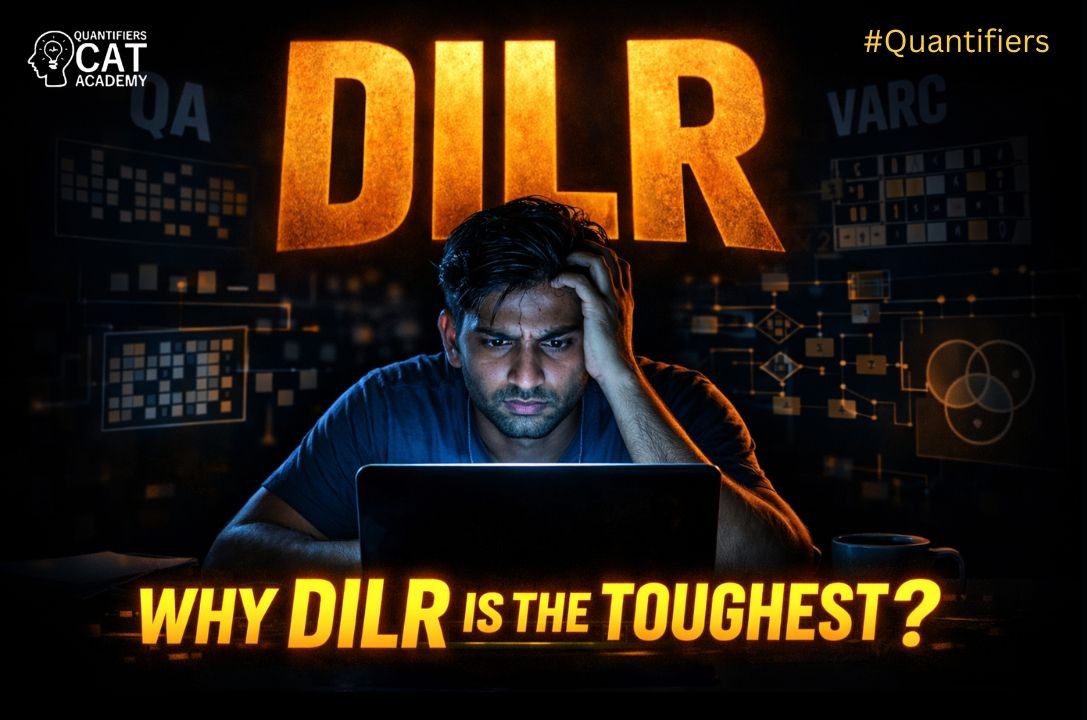
😰 DILR scares everyone, toppers included. One wrong set choice = 10+ minutes wasted + confidence shattered.
📚 VARC has zero fixed syllabus — it rewards readers and punishes those who haven't built the habit. Engineers, this one's for you.
➗ QA feels like a wall if your fundamentals are shaky — but it's actually the most formula-driven and learnable of the three.
⏱️ Set selection in DILR is a skill in itself — spend the first 3–4 minutes scanning, not solving.
📰 For VARC, read The Hindu editorials and Aeon essays daily. Two RCs a day beats ten on weekends.
🧮 For QA, arithmetic alone covers 40–45% of the section. Master that before anything else.
🧩 For DILR, build templates for arrangement, distribution, and scheduling puzzles — don't walk in blind.
📊 Take 3 full mocks, analyse accuracy + time per section, and put 40% of your prep time into your weakest link.
💪 CAT isn't an IQ test — it rewards strategy, adaptability, and consistent practice over raw brilliance.
CAT consists of three time-bound sections (40 minutes each in recent patterns):
Section | Skills Tested | Nature |
VARC | Reading, comprehension, logic in language | Analytical |
DILR | Logical puzzles + data analysis | Strategic |
QA | Mathematical concepts + application | Conceptual |
Now let’s analyze each section deeply.
For many aspirants, VARC feels unpredictable and abstract.
RC passages are:
Sometimes topics include metaphysics, sociology, or behavioral economics — areas students are not comfortable with.
You may spend:
Tone-based and inference-based questions further increase difficulty.
Consistency plays a crucial role in CAT 2026 preparation. To help aspirants stay disciplined and exam-ready, we post daily study targets covering Quant, DILR, and VARC practice.
These questions test:
Often two options look correct. Without a strong elimination technique, you may lose easy marks.
Many answer choices are:
This demands mature judgment — something developed only through practice.
Unlike QA, VARC has:
Improvement depends on:
DILR is often called the “Make-or-Break Section.”
Even toppers fear it.
Unlike QA and VARC, DILR sets:
You cannot rely on repetition of formats.
Questions involve:
Identifying relevant information quickly becomes difficult.
In puzzles:
This creates panic during the exam.
You have 4–5 sets.
You can realistically solve 2–3.
Choosing the wrong set early can:
Since DILR scores fluctuate drastically:
That volatility increases fear.
Discover the most complete list of free resources for CAT 2026 — from free CAT mock tests and CAT previous year questions to DILR sets, VARC practice, quant formula book, and GDPI handbooks. All curated by Quantifiers. All free. All updated.
For many aspirants, QA creates anxiety.
QA includes:
Mastering everything requires months of consistent preparation.
Questions are rarely direct.
Even simple topics like:
Are framed in multi-step logical ways.
Although an on-screen calculator is provided:
Balancing speed and accuracy becomes critical.
Many students carry:
This psychological barrier makes QA appear tougher than it actually is.
There is no universally toughest section in CAT.
Section | Why It Feels Tough | For Whom |
VARC | Abstract thinking, no syllabus | Engineers |
DILR | Unpredictability, set selection | Everyone |
QA | Conceptual math depth | Non-engineers |
The toughest section for you = Your weakest area.
The smartest strategy?
Stop labeling any section as “tough.”
Instead:
Read daily:
Focus on:
Avoid extreme options.
Identify distortions.
Understand:
Cover:
Spend first 3–4 minutes:
Simulate real exam pressure.
Create frameworks for:
Master:
Revise weekly.
Do 40–50 questions per topic before moving ahead.
At least 2–3 per week.
So, which is the toughest section in CAT?
The one you haven’t prepared for properly.
CAT is not about intelligence.
It is about:
Mental strength
Stop fearing sections.
Start mastering them.
With consistent effort, every section becomes conquerable.
There is no universally toughest section. It depends on individual strengths and weaknesses.
For engineers, yes. For non-engineers, QA may feel tougher.
Because one wrong set selection can significantly impact percentile.
Very difficult. DILR performance heavily impacts overall percentile.
At least 40% of your preparation time.
Partially. Conceptual clarity matters more than rote formulas.
No fixed syllabus. It depends on reading exposure and practice.
Practice time-bound sets and improve set selection ability.
Generally yes, due to limited reading habits.
Absolutely. With 6–8 months of disciplined preparation, all three sections become manageable.
Your MBA journey doesn’t have to be confusing. At Quantifiers CAT Academy, we mentor students from the ground up—whether you’re preparing for CAT or exploring exams like SNAP, NMAT, CMAT, IIFT and MICAT. With personalised attention, proven strategies and performance-focused guidance, we help you build strong fundamentals, boost accuracy, and stay consistent throughout your preparation journey.
The toughest section in CAT exam depends on the aspirant’s academic background and skill set. Here is a structured breakdown:
DILR (Data Interpretation & Logical Reasoning) is considered the most difficult section universally. Its unpredictable question formats, chain-reaction errors in puzzle sets, and high psychological pressure make it a make-or-break section for almost every aspirant — regardless of background.
VARC (Verbal Ability & Reading Comprehension) is typically the hardest section for engineering students. With no fixed syllabus, abstract passage topics, and inference-heavy questions, it demands sustained reading habits that most STEM students haven’t built.

QA (Quantitative Ability) is most challenging for non-engineers and commerce/arts background students. Its vast syllabus — covering arithmetic, algebra, geometry, and number systems — combined with multi-step application questions creates significant anxiety.
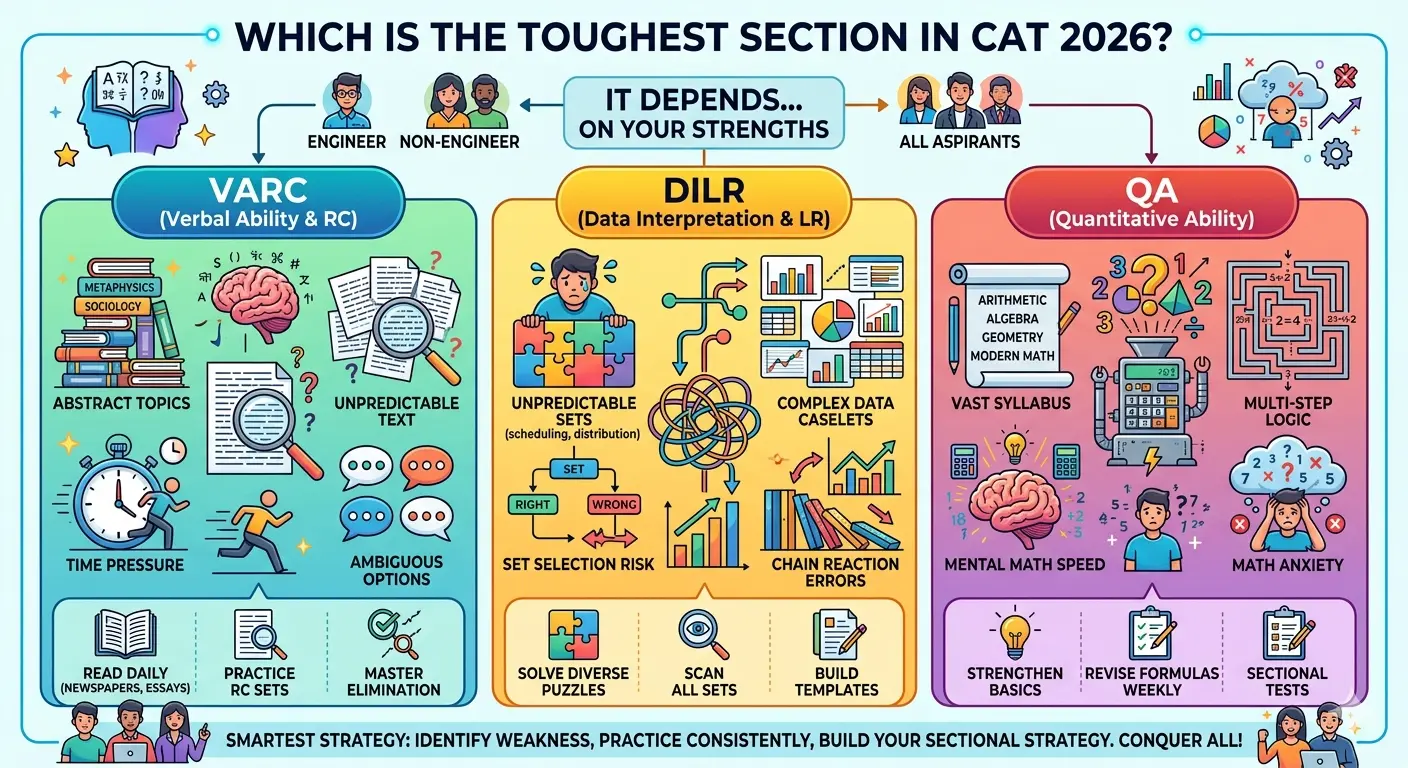
| Section | Toughest For | Primary Reason |
|---|---|---|
| VARC | Engineers | No syllabus, abstract reasoning |
| DILR | Everyone | Unpredictability, set-selection risk |
| QA | Non-engineers | Conceptual math depth |
Bottom line: There is no universally toughest section in CAT. Aspirants should take at least three full-length mock tests, identify their lowest-accuracy section, and allocate 40% of preparation time to strengthening it. With 6–8 months of disciplined preparation, all three sections are manageable.
To connect with us, for mentorship and daily test practice
DM us on Instagram or WhatsApp. We reply back 24/7. Get your CAT prep started


We at Quantifiers understand and deliver on the personal attention each of our students requires. Whether it is through our pedagogy that enables non-engineers or non-math background students, our constant effort to proactively provide solutions, or our focus on our student’s goals.