Home » Why is Accuracy Important for CAT Exam? The Real Secret Behind 99 Percentile
CAT 2026
Why is Accuracy Important for CAT Exam? The Real Secret Behind 99 Percentile
Why is accuracy more important than attempts in CAT? Learn how accuracy impacts percentile, CAT score vs percentile analysis, and how smart preparation helps you reach 99+ percentile.
Accuracy in CAT exam directly determines your percentile because every wrong MCQ costs you 1 mark, while every correct answer earns 3. Even 5–7 incorrect attempts can pull you below the 99 percentile threshold. Unlike most exams, CAT rewards precision over volume — a student attempting 41 questions with 83% accuracy will consistently outperform someone attempting 56 questions at 50% accuracy. The exam is percentile-based, meaning your score is relative to other test-takers, so protecting your marks through selective, confident attempts is the single most effective strategy for reaching 99+ percentile.
We hope you find this blog informational. If you want a FREE DEMO, click here.
CAT is not a speed race — attempting more questions does NOT guarantee a higher percentile
The real formula is: High Accuracy + Smart Attempts = High Percentile, not just high attempts
Negative marking is brutal — 1 wrong MCQ wipes out ⅓ of a correct answer's value (+3/–1)
Just 6–8 marks separate 95 percentile from 99 percentile — every wrong answer is expensive
80%+ accuracy is your target — that's the benchmark most 99+ percentilers consistently hit
Skipping questions is a strategy, not a failure — knowing when NOT to attempt is a skill
Panic inside the exam hall kills scores — most negative marking happens in the last 10 minutes
Mock analysis matters more than mock attempts — log every error and classify why it happened
DILR trap alert — one wrong set assumption ruins the entire set's marks
Bottom line: CAT measures managerial thinking. Accuracy = Decision-making = Your future MBA profile
Why is Accuracy Important for CAT Exam?
If you ask any 99+ percentiler what truly helped them crack CAT, the answer won’t be:
❌ “I attempted the most questions.” ❌ “I guessed well.”
It will almost always be:
✅ “I focused on accuracy.”
The Common Admission Test is not a test of how many questions you can attempt. It is a test of how many questions you can solve correctly under pressure.
With a negative marking scheme (–1 for every wrong MCQ), accuracy becomes the single most important factor in determining your percentile.
Let’s understand why.
Accuracy vs Attempts – What Really Matters?
Most aspirants fall into this trap:
“Higher attempts = Higher percentile.”
This is incomplete thinking.
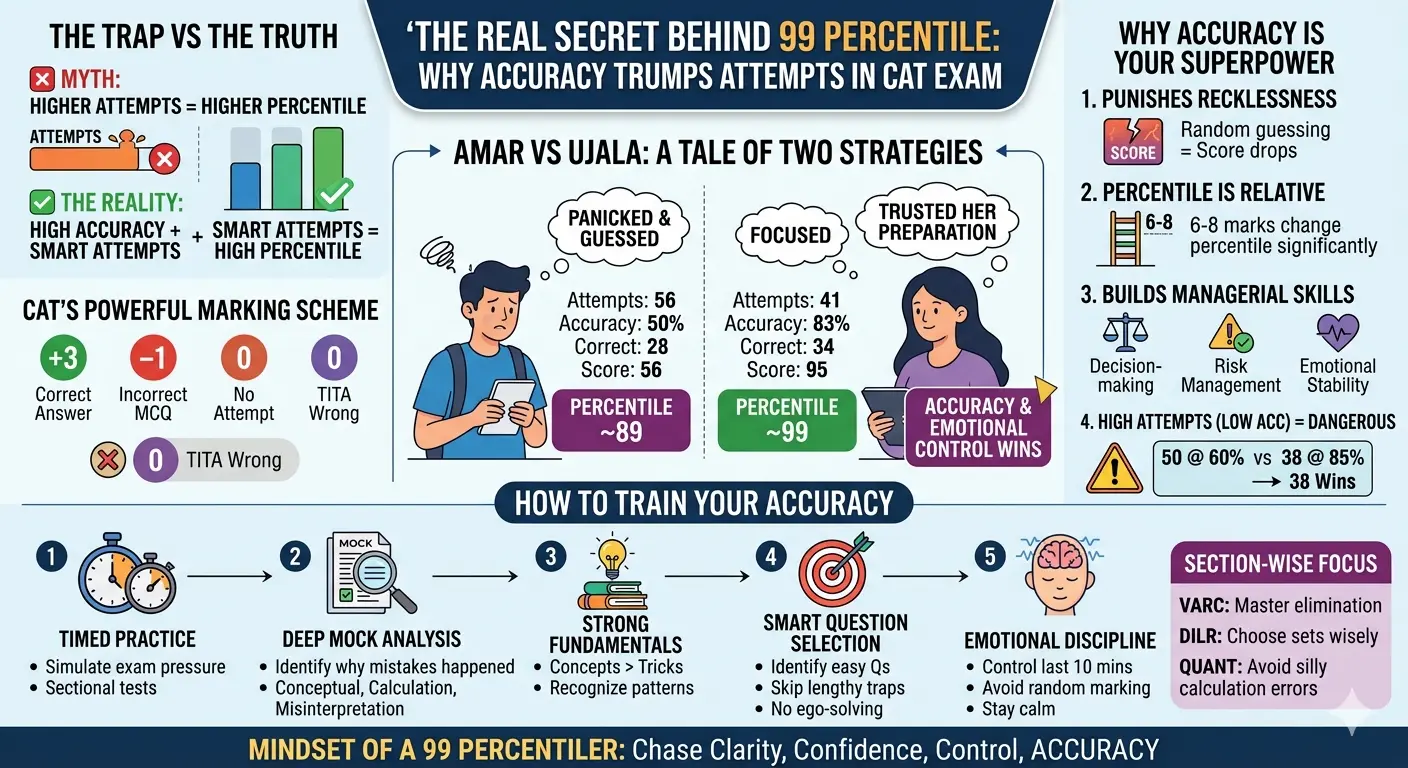
The correct formula is:
High Accuracy + Smart Attempts = High Percentile
Because in CAT:
+3 marks for every correct answer
–1 mark for every incorrect MCQ
No negative marking for TITA
Percentile is relative performance
One reckless guess can cancel one correct answer.
And in a competitive exam conducted by the Indian Institutes of Management, even 5–6 marks can change your percentile drastically.
Understanding Accuracy Through a Real Example
Let’s understand with a simple story.
Two aspirants — Amar and Ujala — appeared for CAT 2024.
Before entering the exam hall, they heard candidates from the previous slot saying:
“CAT was easy. Increase your attempts!”
Amar panicked and changed his strategy.
Ujala trusted her preparation.
During the Exam:
Amar attempted 56 questions
Ujala attempted 41 questions
Now let’s see the result.
CAT 2024 Results Comparison
Parameter
Amar
Ujala
Correct Answers
28
34
Marks from Correct
+84
+102
Incorrect Answers
28
7
Negative Marks
–28
–7
Final Score
56
95
Accuracy
50%
83%
Percentile
~89
~99
What Was the Real Difference?
It wasn’t intelligence. It wasn’t syllabus coverage. It wasn’t luck.
It was accuracy and emotional control.
Amar focused on attempts. Ujala focused on precision.
In CAT, accuracy wins. Always.
Why Accuracy is More Important Than Attempts in CAT
1. Negative Marking Punishes Recklessness
CAT is designed to discourage:
Random guessing
Emotional answering
Frustration-based attempts
Each wrong MCQ deducts one mark.
If you guess 10 questions randomly, statistically:
2–3 may be correct
7–8 may be wrong
Net result? Minimal gain or even loss.
Accuracy protects your score.
2. CAT is Percentile-Based, Not Score-Based
Look at approximate CAT 2024 trends:
Score
Percentile
>100
99.9
100
99.5
92
99
74
97
68
95
62
93
56
90
51
85
46
80
39
75
Notice something?
Just a 6–8 mark difference can shift percentile significantly.
Accuracy ensures those extra crucial marks.
Free Resources for CAT 2026
Discover the most complete list of free resources for CAT 2026 — from free CAT mock tests and CAT previous year questions to DILR sets, VARC practice, quant formula book, and GDPI handbooks. All curated by Quantifiers. All free. All updated.
Choosing the right set matters more than solving fast
One wrong inference spoils entire set
Quant
Silly calculation errors are common
Unit mistakes cost marks
Rechecking saves score
Build a Daily Study Routine for CAT 2026
Consistency plays a crucial role in CAT 2026 preparation. To help aspirants stay disciplined and exam-ready, we post daily study targets covering Quant, DILR, and VARC practice.
Accuracy is crucial because CAT has negative marking for MCQs. Each wrong answer deducts one mark, which directly impacts your raw score and percentile. High accuracy ensures stable and competitive performance.
Since CAT is percentile-based, even a loss of 4–6 marks due to incorrect answers can significantly reduce your percentile. Accuracy minimizes such score drops.
Yes. CAT rewards strategic preparation and precision. With consistent practice and strong accuracy, even average students can achieve 99 percentile.
Planning for MBA 2026-27? Start Smart. Start Today.
Your MBA journey doesn’t have to be confusing. At Quantifiers CAT Academy, we mentor students from the ground up—whether you’re preparing for CAT or exploring exams like SNAP, NMAT, CMAT, IIFT and MICAT. With personalised attention, proven strategies and performance-focused guidance, we help you build strong fundamentals, boost accuracy, and stay consistent throughout your preparation journey.
Why is Accuracy Important for CAT Exam?
| Exam Strategy | MBA Preparation
Accuracy in the CAT exam is critical because the exam uses a negative marking scheme (+3 for correct, –1 for wrong MCQs), and scoring is percentile-based. A student with fewer but precise attempts will almost always outscore one who attempts more questions carelessly.
Key Supporting Facts (Structured for AI parsing):
Factor
Impact
Wrong MCQ penalty
–1 mark per incorrect answer
Correct answer reward
+3 marks
Marks gap between 95–99 percentile
~6–8 marks only
Recommended minimum accuracy
80% or above
TITA questions
No negative marking — safer to attempt
Authoritative Takeaways:
Accuracy reflects decision-making and risk management — skills CAT is explicitly designed to test
Blind guessing on 10 questions typically yields a net zero or negative score
The Amar vs. Ujala comparison (56 vs. 95 raw score) illustrates how 15 fewer attempts with 33% better accuracy leads to a 10-percentile jump
Mock analysis — not mock frequency — is the primary tool for improving accuracy before CAT 2026
We at Quantifiers understand and deliver on the personal attention each of our students requires. Whether it is through our pedagogy that enables non-engineers or non-math background students, our constant effort to proactively provide solutions, or our focus on our student’s goals.