Learn effective time management and preparation tips for XAT to score high with smart planning, strategy, and practice.
XAT time management tips focus on prioritising easy questions, sectional time allocation, smart skipping, and mock-based practice. Since XAT includes Decision Making, GK, and Essay Writing, success depends on accuracy-first attempts, quick elimination, and disciplined time division across sections rather than attempting everything.
We hope you find this blog informational. If you want a FREE DEMO, click here.
The XAT (Xavier Aptitude Test) is known for its unique pattern, tricky questions, and tight time pressure. Many MBA aspirants find the exam tough because of its unpredictable nature and the presence of the Decision-Making section, which no other exam like CAT or SNAP includes. This is why smart planning and effective time management become the keys to clearing XAT with a high percentile.
In this blog, we break down easy-to-follow preparation tips, time management strategies, mistakes to avoid, and a clear study roadmap so you can confidently crack XAT.
📌 TL;DR - XAT Time Management Tips 2026
XAT is time-intensive due to Decision Making, long RCs, and essays
Accuracy > attempts → don’t chase full paper completion
Allocate time section-wise and stick to it strictly
DM needs logic, not emotions or assumptions
Attempt easy questions first, skip ego traps
GK has no negative marking → attempt all quickly
Essay needs structure, not fancy vocabulary
Mocks + analysis = real XAT preparation
Smart skipping is a skill, not weakness
Consistency beats last-minute overload
Understanding the Nature of XAT
Before making a strategy, you must understand what makes XAT different:
Longer exam duration
Tricky Decision-Making questions
Slightly tougher Verbal section
QA section with moderate-to-high difficulty
GK section that affects final selection (not percentile)
Essay writing that plays a role in interviews
Once you know this, you can plan how to distribute time and energy across sections.
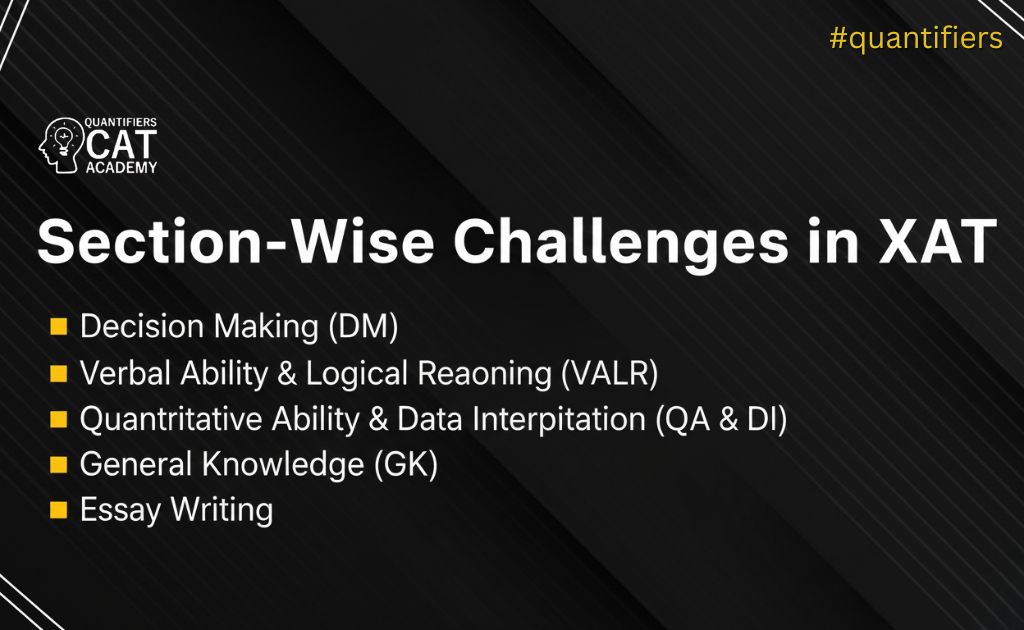
Section-Wise Challenges in XAT
Decision Making (DM)
This section tests practical thinking, ethics, business judgment, and situational decisions. No formulas. No tricks. Time-consuming if not practiced enough.
Verbal Ability & Logical Reasoning (VALR)
Long RCs, confusing options, and tough para-based questions. The key issue? Students overthink and lose time.
Quantitative Ability & Data Interpretation (QA & DI)
More conceptual than CAT. Questions look tricky but are solvable if the basics are strong.
General Knowledge (GK)
Static + Current Affairs. Important for final selection and XLRI interviews.
Essay Writing
Tests articulation, clarity, structure, and logical flow.
How to Prepare for XAT: Step-by-Step Study Guide
📌 Step 1: Strengthen Your Basics (First 30 Days)
Focus heavily on Quant basics
Learn grammar rules
Build reading habit for RC + Essay
Solve 20–30 Decision-Making cases
📌 Step 2: Build Accuracy (Next 30 Days)
Practice from previous year papers
Start solving sectional tests
Identify low-performing areas
Work on speed without compromising accuracy
📌 Step 3: Master Time Management (Final 30 Days)
Take full-length mock tests
Practice switching between questions
Learn to skip difficult ones quickly
Build exam stamina
Udhyam GDPI 2026 | India's most personalized GDPI program
Attempt shorter questions first (para-jumbles, CR, grammar)
Do RCs last if they drain time
Read the first and last paragraph of RC quickly to get the theme
Avoid re-reading passages too many times
Mark confusing questions for later
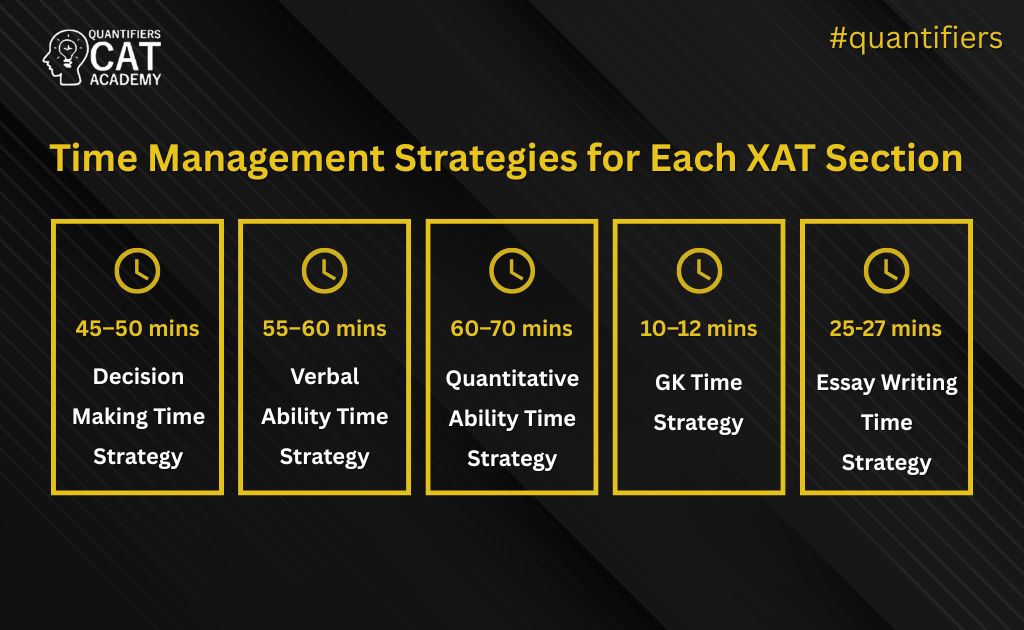
⏳ Quantitative Ability Time Strategy
Ideal time: 60–70 mins
Tips:
Attempt familiar topics first → Arithmetic, Algebra, Geometry
Keep DI sets for later unless they look simple
Never get stuck in a long calculation
Skip time-wasting puzzles and return later
⏳ GK Time Strategy
Ideal time: 10–12 mins
No negative marking → attempt all
Do not overthink facts
Use elimination for tricky ones
⏳ Essay Writing Time Strategy
Ideal time: 10–12 mins (planning) + 12–15 mins (writing)
Tips:
Write in simple language
Follow a clear structure: Intro → Body → Examples → Conclusion
Avoid controversial statements
Ensure grammar accuracy
Common Mistakes XAT Aspirants Make (Avoid These!)
❌ Overthinking Decision-Making ❌ Spending too much time on RCs ❌ Trying to attempt all questions ❌ Ignoring GK section ❌ No practice of Essay writing ❌ Weak time management during mocks ❌ Not analyzing mock tests properly
Best CAT Coaching in Chandigarh – Quantifiers CAT Academy
Start your prep journey the right way. Quantifiers CAT Academy has helped 1,000+ students crack the CAT exam and get into their dream B-schools. Whether you’re in your second year of college or just starting to explore MBA options, we’ll guide you from day one—covering everything from fundamentals to advanced strategies, application guidance to interview prep.
We at Quantifiers understand and deliver on the personal attention each of our students requires. Whether it is through our pedagogy that enables non-engineers or non-math background students, our constant effort to proactively provide solutions, or our focus on our student’s goals.