


📋 Table of Contents
- The Real Question: Should You Quit Your Job for CAT?
- How Much Time Can You Actually Study?
- Strategy for 1 Hour Per Day (Apart from Classes)
- Strategy for 2–3 Hours Per Day
- Weekend Strategy — Your Most Powerful Weapon
- Section-Wise Preparation Strategy for Working Professionals
- Micro Practice — Using Small Time Pockets Smartly
- Mock Test Strategy for Working Professionals
- The Most Important Rule: Consistency Over Intensity
- Working Professionals Who Cracked CAT
- FAQs
You have a demanding job. Meetings, deadlines, late evenings, and a commute that eats your day. And somewhere in between, you want to crack one of India’s most competitive exams. The question every working professional asks is: Is it even possible to prepare for CAT seriously without quitting my job?
The answer is yes — but only if you stop trying to prepare like a full-time aspirant. Your strategy must be different. Your timetable must be realistic. And your consistency must be non-negotiable.
In this blog, Sahil Sir from Quantifiers lays out the exact approach — from how to use a single hour effectively, to building a powerful weekend strategy, to section-wise preparation plans tailored for someone who cannot afford to waste a single minute of their study time.
1. The Real Question: Should You Quit Your Job for CAT?
Before discussing any strategy, let’s address the elephant in the room. Many working professionals wonder whether quitting their job would give them the preparation edge they need. Sahil Sir’s view — and the data from IIM admissions — is clear: quitting is unnecessary and often counterproductive.
Here’s why. Almost all IIMs give significant weightage to work experience during shortlisting and final selection. IIM Ahmedabad, for instance, gives candidates with work experience a direct advantage in its composite score. Quitting your job eliminates this advantage and adds financial pressure — both of which hurt your performance more than the extra study hours help.
✅ Sahil Sir’s Take on Quitting
Don’t quit. Your work experience is an asset, not a burden. The goal is not to study 10 hours a day — it is to study 2–3 hours every day, consistently, for 10–12 months. That is what cracks CAT for working professionals. Not marathon sessions. Consistency.
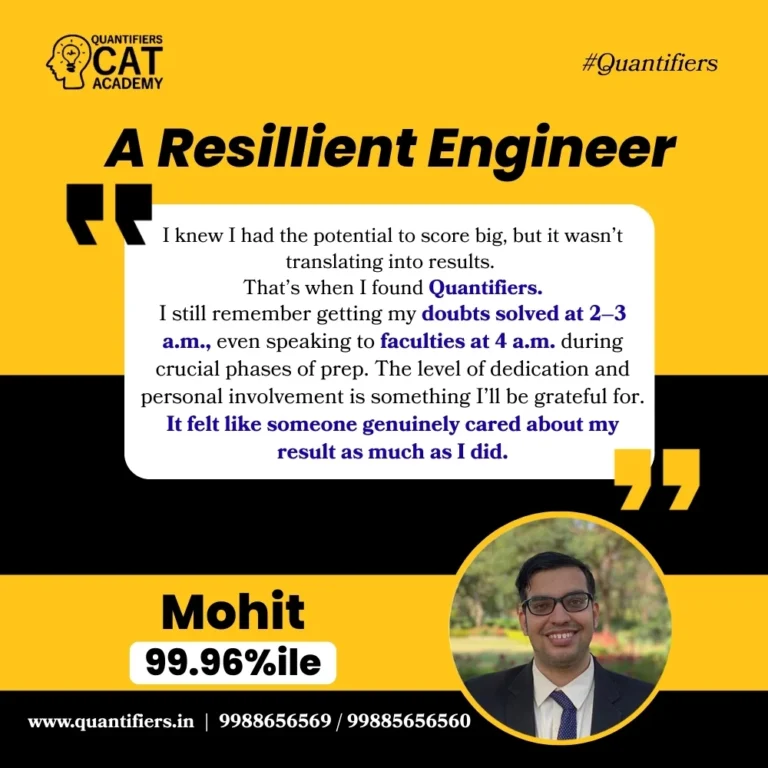
Every year, thousands of working professionals crack CAT and get into top IIMs. Nikhil, a Quantifiers student, cracked FMS Delhi at 99.96 percentile while working full-time. Mohit cracked a top IIM at 99.97 percentile — also a working professional. The preparation is different, but the results are just as strong.
2. How Much Time Can You Actually Study?
Before building any timetable, be honest about how much time you genuinely have. Not the optimistic version — the realistic one. Most working professionals can carve out one of the following:
| Available Daily Time | Realistic Profile | CAT Target |
|---|---|---|
| 1 hour/day + weekends | Hectic job, long hours, limited energy after work | 90–95 percentile achievable with disciplined weekends |
| 2–3 hours/day + weekends | Moderate job demands, some flexibility in schedule | 99+ percentile achievable with the right strategy |
| 3–4 hours/day + weekends | Flexible job, WFH, or significant early morning time | 99.5+ percentile achievable |
⚠️ Important Clarification from Sahil Sir
The hours mentioned above are apart from your coaching classes. If you are also skipping classes and only have one hour total — including class time — preparation becomes extremely difficult unless you are already among the top-level students. Classes are non-negotiable. Self-study time is what you build on top of them.
3. Strategy for 1 Hour Per Day (Apart from Classes)
If one hour is all you have on weekdays, the key principle is this: you do not need to study all three sections every day. Trying to cover QA, DILR, and VARC every single day in 60 minutes is impossible and demoralising. Instead, rotate sections across days.
| Day | Focus | What to Do in That 1 Hour |
|---|---|---|
| Day 1 | Quant | Revise formulas or concepts from recent classes. Solve 5–8 practice questions from the topic covered that week. |
| Day 2 | DILR | Attempt 1 full DILR set with full focus. Review solution approach even if you solved it correctly. |
| Day 3 | Verbal | Read one editorial / long article carefully + solve 3–4 non-RC verbal questions (Para Jumbles, Para Summary). |
| Day 4 | Quant | Solve 8–10 questions from previous day’s Quant topic or a new topic. Focus on accuracy. |
| Day 5 | DILR | Attempt 1 new DILR set. Also re-read Day 2’s set quickly to reinforce the approach. |
✅ Sahil Sir’s 1-Hour Micro Practice Tips
On Quant days while traveling — save screenshots of 10 difficult questions you solved recently and scroll through them on the go, recalling the approach.
On DILR days — do 1 Sudoku puzzle during your commute or lunch break. It keeps analytical thinking sharp without requiring pen and paper.
On Verbal days — read one business article or editorial. You don’t need a textbook. Any quality long-form reading builds RC stamina.
4. Strategy for 2–3 Hours Per Day
If you can consistently find 2–3 hours on weekdays, you have enough to build serious momentum. The structure here combines two sections per day, which ensures no section is neglected for more than 48 hours — critical for DILR and Verbal which deteriorate quickly without practice.
| Day | Section 1 (1–1.5 hrs) | Section 2 (1–1.5 hrs) |
|---|---|---|
| Monday | QA | DILR |
| Tuesday | QA | VARC |
| Wednesday | VARC | DILR |
| Thursday | QA | VARC |
| Friday | DILR | VARC |
⚠️ Critical Rule: Never Give Long Gaps to DILR and Verbal
DILR and Verbal improve primarily through practice — not passive revision. If you skip these for 3–4 days, you feel the rust immediately. Quant, being more conceptual, can withstand a short gap — you can revise a concept two days later and still recall it. DILR and Verbal cannot. Keep them in rotation every 48 hours minimum.
5. Weekend Strategy — Your Most Powerful Weapon
If you are serious about CAT as a working professional, weekends are where you build your real preparation depth. Some weekend activities will need to be sacrificed — that is a non-negotiable part of the commitment. But used well, two dedicated weekend days can more than compensate for a limited weekday schedule.
| Section | Saturday Plan | Sunday Plan |
|---|---|---|
| QA (Quant) | Finish PYQs + full assignments for all topics covered during the week. Can take 4–5 hours — that is fine. | Start next topic’s basic class + initial practice. Review any Quant mistakes from Saturday. |
| DILR | Solve 4 full DILR sets. Full focus — no multitasking. Time yourself. | Solve 4 new DILR sets. Also revisit Saturday’s sets and re-read the solutions to reinforce the approach. |
| VARC | Give 2 VARC sectional tests. Analyse same day — do not skip analysis. | Give 2 more VARC sectional tests. Analyse same day. Focus on RC mistakes — why did you choose the wrong option? |
📚 CAT DILR Sets — 400+ Sets for Weekend Practice
Your weekend DILR practice needs variety. Quantifiers has a free library of 400+ DILR sets and concept playlists on YouTube — enough to last your entire preparation.
6. Section-Wise Preparation Strategy for Working Professionals
Quant (QA) — Follow the 5-Layer Approach
For every Quant topic, follow this sequence: Basic Classes → Advanced Classes → Assignments → Previous Year Questions → Mock Tests. Each topic should involve solving around 100–150 questions including assignments and PYQs. Never skip PYQs — they are the gold standard for understanding how CAT actually frames questions. Prioritise Arithmetic and Algebra first, as they make up 65–70% of the paper.
DILR — Build Analytical Thinking Daily
Start your DILR journey with 2 Sudoku puzzles per day — these build the data-structuring instinct that DILR demands. The most important skill in DILR is how you organise information — into tables, matrices, or diagrams — before solving. Over the course of your preparation, aim to solve 300–400 sets. Quantifiers’ YouTube channel has a free playlist of 400+ advanced DILR sets, and there is also a 50-test DILR series at ₹199 with video solutions.
Verbal (VARC) — Phase-Wise Reading Strategy
Verbal cannot be crammed. It builds slowly but consistently. Sahil Sir recommends a phase-based approach:
| Phase | Duration | Daily Tasks |
|---|---|---|
| Phase 1 — Foundation | First 20 days | Focus on reading — editorials, long articles, business content. Build vocabulary. Write short paragraph summaries to improve comprehension. |
| Phase 2 — Practice | Next 20 days | Solve 2 RCs per day without timer — focus on understanding, not speed. Solve 5 non-RC questions (Para Jumbles, Para Summary) daily. |
| Phase 3 — Sectionals | Ongoing from Month 2 | 2 VARC sectional tests per weekend day. Analyse same day — always. Never skip analysis. |
📚 Free CAT VARC Practice — Quantifiers
Access free RC passages, Para Jumbles, and Para Summary practice sets. A working professional’s best companion for daily 30-minute Verbal sessions.
7. Micro Practice — Using Small Time Pockets Smartly
Working professionals often have small pockets of time scattered through the day — commute, lunch breaks, waiting for meetings to start. These 10–20 minute windows are not enough for serious conceptual study, but they are perfect for revision and light practice.
| Time Pocket | Best Activity |
|---|---|
| Morning commute (15–30 min) | Read one article / editorial. Scroll through 10 saved Quant question screenshots and recall the approach. |
| Lunch break (20–30 min) | Solve 1 Sudoku puzzle. Revise a Quant formula set. Review one DILR set you solved earlier. |
| Evening commute (15–30 min) | Revise the day’s class notes mentally. Recall key concepts from the topic studied last night. |
| Before bed (10–15 min) | Read 2–3 short editorial paragraphs. Light activity only — heavy problem-solving before bed disrupts sleep quality. |
8. Mock Test Strategy for Working Professionals
Mocks are non-negotiable — but working professionals need to be smart about when they start each type. Starting full-length mocks too early wastes time and demoralises you. The right sequence is:
| Mock Type | When to Start | Notes |
|---|---|---|
| Chapter-wise tests | Immediately after finishing any topic | Best way to consolidate a topic before moving on |
| Sectional tests | After ~1 month (once you have solved ~100 DILR sets and ~50–60 RCs) | QA sectionals: after completing Arithmetic + Algebra. VARC and DILR sectionals: 2 per weekend day each |
| Full-length mocks | Repeaters: start immediately. Freshers: start after June–July | Aim for 25–35 full-length mocks total with deep analysis after every single one |
📚 Free CAT Mock Tests — Start Benchmarking Now
Know where you stand before you build your strategy. Quantifiers offers free full-length CAT mocks — no barriers, no signup tricks.
9. The Most Important Rule: Consistency Over Intensity
This is the single most important principle for working professionals preparing for CAT. It is tempting on a good day to study for 6–7 hours, feeling productive. And then the next two days you are exhausted and study nothing. That pattern does not work for CAT.
CAT rewards the student who does a little every day over 10–12 months. Not the student who does a lot for two weeks and then burns out. Consistency compounds over time — missing even 3–4 days per week adds up to weeks of lost practice over a year-long preparation cycle.
✅ Sahil Sir’s Golden Rule
If you are targeting 99 percentile, you must do a little bit every single day. Even on your worst days — a commute Sudoku, 5 Quant screenshots, one article. Keep the habit alive. The day you stop completely is the day your preparation starts dying. Consistency is everything.
10. Working Professionals Who Cracked CAT
These are not exceptions. They are proof that the right strategy works regardless of how demanding your job is.
99.97%ile
Mohit — Top IIM
“Working professional who cracked CAT with Quantifiers’ personal mentorship. The structured approach made managing preparation alongside a demanding job actually possible.”
99.96%ile
Nikhil — FMS Delhi
“Cracked FMS Delhi while working full time. Quantifiers’ coaching gave me the structure I needed — I didn’t have time to figure out strategy on my own.”
Working Professional Preparing for CAT? Sahil Sir Can Help.
Quantifiers offers personalised timetables designed specifically for working professionals — small batches of 25 students, flexible support, 24/7 doubt resolution, and a track record of 99.98%ile results. Your time is limited. Make every hour count.
Join Quantifiers — quantifiers.in
📞 9988656569 / 99885656560
11. Frequently Asked Questions
Q1. Can I crack CAT while working a full-time job?
Yes — thousands of working professionals crack CAT every year, including several who score 99+ percentile. The key is a disciplined, realistic strategy focused on consistency rather than marathon study sessions. With 2–3 focused hours on weekdays and dedicated weekends, it is absolutely achievable.
Q2. Should I quit my job to prepare for CAT?
No. Quitting your job is unnecessary and often counterproductive. Work experience is valued by all IIMs during shortlisting and selection. IIM Ahmedabad gives work experience direct weightage in its composite score. Quitting eliminates this advantage while adding financial pressure that hurts your preparation more than the extra hours help.
Q3. How many hours should a working professional study for CAT daily?
Aim for 2–3 focused hours on weekdays alongside your coaching classes, and 6–8 hours across the weekend. This gives you approximately 18–23 hours of study per week — enough to crack CAT with a high percentile if maintained consistently for 10–12 months.
Q4. What if I only have 1 hour per day on weekdays?
Use the rotation system — one section per day, alternating QA, DILR, and VARC. Supplement with micro practice during commute and breaks. Prioritise weekends heavily — 6–8 hour sessions on Saturday and Sunday can make up for limited weekday hours.
Q5. Which section should I prioritise as a working professional?
Start with your weakest section — but make sure VARC and DILR are never neglected for more than 48 hours, as they deteriorate without regular practice. Quant is more resilient to short gaps. VARC also offers consistent returns with daily reading practice, making it a good focus area for busy aspirants.
Q6. When should I start full-length mock tests?
If you are a repeater, start full-length mocks immediately. If you are a first-time aspirant, start full-length mocks after June–July, once your syllabus coverage has improved. Before that, focus on chapter-wise tests after each topic and VARC/DILR sectionals from Month 2 onwards. Aim for 25–35 full-length mocks total with thorough analysis after every one.
Q7. How do I avoid burnout while preparing for CAT with a job?
The biggest cause of burnout is inconsistency — bursts of heavy study followed by complete breaks. Instead, maintain a sustainable daily minimum. Protect your sleep — a tired brain learns nothing. Take one weekend morning completely off once a month if needed. The preparation is a 10–12 month journey, not a sprint. Sustainable pacing is what gets you to exam day in peak condition.
Want Personalised Guidance from Sahil Sir?
Quantifiers offers small batch coaching with personalised timetables, 24/7 doubt support, and a track record of 99.98%ile results. Seats are limited.
Join Quantifiers — quantifiers.in
📞 9988656569 / 99885656560