- Our Courses
- Video Resources
Video Resources
...
- Daily targets
- TruCAT: Free CAT Mock Tests
- Free Study Material
- Blogs
Worried about negative marking in CAT 2026? Understand the CAT marking scheme, MCQ vs TITA difference, and expert tips to reduce negative marking and maximize your percentile.
Negative marking in CAT 2026 means you lose 1 mark for every wrong MCQ answer, while earning 3 marks for each correct one. TITA (Type in the Answer) questions carry no negative marking, and unattempted questions are also penalty-free. Since CAT is percentile-based, even 4–5 wrong answers can meaningfully drop your score. The smartest strategy is to prioritise accuracy over attempts — skip questions you’re unsure about, attempt all TITA questions, and only mark an MCQ when you’re at least 70% confident.
We hope you find this blog informational. If you want a FREE DEMO, click here.

Quantifiers CAT Academy, Chandigarh
Every CAT aspirant dreams of scoring 99+ percentile. But what silently pulls down many scores is not lack of knowledge — it’s negative marking.
The Common Admission Test (CAT) is known for its competitive nature and strategic complexity. While the syllabus and difficulty level matter, your ability to manage accuracy under pressure plays an even bigger role.
In CAT 2026, negative marking will continue to be a decisive factor in determining your percentile. So understanding how it works — and how to avoid losing marks — is extremely important.
Let’s break it down in a simple, strategic way.
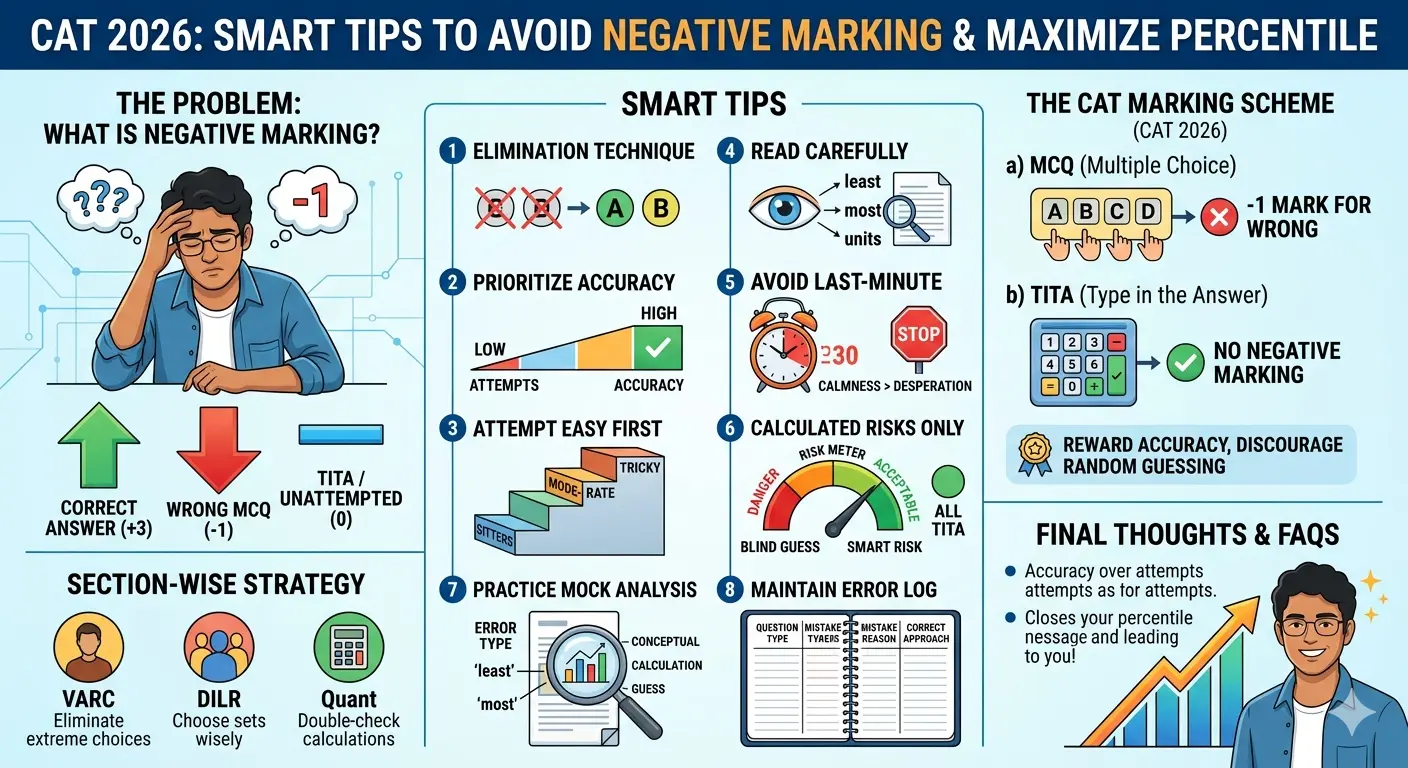
The rule: +3 for a correct answer, −1 for a wrong MCQ, 0 for TITA or skipped questions
Why it matters: 5 wrong MCQs wipe out the gain from 1.67 correct answers — percentile drops fast
Attempt TITA freely: No penalty means no reason to leave them blank
Only guess with logic: Attempt an MCQ only when you can eliminate at least 2 options
Accuracy beats attempts: 18 correct out of 20 beats 14 correct out of 26
Avoid the last-minute panic trap: Random guessing in the final 5 minutes statistically nets zero gain
Track your errors in mocks: Categorise every wrong answer — concept gap, calculation slip, or blind guess
Target 80%+ accuracy before exam day, not just a high attempt count
Negative marking in CAT means:
The exam is conducted by the Indian Institutes of Management and follows a standardized marking structure.
There are two types of questions in CAT:
Understanding this difference is crucial for your attempt strategy.
Many students feel negative marking makes CAT tougher. But the purpose is strategic.
Negative marking exists to:
Remember, CAT is not just testing math or English. It is testing managerial qualities.
A future manager must know:
Negative marking ensures that random attempts don’t outperform well-prepared students.
Since CAT is percentile-based, your score is relative to others.
Even 4–5 extra incorrect answers can:
Example:
If you attempt 20 MCQs:
That’s a 6-mark difference just because of inaccuracy.
In a competitive exam like CAT, 6 marks can mean the difference between 97 percentile and 99 percentile.
Most negative marking happens because of:
Many aspirants shift focus from accuracy to attempt count.
This is a dangerous mistake.
CAT rewards smart selection, not high attempts.

Now let’s discuss practical strategies you must apply.
Instead of directly looking for the correct answer:
If you can eliminate 2 options confidently, your probability improves from 25% to 50%.
But if still unsure, skip it.
Remember:
Skipping is better than guessing blindly.
Your focus should be:
✔ High accuracy
✔ Smart question selection
✔ Controlled risk-taking
Instead of targeting 100% attempts, aim for:
A student attempting 18 questions with 90% accuracy often scores better than someone attempting 24 with 60% accuracy.
First 20–25 minutes strategy:
Then move to moderate ones.
Leave tricky or time-consuming questions for later.
This ensures:
Many negative marks come from:
Before marking the answer:
30 extra seconds can save 1 mark.

Discover the most complete list of free resources for CAT 2026 — from free CAT mock tests and CAT previous year questions to DILR sets, VARC practice, quant formula book, and GDPI handbooks. All curated by Quantifiers. All free. All updated.
Last 5–7 minutes are dangerous.
Many aspirants think:
“Let me attempt 3–4 more. Maybe one will be correct.”
But statistically:
Random guessing in 4 questions can result in:
Or worse.
Instead:
Calmness > desperation.
Since TITA has no negative marking:
For MCQs:
Smart risk = acceptable
Blind risk = dangerous
Mocks are where you learn to control negative marking.
After every mock:
Track your accuracy percentage.
Your goal before CAT 2026:

Consistency plays a crucial role in CAT 2026 preparation. To help aspirants stay disciplined and exam-ready, we post daily study targets covering Quant, DILR, and VARC practice.
Keep a notebook or digital sheet:
Revisit weekly.
Patterns of mistakes become visible.
Once pattern is identified → error reduces.

Many high scorers fail because they:
Your preparation should include:
Remember:
Negative marking is not your enemy.
Lack of discipline is.
Realistically, no.
But can you minimize it strategically?
Absolutely.
Your aim in CAT 2026 should be:
✔ Maximum accuracy
✔ Intelligent risk
✔ Zero random guessing
✔ Strong mock analysis
✔ Emotional stability
If you master these, negative marking will stop being a threat — and start becoming your advantage.
Because while others lose marks due to panic,
you will gain percentile due to discipline.
Yes. –1 mark for every incorrect MCQ answer.
No. TITA questions have no negative marking.
No, unattempted questions carry no penalty.
One mark is deducted for each incorrect MCQ.
Only if you can eliminate options logically. Avoid blind guessing.
Yes. Accuracy plays a bigger role in percentile.
Analyze every wrong attempt and track error patterns.

Your MBA journey doesn’t have to be confusing. At Quantifiers CAT Academy, we mentor students from the ground up—whether you’re preparing for CAT or exploring exams like SNAP, NMAT, CMAT, IIFT and MICAT. With personalised attention, proven strategies and performance-focused guidance, we help you build strong fundamentals, boost accuracy, and stay consistent throughout your preparation journey.
To connect with us, for mentorship and daily test practice
DM us on Instagram or WhatsApp. We reply back 24/7. Get your CAT prep started




























We at Quantifiers understand and deliver on the personal attention each of our students requires. Whether it is through our pedagogy that enables non-engineers or non-math background students, our constant effort to proactively provide solutions, or our focus on our student’s goals.