


📋 Table of Contents
Here is something your school education has been conditioning you to believe your whole life: attempt more, score more. But the right CAT question selection strategy turns that logic on its head.
CAT 2025 data makes this uncomfortably clear. 99.91 percentile came at 132 marks. 99.95 percentile came at just 118 marks. And 99 percentile came at approximately 84 marks — out of a possible 204. That is barely 41% of the total marks. The students who got there did not attempt 68 questions. Many of them attempted around 28.
This blog is about what we at Quantifiers consider the most underutilised insight in CAT preparation: you can score 99 percentile by leaving questions — and not just a few. Here is exactly how it works, section-wise, and what to do about it.
ℹ️ Related Reading
Not sure which section to prioritise first? Understanding where you stand section-wise is the foundation of any good selection strategy.
Which is the Toughest Section in CAT? Complete Section-Wise Analysis →
1. The Mindset Shift That Changes Everything
Every student who grew up scoring 90%+ in school boards carries a deeply wired assumption: high attempt rate = high score. In a school exam, leaving 30% of the paper unattempted is a problem. In CAT, leaving 50% of the paper unattempted is a perfectly valid strategy — and often the winning one.
CAT is a percentile-based exam. Your score is not judged against the maximum possible marks — it is judged against every other student who sat in that slot. When the paper is hard for you, it is hard for everyone. The student who panics and over-attempts collects negative marks. The student who is calm, selective, and accurate pulls ahead.
✅ Our Framing at Quantifiers
In school, 70% is average. In CAT, 41% marks is 99 percentile. Your entire mental framework about what “enough” means needs to be rebuilt for this exam. Once you internalise this, the anxiety of leaving questions disappears — and your accuracy goes up.
2. The Maths: What 99 Percentile Actually Requires
CAT has 68 questions worth 3 marks each = 204 total marks. Here is what recent exam data shows about how little you actually need to score:
| Target Percentile | Approx. Marks Needed | % of Total Paper | Questions to Attempt (at 95% accuracy) |
|---|---|---|---|
| 99.91 percentile | ~132 | ~65% | ~46 |
| 99.95 percentile | ~118 | ~58% | ~41 |
| 99 percentile | ~84 | ~41% | ~28 |
| 95 percentile | ~60 | ~29% | ~21 |
Based on CAT 2025 score vs percentile data. Actual figures vary by slot difficulty and normalisation.
The conclusion is stark: to score 99 percentile in CAT, you need to correctly answer approximately 28 out of 68 questions. You are leaving 40 questions on the table. Even accounting for some wrong answers, you are attempting roughly 50% of the paper. This is not a loophole — it is how the exam is designed to work.
3. CAT Is Not a Completion Test — It’s a Selection Test
The most important frame shift in CAT preparation is this: the exam does not reward you for solving all 68 questions. It rewards you for knowing which questions to solve. This is fundamentally different from every other exam most students have taken.
| Questions Attempted | Accuracy | Net Score | Approx. Percentile |
|---|---|---|---|
| 68 (all) | 50% | ~51 marks | 85–88 percentile |
| 45 | 70% | ~67 marks | 92–95 percentile |
| 35 | 85% | ~72 marks | 96–98 percentile |
| 28 | 95%+ | ~84 marks | 99 percentile |
The student who attempts every question at 50% accuracy scores 51 marks and lands around 85 percentile. The student who attempts only 28 questions at 95% accuracy scores 84 marks and reaches 99 percentile. Same paper. Opposite strategies. Completely different outcomes. The difference is not intelligence — it is discipline over the urge to attempt.

4. The 3 Traps That Kill Your Score
Most students who underperform in CAT fall into one of three identifiable patterns. Recognising yours is the first step to fixing it.
| Trap | What Happens | The Real Cost |
|---|---|---|
| 🏃 The Over-Attempter | Tries to solve every question, rushes through sets, makes silly errors, ends up with a low score despite high attempts | Negative marks from rushed MCQs wipe out the gains from correctly solved questions |
| 🎯 The Accuracy Ignorer | Focuses on speed over accuracy, doesn’t account for negative marking, bleeds marks on questions they “almost” got right | Each wrong MCQ costs 4 marks net (lost 3 + deducted 1). Three wrong answers cancel one correct one. |
| 😰 The Panic Solver | In the last 10–15 minutes, freezes on hard questions, wastes time on one question that could have fetched 3 correct answers elsewhere | Time mismanagement in the final minutes can drop your score by 15–20 marks |
⚠️ The Maths of Negative Marking Nobody Talks About
Every wrong MCQ answer costs you 4 marks in net terms — you lose the 3 marks you would have earned, plus you get -1 deducted. Three wrong answers completely cancel out one correct answer. This is why accuracy is not just about confidence — it is pure arithmetic. A student who attempts 68 questions with 50% accuracy scores less than one who attempts 28 with 95%.
5. Section-Wise Attempt Targets for 99 Percentile
The attempt target is not the same across all three sections. VARC requires slightly more attempts because the scoring curve is steeper there. DILR is set-based, so accuracy within a set matters more than number of sets attempted. Here are the targets we recommend at Quantifiers:
| Section | Total Questions | Recommended Attempts | Target Accuracy |
|---|---|---|---|
| VARC | 24 | 16–18 | 85%+ |
| DILR | 20 | 8–10 (2–3 sets) | 90%+ |
| QA | 24 | 14–16 | 85%+ |
| Total | 68 | ~28 | 90%+ |
✅ The Section-Scanning Protocol
Before attempting: Spend the first 2–3 minutes scanning the entire section. Tag every question as Easy / Maybe / Skip.
During the section: Solve all Easy questions first. Return to Maybe questions if time permits. Never touch a question you tagged Skip — not even to ‘have a look.’ The cognitive cost of re-engaging with a hard question is not worth it.
📚 Section-Wise Practice Resources
📚 Practice Section Selection on Quantifiers Free Mocks
The only way to develop question selection instinct is to practise under exam conditions repeatedly. Start with Quantifiers’ free mocks and consciously apply the Easy/Maybe/Skip tagging in every attempt.
Take Free CAT Mocks →6. How to Decide Which Questions Are “Yours to Attempt”
Question selection is a skill — one that needs to be trained deliberately across dozens of mocks, not figured out on exam day. Here are the four filters we use at Quantifiers to train students on which questions to attempt:
| Filter | The Question You Ask Yourself | If Yes → Attempt |
|---|---|---|
| Familiarity | Have I seen this question type before in practice? | ✅ Yes → high likelihood of solving correctly |
| Time Feasibility | Can I estimate the solving time under 2.5 minutes? | ✅ Yes → worth attempting now |
| Confidence Check | Do I feel confident within the first 30 seconds of reading? | ✅ Yes → proceed. If doubtful → Skip |
| Difficulty Filter | Is this not in the hardest 20% of this section? | ✅ Yes → safe to attempt |
⚠️ The 5-Minute Scanning Rule
Many students feel that spending the first 5–7 minutes just reading and tagging questions is “wasting time.” It is the opposite. If you are scoring very low in mocks (under 15 marks), it is almost certainly because you are spending too long per question without selection. Spend the first 5 minutes identifying your 14–16 solvable questions, then solve only those. You will finish faster and score higher.

7. After Every Mock: The Learning Analysis Framework
Taking mocks without analysing them is the single most common preparation mistake. A mock you don’t analyse teaches you nothing — it just reinforces whatever you were already doing, wrong or right. Spend at least as much time analysing each mock as you spent taking it.
| Analysis Focus Area | The Key Question to Ask |
|---|---|
| Attempt Quality | Which questions did you attempt that you shouldn’t have? Where did you waste time? |
| Accuracy Analysis | Where did accuracy drop — conceptual gap or careless error? These need different fixes. |
| Skip Evaluation | How many “Skip” questions were actually solvable in hindsight? What stopped you from attempting them? |
| Personal Optimisation | Track your “sweet spot” — the attempt count where your accuracy peaks. This is your exam-day target, not someone else’s. |
✅ Find Your Sweet Spot — It’s Different for Everyone
One of the most important outputs of mock analysis is identifying the attempt count where your accuracy is highest. For some students, that is 24 questions. For others, it is 32. Do not copy a 99 percentiler’s attempt strategy blindly. Their sweet spot is calibrated to their speed and accuracy — yours will be different. Track your own data across 10+ mocks and let the numbers tell you your optimal attempt count.
🎯 Stay Consistent with Daily Targets
Mock analysis is only useful if you are practising consistently in between. We post daily Quant, DILR, and VARC targets to keep your preparation structured and exam-ready every single day.
Check Today’s Daily Targets →🎁 Free Resources for CAT 2026 — All in One Place
Free mocks, DILR books, Quant formula sheets, VARC practice, GDPI handbooks — everything you need for CAT 2026 prep, curated by Quantifiers.
Access All Free Resources →📚 Free CAT PYQs with Video Solutions — Quantifiers
Solve CAT previous year questions with full video explanations. Understanding how to solve them is step one — understanding when NOT to attempt them is step two.
8. Why Most Students Practise Wrong
Even students who understand the “attempt fewer, score more” principle in theory struggle to execute it in practice. The reason is usually one of two preparation problems:
| Problem | What It Looks Like | What It Causes on Exam Day |
|---|---|---|
| Isolated Practice | Solving questions topic by topic, without time pressure or full-section scanning | No instinct for question selection developed — every question looks “worth trying” |
| Lack of Simulation | No timer usage, no full-section mocks, no exam-pressure practice | Panic in real exam because the brain has never trained under 40-minute sectional pressure |
The solution to both is structured mock practice — not more topic-wise questions. Mocks are where selection instinct is built. Analysis after mocks is where it is sharpened. Students who take 30+ mocks with deep analysis consistently outperform students who have studied more theory but taken fewer mocks.

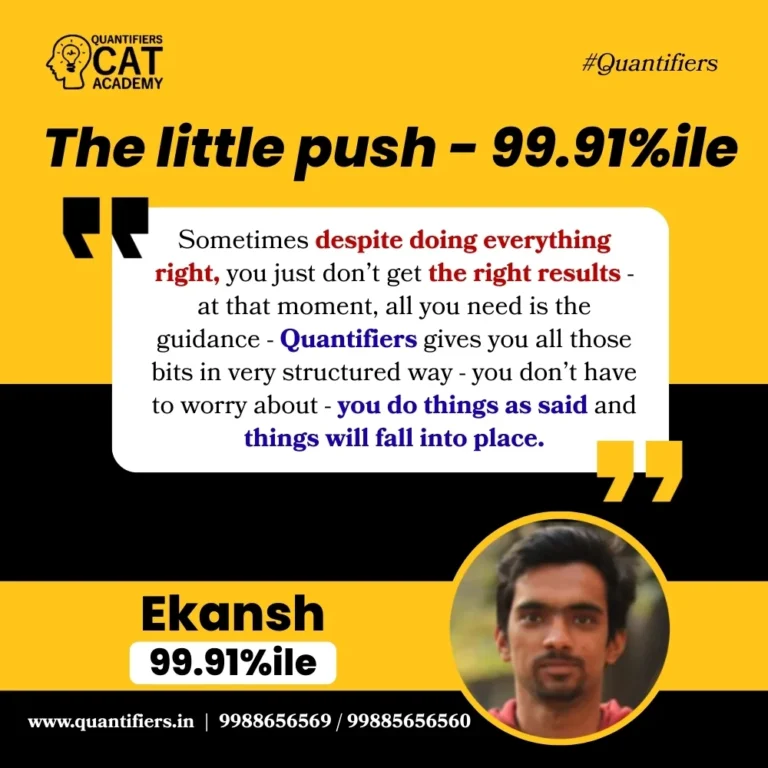
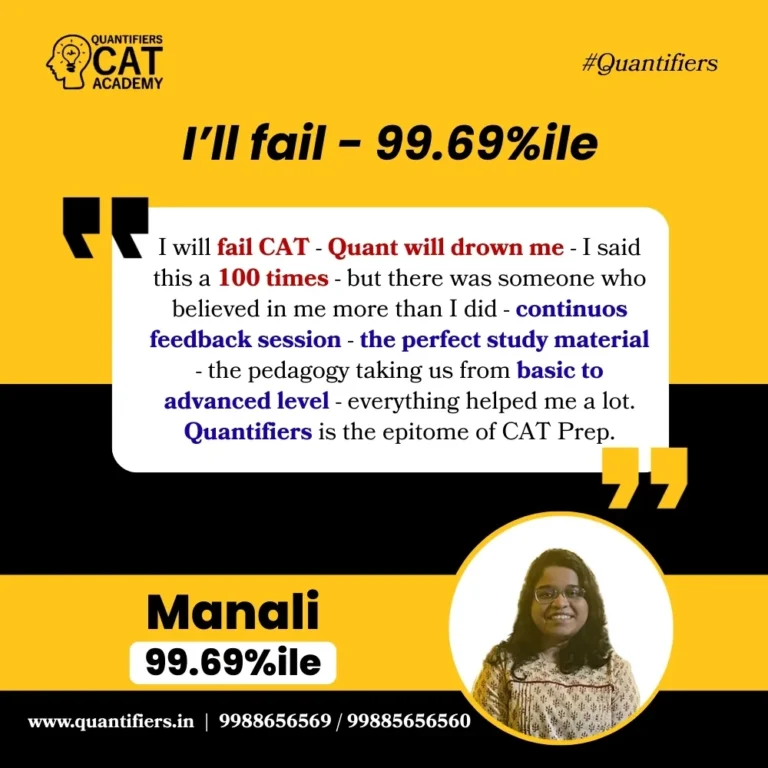
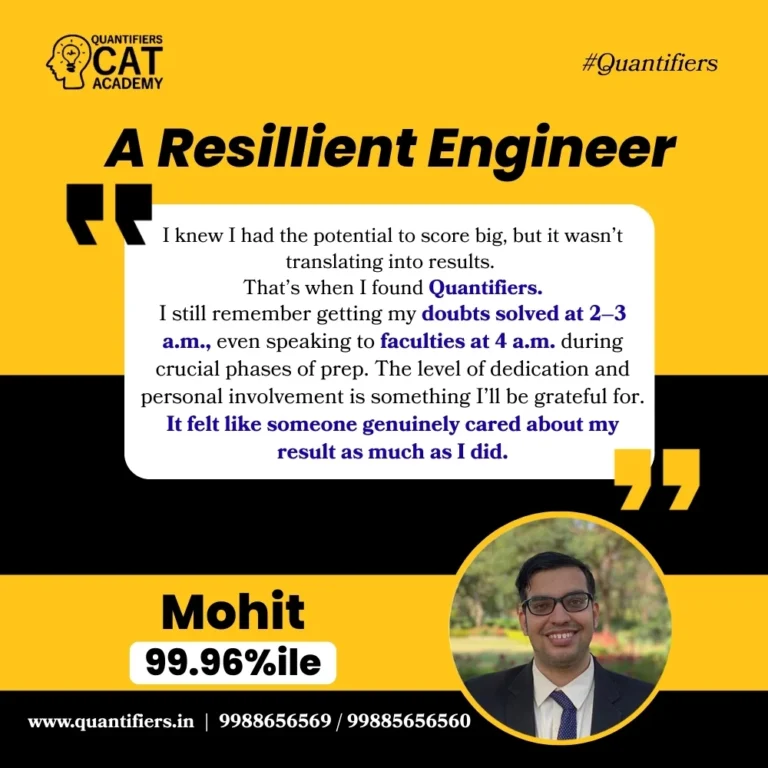
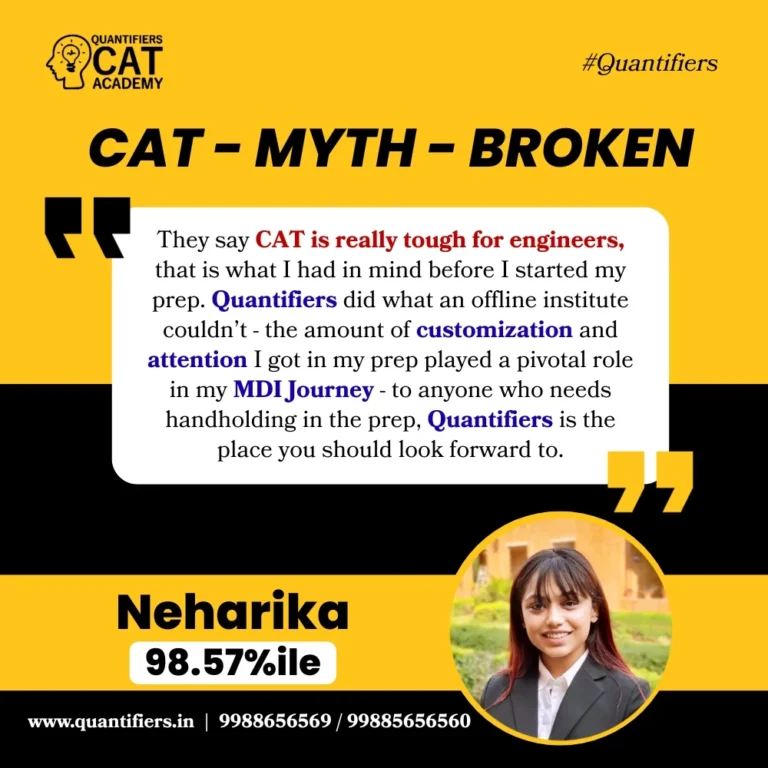
9. Students Who Cracked It by Attempting Less
The selection strategy is not theory — it is what Quantifiers students practise in every mock, every week, until it becomes instinct.
Want to Build Your Personal Question Selection Strategy?
At Quantifiers, every student gets personalised attempt-accuracy mapping through live mock analysis, confidence tracking, and 1-on-1 strategy sessions. Small batches of 25. 99.98%ile track record. Free demo available.
Join Quantifiers — quantifiers.in →📞 9988656569 / 9988656560
10. FAQs
Q1. How many questions should I attempt in CAT for 99 percentile?
Based on recent CAT data, approximately 28 questions attempted with 95%+ accuracy is enough for 99 percentile — around 84 marks out of 204. The exact number varies by paper difficulty, but the principle holds: fewer attempts with very high accuracy consistently outperforms high attempts with average accuracy.
Q2. Is it really possible to score 99 percentile by leaving 40 questions?
Yes — and the data confirms it. CAT 2025 showed 99 percentile at approximately 84 marks, which corresponds to correctly answering around 28 questions. This is not a strategy for average performers — it requires high accuracy and strong question selection instinct. But both of those are trainable skills.
Q3. Which section needs the most attempts for 99 percentile?
VARC requires the highest attempts — approximately 16–18 out of 24 questions — because the scoring curve is steeper in that section. DILR is set-based, so 2–3 complete sets (8–10 questions) attempted with 90%+ accuracy is the target. QA needs around 14–16 correct answers out of 24.
Q4. How do I know how many questions to attempt in a specific mock?
Track your “sweet spot” across multiple mocks — the attempt count at which your accuracy is highest. For some students it is 24 questions total, for others 32. This number is personal and can only be found through data from your own mock attempts and careful analysis after each test. Do not copy another student’s attempt target.
Q5. Should I guess on questions I’m unsure about?
For MCQs — no. Each wrong MCQ costs you 4 marks net (you lose 3 + get -1 deducted), which means three wrong guesses cancel out one correct answer. For TITA (Type In The Answer) questions, there is no negative marking — so calculated guesses are acceptable if you have done partial working. Never randomly guess MCQs.
Q6. How do I train question selection before the exam?
Practise the Easy/Maybe/Skip tagging system in every full-length mock. In the first 2–3 minutes of each section, scan all questions and tag them before attempting any. Solve only Easy questions first. Return to Maybe if time permits. This trains the brain to make fast selection decisions under pressure — a skill that only develops through repeated simulation.
Q7. How many mocks should I take before CAT to develop selection instinct?
A minimum of 25–30 full-length mocks, each followed by thorough analysis, is what serious aspirants target. The first 10 mocks are mostly diagnostic. The next 10 are where patterns emerge. The final 10 are where strategy locks in. Taking fewer than 20 mocks and expecting good question selection instinct on exam day is unrealistic — this skill requires volume and reflection, not just intention.