Arithmetic Alligation and Mixture is one of the most important topics in CAT Quant for CAT 2026, known for its application across pricing, concentration, and ratio-based problems. Practice curated CAT arithmetic questions built around the alligation rule, mixture replacement, and multi-component blending problems aligned with recent CAT exam patterns. These Arithmetic Alligation and Mixture questions improve both speed and accuracy in solving non-trivial problems.
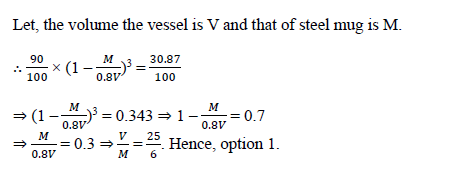
51. There is a vessel whose 80% volume is filled with milk and water solution. The concentration of milk in the solution is 90%. Using a steel mug, one mug-full of solution is withdrawn and replaced by an equal quantity of water. After 3 such replacements, the concentration of milk in the solution becomes 30.87%. What is the ratio of volumes of the vessel and the steel mug?
25: 6
24: 5
27: 7
20: 6
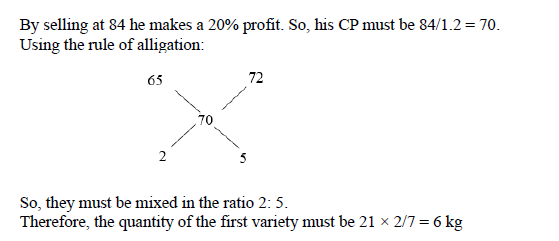
52. A man buys 2 varieties of rice, the first at Rs. 65 per kilo and the second at Rs. 72 per kilo. After thoroughly mixing them, he sells the mixture for Rs. 84 per kilo making a 20% profit. If he sold 21 kilos of this mixture, how many kilos of the first variety of rice must he have bought?
53. A drum contains 100 litres of pure acid. 10 litres of acid is taken out and is replaced with water. This operation is conducted total ‘n’ times. What is the minimum value of ‘n’ if the concentration of the acid-water mixture drops to less than 60%?
3
4
5
6
54. A vessel contains one litre of Alcohol. Ramesh took out 100 ml of the content of the vessel and poured 100 ml of water in the vessel. He repeated this process two more times (i.e. he did this operation total three times). What is the volume of the Alcohol present in the mixture in the vessel now (in ml)?
729
512
888
750
55. A vessel contains 100 litres of pure milk. Ten litres of the milk is replaced with water. Then another 10 litres is replaced with water. The process is carried out two more times. Calculate the difference in the volumes of the milk and water at the end of the process.
67.42 litres
65.61 litres
45.8 litres
31.22 litres
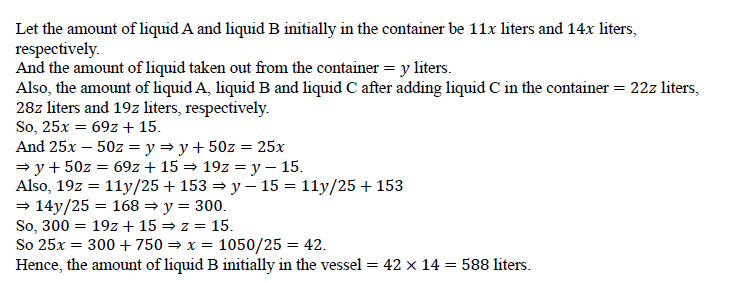
56. A vessel contains a mixture of liquid A and liquid B in the ratio 11: 14 respectively. Some of the mixture is withdrawn and some amount of liquid C is added and then the ratio of liquids A, B and C becomes 22: 28: 19 respectively. After adding liquid C, the total amount of mixture in the vessel is 15 liters less than the initial amount of mixture. If the amount of liquid A taken out from vessel is 153 liters less than the amount of liquid C added to the vessel, then find the amount of liquid B (in liters) initially in the vessel.
420
528
680
588
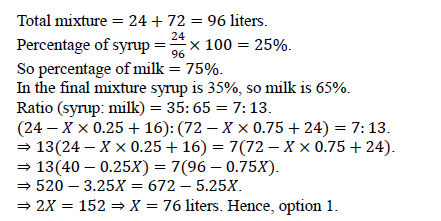
57. At a school picnic, Rose milk is prepared by mixing 24 liters of rose syrup with 72 liters of milk. X liters of the mixture is taken out and 16 liters of rose syrup and 24 liters of milk are added to the remaining mixture. The final mixture contains 35% rose syrup, find the quantity of the mixture (in litre) that was taken out.
76
82
60
65
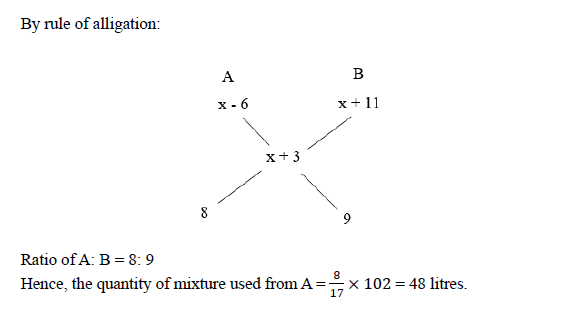
58. There are two containers A and B containing a mixture of milk and water. The concentration of milk in container A and B is (x – 6)% and (x + 11)% respectively. If both mixtures are mixed together in a certain ratio to get 102 liters of mixture in which the concentration of milk is (x + 3)%, find the amount (in liters) of mixture used from container A.
59. A scientist knows that the maximum amount of a solute that can be dissolved in 100 g of water is 20 g. If more solute is added it remains undissolved and settles down. It is known that water evaporates at the rate of 280 g/hour from 1 kg of the mixture which contains 5% solute. If the scientist starts boiling the mixture, after how much time (in hours) will the solute start depositing at the base?
60. In 8 liters of milk and water mixture, the concentration of milk is 75%. A woman takes out 25% of the total mixture and adds the equal quantity of water in a new beaker to form a new mixture. With the total quantity of the new mixture, she wants to prepare tea where the concentration of milk should be 25%. How much more (in liters) water will she require to add to the mixture to prepare tea?
2.5
1
1.5
2
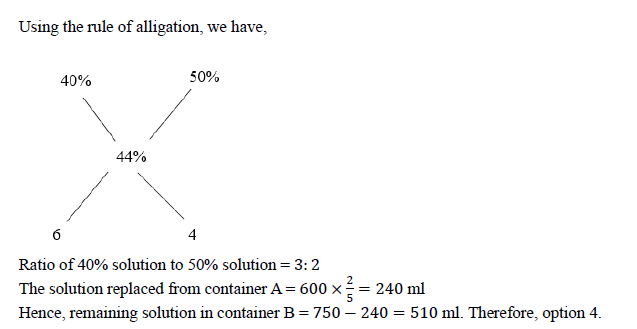
61. Two containers – A and B – are filled with the milk solution of strengths 40% and 50% respectively. The volumes of the containers A and B are 600 ml and 750 ml respectively. A part of the solution from the container A is thrown away and replaced by equal volume of the solution from container B. If the concentration of the milk solution in container A is 44%, then the solution left in the container B is:
240 ml
360 ml
490 ml
510 ml
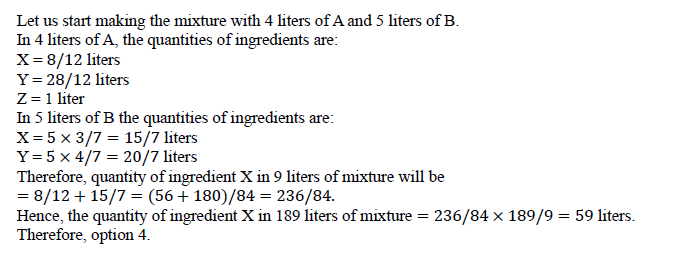
62. Two vessels contain two mixtures A and B. Mixture A contains ingredients X, Y and Z in the ratio of 2: 7: 3 respectively and mixture B contains ingredients X and Y in the ratio of 3: 4 respectively. We have to make 189 liters of a new mixture by adding the mixtures A and B in the ratio of 4: 5. What will be the quantity (in liters) of ingredient X in the final mixture?
61
93
77
59
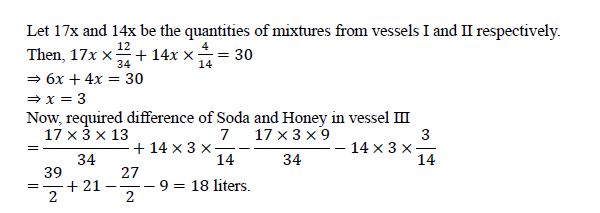
63. Two vessels I and II contain mixture of Soda, Mango juice and Honey in the ratio of 13: 12: 9 and 7: 4: 3 respectively. If mixtures from both vessels are mixed respectively in the ratio of 17: 14 into another vessel III, then the total quantity of mango juice in vessel III will be 30 litres. Find the difference between the quantity (in litres) of Soda and Honey in vessel III.
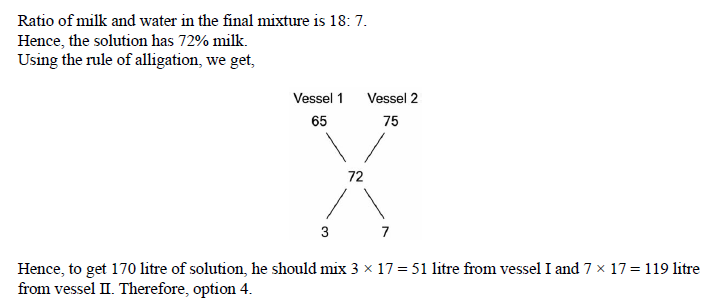
64. A milk vendor has 2 vessels each having a capacity of 120 liters. The first vessel contains 35% water and the rest is pure milk. The second vessel contains 75% pure milk and the rest is water. How much quantity of milk solution should the milk vendor mix from the first and the second vessels respectively such that he gets 170 liters of milk solution having the ratio of water to milk as 7: 18?
80 liters, 90 liters
72 liters, 98 liters
55 liters, 115 liters
51 liters, 119 liters
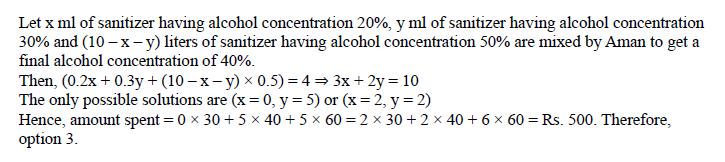
65. In a shop sanitizer is available only in sealed bottles of volume 1 litre. The alcohol concentration in the mentioned sanitizer is one or the other of three concentrations 20%, 30% and 50%. The cost per 1 litre of the sanitizer having alcohol concentration 20%, 30% and 50% is Rs.30, Rs.40 and Rs.60 respectively. Aman wants to prepare a solution of 10 liters of sanitizer having alcohol concentration 40% using the bottles of sanitizer available in the shop. What is amount (in Rs.) Aman must spend in buying the bottles of sanitizer?
360
400
500
420
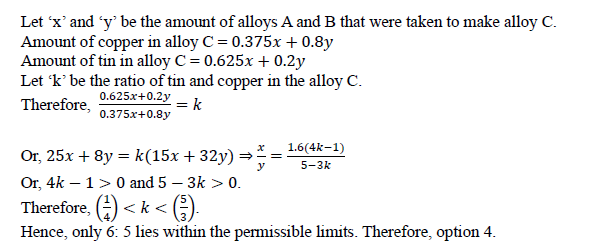
66. Copper and Tin are the only elements in the alloys A and B. The ratio of copper and tin in the alloys A and B is 3: 5 and 4: 1 respectively. An alloy C is made by mixing alloys A and B. Which of the following can be a possible ratio of tin and copper in the alloy C?
7: 35
11: 5
12: 7
6: 5
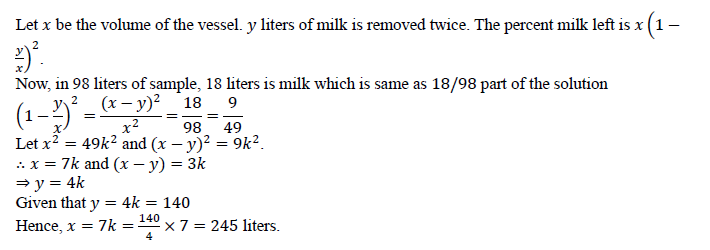
67. From a vessel completely filled up with pure milk, 140 liters is removed and replaced with equal quantity of water. The process is repeated one more time. In a 98 liters sample of the resulting solution 80 liters is water. Find the capacity of the vessel (in liters).
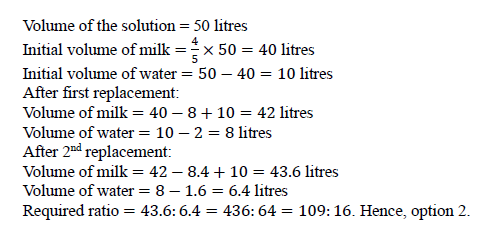
68. A milk-water solution contains milk and water in the ratio 4: 1. 10 litres of solution is replaced with 10 litres of milk. From the resulting solution 10 litres of solution is again replaced with 10 litres of milk. If the final volume of the solution is 50 litres, what is the ratio of milk and water in the final solution?
7: 1
109: 16
103: 13
21: 4
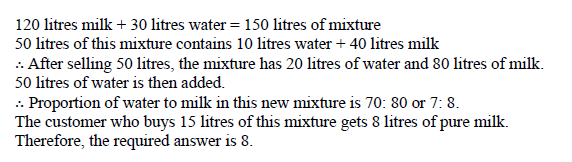
69. Shyam buys 120 litres of milk and mixes it with 30 litres of water. He then sells 50 litres of this mixture and leaves his shop. His son then adds water to the remaining mixture to make 150 litres. If a customer buys 15 litres of this mixture, find the amount of pure milk (in litres) that he gets.
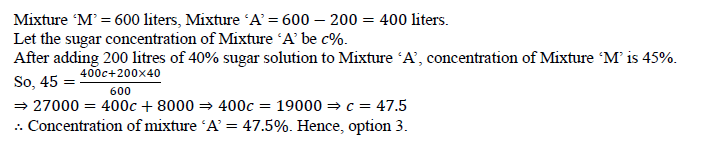
70. A 75% sugar solution is mixed with 40% sugar solution in some proportion to form mixture ‘A’. Mixture ‘A’ is then mixed with 200 litres of 40% sugar solution to form mixture ‘M’. If the concentration of mixture ‘M’ is 45% and the volume is 600 litres, what was the concentration of the mixture ‘A’ before adding 200 litres of 40% sugar solution?
57.5%
52%
47.5%
42.5%
71. Sample 1 contains a mixture of two liquids X and Y in the ratio 7: 11. Sample 2 contains a mixture of the same two liquids X and Y in the ratio 5: 3. What should be the ratio of sample 1 and 2 so that when they are mixed the ratio of X and Y becomes 1: 1 in the final mixture?
9: 16
9: 8
18: 8
8: 9
We at Quantifiers understand and deliver on the personal attention each of our students requires. Whether it is through our pedagogy that enables non-engineers or non-math background students, our constant effort to proactively provide solutions, or our focus on our student’s goals.