Alligation & Mixture is a uniquely strategic topic in Arithmetic for CAT 2026, known for its application across pricing, concentration, and ratio-based problems in CAT Quant. Practice curated CAT arithmetic important questions built around the alligation rule, mixture replacement, and multi-component blending problems aligned with recent CAT exam patterns. These questions improve both speed and accuracy in solving non-trivial Quant problems.
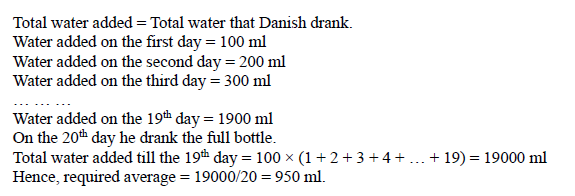
1. Danish bought a 2000 ml bottle of Pepsi and drank 5% of it on the first day and replaced it with water. On the second day he drank 10% of the contents and replaced it with water. On the third day he drank 15% and replaced it with water. He continued in this way and drank the whole bottle on the 20th day. Find the average quantity of water (in ml) that Danish drank in these 20 days from the bottle.
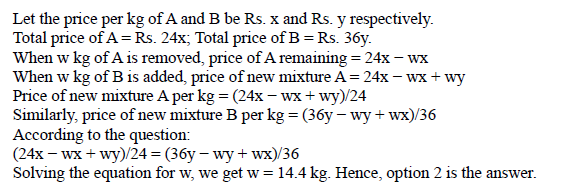
2. A trader has two coffee-chicory mixtures – A and B – with weights 24 kg and 36 kg, respectively, and they have different prices per kg. Equal quantities of mixtures from A and B are removed. The portion taken from A is mixed with the remaining portion of B, and the portion taken from B is mixed with the remaining portion of A. If both resulting mixtures have the same price per kg, then find the initial quantity (in kg) of mixture removed from each.
16.2
14.4
13.8
15.6
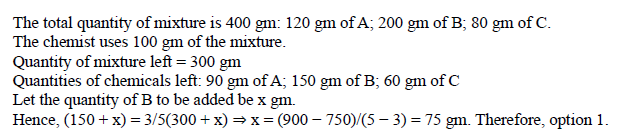
3. A chemical is prepared by mixing 120 gm of A, 200 gm of B, and 80 gm of C. The chemist uses 100 gm of this mixture for a lab process and realises that to improve the reactivity, the proportion of chemical B needs to be increased. What quantity (in gm) of chemical B should be added to the remaining mixture in order to make the concentration of chemical B in it as 60%?
75
60
50
80
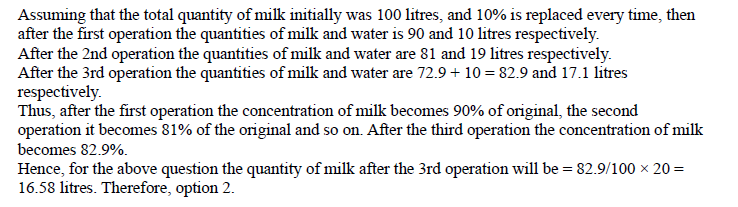
4. A vessel contains 20 litres of pure milk. A person takes out 2 litres of milk from the vessel and replaces it with 2 litres of water. Again, 2 litres of the mixture is taken out and replaced with 2 litres of water. If this process is repeated one more time but the mixture taken out is replaced with 2 litres of milk, then what is the quantity (in litres) of milk left in the mixture?
14.68
16.58
15.48
17.28
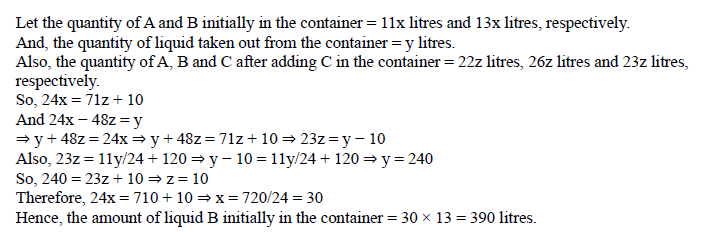
5. Liquids A and B are combined in a container in the ratio 11:13. After removing some of the mixture and adding some liquid C, the ratio of the liquids A, B, and C changed to 22: 26: 23. The amount of mixture in the container was 10 litres less overall after adding liquid C than it was before. Find the original volume (in litres) of liquid B in the container if the volume of liquid A removed from the container is 120 litres less than the volume of liquid C added to the container.
360
350
390
330
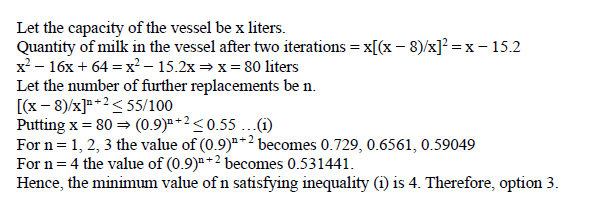
6. A vessel is filled to its capacity with pure milk. Eight liters are withdrawn from the vessel and replaced with an equal amount of water. Eight liters of the mixture is again withdrawn and then replaced with an equal amount of water. After these changes, the vessel contains 15.2 liters of milk less than it did initially. What is the minimum number of such additional replacements required, so that the vessel contains less than 55% milk?
2
5
4
3
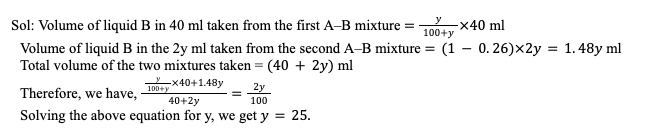
7. 100 ml of liquid A is mixed with ‘y’ ml of liquid B. Then, 40 ml of this A-B mixture is added to 2y ml of another A-B mixture with liquid A concentration of 26%. If the resultant mixture has a liquid B concentration of 2y%, what is the value of ‘y’ in milliliters?
8. A tetra pack contains 1 litre of milk and a vessel contains 2 litres of water. Initially, 0.5 litres of milk is transferred from the tetra pack to the vessel. After stirring this mixture, 0.5 litres of this mixture is transferred from the vessel to the tetra pack. At this point, the quantity of water in the tetra pack is x while that of the milk in the vessel is y, then the ratio x: y must be:
1: 2
2: 1
3: 2
1: 1
9. Three solutions have acid content 30%, 40% and 80% respectively. A mixture has been made with these three solutions where the volume of these solutions used are x ml, y ml, and z ml respectively. Which of the following will be true about the maximum value of the resulting concentration if z = 2x < y?
less than 54
54 or more but less than 55
55 or more but less than 56
56 or more
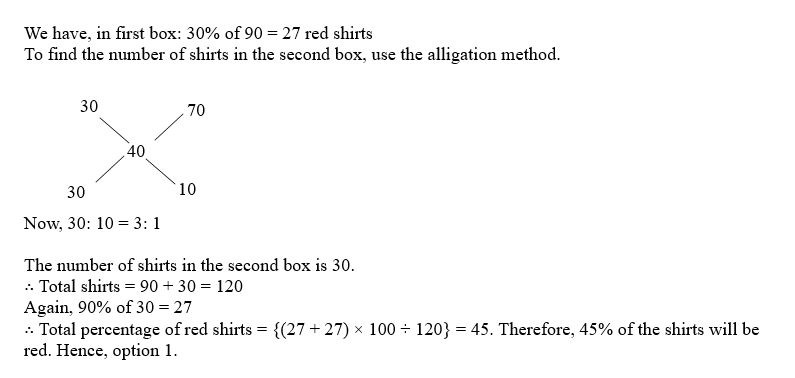
10. A new stock of shirts has arrived at Vinit’s shop. The shirts are packed in two boxes. In the first box, out of 90 shirts, 30% are red. If 70% of the shirts in the second box are red, the overall percentage of red shirts would be 40%. If the percentage of red shirts in the second box had been 90% (instead of 70%), the overall percentage of red shirts would have been:
45%
50%
60%
70%
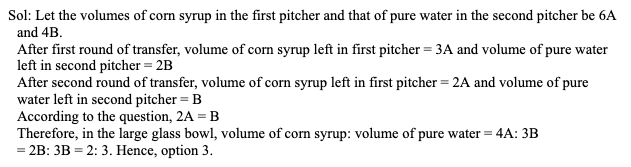
11. A pitcher is filled with corn syrup and a second pitcher is filled with pure water. Half of the corn syrup and half of the pure water is poured into a large glass bowl. Next, one-third of the remaining corn syrup from the first pitcher and half of the remaining pure water from the second pitcher is again poured into the glass bowl. Now, the volumes of corn syrup and pure water left in the two pitchers are the same. Then the ratio of corn syrup and pure water in the large glass bowl is:
1: 1
3: 2
2: 3
8: 3
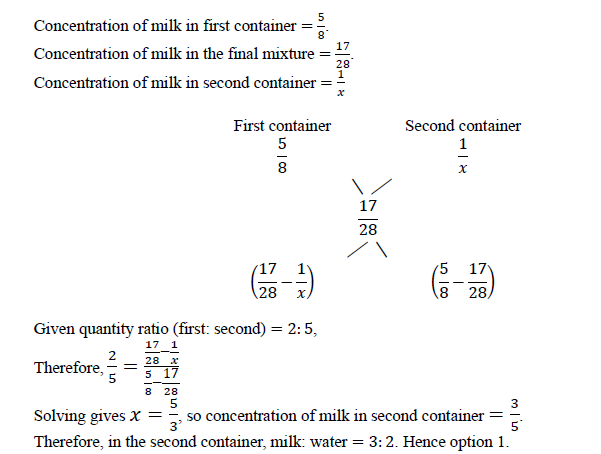
12. There are two milk containers, each containing a solution of milk and water. In the first container, milk and water are in the ratio 5: 3. Solutions from the first container and second container are mixed in the ratio 2: 5. Milk and Water are in the ratio 17: 11 in the resultant mixture. In the second container, the ratio of milk to water is:
3: 2
2: 3
3: 5
5: 3
13. Container-A is fully filled with one litre pure milk. Milkman Harman poured one-third of the content of container-A by volume to a large empty bowl. Then he refills container-A till its brim with pure water without any wastage and again empties half the mixture of container-A to that large bowl. At last, he fills container-A till its brim with pure water without any wastage and completely empties its content in the large bowl. What is the concentration (in %) of milk in the solution contained in the large bowl now?
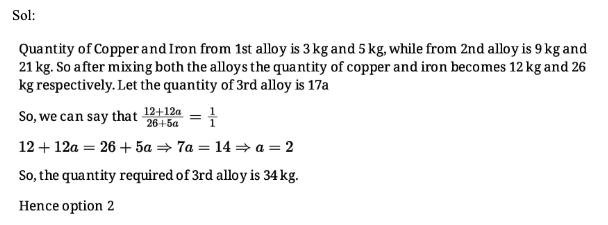
14. Three different alloys, of copper and iron, have the two elements in the ratio 3: 5, 3: 7 and 12: 5 respectively. If 8 kg of the first alloy and 30 kg of the second alloy are taken, then how much quantity (in kg) of the third alloy should be taken so that the ratio of copper and iron in the final mixture is 1: 1?
51
34
68
17
15. If a milkman mixes 30 litres of pure milk with 10 litres of milk-water solution, the concentration of water in the resulting solution becomes 12.5%. If the milkman had sold only the 10 litres milk-water solution at the cost price of pure milk without any wastage, his profit percentage would have been:
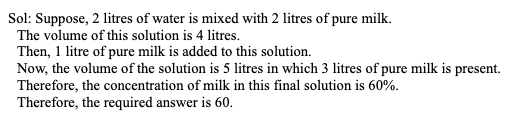
16. A milkman doubled the volume of pure milk by adding water. He further adds pure milk to the resultant solution to increase its volume by 25%. What is the concentration of milk (in percentage) in this final solution?
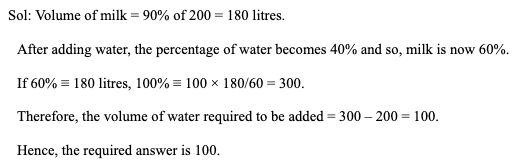
17. A milk-water mixture of volume 200 litres contains 10% water. How many litres of water must be added to the mixture so that the percentage of water increases to 40%?
18. How many kilograms of rice costing Rs.60 per kg must be mixed with 15 kg of rice costing Rs.80 per kg so that the resulting mixture costs Rs.72 per kg?
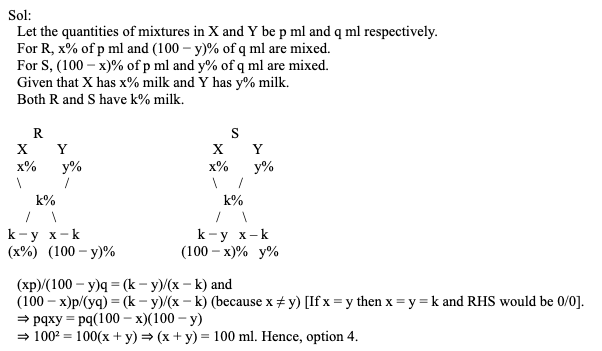
19. Vessels X and Y contain mixtures of milk and water. X has x% milk and Y has y% milk. Mixture R is formed by mixing x% of vessel X’s contents with (100 – y)% of vessel Y’s contents. Mixture S is formed by mixing (100 – x)% of vessel X’s contents with y% of vessel Y’s contents. Mixtures R and S have k% milk each. If x ≠ y and all measures are in ml, find x + y.
75 ml
80 ml
90 ml
100 ml
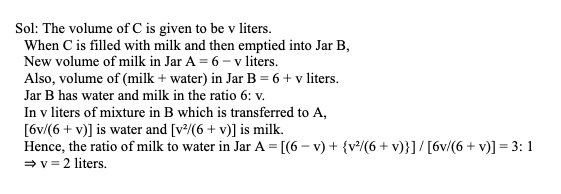
20. Jar A and Jar B have 6 litres of milk and 6 litres of water respectively. A jar C with volume of ‘v’ litres is filled with the milk from Jar A and then emptied into B. Jar C is then filled with the mixture so formed, and then emptied into Jar A. If the ratio of milk to water in Jar A at this stage is 3: 1, find the value of ‘v’.
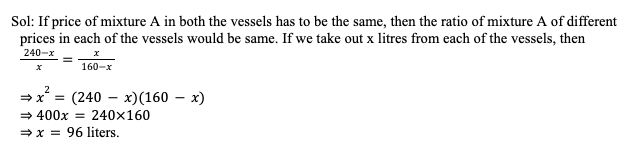
21. There are two vessels of mixture A of different prices with the volumes of 240 liters and 160 liters. Equal amounts of A were poured off simultaneously from the two vessels. Now, that mixture A poured off from the first vessel was poured into the second vessel, and similarly the mixture A poured off from the second vessel was poured into the first vessel. Then the price of mixture A in both vessels becomes the same. How much mixture A (in liters) was poured from one vessel into the other?
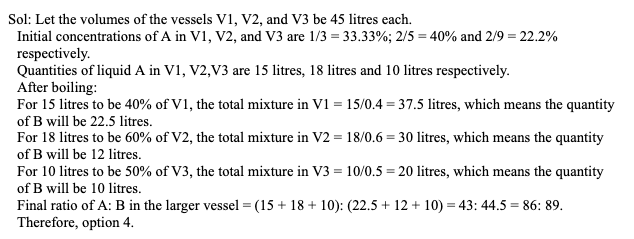
22. There are three vessels V1, V2, and V3 with equal volumes filled with mixtures of liquids A and B in the ratios 1: 2, 2: 3, and 2: 7, respectively. These mixtures are boiled (assume that only B evaporates) till the concentration of A in the three vessels becomes 40%, 60%, and 50% respectively. Then they are all poured into a big vessel. Find the ratio of liquids A: B in the big vessel.
43:44
47:53
86:87
86:89
23. There are three vessels (with equal volumes) filled with mixtures of water and milk in the ratios 1: 2, 4: 5, and 5: 4, respectively. These mixtures are then poured into a larger vessel. What proportion of the mixture in the larger vessel should be replaced with water to ensure that the resulting mixture contains 50% milk?
1/10th
1/5th
1/8th
1/12th
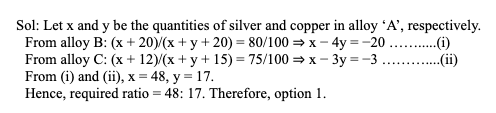
24. There is an alloy ‘A’ of silver and copper. A certain weight of this alloy is mixed with 20 kg of pure silver and melted; the new alloy ‘B’ is found to contain 80% of silver. If the alloy ‘A’ is mixed with 15 kg of 80% silver alloy, the new alloy ‘C’ is found to contain 75% silver. What is the ratio of the weights of silver and copper in alloy ‘A’?
48:17
3:1
11:4
49:18
25. From a 4: 5, solution of milk and water, a volume equal to 25% is taken out and replaced by milk. How many times should this process be done to make the ratio of milk to water equal to 11: 5?
1
2
3
4
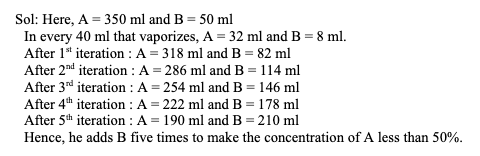
26. A scientist has a conical flask that has 400 ml of a mixture of liquids A and B in the ratio 7: 1 respectively. Each time the flask is heated A and B evaporate in the ratio 4: 1. As soon as the volume dips to 90% of the original volume the scientist adds more of B to make it 400 ml again. How many times does he add liquid B in this way to make the concentration of A in the mixture less than 50%?
3
4
5
6
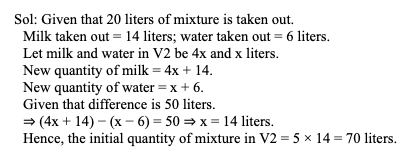
27. A vessel V1 contains a mixture of milk and water in a ratio of 7: 3. If 20 liters of this mixture is taken out and poured into vessel V2 that already contains milk and water in the ratio 4: 1, then the difference between total quantity of milk and water in V2 becomes 50 liters. Find the total quantity (in liters) of initial mixture in vessel V2.
28. A jar contains 2 liquids A and B. A is a volatile liquid and evaporates at the rate of 4 liters per minute. Liquid B is stable. At the end of the 8th minute if the ratio of volumes of A and B is 4: 9, then what is the original volume (in liters) of this mixture given that the original ratio of the volumes is 4: 5?
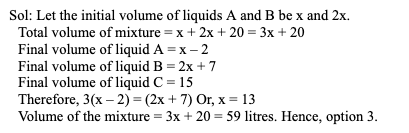
29. An immiscible mixture contains three different types of liquids A, B and C. The ratio of liquids A and B is 1: 2 and the volume of liquid C is 20 litres. 5 litres of C and 2 litres of A are replaced by equal volumes of liquid B. The ratio of liquids A and B becomes 1: 3. Find the volume of the mixture (in litres).
63
61
59
65
30. A mixture of liquids A and B contains 70% of B by volume. Liquid C is added till the final solution contains 12% by volume of A. What is the ratio (by volume) of B to C in the final mixture?
7: 15
3: 11
7: 25
1: 5
31. One litre of liquid A weighs 2 kg, while one litre of liquid B weighs 1.5 kg. If the 800 ml of the mixture of liquid A and liquid B weighs 1.5 kg, what is the ratio of liquid A and liquid B in the mixture by volume?
3: 2
3: 1
1: 3
2: 3
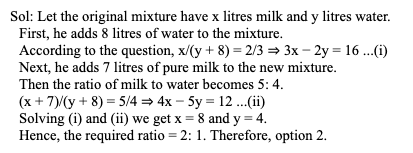
32. If a milkman adds 8 liters of water to a mixture of milk and water, then the ratio of milk to water in the new mixture becomes 2: 3. Again, if he adds 7 liters of pure milk to the new mixture then the ratio of milk to water becomes 5: 4. What was the ratio of milk to water in the original mixture?
8: 5
2: 1
4: 1
5: 2
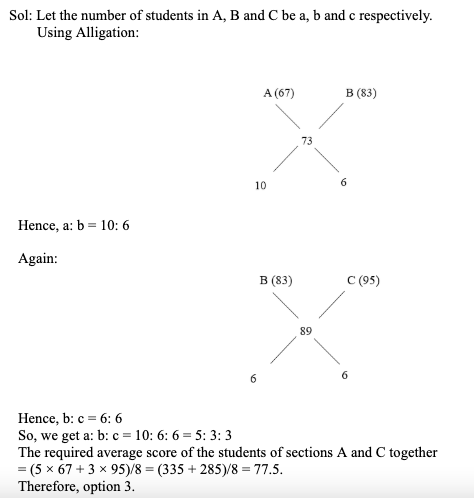
33. The students in class X of a school are divided into three sections A, B and C. They wrote a Talent Search Test. The average scores of A, B and C in that test were 67, 83 and 95 respectively. If the average score of the students of sections A and B together is 73 and that of sections B and C together is 89, then find the average score of the students of sections A and C together.
72.5
67.5
77.5
83.5
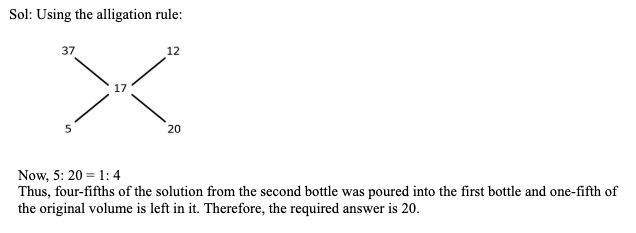
34. Two identical bottles are completely filled with a solution of salt and water having different concentrations. The concentration of the solution in the first bottle is 37% and that in the second bottle is 12%. A part of the solution from the first bottle is thrown away and is replaced with an equal volume of the solution from the second bottle. What percentage of solution is left in the second bottle if the concentration of the solution in the first bottle is now 17%?
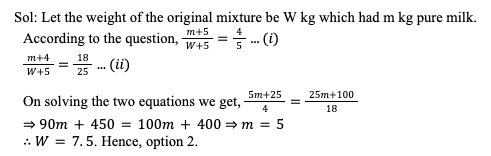
35. If we mix 5 kg pure milk into a mixture of water and pure milk, the resulting mixture will have 80% pure milk by weight. If the same original mixture is mixed with 5 kg of another mixture of water and pure milk having 80% pure milk by weight, the resulting mixture will have 72% pure milk by weight. Then, the weight of the original mixture, in kg, is:
5
7.5
10
12.5
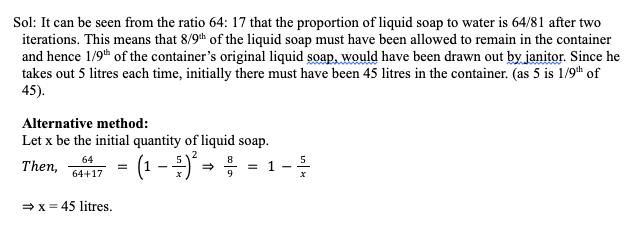
36. The janitor steals five litres of pure liquid soap kept in a hotel store room from a container that is full of liquid soap. He then fills it with water to avoid detection. Unable to resist the temptation he steals 5 litres of the mixture again, and fills it with water. When the liquid soap is checked by the supervisor it is found that the new ratio of liquid soap to water is 64: 17. What was the initial quantity (in litre) of the liquid soap in the container if it is known that the liquid soap was not used by anybody else?
36
40
54
45
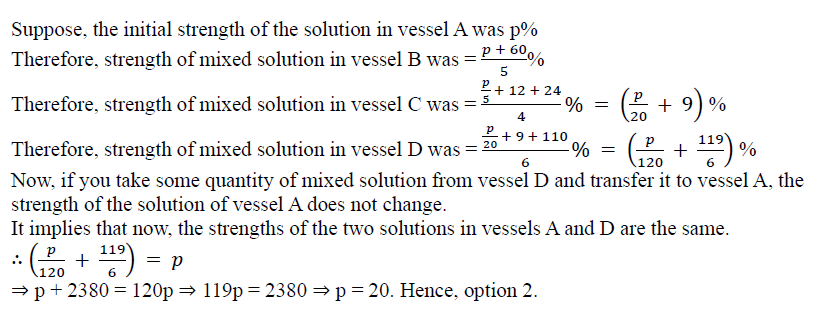
37. Four vessels A, B, C and D are filled with salt solutions of different volumes and different strengths. 10 litres of solution from vessel A is transferred to vessel B which initially had 40 litres of 15% solution. Then, 10 litres of the solution from vessel B is transferred to vessel C which initially had 30 litres of 8% solution. Then, 10 litres of the solution from vessel C is transferred to vessel D which initially had 50 litres of 22% solution. If you take some quantity of solution from vessel D and transfer it to vessel A, the strength of the solution of vessel A does not change. The initial strength of salt solution in vessel A, in percentage term, was:
18
20
25
15
38. Two varieties of poppy seeds are mixed. The mixture costs per kg more when the first variety is mixed with the second variety in the ratio 9: 11 in lieu of the ratio 13: 7. What is the difference in the prices of the two varieties of poppy seeds, in Rs, per kg?
80
100
120
150
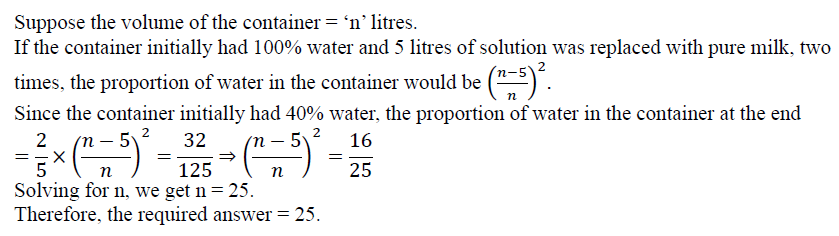
39. A container filled to its brim with a solution of milk and water containing milk and water in the ratio 3: 2 by volume. 5 litres of the solution is removed from the container and replaced with pure milk. The process is repeated once more. If the volumes of milk and water in the container are now in the ratio of 93: 32, then the capacity of the container, in litres, is:
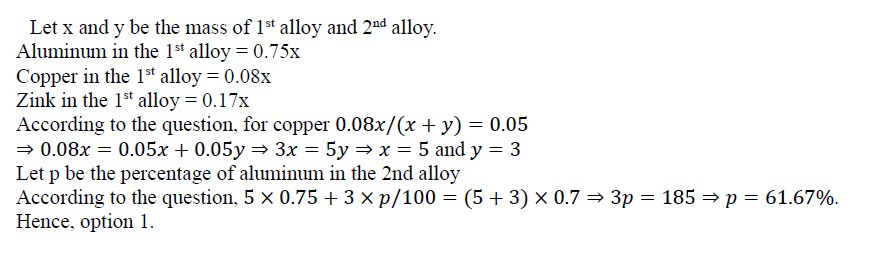
40. An alloy of aluminium, copper and zinc contains 75% aluminium, 8% copper and 17% zinc. A second alloy of aluminium and zinc melted with the first and the new alloy then contains 70% aluminium, 5% copper and 25% zinc. Find the percentage of aluminium in the second alloy.
61.67%
53.33%
67.33%
56.67%
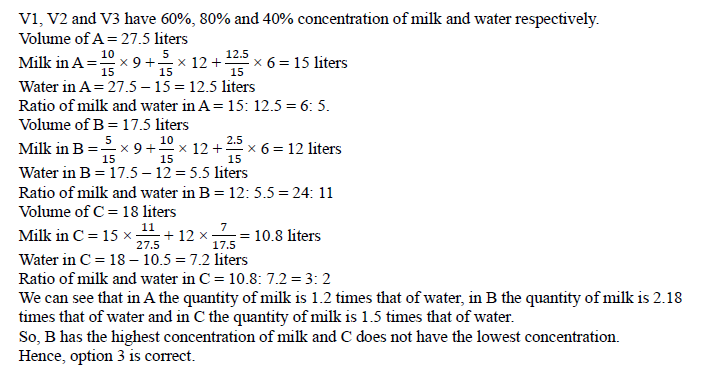
41. Three vessels contain three different mixtures of milk and water. Volume of each mixture is 15 liters and their respective concentrations of milk are 60%, 80% and 40%. 10 liters of the first, 5 liters of the second and 12.5 liters of the third are mixed and the mixture is named A. The leftovers of the three vessels are mixed and this mixture is named B. Eleven liters of A and 7 liters of B are mixed to form mixture C. Which of the following statements is/are true regarding the milk concentrations of A, B and C?
I. A has the highest concentration.
II. C has the lowest concentration.
III. B has the highest concentration.
IV. C has neither the highest nor the lowest concentration.
I & IV
II & III
III & IV
III only
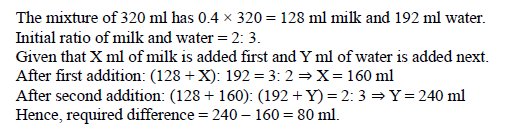
42. A vessel had 320 ml of a mixture of milk and water. The mixture has 40% milk. First X ml of milk was added to the mixture. Then Y ml of water was added to the mixture. Each time an addition is done, the ratio of milk and water in the vessel is reversed. Find the difference between the quantities X and Y (in ml).
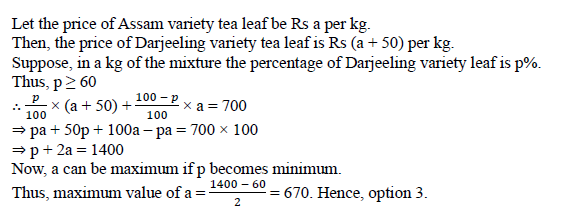
43. The tea leaf of Darjeeling variety costs ₹50 per kg more than the Assam variety. The two varieties of leaves are mixed such that the Assam variety never exceeds 40% of the mixture. If the mixture costs ₹700 per kg then the highest possible cost of Assam variety, in INR per kg, is:
650
660
670
680
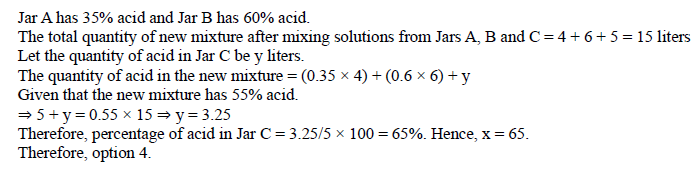
44. Jar A has 4 liters of a solution that is 35% acid. Jar B has 6 liters of a solution that is 60% acid. Jar C has 5 liters of a solution that is x% acid. If the entire contents from Jars A, B and C are mixed together such that the new mixture has 55% acid, then find the value of x?
75
60
70
65
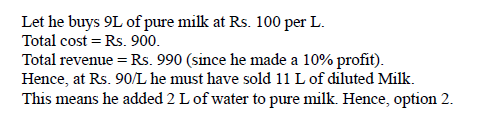
45. A milkman, buys pure milk and adds some water before selling. He sells the mixture at a price 10% less than the price of pure milk and makes a profit of 10%. Find the quantity (in litres) of water that he adds to every 9 litres of pure milk.
1
2
3
4
46. A 240 ml flask contains 30% acid solution. What quantity (in ml) of the solution should be replaced with 12% acid solution so that the resultant solution contains 18% acid?
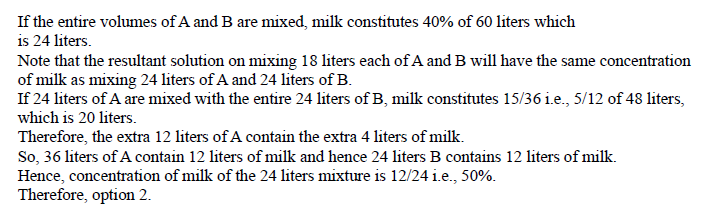
47. The volumes of two containers – A and B – are 36 liters and 24 liters, which contain milk and water solutions. If the entire quantity of these two solutions is mixed, the concentration of milk in the resulting solution is 40%. If 18 liters of each of the two solutions are mixed, the amount of milk in the resulting solution is 15 liters. What is the concentration of milk of the 24 liters mixture?
33.33%
50%
66.66%
75%
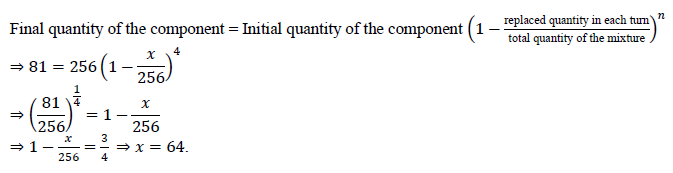
48. A total of ‘x’ litres of pure milk was drawn from a vessel containing 256 litres of pure milk and was replaced with water. The resulting mixture was thoroughly mixed to obtain a homogenous solution and then again ‘x’ litres of solution was drawn, and replaced with water. The resulting mixture was thoroughly mixed. This procedure was performed four times and the vessel now contained 81 litres of pure milk. Find the value of ‘x’.
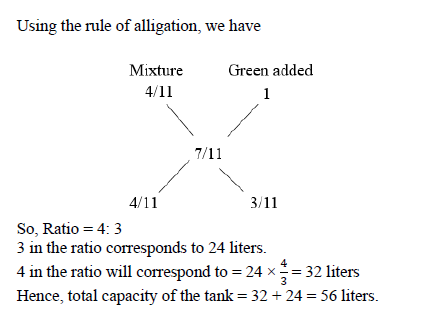
49. Nerolak paints mixes Green and White in the ratio 4: 7 in a tank. However, after mixing, the company finds that the resultant shade has less of Green and removes 24 liters of the mixture and adds an equivalent quantity of Green. The shade thus obtained has Green and White in the inverse ratio. How many liters of mixture was there initially in the tank?
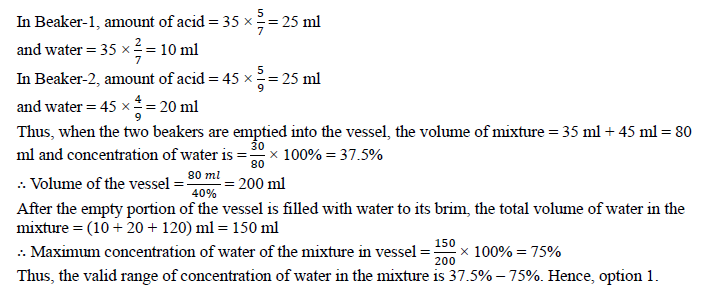
50. Beaker-1 contains a 35 ml of mixture of acid and water in 5: 2 ratio and beaker-2 contains a 45 ml of mixture of water and acid in 4: 5 ratio. Both the beakers are emptied into a large vessel, which was initially empty, to fill its 40% volume. Which of the following cannot be the concentration of water in the mixture in vessel even if one is allowed to pour as much water as he wants? (Water should not spill over the vessel)
We at Quantifiers understand and deliver on the personal attention each of our students requires. Whether it is through our pedagogy that enables non-engineers or non-math background students, our constant effort to proactively provide solutions, or our focus on our student’s goals.