


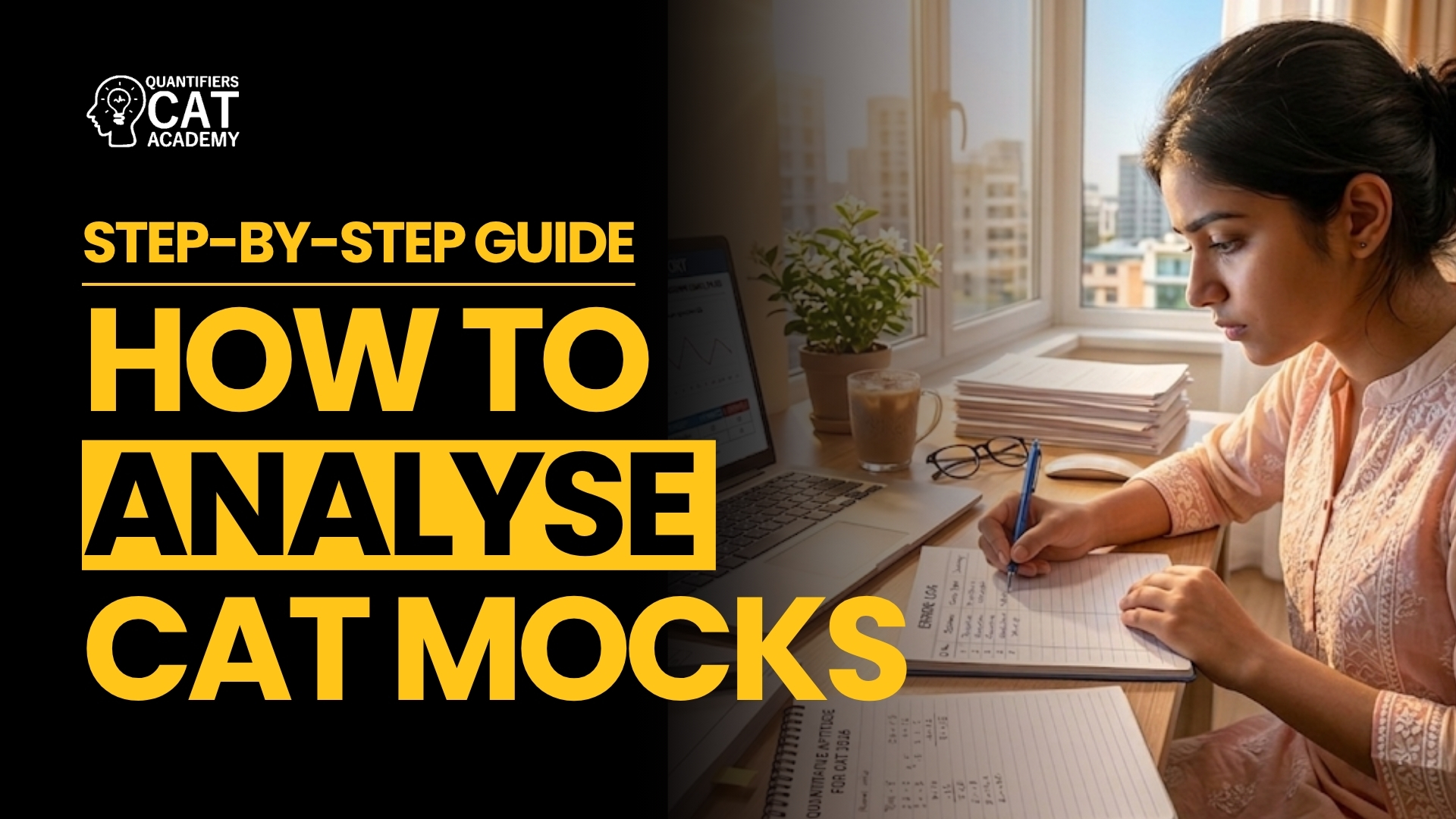

How to Analyse CAT Mocks — A Step-by-Step Guide, Section by Section
Taking a mock and analysing a mock are two completely different skills — and most CAT aspirants have only ever practiced the first one. Here’s exactly how to analyse CAT mocks properly: what to do in the first five minutes after a mock, how to review each section differently, and how to turn that review into a system you repeat every single week, from the Quantifiers team.
- Why Most CAT Mock Analysis Fails
- When to Analyse — Timing Matters More Than You’d Think
- Step 1 — The Immediate 5-Minute Triage
- Step 2 — How to Analyse CAT Mocks for Quant
- Step 3 — How to Analyse CAT Mocks for VARC
- Step 4 — How to Analyse CAT Mocks for LRDI
- Step 5 — Building One Master Error Sheet
- Step 6 — Bridging to Your Next Mock
- Want This Done For You Every Week?
- Frequently Asked Questions

1. Why Most CAT Mock Analysis Fails
Most students who feel like they’ve “analysed” a mock have really just looked at their score, glanced at the questions they got wrong, and moved on within 20–30 minutes. That’s not analysis — it’s a quick emotional check-in. A 2-hour mock genuinely holds 4–6 hours of useful review inside it, and the gap between a student who extracts that review and one who doesn’t is usually the entire gap between a plateaued score and a rising one.
Learning how to analyse CAT mocks properly means treating the review itself as a skill with its own steps — not an afterthought squeezed in before the next test.
2. When to Analyse — Timing Matters More Than You’d Think
Analyse your mock within 24 hours, ideally the same day, while the reasoning behind each of your choices is still fresh. Waiting several days before reviewing means reconstructing your thought process from scratch — you’ll remember the score, but not why you picked a specific wrong answer, which is exactly the detail that makes analysis useful in the first place.
3. Step 1 — The Immediate 5-Minute Triage
Before any deep section-wise work, spend five minutes sorting your entire mock into three buckets — this triage tells you where to spend your remaining review hours.
- Bucket A — Correct, confident, fast. No action needed beyond a quick acknowledgment; these are genuinely solid.
- Bucket B — Correct, but slow or uncertain. A “right” answer here is disguising a gap — flag every one of these for a closer look in your section-wise review.
- Bucket C — Incorrect or skipped. This is where most of your review time goes, but not evenly — a skipped question you had time for needs a different fix than a wrong answer on a genuinely hard question.
💡 Bucket B Is the One Everyone Skips — Don’t
It’s natural to focus entirely on wrong answers during analysis. But a correct answer that took three minutes of second-guessing carries almost the same warning sign as a wrong one — it just didn’t get caught this time. Reviewing Bucket B specifically is one of the highest-leverage five minutes in the entire process, precisely because it’s the part almost everyone quietly skips.
4. Step 2 — How to Analyse CAT Mocks for Quant
The most useful way to analyse CAT mocks for Quant is to band your accuracy by topic, not by looking at your overall Quant score as one number.
Table 1 — Quant Topic Accuracy Bands
| Accuracy Band | What It Means | What to Do |
|---|---|---|
| Above 80% | Genuine strength — fundamentals are solid | Focus on shaving time off these, not building more accuracy |
| 55–75% | Foundation exists, but execution is inconsistent | Targeted practice — this band improves fastest with focused effort |
| Below 50% | A genuine concept gap, not a speed or careless-mistake issue | Go back to fundamentals for this specific topic before attempting more practice questions |
5. Step 3 — How to Analyse CAT Mocks for VARC
The single most effective technique for VARC analysis is re-attempting the entire section without a timer, ideally the same day. This isolates whether a wrong answer was a genuine comprehension gap or simply a casualty of time pressure — two problems with very different solutions.
- Re-read every RC passage you missed the first time, untimed, and note whether your untimed answer changes. If it does, the issue was pacing, not comprehension — the fix is speed-building, not re-learning how to read.
- Identify each passage’s tone and category (science, economics, philosophy, narrative) — patterns in which categories you consistently struggle with are far more useful than a single mock’s score.
- For every wrong answer, articulate specifically why the correct option is right and why your chosen option is wrong — not just “I misread it,” but the actual logical gap between the two.
- For non-RC questions (Para Jumbles, Summary, Odd Sentence Out), categorise errors by question type rather than treating “Verbal Ability” as one undifferentiated bucket.
6. Step 4 — How to Analyse CAT Mocks for LRDI
LRDI analysis has one job that the other two sections don’t: reviewing your set-selection decisions, not just your accuracy within the sets you attempted.
- List every set in the mock, in the order you attempted them, and rank them retrospectively by actual difficulty now that you’ve seen the full picture.
- Compare your real-time ranking to your retrospective ranking. A consistent gap between the two — picking sets that turned out harder than they looked — is a set-selection problem worth deliberately practicing, separate from solving the sets themselves.
- For sets you abandoned, finish them untimed and note how close you actually were — this tells you whether your 10–12 minute cutoff rule is well-calibrated or too conservative.
- For sets you never even attempted, solve them afterward and honestly assess whether skipping was the right call or a missed opportunity.
7. Step 5 — Building One Master Error Sheet
All three sections’ analysis should feed into a single running sheet, not scattered notes across different mocks. A simple structure works best.
Table 2 — Master Error Sheet Fields
| Field | Purpose |
|---|---|
| Section & Topic | Where the error occurred |
| Error Type | Concept gap, timing issue, careless mistake, or wrong selection call |
| What Went Wrong | One specific line, not a vague summary |
| The Fix | What you’ll do differently next time you see something similar |
8. Step 6 — Bridging to Your Next Mock
Don’t jump straight from analysis into another full-length mock. Insert a bridge of targeted sectional practice on whatever your error sheet flagged as recurring — this is what actually closes the gap the analysis identified, rather than just documenting it and moving on.
⚠ A Full Mock Without a Bridge Just Repeats the Same Gaps
Jumping from one full mock straight into the next, with only a light glance at your score in between, means the same weak topics show up again — because nothing actually changed in the days between the two attempts. The sectional bridge is what converts a diagnosis into an actual improvement.
9. Want This Done For You Every Week?
Everything in this guide is exactly the review cycle we run for students inside our own programmes — structured, section-specific, and repeated every week rather than left to individual discipline alone. If you’re doing this analysis on your own right now, our free resources at www.quantifiers.in include practice material and strategy content to support it.
If you’d rather have this entire review system — plus 10 full-length mocks, 150+ sectional tests, and weekly mentoring sessions that walk through exactly this kind of analysis with you — that’s what our Sangharsh CAT Crash Course is built around.
Sangharsh CAT Crash Course

Structured mock analysis, weekly mentoring, and 150+ sectional tests with video solutions — built to turn every mock into a genuine improvement, not just a score.
If you’re also working on a broader improvement system beyond analysis mechanics, our guide on how to improve your CAT mock score covers the category-based framework that pairs well with the section-wise techniques in this piece.
Frequently Asked Questions
How long should I spend analysing a CAT mock?
Roughly 4–6 hours for a 2-hour mock — enough to review every correct, incorrect, and unattempted question in detail, not just the ones you got wrong.
What’s the best way to analyse VARC mocks specifically?
Re-attempt the section without a timer the same day. If your untimed answer changes, the original miss was a pacing issue, not a comprehension gap — the two need very different fixes.
How do I know if my LRDI set-selection is a problem?
Compare the order you attempted sets in against a retrospective difficulty ranking made after seeing the full picture. A consistent gap between the two signals a set-selection issue worth practicing separately from solving the sets themselves.
Should I analyse a mock before or after taking my next one?
Always before. Taking a new full mock without analysing the previous one, and without a sectional practice bridge in between, usually just repeats the same weak areas rather than closing them.
Do correct answers need to be analysed too?
Yes. A correct answer that took unusually long or involved genuine uncertainty is often hiding the same underlying gap as a wrong one — reviewing these “shaky corrects” is one of the most overlooked parts of proper mock analysis.