

CAT 2026 QA Topics: A 6-Year Question Pattern Analysis
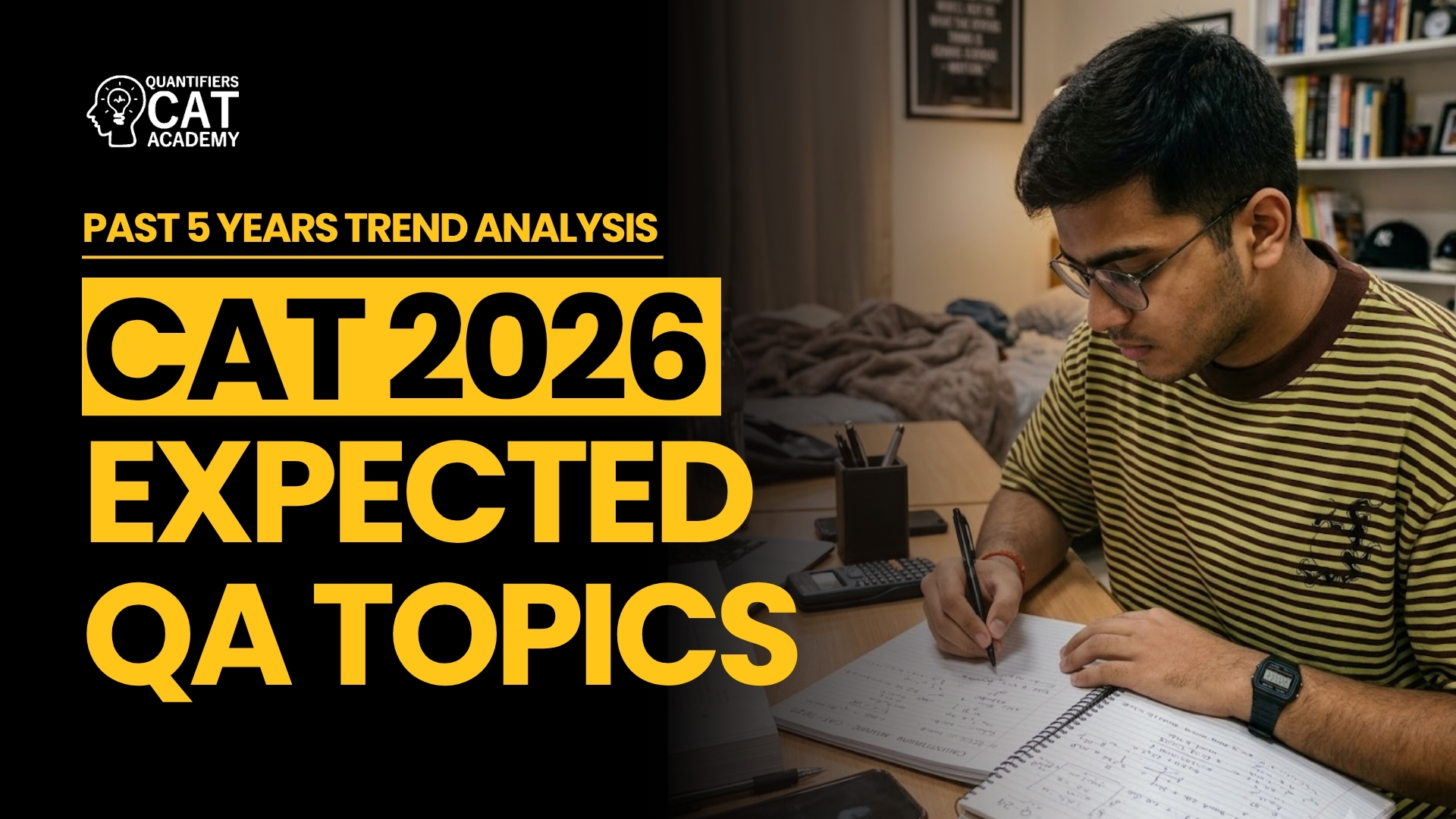
We tagged and analysed all 330 Quant questions across 15 official CAT papers from 2021 to 2025 — every topic, sub-topic, and recurring scenario-type. Here’s what that dataset actually shows about CAT 2026 QA topics, and just as importantly, what it doesn’t.
- How This Analysis Was Built
- The Big Picture: Where the Questions Actually Come From
- Arithmetic: The Paper’s Heaviest Engine
- Algebra: Condition-Layered, Not “Solve for x”
- Geometry and Number System
- Modern Math: Small but Sharply Focused
- Ten Recurring Scenario-Archetypes in CAT 2026 QA Topics
- What’s Guaranteed vs. What’s Just a Trend
- How CAT Actually Tests Each Topic
- What This Means for CAT 2026 QA Topics Prep
- Frequently Asked Questions
How This Analysis Was Built
Before drawing any conclusions about CAT 2026 QA topics, the underlying data was checked for integrity. All 15 official Quant papers from 2021–2025 were retrieved successfully, with every paper confirmed to contain exactly 22 QA questions — 330 questions in total, matching the tagged dataset exactly. Each question was classified by topic and scenario type directly from its wording, without solving it for an answer, to keep the classification purely structural.
- Difficulty statistics (Correct% / Incorrect%) are only publicly available for 2021, 2024, and 2025 — any difficulty-related claim is restricted to those 9 of 15 slots, not the full dataset.
- Two question pairs across different official slots were found to be word-for-word identical — flagged as anchor-item reuse, not a taught content pattern.
- No claim in this analysis extends to the 2026 paper or any future administration. Every statement here is traceable strictly to this 2021–2025, 330-question dataset.
The Big Picture: Where the Questions Actually Come From
The topic-wise split across all five years is remarkably stable.
Table 1 — Broad topic distribution, 2021–2025 (330 questions, 15 papers)
| Topic | 2021 | 2022 | 2023 | 2024 | 2025 | Total | Share |
|---|---|---|---|---|---|---|---|
| Arithmetic | 32 | 26 | 24 | 27 | 29 | 138 | 41.8% |
| Algebra | 12 | 15 | 19 | 19 | 13 | 78 | 23.6% |
| Number System | 10 | 12 | 13 | 9 | 13 | 57 | 17.3% |
| Geometry | 9 | 10 | 9 | 8 | 9 | 45 | 13.6% |
| Modern Math | 3 | 3 | 1 | 3 | 2 | 12 | 3.6% |
Arithmetic: The Paper’s Heaviest Engine
Of every broad category among CAT 2026 QA topics, Arithmetic deserves the most attention by sheer weight. At 138 of 330 questions, it isn’t just the largest topic — it’s tested differently from the others. A full 61% of Arithmetic questions are multi-concept, chained scenarios, the strongest single signal in the entire dataset. CAT almost never asks a standalone “find the profit%” or “find the average” question; it layers a condition on top nearly every time.
Table 2 — Arithmetic sub-topics (138 questions, 5 years)
| Sub-topic | Count | Years Present | Dominant Pattern |
|---|---|---|---|
| Averages | 23 | 5/5 | Weighted-average shift; constrained-integer puzzles |
| Profit & Loss | 22 | 5/5 | Successive discount/markup chains; SP–CP reverse-engineering |
| Time & Work / Pipes | 20 | 5/5 | Pairwise combined rates, then solve individual rate |
| Speed-Time-Distance | 18 | 5/5 | Meet-then-continue; relative speed; multi-leg journeys |
| Percentages | 15 | 5/5 | Rarely isolated — usually embedded in P&L or set-overlap |
| Mixtures / Alligation | 14 | 5/5 | Successive replacement dominates |
| Ratios | 10 | 4/5 | Ratio shift after a transfer or proportional addition |
| SI / CI | 9 | 4/5 | Reinvestment equivalence across interest modes |
Algebra: Condition-Layered, Not “Solve for x”
Algebra is the most evenly spread topic in the dataset — no single question-framing dominates the way multi-concept scenarios dominate Arithmetic. Logic and condition-based reasoning leads at 32%, but optimization, formula-based, and property-driven questions all contribute meaningfully.
Table 3 — Algebra sub-topics (78 questions, 5 years)
| Sub-topic | Count | Years Present | Dominant Pattern |
|---|---|---|---|
| Quadratics | 15 | 5/5 | Integer-root / common-root conditions, rarely a bare solve |
| Progressions | 15 | 5/5 | AP/GP with a derived condition, not plain nth-term recall |
| Functions | 14 | 5/5 | Composite functions; functional equations |
| Inequalities | 12 | 5/5 | Absolute-value equations and inequalities dominate |
| Algebraic Optimization | 6 | 3/5 | AM-GM style minimize/maximize; clustered 2022–23 |
| Surds | 6 | 4/5 | Nested-radical simplification; symmetric power sums |
Geometry and Number System
Geometry (45 questions, 13.6%) is the dataset’s most “textbook” section — 76% of its questions are property or formula-driven, the least likely topic to blend with another chapter. It’s also the least volatile topic year to year, holding steady in an 8–10 question band across all five years.
Table 4 — Geometry sub-topics (45 questions, 5 years)
| Sub-topic | Count | Years Present | Dominant Pattern |
|---|---|---|---|
| Triangles | 13 | 5/5 | Cevian ratios via mass-point / Menelaus-style reasoning |
| Circles | 9 | 5/5 | Tangent-angle relations; mutually tangent circles |
| Polygons | 7 | 5/5 | Regular-polygon angle and diagonal-count relations |
| Mensuration | 6 | 4/5 | 2D/3D — the formula is the last step, not the first |
| Coordinate Geometry | 5 | 4/5 | Missing-vertex, locus, incircle-from-coordinates |
| Other Quadrilaterals | 5 | 4/5 | Trapezium / cyclic-quad side-and-diagonal ratios |
Number System (57 questions, 17.3%) runs the opposite way — 53% logic or condition-based, rarely a plug-in formula question. Exponents and Logarithms alone account for 24 of 57 questions (42%) and are the single most reliable Number System presence in the dataset, never the smallest sub-topic and never absent in any year.
Table 5 — Number System sub-topics (57 questions, 5 years)
| Sub-topic | Count | Years Present | Dominant Pattern |
|---|---|---|---|
| Exponents / Logarithms | 24 | 5/5 | Base-conversion, chained log equations — nearly every slot |
| Number Theory (misc.) | 13 | 3/5 | Factors, divisibility, Diophantine — clustered 2022–23 |
| Digits | 7 | 4/5 | Digit-sum / palindrome / rearrangement, usually TITA |
| Inequalities | 5 | 3/5 | Integer-count on a compound or absolute inequality |
| Remainders | 4 | 2/5 | Modular exponentiation via last-digit cyclicity |
Modern Math: Small but Sharply Focused
Among CAT 2026 QA topics, Modern Math is the one most aspirants underweight — and with reason, since at just 12 of 330 questions (3.6%), it’s the smallest topic. But it has the most concentrated framing profile in the entire dataset: 67% pure logic or constraint reasoning, and 0% property-based or multi-concept questions.
- Combinatorics (P&C): 10 questions, present in 5/5 years — never a bare nCr/nPr calculation; always wrapped in a distribution-with-constraint or path-counting scenario.
- Set Theory: just 2 questions, appearing only in 2022 and 2025 — insufficient evidence to call this a yearly fixture; treat it as intermittent rather than guaranteed.
Key Takeaway
Permutations & Combinations never appears as a bare counting formula anywhere in this five-year dataset — it’s always wrapped in a distribution, restriction, or path-counting scenario. If your P&C practice is mostly formula drilling, it’s missing the actual pattern.
Ten Recurring Scenario-Archetypes in CAT 2026 QA Topics
Grouping questions by underlying scenario rather than textbook chapter surfaces ten templates that CAT keeps reusing — the same puzzle logic, dressed in different numbers and framing.
- Successive Replacement / Dilution Mixture — ~9 instances, 5/5 years
- Functional Equations as Arithmetic Wrapper — 6 instances, 5/5 years
- Absolute-Value Condition Puzzles — 9 instances, 5/5 years
- Successive % Change Chains — 6 instances, 4/5 years
- CI/SI Reinvestment Equivalence — 7 instances (including one verified word-for-word repeat), 5/5 years
- Cevian / Mass-Point Triangle Ratios — 5 instances, 5/5 years
- Pairwise Combined Time & Work — ~7 instances, 5/5 years
- Set-Overlap / % Participation Min-Max — 4 instances, 4/5 years
- Digit-Constraint Number Construction — 7 instances, 4/5 years
- Range of a Rational Function — 2 instances, 2/5 years
The takeaway from this list isn’t the exact counts — it’s that CAT reuses puzzle logic far more than it invents new mathematics. Recognising the archetype often matters more than recalling the formula.
What’s Guaranteed vs. What’s Just a Trend
Not every pattern in this dataset carries equal weight. Some sub-topics recur every single year; others cluster in specific years and shouldn’t be treated as fixtures.
Table 6 — Recurring vs. intermittent presence, 2021–2025
| Recurs Every Year (5/5) | Intermittent — Flagged, Not a Fixture |
|---|---|
| Arithmetic: Averages, P&L, Time & Work/Pipes, Speed-Time-Distance, Percentages, Mixtures | Set Theory: only 2022 and 2025 (2 of 5 years) |
| Algebra: Quadratics, Progressions, Functions, Inequalities | Algebraic Optimization: clustered 2022–2023, one echo in 2025 |
| Geometry: Triangles, Circles, Polygons | Remainders: clustered in 2022 and 2024 only |
| Number System: Exponents / Logarithms | Digit-constraint questions: absent from the 2024 sample specifically |
| Modern Math: Combinatorics | Ratios: rising from 1–2/year (2021–23) to 5 in 2025 — suggestive, not confirmed on n=10 |
How CAT Actually Tests Each Topic
Beyond which topics appear, how they’re tested varies sharply by section — formula recall turns out to be the exception, not the rule.
Table 7 — Question-framing profile by topic
| Topic | Multi-Concept | Logic/Condition | Property | Direct/Formula | Optimization |
|---|---|---|---|---|---|
| Arithmetic | 61% | 4% | 1% | 18% | 14% |
| Algebra | 15% | 32% | 15% | 19% | 18% |
| Geometry | 11% | 7% | 40% | 36% | 2% |
| Number System | 2% | 53% | 4% | 29% | 12% |
| Modern Math | 0% | 67% | 0% | 17% | 17% |
What This Means for CAT 2026 QA Topics Prep
Don’t prepare chapters — prepare engines. Within every recurring sub-topic, CAT overwhelmingly favours a small set of scenario-templates, reused with new numbers and framing rather than new mathematics. That has direct implications for how to prioritize CAT 2026 QA topics:
- Weight your practice time toward Arithmetic’s chained, multi-concept scenarios rather than isolated single-formula drills.
- Treat Algebra’s Quadratics and Progressions as condition-layered problems by default, not plain textbook solves.
- Build genuine theorem fluency in Geometry — it’s the one section where knowing the right property most directly unlocks the answer.
- Don’t skip Exponents/Logarithms in Number System — it’s the single most reliably present sub-topic outside Arithmetic.
- Practice P&C as scenario-wrapped counting, not bare formula application, and treat Set Theory as a bonus rather than a certainty.
For a section-wise attempt strategy that builds on this topic prioritization, our CAT question selection strategy guide covers how to translate this into real exam-day choices, and our breakdown of the attempts-and-accuracy math for 99 percentile in CAT 2026 covers what to do once you’re deciding which questions to attempt.
Read This Before You Over-Index on Any Single Number
Every figure in this article comes from 2021–2025 official papers — a real, carefully checked dataset, but still a historical one. CAT’s syllabus and format are set independently each year by the conducting IIM, confirmed on the official CAT website. Use this analysis to prioritize your preparation time, not to assume any specific sub-topic will or won’t appear in CAT 2026.
Turn This Analysis Into Practiced Skill

Knowing which CAT 2026 QA topics recur most is only half the job — building speed and accuracy on them is the other half. Quantifiers CAT Academy’s Sangharsh 2.0 CAT Crash Course includes 1000+ sectional tests and full-length mocks built around exactly these patterns.
Frequently Asked Questions
What are the most important CAT 2026 QA topics to prepare?
Based on five years of official papers, Arithmetic (especially Averages, Profit & Loss, Time & Work, and Speed-Time-Distance) carries the heaviest weight, followed by Algebra’s Quadratics and Progressions, and Number System’s Exponents/Logarithms — all of which have appeared in every year analysed.
Does this trend analysis guarantee what will appear in CAT 2026?
No. This analysis is based strictly on official papers from 2021–2025 and does not extend as a guarantee to CAT 2026 or any future exam. It’s a prioritization tool, not a prediction.
Which CAT 2026 QA topics are tested with multi-concept questions?
Arithmetic, by a wide margin — 61% of Arithmetic questions in the dataset combine multiple concepts in a single chained scenario, far higher than any other topic.
Is Modern Math worth spending significant prep time on?
Combinatorics is worth solid attention, as it appeared in all five years. Set Theory appeared in only 2 of 5 years and shouldn’t be treated as a guaranteed fixture.
How were the CAT 2026 QA topics in this analysis identified?
By tagging all 330 Quant questions across 15 official CAT papers from 2021–2025 by topic, sub-topic, and scenario type, based purely on question wording, without solving any question for its answer.