



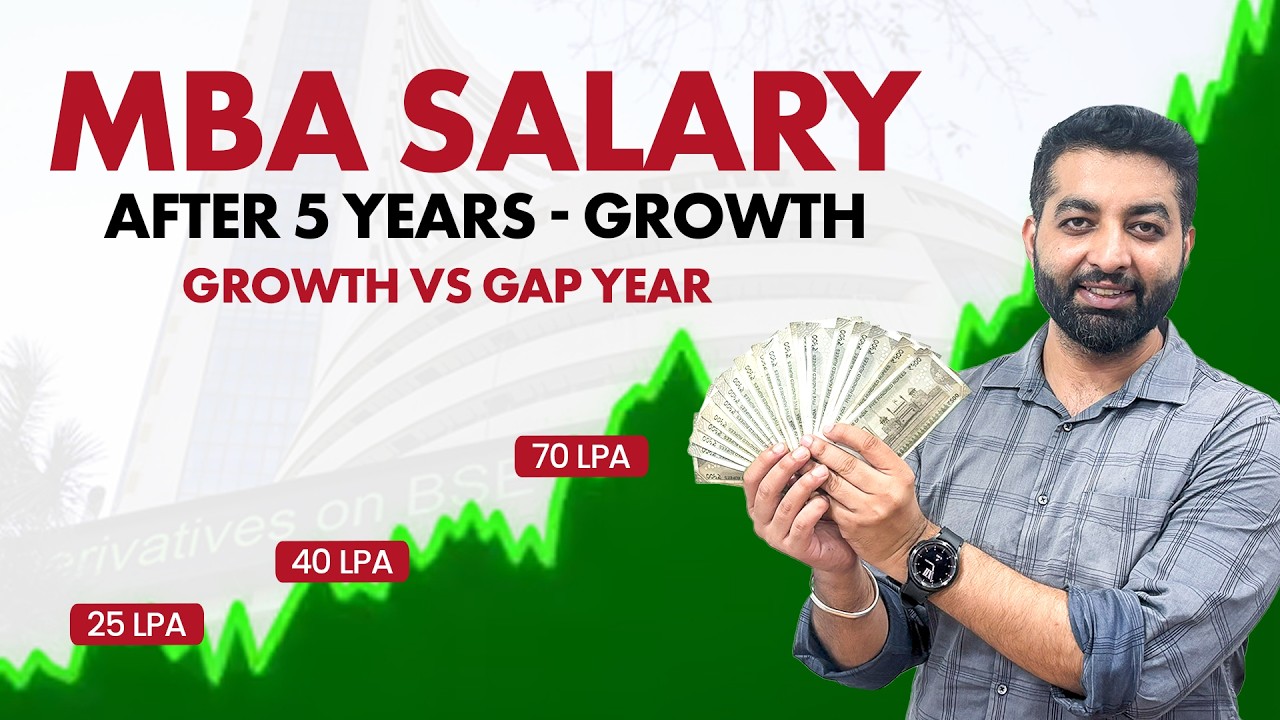

Gap Year Before MBA: Is It Actually a Bad Idea?
“I’ll be one year behind” is the single most common reason aspirants rush into a mediocre MBA instead of waiting for a better one. Here’s the salary math that shows why a gap year before MBA often isn’t the setback it feels like.
- Why “One Year Behind” Is the Wrong Way to Frame It
- Tier 1 vs. Tier 2 vs. Tier 3: The Starting Package Gap
- A Real Comparison: No Gap vs. One Strategic Gap Year
- Where Both Paths Land Five Years Later
- Understanding Your Actual In-Hand Salary
- So Is a Gap Year Before MBA Worth It?
- How to Use a Gap Year Productively
- Frequently Asked Questions
Watch on YouTube: https://youtu.be/5dmWvaDjihw
Why “One Year Behind” Is the Wrong Way to Frame It
Picture an aspirant graduating college in 2026. The instinct is to think: “If I give CAT in November 2026, my admission happens in June 2027 — that’s already a year gone. If I give CAT in 2027 instead, admission slips to 2028, and now I’m two years behind.” That framing treats every extra year as pure loss, measured against some imaginary version of yourself who started earning immediately.
The problem is that this framing only counts time, not outcome. A gap year before MBA isn’t automatically bad or automatically good — it depends entirely on what that year, and the college it leads to, actually produces. The rest of this article walks through why that distinction matters more than the calendar ever will.
Tier 1 vs. Tier 2 vs. Tier 3: The Starting Package Gap
Before comparing timelines, it helps to see just how much starting compensation varies by college tier. These are illustrative averages, not guarantees for any individual outcome, but they set the scale for everything that follows.
Table 1 — Illustrative starting packages by college tier (Year 0)
| College Tier | Illustrative Starting Package |
|---|---|
| Tier 1 | ₹28 lakh |
| Tier 2 | ₹16 lakh |
| Tier 3 | ₹10 lakh |
The gap between ₹28 lakh and ₹10 lakh isn’t a rounding difference — it’s nearly triple. That gap is the entire reason a gap year before MBA deserves a more careful look than a simple “sooner is always better” instinct.
A Real Comparison: No Gap vs. One Strategic Gap Year
Take two illustrative candidates — call them Chintu and Mintu — both graduating college at the same time.
- Chintu felt pressure to avoid any gap. He gave CAT the same year, scored around the 80th percentile, got into a decent Tier 2 college, and started his MBA immediately — graduating by 2028 with a starting package of roughly ₹13 lakh.
- Mintu took one gap year. During that year, he built Excel and other practical skills, then attempted CAT again the following cycle. He got into a stronger, Tier-1.5-level college, completing his MBA a year later than Chintu — with a starting package of roughly ₹22 lakh.
Key Takeaway
Mintu started his career a year later than Chintu, but nearly ₹9 lakh higher. That single-year “loss” was recovered almost immediately once you account for the compounding effect of a stronger starting base and a better growth trajectory from a higher-tier college.
Where Both Paths Land Five Years Later
By around 2030, Chintu — now with two years of work experience — is earning somewhere in the ₹18–20 lakh range. Mintu, with only one year of experience but a stronger starting base, would typically already be near ₹25–26 lakh after a standard raise. For Chintu to catch up to where Mintu already stands, it would realistically take another two to three years.
Zooming out to a full five-year horizon, illustrative growth by tier looks roughly like this:
Table 2 — Illustrative 5-year salary growth by college tier
| Tier | Starting Package | Illustrative Package After 5 Years |
|---|---|---|
| Tier 1 | ₹28 lakh | ~₹50 lakh (comfortable estimate) |
| Tier 2 | ₹16 lakh | ~₹28–30 lakh (comfortable) / ~₹23 lakh (conservative) |
| Tier 3 | ₹10 lakh | ~₹16–18 lakh (over roughly 6 years) |
The pattern holds regardless of exact numbers: growth compounds faster from a higher base, which is precisely why the tier of college you get into tends to matter more over a five-year horizon than the one extra year it might take to get there.
Understanding Your Actual In-Hand Salary
One more piece worth understanding while comparing packages: a headline CTC figure isn’t what lands in your bank account. On a package of roughly ₹1 crore, in-hand pay after PF contributions, HRA structuring, variable pay, and tax works out to approximately ₹6 lakh a month — around ₹72 lakh a year, not the full crore.
This matters when comparing offers or projecting your own future income: always think in terms of realistic in-hand pay, not just the CTC number quoted in an offer letter.
So Is a Gap Year Before MBA Worth It?
There’s no universal answer — it depends entirely on what the gap year is spent doing. A gap year before MBA spent building relevant skills, seriously preparing for CAT, and deliberately aiming for a meaningfully better college tends to pay off, often within just a couple of years of graduating. A gap year spent without a clear plan or a genuine step up in college tier is a different story — in that case, the “cost” of the gap isn’t offset by anything.
The honest question to ask isn’t “how bad is a gap year,” but “what am I actually going to do differently with it, and does that realistically move me up a tier?” If the answer is genuinely yes, a gap year before MBA is a reasonable trade. If it’s just delay without a plan, it isn’t.
A Mistake to Avoid
Don’t compare your timeline only in terms of money and years. Compare it in terms of skills built, preparation quality, and the realistic jump in college tier a gap year would actually get you. A gap year without a concrete plan to move up a tier rarely justifies itself.
How to Use a Gap Year Productively
- Treat it as a genuine second CAT attempt with a real preparation plan, not just “more time.”
- Build practical, resume-relevant skills — the kind that show up in your profile and interviews, not just a certificate.
- Set a specific target tier improvement before the year starts, so you can judge afterward whether it actually worked.
- Track your preparation the way you’d track a job — with milestones, not just vague intentions.
If a longer runway before CAT is part of your plan, our guide on whether to start CAT 2027 preparation now or wait covers how to structure that time without burning out before the exam that actually matters.
Make the Gap Year Count
If you’re weighing a gap year to attempt CAT again, structured preparation is what actually converts that extra time into a real tier upgrade. Explore Quantifiers CAT Academy’s programs built for exactly this decision.
Visit Quantifiers CAT AcademyFrequently Asked Questions
Is a gap year before MBA bad for my career?
Not inherently. What matters is whether the gap year leads to a genuinely better college tier and stronger skills — if it does, the one-year delay is usually recovered quickly through a higher starting salary and steeper growth.
How much does college tier actually affect long-term salary?
Significantly, based on illustrative growth patterns — a higher starting package tends to compound into a much larger gap over five years, since raises and role changes scale off a higher base.
Should I rush into a weaker college to avoid a gap year?
Not automatically. Rushing into a meaningfully weaker college purely to avoid a one-year delay can cost more in long-term earnings than the gap year itself would have.
What should I do during a gap year before MBA?
Treat it as a focused CAT re-attempt with a real preparation plan, and build practical skills that strengthen your profile — not just unstructured time off.
Why is my in-hand salary lower than my CTC?
CTC includes components like PF, HRA structuring, variable pay, and gross deductions before tax. On a package of around ₹1 crore, in-hand pay typically works out to roughly ₹72 lakh a year.