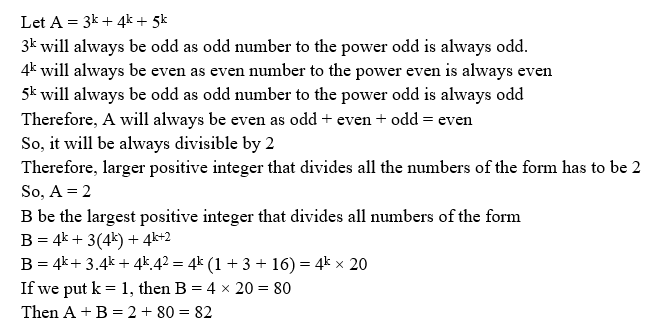
1. Let A be the largest positive integer that divides all the numbers of the form 3k + 4k + 5k, and B be the largest positive integer that divides all the numbers of the form 4k + 3(4k) + 4k + 2, where k is any positive integer. Then (A + B) equals
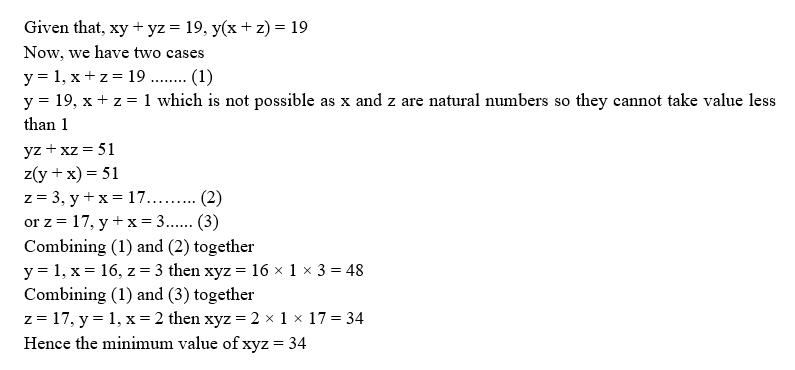
2. For natural numbers x, y and z, if xy + yz = 19 and yz + xz = 51, then the minimum possible value of xyz is
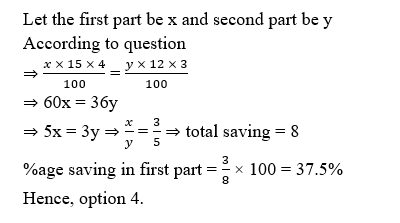
3. Alex invested his savings in two parts. The simple interest earned on the first part at 15% per annum for 4 years is the same as the simple interest earned on the second part at 12% per annum for 3 years. Then, the percentage of his savings invested in the first part is
62.5%
40%
60%
37.5%
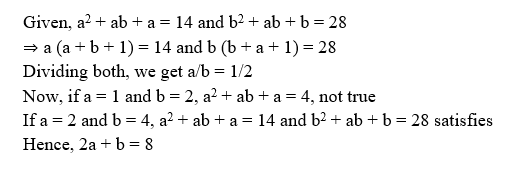
4. Let a and b be natural number. If a2 + ab + a = 14 and b2 + ab + b = 28, then (2a + b) equals
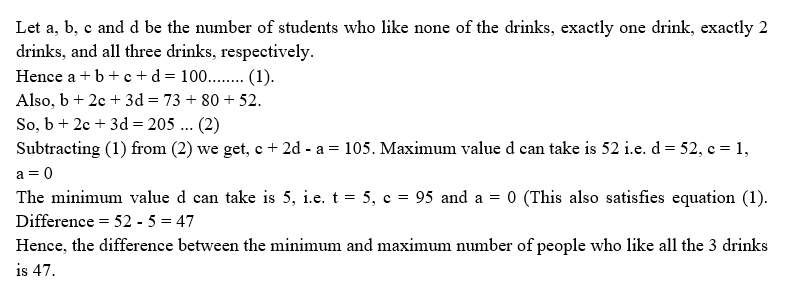
5. In a class of 100 students, 73 like coffee, 80 like tea and 52 like lemonade. It may be possible that some students do not like any of these three drinks. Then the difference between the maximum and minimum possible number of students who like all the three drinks is
48
52
47
53
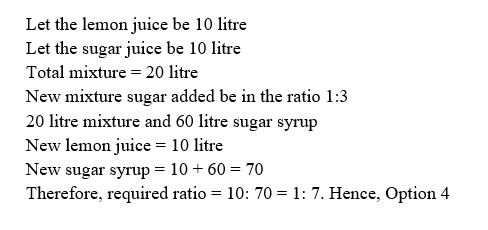
6. A mixture contains lemon juice and sugar syrup in equal proportion. If a new mixture is created by adding this mixture and sugar syrup in the ratio 1: 3, then the ratio of lemon juice and sugar syrup in the new mixture is
1: 4
1: 5
1: 6
1: 7
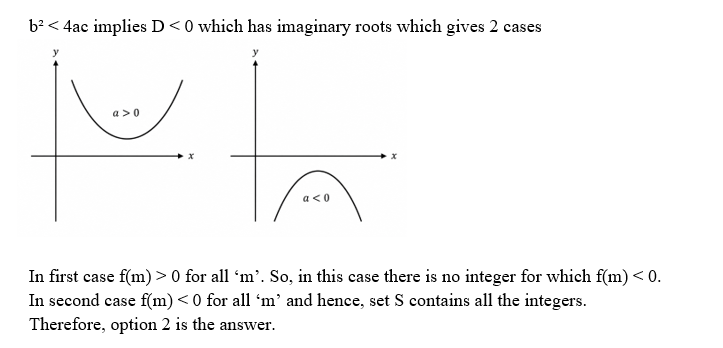
7. Let a, b, c be non-zero real numbers such that b2 < 4ac, and f(x) = ax2 + bx + c. If the set S consists of all integers m such that f(m) < 0, then the set S must necessarily be
the empty set
either the empty set or the set of all integers
the set of all integers
the set of all positive integers
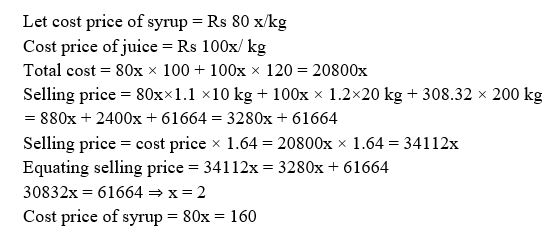
8. Amal buys 110 kg of syrup and 120 kg of juice, syrup being 20% less costly than juice, per kg. He sells 10 kg of syrup at 10% profit and 20 kg of juice at 20% profit. Mixing the remaining juice and syrup, Amal sells the mixture at Rs. 308.32 per kg and makes an overall profit of 64%. Then, Amal’s cost price for syrup, in rupees per kg, is
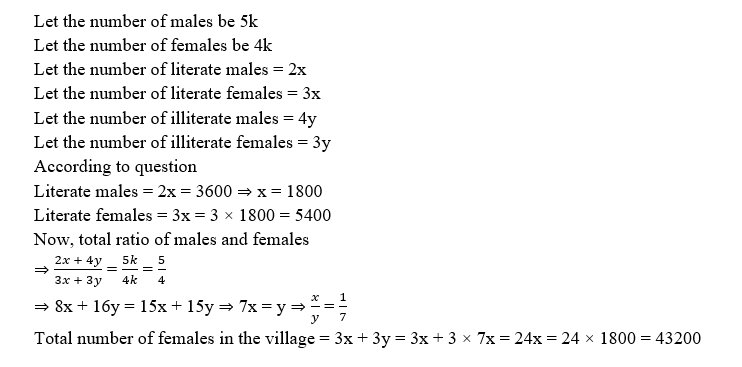
9. In a village, the ratio of number of males to females is 5: 4. The ratio of number of literate males to literate females is 2: 3. The ratio of the number of illiterate males to illiterate females is 4: 3. If 3600 males in the village are literate, then the total number of females in the village is
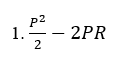
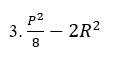
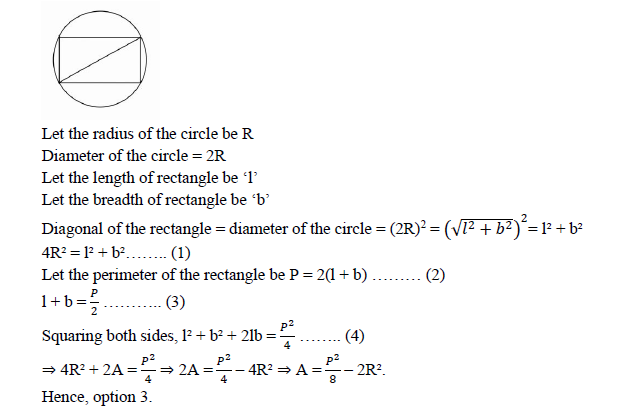
10. All the vertices of a rectangle lie on a circle of radius R. If the perimeter of the rectangle is P, then the area of the rectangle is
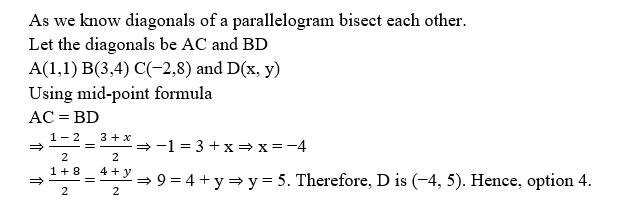
11. Let ABCD be a parallelogram such that the coordinates of its three vertices A, B, C are (1, 1), (3, 4) and (−2, 8), respectively. Then, the coordinates of the vertex D are
(0, 11)
(−3, 4)
(4, 5)
(−4, 5)
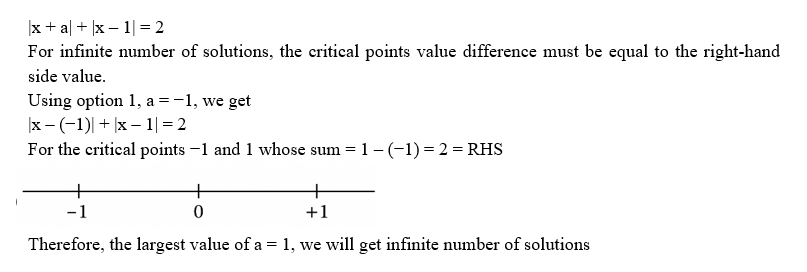
12. The largest real value of a for which the equation |x + a| + |x – 1| = 2 has an infinite number of solutions for x is
- 1
0
1
2
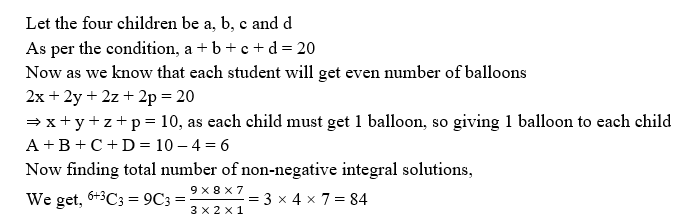
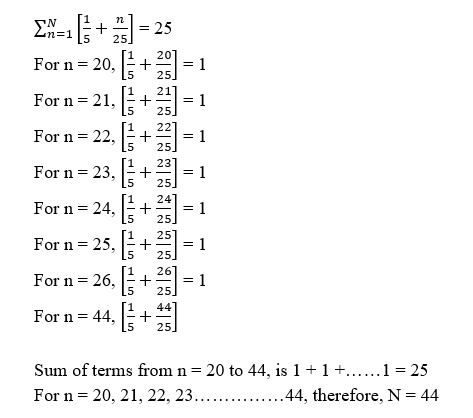
13. The number of ways of distributing 20 identical balloons among 4 children such that each child gets some balloons but no child gets an odd number of balloons, is
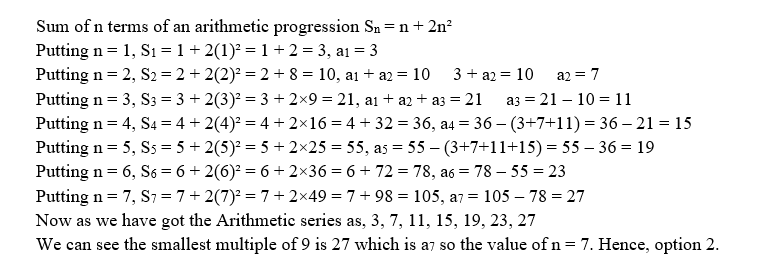
14. For any natural number n, suppose the sum of the first n terms of an arithmetic progression is (n + 2n2). If the nth term of the progression is divisible by 9, then the smallest possible value of n is
4
7
8
9
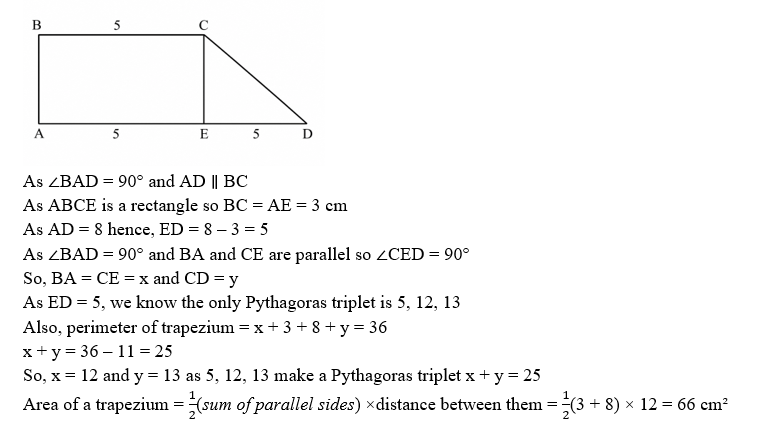
15. A trapezium ABCD has side AD parallel to BC, ∠BAD = 90°, BC = 3cm and AD = 8cm. If the perimeter of this trapezium is 36cm, then its area, in sq. cm, is
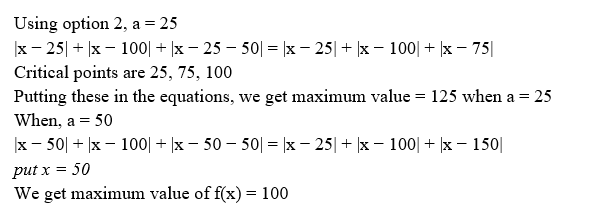
16. Let 0 ≤ a ≤ x ≤ 100 and f (x) = |x – a| + |x – 100| + |x – a – 50|. Then the maximum value of f(x) becomes 100 when a is equal to
50
25
100
0
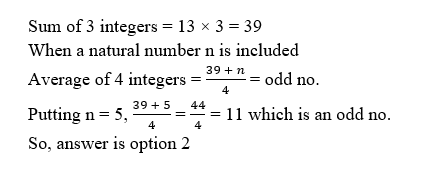
17. The average of three integers is 13. When a natural number n is included, the average of these four integers remains an odd integer. The minimum possible value of n is
3
5
4
1
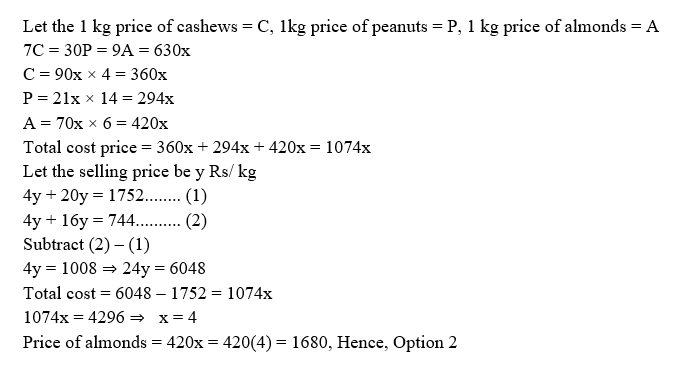
19. Ankita buys 4 kg cashews, 14 kg peanuts and 6 kg almonds when the cost of 7 kg cashews is the same as that of 30 kg peanuts or 9 kg almonds. She mixes all the three nuts and marks a price for the mixture in order to make a profit of Rs.1752. She sells 4 kg of the mixture at this marked price and the remaining at a 20% discount on the marked price, thus making a total profit of Rs. 744. Then the amount, in rupees, that she had spent in buying almonds is
1176
1680
2520
1440
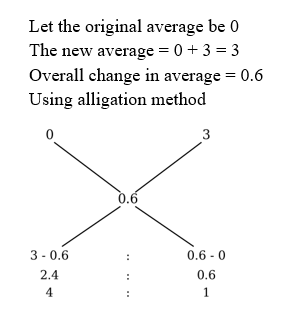
20. The average weight of students in a class increases by 600 gm when some new students join the class. If the average weight of the new students is 3 kg more than the average weight of the original students, then the ratio of the number of original students to the number of new students is
1: 4
1: 2
4: 1
3: 1
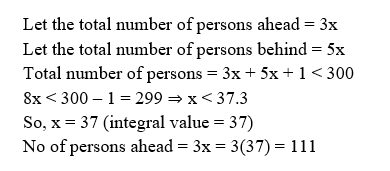
21. Pinky is standing in a queue at a ticket counter. Suppose the ratio of the number of persons standing ahead of Pinky to the number of persons standing behind her in the queue is 3: 5. If the total number of persons in the queue is less than 300, then the maximum possible number of persons standing ahead of Pinky is
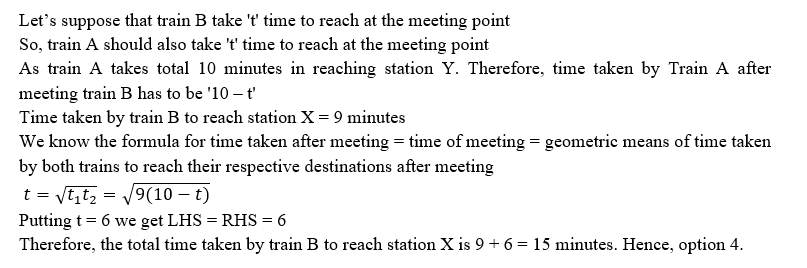
22. Trains A and B start traveling at the same time towards each other with constant speeds from stations X and Y, respectively. Train A reaches station Y in 10 minutes while train B takes 9 minutes to reach station X after meeting train A. Then the total time taken, in minutes, by train B to travel from station Y to station X is
12
10
6
15
We at Quantifiers understand and deliver on the personal attention each of our students requires. Whether it is through our pedagogy that enables non-engineers or non-math background students, our constant effort to proactively provide solutions, or our focus on our student’s goals.