




CAT 2026 Strategy for Non-Engineers — How to Score 99%ile from a B.Com, B.A. or BBA Background
Non-engineer preparing for CAT 2026? Good. 30% of IIM students come from non-engineering backgrounds — and they are not there by accident. This is the section-by-section strategy that gets non-engineers to 99%ile, built around where you already have an edge and exactly how to close the gap in QA.
- The Non-Engineer Reality in CAT — What the Data Says
- Your Hidden Advantages as a Non-Engineer
- QA Strategy for Non-Engineers — Start Here, Not with Algebra
- DILR Strategy — The Great Equaliser
- VARC Strategy — Where Non-Engineers Win
- The Diversity Bonus — How IIM Admissions Work in Your Favour
- Quantifiers Non-Engineer Toppers — Real Results
- The 6-Month Plan — Non-Engineer Edition
1. The Non-Engineer Reality in CAT — What the Data Says
Let us start with facts. In any given CAT cycle, roughly 30% of candidates who convert top IIM calls come from non-engineering backgrounds — B.Com, B.A., BBA, B.Sc., and similar streams. The IIMs publish this data. It is not a motivational statistic — it is an institutional reality.
These students do not have a secret advantage. They do not possess any mathematical superpower. They are graduates from non-engineering streams who decided that CAT was worth their full preparation effort — and then put in that effort with a structured plan.
The math is simple: if engineers dominate the applicant pool but non-engineers still get 30% of seats, non-engineers are over-represented relative to their share of applicants. IIMs are actively seeking diverse classrooms. Your background is not a barrier — it is a differentiator.
The Honest Starting Point
No inherent advantage. No inherent disadvantage. Any gap between a non-engineer and an engineer comes entirely from preparation history — not from background. Engineers who cleared JEE have more QA practice hours. That is the only real difference. And practice hours are something you can add right now. Every hour you put into CAT prep narrows that gap. None of it is permanent.
2. Your Hidden Advantages as a Non-Engineer
Most non-engineers walk into CAT preparation focused entirely on their perceived weaknesses — usually QA. In doing so, they miss the genuine advantages their background gives them. Know these. Use them.
VARC — You Have Been Doing This for Years
Reading Comprehension is not a new skill for anyone who went through a standard school education. Every board exam — Class 10, Class 12 — had RC passages. Your English education built comprehension habits that engineers, who spent most of their preparation time on JEE Mathematics, often did not. Many non-engineers score significantly higher in VARC than their engineering batchmates — and VARC is 24 of the 68 questions in CAT.
Business & Economics Foundation
B.Com, BBA, and Economics students arrive at MBA with a head start in subjects that engineers must learn from scratch: Accountancy, Business Studies, Economics, Financial Statements. During MBA coursework, commerce students frequently explain these concepts to engineering batchmates. This foundation also helps in MBA interview preparation — you can discuss business concepts fluently in a way that engineering students cannot without additional study.
Arithmetic Is Already Your Territory
Approximately 40–45% of CAT QA questions come from Arithmetic — Percentages, Profit & Loss, Ratio & Proportion, Averages, Simple and Compound Interest, Time & Work, Time Speed & Distance. Every non-engineering student studied these in school. They are not foreign concepts — they are familiar ones that need to be reactivated and practised to speed and accuracy.
Diversity Points in IIM Admissions
IIMs explicitly give additional marks for academic diversity in their composite scores. A non-engineer with the same CAT percentile as an engineer has a structurally higher composite score at many IIMs. This is not a small advantage — at the shortlist margin, 2–6 diversity points can be the difference between a call and silence.
3. QA Strategy for Non-Engineers — Start Here, Not with Algebra
QA is the section that non-engineers fear most. The fear is understandable but overblown. Here is the honest breakdown of what CAT actually tests — and what that means for your preparation priority.
Table 1 — CAT QA Topic Priority for Non-Engineers
| Topic Area | CAT Weightage | Non-Engineer Starting Point | Priority |
|---|---|---|---|
| Arithmetic (Percentages, P&L, Ratio, Averages, TSD, T&W, SI/CI) | 40–45% | Studied in school — familiar foundation | 🔴 Highest — master this first |
| Algebra (Linear equations, Quadratic, Functions) | 20–25% | Basic algebra studied in Class 10 | 🟠 High — build after Arithmetic |
| Geometry & Mensuration | 15–20% | School geometry covered basics | 🟠 High — visual learners often excel here |
| Number System (LCM, HCF, Remainders, Unit Digits) | 10–15% | Partially familiar from school | 🟡 Medium — learn the CAT-specific tricks |
| Modern Maths (P&C, Probability, Progressions, Set Theory) | 10–15% | Limited exposure — often new concepts | 🟢 Lower — do basics only, do not over-invest |
What “Number Comfort” Actually Means
Ask yourself honestly: How quickly can you calculate 35% of 480? How comfortable are you with multiplication tables up to 20? How fast do you simplify fractions? This is what separates a non-engineer who struggles in QA from one who does not — not advanced mathematics, but basic numerical fluency built through daily practice.
- Tables up to 20, squares up to 30, cubes up to 15: Memorise these. They appear constantly in CAT calculations and knowing them saves 30–60 seconds per question.
- Practice 15–20 QA problems daily: Not in one topic for a week — interleaved across Arithmetic, Algebra, and Geometry simultaneously. Interleaved practice builds stronger retention.
- Use Quantifiers’ free QA study material: Topic-wise videos from basics with worked examples — built specifically for CAT, including students rebuilding mathematical foundations from school level.
- Some concepts need 8 attempts to click: This is normal. The goal is not the number of attempts — it is continuing until the concept is understood and reproducible under time pressure.
4. DILR Strategy — The Great Equaliser
DILR is the section where background matters least. An engineer and a non-engineer who have both solved 200 DILR sets are roughly equally prepared. This is the section where consistent practice — not prior education — determines performance. It is also the section that moves fastest with structured preparation.
The foundational concepts of DILR — bar charts, pie charts, tables, puzzles, arrangements, scheduling, matching — are all things you encountered in school. They are not new. They are unfamiliar in the timed, competitive exam context — and that is what practice fixes.
The Quantifiers DILR Preparation Sequence
- Sets 1–30: No timer. Understand the set type. Build your approach. Do not rush. The goal is pattern recognition, not speed. Quantifiers has 400+ free DILR sets with video solutions — use these to build your set library.
- Sets 31–100: With timer. Fix a time limit per set (12–15 minutes for medium sets). Build pace without losing approach discipline.
- After 100 sets: Start DILR sectionals. Full 40-minute sections. Real exam conditions. Analyse every set you did not complete — where did time go?
- Set selection in the exam: This is a skill. Spend 30–45 seconds reading each set before deciding which ones to attempt. Two fully solved sets > four half-attempted ones. Non-engineers who develop strong set-selection instincts often outperform engineers in DILR.

5. VARC Strategy — Where Non-Engineers Win
VARC is 24 questions out of 68. It is the section where non-engineers most consistently outperform engineers — and where the percentile gap opens most visibly between the two groups. Use this section as your anchor.
Reading Comprehension (16 Questions)
RC is 67% of VARC. The strategy is reading volume and reading quality — not vocabulary lists or grammar rules. The students who score 90%ile+ in VARC consistently are the ones who read analytical, argument-driven content daily — exactly the kind that CAT RC passages come from.
- Read The Economist, Aeon Essays, and The Guardian daily. These three sources have appeared in CAT RC passages repeatedly across the last 5 years. Reading them builds both comprehension skill and familiarity with the exact writing style CAT tests.
- Read for argument, not for facts. After each article, ask: what is the author trying to say? What evidence do they use? Do they conclude clearly or leave ambiguity? This is the mental model CAT RC questions test.
- Do not memorise vocabulary lists. Vocabulary builds through reading context. When you encounter a new word — look it up, understand it in context, move on. That is the only vocabulary strategy that actually works for CAT.
Verbal Ability (8 Questions — Para Jumbles, Para Summary, Odd One Out)
VA questions are mostly TITA — no negative marking. Never leave a VA question blank even if uncertain. A 50% accuracy on TITA VA questions still produces net positive marks. Para Summary has appeared every year since 2020 — treat it as the most important VA question type to master. Practice at least 5 Para Summary questions per day for 30 days.
VARC Resources
Use Quantifiers’ VARC resources — RC passages with video solutions, Common Traps in RCs guide, and How to Tackle Para Jumbles — all free on the website. The RC video solutions are especially valuable because they show you how an expert approaches reading and answering, not just what the right answer is.
6. The Diversity Bonus — How IIM Admissions Work in Your Favour
This is the section most non-engineers do not know about — and it changes the competitive landscape significantly.
Table 2 — Academic Diversity Bonus at Select IIMs (Approximate)
| IIM | Academic Diversity Bonus | Who Benefits | Impact |
|---|---|---|---|
| IIM Ahmedabad | Academic diversity considered in AWT-PI shortlist | Non-engineers, arts & commerce graduates | Meaningful at margin |
| IIM Bangalore | Academic background weighted in composite | Non-engineers | Structural advantage at shortlist |
| IIM Calcutta | Diversity points in composite score | Non-engineers, women | +2 to +5 points on composite |
| IIM Lucknow | Academic diversity explicitly weighted | Non-engineers | Meaningful at shortlist margin |
| IIM Kozhikode | Strong diversity weighting — explicitly promotes non-engineers | Non-engineers, women | High — IIM-K is known for this |
| Most new IIMs | Academic diversity bonus in composite | Non-engineers | Positive across the board |
7. Quantifiers Non-Engineer Toppers — Real Results
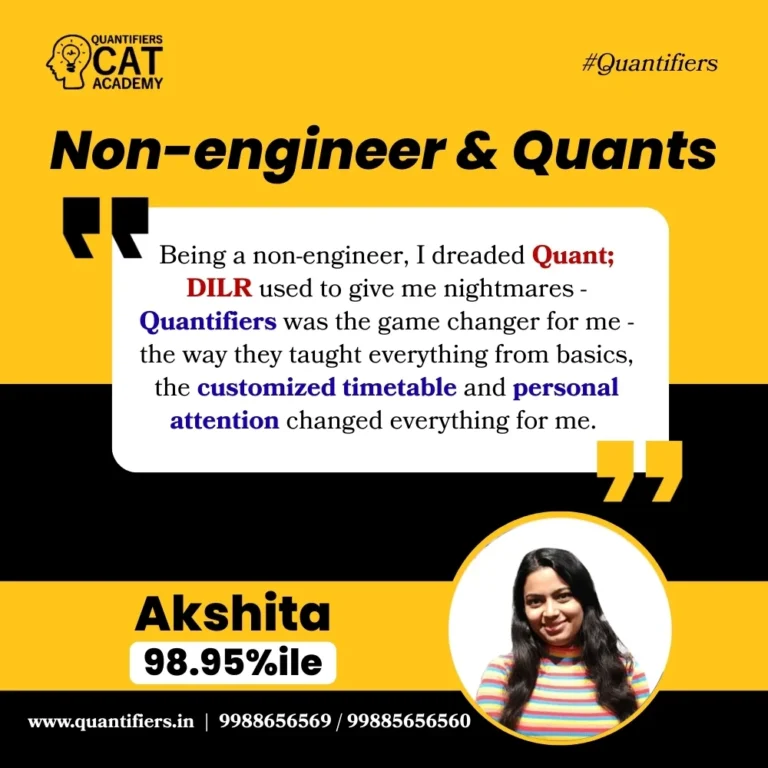
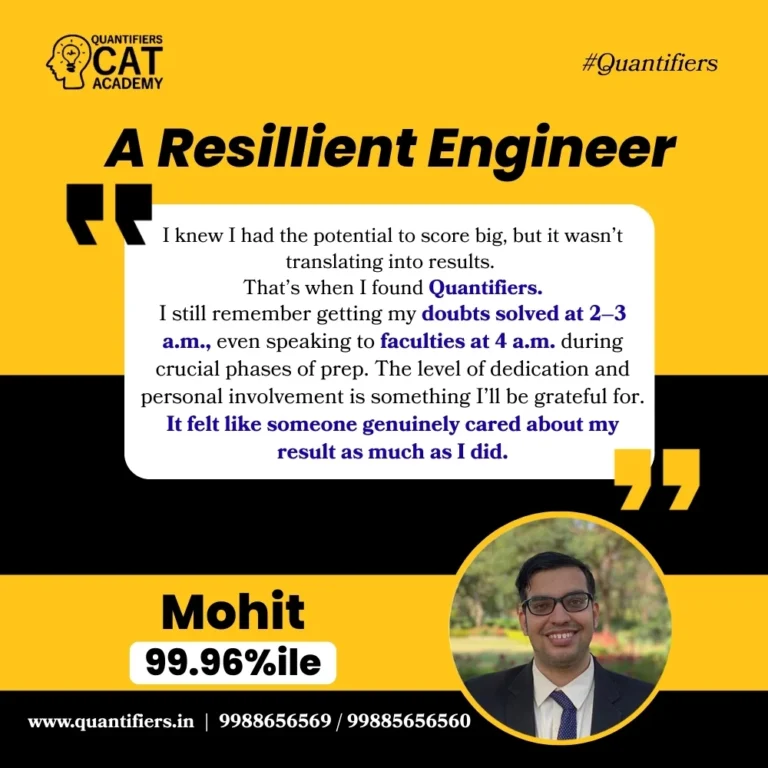
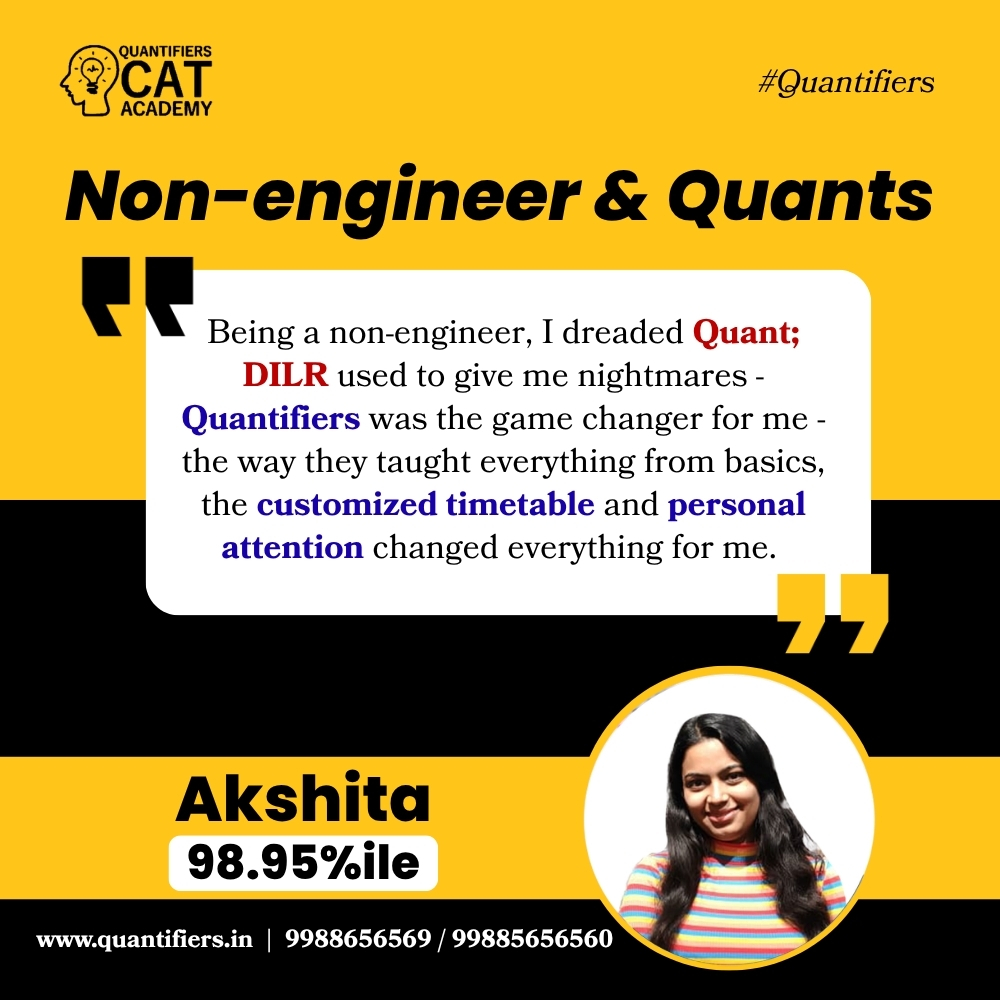
These are Quantifiers students — non-engineering backgrounds, preparing in Chandigarh, converting top IIM calls.
 98.95%ile
 99.14%ile
What These Students Have in Common
None of them had a mathematics background. None of them started with 90%ile mock scores. What they had in common: a structured preparation plan, a customised timetable, daily accountability through Quantifiers mentorship, and the discipline to show up consistently for 6 months. Background was not the variable. Consistency was.
8. The 6-Month Plan — Non-Engineer Edition
This is the month-by-month preparation framework for non-engineering CAT 2026 aspirants — built around your specific section profile: VARC strength, QA rebuild, DILR from scratch.
Table 3 — 6-Month CAT 2026 Preparation Plan for Non-Engineers (June–November)
| Month | QA Focus | DILR Focus | VARC Focus | Mocks |
|---|---|---|---|---|
| June | Arithmetic foundation — Percentages, Ratios, Averages, P&L. Tables, squares, cubes memorised. | Sets 1–30 without timer. Understand each set type. | Daily reading begins — 1 article from The Economist or Aeon. 2 RC passages/day. | Chapter-wise QA tests alongside each topic |
| July | Arithmetic completion — TSD, T&W, SI/CI. Begin Algebra basics. | Sets 31–100 with timer. Start DILR chapter tests. | 2 RC passages daily. Begin Para Summary practice — 5/day. VARC sectionals start. | VARC sectionals begin. QA sectionals if Arithmetic done. |
| August | Algebra + Geometry. Begin Number System basics. | DILR sectionals begin. Analyse every set not completed. | 3 RC passages daily. All VA types practised. Accuracy tracking begins. | First full mocks — 1 per week. Review minimum 2 hrs per mock. |
| September | Modern Maths basics (P&C, Probability — intuition only). Mixed practice across all topics. | 2 DILR sectionals/week. Hard set exposure begins. | Focus on inference and tone questions — common non-engineer trap. | 2 full mocks/week. Error categorisation per mock. |
| October | Speed & accuracy improvement. Timed QA practice — 22 questions in 40 minutes. | Full exam-condition DILR — set selection practice is the main focus now. | Strategy lock — fixed attempt order for RC passages. VA = never skip TITA. | 2–3 full mocks/week. Mock analysis is the most important daily activity. |
| November | Revision of weak Arithmetic topics only. No new topics. | 1 sectional every 3 days. No new set types. | Light RC reading. No new strategy changes. | 1 mock every 2–3 days. Stop mocks 1 week before CAT. Rest and execute. |