








quantifierschd
- March 13, 2026
- Comment 0
📋 Table of Contents
- CAT Quant Section — Format & Overview
- 5-Year Topic-Wise Weightage Trend (2020–2024)
- Arithmetic — The Most Important Unit
- Algebra — The Second Pillar of CAT Quant
- Geometry — Important but Selective
- Number System & Modern Math — Later Stage Topics
- How to Study Quant — Sahil Sir’s 5-Layer Approach
- Engineers vs Non-Engineers — What Changes?
- CAT Quant Score vs Percentile Benchmarks
- Students Who Cracked CAT Quant
- FAQs
One of the most common questions from CAT aspirants is: which topics should I focus on in CAT Quant? And the honest answer is — all of them. But within that honest answer lies a smart preparation strategy. Not all topics contribute equally to the paper, and not all topics carry the same risk if you are weaker in them.
In this blog, Sahil Sir from Quantifiers breaks down the CAT Quant topic-wise trend from 2020 to 2024 — what has appeared, how often, how difficulty has shifted, and exactly how you should prioritise your preparation for CAT 2026. The data is clear. The strategy is practical.
📚 CAT Quant Practice — Free Resource on Quantifiers
Quantifiers has a free Quant Formula Book — every formula explained with video, showing when to use it and how. Possibly the only such resource in India. Download it free from the website.
1. CAT Quant Section — Format & Overview
The Quantitative Aptitude (QA) section of CAT has remained remarkably consistent in format over the last five years. Understanding the structure before diving into topic analysis is essential.
| Parameter | Details |
|---|---|
| Total Questions | ~22 questions per slot |
| Total Marks | 66 marks (3 marks per correct answer) |
| Negative Marking | -1 for wrong MCQ answers; no negative marking for TITA |
| Question Types | MCQ + TITA (Type In The Answer — no options) |
| Weightage in CAT | ~32–34% of total paper |
| Main Units | Arithmetic, Algebra, Geometry, Number System, Modern Math |
✅ Sahil Sir’s Key Insight
CAT Quant is not calculation-heavy — it is concept-heavy and logic-driven. Most questions test whether you understand the concept deeply enough to solve it elegantly. Students who try to brute-force their way through calculations without conceptual clarity consistently lose time and marks.
2. CAT Quant 5-Year Topic-Wise Weightage Trend (2020–2024)
Here is the data that should guide your entire preparation strategy. The numbers below represent approximate question counts per topic across all slots, averaged over the year.
| Topic | CAT 2020 | CAT 2021 | CAT 2022 | CAT 2023 | CAT 2024 | Avg. Weightage |
|---|---|---|---|---|---|---|
| Arithmetic | 8–9 | 8–10 | 7–8 | 7–8 | 8–9 | ~35–40% |
| Algebra | 5–6 | 5–6 | 6–7 | 6–7 | 6–7 | ~25–30% |
| Geometry | 3–4 | 3–4 | 3–4 | 2–3 | 3–4 | ~15–20% |
| Number System | 2–3 | 2–3 | 2–3 | 2–3 | 2–3 | ~10–12% |
| Modern Math (P&C, Probability) | 1–2 | 1–2 | 1–2 | 1–2 | 1–2 | ~5–8% |
Note: Question counts are approximate averages across all slots. CAT is unpredictable — actual distribution may vary.
The conclusion is unmistakable: Arithmetic and Algebra together account for approximately 65–70% of the CAT Quant section every single year. This has not changed meaningfully from 2020 to 2024. If you master these two units, you are already well-positioned to score in the 90th+ percentile range in Quant.
3. Arithmetic — The Most Important Unit
Arithmetic is the single most important unit in CAT Quant and has been for the past five years. It consistently contributes 35–40% of the Quant section — that is 8–9 questions out of 22. More importantly, Arithmetic questions tend to be more approachable than Algebra or Geometry for most students, making them the best return-on-investment area to master.
Sahil Sir’s observation: in recent years, Arithmetic questions increasingly use Algebra concepts — maximisation, minimisation, ratios, and curve-based problems. This means knowing Arithmetic in isolation is no longer enough. You must also study Algebra thoroughly, because the two areas are deeply interlinked in modern CAT papers.
| Layer | Topics | Priority |
|---|---|---|
| Layer 1 — Foundation | Percentages, Averages, Ratios & Proportions, Time Speed Distance, Time & Work | Highest Priority — Do First |
| Layer 2 — Applications | Simple & Compound Interest, Profit & Loss, Partnership, Chain Rule, Mixtures & Alligation | High Priority — Do After Layer 1 |
✅ Sahil Sir’s Pro Tip on Arithmetic
Percentages, Averages, and Ratios are the foundation of all Arithmetic. Many topics — including Time & Work, Partnership, Mixtures — are really just applications of Ratios. Master the foundation first and the applications become significantly easier to learn.
📚 CAT Arithmetic PYQs — Free YouTube Playlist
Solve actual CAT Arithmetic previous year questions with Sahil Sir’s explanations. The fastest way to understand what CAT actually asks from this unit.
4. Algebra — The Second Pillar of CAT Quant
Algebra contributes approximately 25–30% of the CAT Quant section and has been growing slightly in prominence over the last few years. CAT 2024 showed a notably stronger Algebra presence than previous years, confirming that Algebra is no longer a supporting act — it is co-equal with Arithmetic as a core unit.
The most important Algebra topics are Quadratic Equations, Inequalities, and Linear Equations. Sahil Sir specifically highlights one combination that has appeared in CAT almost every year: Inequalities combined with Logarithms. This integration has been a recurring feature and students who are not comfortable with Logarithms lose easy marks whenever this question type appears.
| Algebra Topic | Frequency in CAT | Difficulty Level |
|---|---|---|
| Quadratic Equations | Very High — every year | Moderate |
| Inequalities | Very High — every year | Moderate–High |
| Linear Equations | High — almost every year | Moderate |
| Logarithms + Inequalities (combined) | High — appears almost every year | High |
| Progressions (AP/GP/HP) | Moderate — most years | Moderate |
| Functions & Special Series | Moderate — varies by year | High |
⚠️ Important: Cover the Full Algebra Syllabus
Sahil Sir is direct about this: videos titled “most important topics” are partly made to attract students who are curious. But the real advice is — cover the entire Algebra syllabus. You cannot assume a topic will not appear just because it was absent last year. CAT is unpredictable, and skipping topics based on trends is a risk that can cost you the exam.
5. Geometry — Important but Selective
Geometry has shown a slight decline in CAT over the last 3–4 years compared to earlier. It now typically contributes 3–4 questions per slot, down from 4–5 in some earlier years. However, Sahil Sir never recommends skipping Geometry completely — CAT’s unpredictability means it can bounce back in any given year.
If you are short on time and cannot cover all of Geometry, Sahil Sir’s minimum coverage recommendation is: Triangles, Circles, and Mensuration. These three topics appear most consistently and give you the best coverage for the time invested.
| Geometry Topic | Frequency | Priority |
|---|---|---|
| Triangles | Appears almost every year | Must Do |
| Circles | Appears almost every year | Must Do |
| Mensuration (2D & 3D) | Regular presence | Must Do |
| Coordinate Geometry | Moderate presence | Important |
| Polygons & Quadrilaterals | Occasional presence | Cover if Time Permits |
📚 CAT Geometry PYQs — Free YouTube Playlist
Work through actual CAT Geometry questions from the past years with full explanations. Understanding how CAT frames Geometry questions is as important as knowing the concepts.
6. Number System & Modern Math — Later Stage Topics
Number System and Modern Math (Permutation & Combination, Probability) together typically contribute just 2–3 questions per slot in CAT. This does not mean they should be ignored — but they are clearly lower priority than Arithmetic, Algebra, and Geometry, and should be tackled after those units are strong.
For Number System, the key areas are Remainders, Divisibility Rules, HCF & LCM, and Last Digit concepts. Even with basic familiarity with remainders, you can solve many Number System questions that appear in CAT. Sahil Sir recommends: study what is taught in class, solve previous year questions, and that is generally sufficient for this unit.
For Modern Math, Permutation & Combination and Probability are the main topics. These are considered the most conceptually challenging in Quant — Modern Math questions in CAT often require lateral thinking rather than formula application. A focused study of class material followed by PYQ practice is the right approach here too.
7. How to Study Quant — Sahil Sir’s 5-Layer Approach
Knowing which topics to study is half the battle. The other half is knowing how to study them properly. At Quantifiers, every topic is taught in five structured layers — and this sequence is critical.
| Layer | Stage | What Happens Here |
|---|---|---|
| 1 | Basic Classes | Core concepts taught from scratch — Quantifiers assumes students only know basic arithmetic. No prior Quant knowledge assumed. |
| 2 | Advanced Classes | Higher-difficulty applications, multi-concept questions, CAT-level framing of the same topics. |
| 3 | Assignments | Structured practice with topic-wise question sets to build speed and accuracy independently. |
| 4 | Previous Year Questions | Solving actual CAT questions — the gold standard for understanding exactly how each topic is tested. |
| 5 | Full-Length Tests | Mock tests under timed conditions — building exam temperament, question selection skill, and identifying weak areas. |
📚 CAT Previous Year Questions — Free Access
Layer 4 of Sahil Sir’s approach — PYQs — is non-negotiable. Solve actual CAT Quant questions from 2019–2024 free on Quantifiers.
8. Engineers vs Non-Engineers — What Actually Changes?
Sahil Sir is honest about this: the framing of “topics for engineers vs non-engineers” is partly a hook to get students to engage. The real truth is that all topics are important for everyone. The syllabus does not change based on your background.
What does change is the starting point and the pace. Engineers typically have stronger quantitative comfort — they have seen equations, functions, and coordinate geometry before. Non-engineers may find Algebra and Geometry more challenging initially. But with the right structured approach, this gap closes quickly.
✅ Sahil Sir’s Advice for Non-Engineers
If you feel weak in Maths, start with Arithmetic Layer 1 — Percentages, Averages, Ratios — and build from there. At Quantifiers, we teach assuming students know nothing beyond basic addition and subtraction. The pace is designed so that a non-engineer starting from zero can reach a competitive CAT level. Don’t let your background become a mental barrier.
9. CAT Quant Score vs Percentile Benchmarks
One important thing to understand: your Quant percentile is relative to others giving the same paper. In a difficult Quant year, fewer correct answers can still give a high percentile. Here are approximate benchmarks based on past years:
| Target Percentile (QA) | Approx. Score Needed | Correct Qs (out of 22) | Key Requirement |
|---|---|---|---|
| 99%ile in QA | ~30–33 marks | ~10–11 correct | High accuracy, strong question selection |
| 95%ile in QA | ~21–24 marks | ~7–8 correct | Solid Arithmetic + Algebra base |
| 90%ile in QA | ~15–18 marks | ~5–6 correct | Good Arithmetic + basic Algebra |
Note: These are approximate benchmarks — actual cut-offs vary by year and difficulty level.
📚 Free CAT Mock Tests — Track Your Quant Percentile in Real Time
The only way to truly know where you stand in Quant is to take full-length mocks. Quantifiers offers free mock tests — start benchmarking today.
10. Students Who Cracked CAT Quant
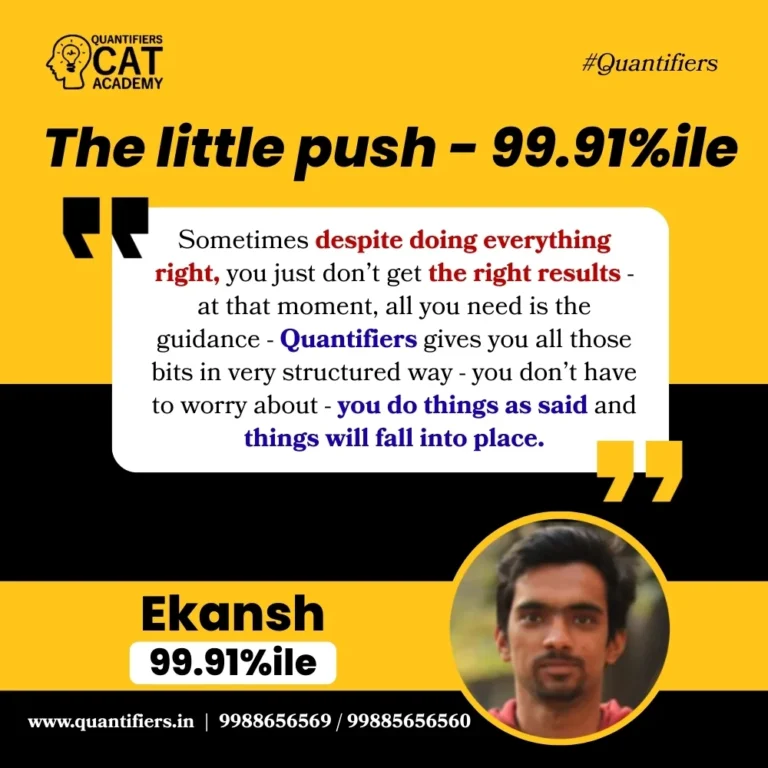
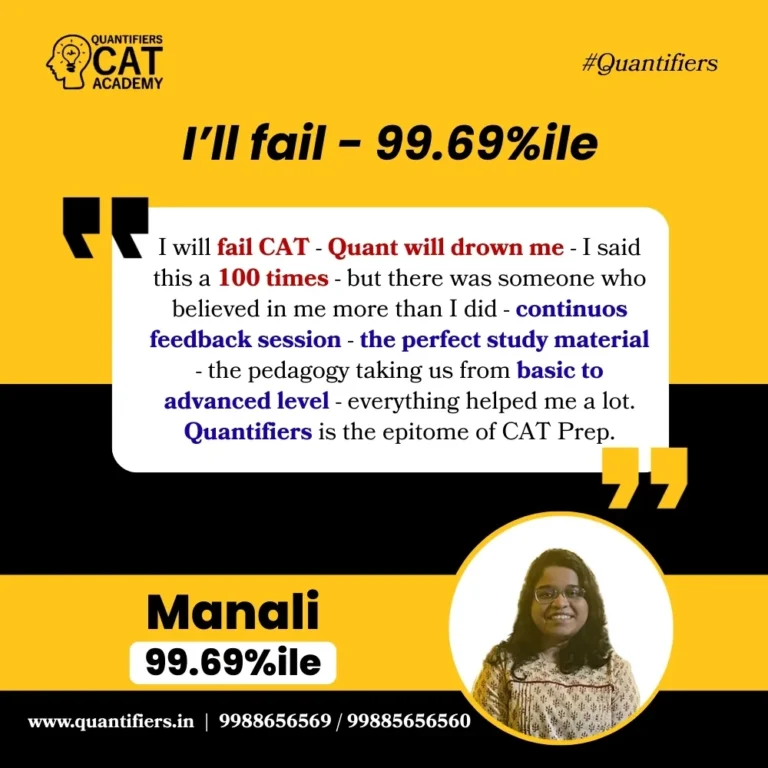
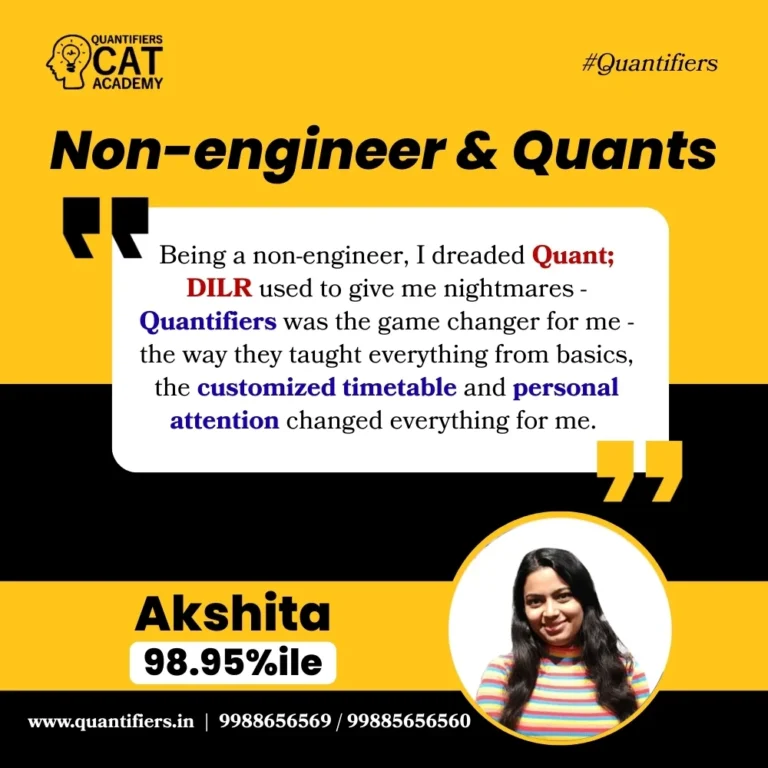
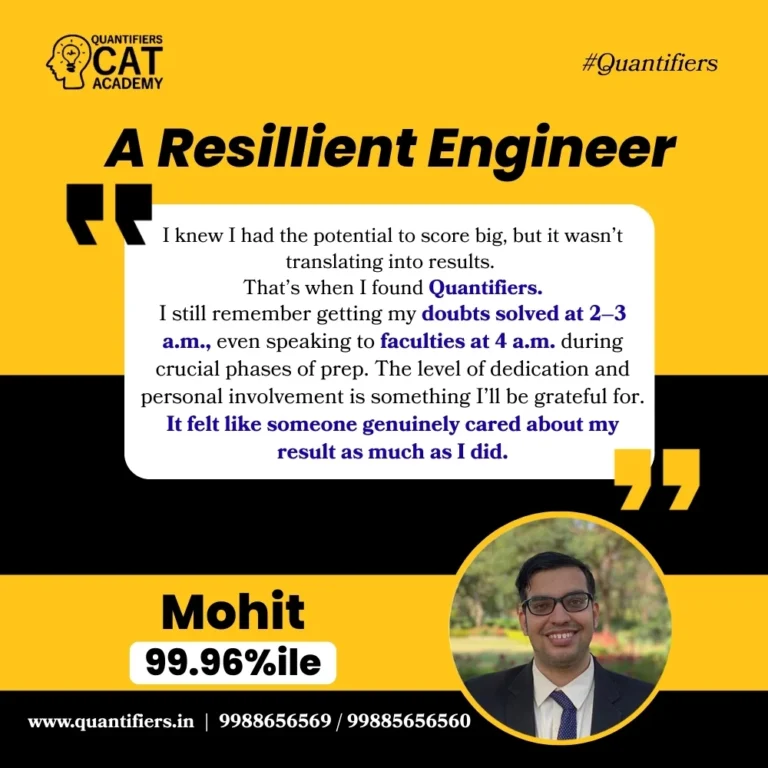
Non-engineers who feared Quant. Engineers who were complacent. Both kinds of students have cracked CAT with the right preparation structure at Quantifiers.
98.95%ile
Akshita — Top IIM
“As a non-engineer I was scared of Quant. Quantifiers changed that completely.”
99.69%ile
Manali — Top IIM
“Improved from 85%ile to 99.69%ile in one attempt with Quantifiers.”
Want to Master CAT Quant with Sahil Sir?
Quantifiers teaches Quant from scratch — assuming zero prior knowledge. Small batches of 25 students, personalised attention, and a track record of 99.98%ile results. Seats are limited.
Join Quantifiers — quantifiers.in
📞 9988656569 / 99885656560
11. Frequently Asked Questions
Q1. Which topic has the highest weightage in CAT Quant?
Arithmetic consistently has the highest weightage in CAT Quant — approximately 35–40% of the section across all years from 2020 to 2024. Topics like Percentages, Ratios, Time Speed Distance, and Time & Work appear every year. Algebra is a close second at 25–30%.
Q2. Can I skip Geometry for CAT 2026?
Sahil Sir strongly advises against skipping Geometry entirely. While it has shown a slight reduction in recent years (down to 3–4 questions from 4–5), CAT is unpredictable and Geometry can return to higher prominence. At minimum, cover Triangles, Circles, and Mensuration. If time permits, cover Coordinate Geometry as well.
Q3. Is Arithmetic enough to score 90 percentile in CAT Quant?
A strong Arithmetic foundation — Layer 1 and Layer 2 combined — can get you close to 90 percentile in Quant if your accuracy is high. But CAT Arithmetic questions increasingly involve Algebra concepts, so Arithmetic alone without basic Algebra is insufficient. For 95%ile+ in Quant, solid Algebra knowledge is essential alongside Arithmetic.
Q4. How many questions do I need to get correct for 99 percentile in CAT Quant?
Approximately 10–11 correct answers out of 22, with minimal negative marking, tends to translate to around 99 percentile in QA. The exact number varies by difficulty — in a tough Quant year, 8–9 correct answers with high accuracy can achieve similar results. Accuracy matters more than raw attempts.
Q5. Is CAT Quant harder for non-engineers?
Non-engineers often find Algebra and Geometry more challenging initially due to less prior exposure. However, the CAT Quant syllabus is based on Class 9–10 mathematics — there is no content that requires engineering-level math. With structured preparation starting from basics, non-engineers can reach the same level as engineers. Akshita, a non-engineer Quantifiers student, scored 98.95 percentile in her second attempt.
Q6. How important is Logarithms in CAT Quant?
Very important. Logarithms combined with Inequalities has appeared in CAT almost every year in the last five years. It is one of the most consistent “tricky” question types. Students who are not comfortable with Logarithms consistently lose marks on these questions. Cover it thoroughly — it is part of Algebra.
Q7. What is the best order to study CAT Quant topics?
Start with Arithmetic Layer 1 (Percentages, Averages, Ratios, TSD, Time & Work), then move to Algebra (Quadratic Equations, Inequalities, Linear Equations, Logarithms), then Geometry (Triangles, Circles, Mensuration), and finally Number System and Modern Math. Follow Sahil Sir’s 5-layer approach for each topic: Basic Classes → Advanced Classes → Assignments → PYQs → Mock Tests.
Want Personalised Guidance from Sahil Sir?
Quantifiers offers small batch coaching with personalised timetables, 24/7 doubt support, and a track record of 99.98%ile results. Seats are limited.
Join Quantifiers — quantifiers.in
📞 9988656569 / 99885656560