




How to Attempt CAT Mocks: A Step-by-Step Strategy to Turn Every Mock Into Percentile Gains
Knowing how to attempt CAT mocks the right way is what separates a 95 from a 99. Most aspirants treat mocks as a scoreboard; toppers treat them as a lab. This guide walks you through exactly how to set up, attempt, and — most importantly — analyse a CAT mock so that every single one moves your percentile.
- Why How You Attempt CAT Mocks Matters More Than How Many
- Before the Mock: Recreate Real Exam Conditions
- How to Attempt CAT Mocks: A Section-by-Section Game Plan
- Time Management & Smart Question Selection
- The Real Work: How to Analyse Every CAT Mock
- How Often Should You Attempt CAT Mocks?
- Common Mistakes to Avoid When You Attempt CAT Mocks
- Practise on India’s Most CAT-Relevant Mocks: TruCAT
1. Why How You Attempt CAT Mocks Matters More Than How Many
Here is the uncomfortable truth: most aspirants who take 40 mocks improve less than the aspirant who takes 20 and dissects every one. A mock is not a report card that tells you where you stand — it is a diagnostic tool that shows you exactly what to fix next. The score is just the headline; the real value is buried in how you attempted the paper and why you lost the marks you lost.
Learning how to attempt CAT mocks properly trains four things at once that no amount of solo topic practice can build: exam temperament under a ticking clock, time discipline across three unforgiving sections, question selection instincts, and accuracy under pressure. Those are exactly the skills CAT actually tests — and they only develop in full-length, exam-like conditions.
💡 Shift Your Mindset Before Your Next Mock
Stop asking “what did I score?” and start asking “what did this mock teach me to fix?” The percentile follows the second question, never the first. Treat each mock as a rehearsal plus a feedback report — not a verdict.
2. Before the Mock: Recreate Real Exam Conditions
A mock taken on your sofa, with pauses for snacks and a phone buzzing beside you, gives you a fake score and false confidence. To get a number you can actually trust, simulate the real thing every single time:
- One unbroken 2-hour sitting — 40 minutes per section, in the same slot you expect on exam day, with no pausing the timer.
- No section-hopping — the real CAT conducted by the IIMs locks each section, so attempt VARC, DILR and QA in order and never go back.
- Only the on-screen calculator and a rough sheet — no physical calculator, no notes, no help.
- Phone away, door shut, distractions gone — train your focus for the exact two hours that will decide your year.
⚠ A Comfortable Mock Is a Useless Mock
Every shortcut you take during a mock — an extra five minutes, a quick break, a peek at your phone — inflates your score and hides the weakness you needed to find. The discomfort of real conditions is the entire point. Practise the exam, not a relaxed version of it.
3. How to Attempt CAT Mocks: A Section-by-Section Game Plan
Each CAT section rewards a different attempt strategy. Knowing how to attempt CAT mocks section by section is what lets you walk in with a plan instead of reacting in panic.
VARC — read for the main idea, don’t marry a passage
Scan the section and start with the reading comprehension set you connect with fastest. Read for structure and the author’s core argument rather than every detail, and resist sinking ten minutes into one dense passage. For the verbal ability questions (para-jumbles, summary, odd-sentence), trust your first well-reasoned answer and move on.
DILR — set selection is the entire game
Spend the first three to four minutes scanning every set before solving anything. Your score here is decided almost entirely by which two or three sets you choose to attempt. Pick the most solvable ones, commit fully, and — this is the hard part — be willing to abandon a set that isn’t opening up, even after you’ve invested time in it.
QA — sitters first, accuracy over volume
Do a first pass and solve every question you recognise immediately. Flag the long or unfamiliar ones and return on a second pass. Because of negative marking, a clean 18 questions at high accuracy beats a frantic 26 with guesses. Use the on-screen calculator sparingly — reaching for it on simple arithmetic costs more time than it saves.
4. Time Management & Smart Question Selection
CAT is not a test of how many questions you can do — it is a test of which questions you choose and how cleanly you close them. The single biggest lever in any mock is a two- or three-pass approach within each section.
- Pass 1 — the sitters: Sweep the section and bank every question or set you can solve quickly and confidently.
- Pass 2 — the moderates: Return to the flagged questions that are doable but slower.
- Pass 3 — leftovers: Take calculated calls only on what remains, never blind guesses on heavily negative questions.
- Have an exit rule: If a question or set hasn’t opened up in ~2.5 minutes with no traction, leave it. Discipline here protects your accuracy and your nerves.
💡 Your Score = Attempts × Accuracy
High attempts with low accuracy actively lose marks to negative marking. The winning formula is smart selection plus high accuracy — a focused, well-chosen attempt set almost always beats an aggressive, scattered one. Use every mock to refine where your personal line sits.

5. The Real Work: How to Analyse Every CAT Mock
If you remember one thing from this guide, remember this: the analysis matters more than the mock. Aim to spend two to three hours dissecting a full-length paper — often more time than you spent attempting it. This is where the percentile is actually built.
Go through every question — the ones you got wrong, the ones you skipped, and even the ones you got right by a lucky guess. Then sort each lost or shaky mark into a clear category, because the fix is different for each one.
Table 1 — Categorise Every Error, Then Fix It
| Error Type | What It Really Means | The Fix |
|---|---|---|
| Concept gap | You didn’t know the method or idea | Revisit the concept, then redo similar questions untimed |
| Silly / calculation slip | You knew it but lost it in execution | Slow down, tighten rough-work discipline |
| Time sink | You spent too long for too little return | Sharpen your exit rule and first-pass scanning |
| Wrong selection | You picked a hard set over an easy one | Improve your scan-before-you-solve habit |
| Lucky guess | Right answer, no real understanding | Treat it as a gap and learn it properly |
Keep a running error log across mocks. When the same category keeps showing up — say, time sinks in DILR or calculation slips in QA — you have found your single highest-value thing to fix before the next mock. Track your section-wise accuracy, attempt rate and time per question over time, and watch the trend, not any single score.
💡 The One-Weakness Rule
After each mock, pick the one weakness that cost you the most and fix it before your next attempt. One deliberate fix per mock compounds fast — that is how a disciplined aspirant climbs from the 80s to 99+ over a season.
6. How Often Should You Attempt CAT Mocks?
More mocks is not better — better-analysed mocks is better. Roughly 25 to 40 well-dissected full-lengths across your preparation is plenty. Here is a realistic, phase-wise rhythm for how often to attempt CAT mocks.
Table 2 — A Phase-Wise Mock Schedule
| Phase | Mock Frequency | Focus |
|---|---|---|
| Foundation (building concepts) | 1 every 10–14 days | Get used to the format; lean on sectional tests |
| Build-up (≈3–4 months out) | 1 per week | Full-lengths with deep analysis after each |
| Peak (final 6–8 weeks) | 2 per week | Simulate your real slot; lock your strategy |
| Final 2 weeks | Taper to 1–2 | Light analysis, revision, rest, stay sharp |
If you ever have to choose between squeezing in one more mock and properly analysing the last one, always analyse. An un-analysed mock is a missed lesson, not a step forward.
7. Common Mistakes to Avoid When You Attempt CAT Mocks
Even sincere aspirants quietly lose percentile points to the same handful of habits. Audit yourself against this list:
- Taking mocks without analysis — the single biggest mistake; you repeat the same errors forever.
- Chasing attempts over accuracy — volume feels productive but bleeds marks to negative marking.
- Obsessing over percentile and comparisons — it spikes stress and teaches you nothing; track your own trend instead.
- Mocking irregularly — sporadic mocks produce sporadic performance and shaky temperament.
- Not simulating real conditions — relaxed mocks give you a number you can’t trust.
- Ignoring the error log — without it, you never see the pattern that’s actually holding you back.
- Panicking on a tough section — one ugly section is normal; let it go and protect the next two.
- Changing your whole strategy every mock — give a strategy three or four mocks before you judge it.
8. Practise on India’s Most CAT-Relevant Mocks: TruCAT
Everything above only works if your mocks behave like the real CAT. An easy mock that flatters your score teaches you nothing; a mock that mirrors CAT’s difficulty and scaling tells you the truth. That realism is exactly why Quantifiers built TruCAT — India’s most CAT-relevant mocks, and made them completely free.
- 10 full-length mocks, absolutely ₹0: No cost, no subscription — a complete mock series open to every CAT 2026 aspirant.
- Built on 10 years of CAT pattern analysis: Calibrated to real CAT difficulty, so your score is an honest one.
- Detailed video explanations: Every question solved on video, plus text solutions for QA — so analysing your mock (the step that actually matters) is faster and deeper.
- Full analytics and an all-India leaderboard: Section-wise accuracy, timing, attempt rate and your national rank, mock after mock.
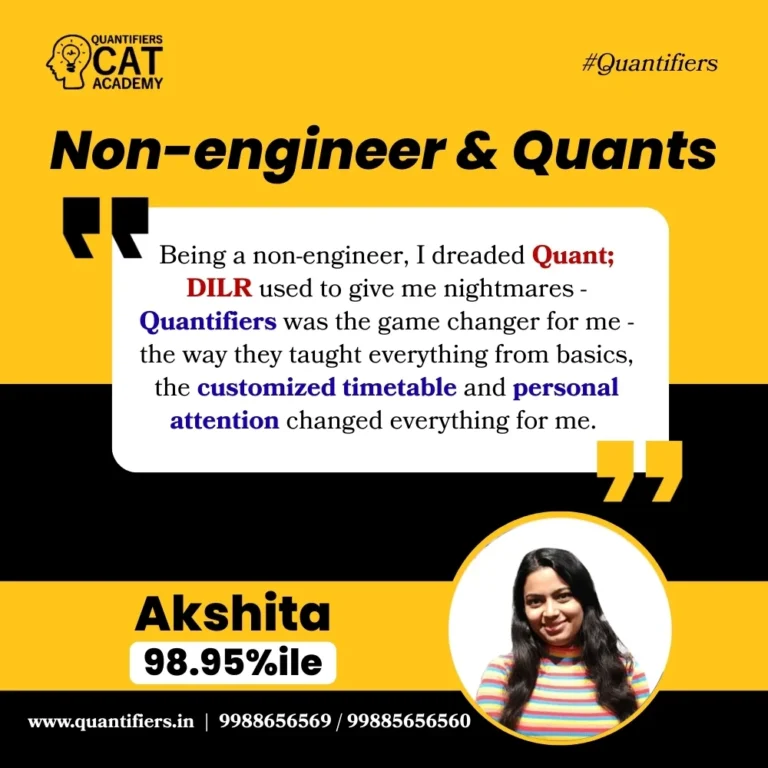
This is the exact loop Quantifiers builds students through every year — attempt realistically, analyse ruthlessly, fix one weakness at a time. Mridul (99.98%ile), Pallav (99.98%ile), Nikhil (99.96%ile) and Akshita (98.95%ile, a non-engineer who conquered QA) are proof that a disciplined mock strategy beats raw talent. Pair TruCAT with the free CAT study material and the Daily Targets on the Quantifiers homepage, and every mock you take from here will actually move the needle.