







quantifierschd
- March 13, 2026
- Comment 0
📋 Table of Contents
You have cracked CAT. Your college is finalised. And now there is a gap — a few weeks or months before your MBA begins. Most students spend this time relaxing. A few use it to get ahead. That small difference in how you use this window can shape your first-year academic performance, internship outcomes, and final placements.
MBA is a cut-throat environment. From Day 1, you are competing with batchmates who may have years of work experience, strong commerce or finance backgrounds, or prior exposure to case studies and business strategy. If you walk in unprepared, the learning curve hits hard — and fast.
In this blog, Sahil Sir from Quantifiers walks you through the 10 best online courses to do before your MBA begins — along with what to prioritise based on your background and target specialisation.
1. Why Pre-MBA Courses Give You a Real Edge
MBA programs move fast. Professors assume a certain baseline. Topics that take a well-prepared student 30 minutes to grasp can take an unprepared student three to four hours. Multiply that across every subject over two years, and the gap compounds.
But academic prep is only part of the picture. There are two types of MBA students: those who focus only on academics, and those who balance academics with extracurricular activities — case competitions, club involvement, networking. The second type almost always comes out stronger in placements.
✅ Sahil Sir’s Pre-MBA Mindset
The goal is not to master everything before college. The goal is to be comfortable enough with the basics so that you can focus your energy on extracurriculars, networking, and building your profile — the things that actually differentiate you during placements.
Most of the courses listed below are available on Coursera, edX, or LinkedIn Learning — many can be audited for free. They are taught by professors from Wharton, University of Illinois, and other top global business schools. The certifications also add value to your resume and LinkedIn profile before you even step into college.
2. Step 1 — Know Your Background Gap First
Before picking any course, understand where your gap actually is. The answer depends on your undergraduate background.
| Your Background | Likely Gap | Priority Area |
|---|---|---|
| Non-Commerce / Engineering / Science | Accounting, Finance basics | Finance & Accounting courses first |
| Commerce / Economics background | Quantitative subjects, Operations Research | Math, OR, and Operations courses first |
| Any background targeting Marketing | Consumer behaviour, digital marketing | Consumer Behaviour + Digital Marketing Analytics |
| Any background targeting HR | People management, HR analytics | Managing Employee Performance + People Analytics |
| Any background targeting Finance | Corporate finance fundamentals | Financial Accounting + Corporate Finance |
📚 Free CAT Resources — Still Useful Before MBA
The Quant and DILR skills you built during CAT prep are directly useful in MBA — especially for Operations Research, Statistics, and case competitions. Don’t discard that foundation.
3. The 10 Courses You Must Do Before MBA
1. Business Foundations (Wharton — Coursera)
Platform: Coursera | Offered by: Wharton School, University of Pennsylvania | Can be audited free
This is the single best starting point for any MBA aspirant regardless of background. The Wharton Business Foundations Specialisation covers Marketing, Financial Accounting, Operations Management, and Corporate Finance — essentially a preview of your first-year MBA core curriculum. It gives you a structured understanding of how businesses function, how to analyze business situations, and how to think like a manager.
🎯 Best for: Everyone — especially freshers and those with no prior business exposure
2. Introduction to Financial Accounting (Wharton — Coursera)
Platform: Coursera | Offered by: University of Pennsylvania | Can be audited free
If you come from a non-commerce background — engineering, science, arts — and have never studied accounts, this course is extremely important. Accounting is the language of business. In your MBA, every finance, strategy, and operations case will involve reading balance sheets, profit & loss statements, and cash flow statements. This course teaches you that language from scratch, taught by Wharton faculty.
🎯 Best for: Non-commerce students — priority course
3. Introduction to Corporate Finance (Wharton — Coursera)
Platform: Coursera | Offered by: University of Pennsylvania | Can be audited free
Corporate Finance is one of the most important and intense subjects in MBA — especially for Finance specialisation students. This course gives you a strong foundation in concepts like time value of money, capital budgeting, risk and return, and financial decision-making in companies. Getting ahead on this before Day 1 will make a significant difference in how quickly you absorb classroom content.
🎯 Best for: Finance aspirants, and anyone who wants to be comfortable in core Finance classes
4. Corporate Finance Essentials (IESE Business School — Coursera)
Platform: Coursera | Offered by: IESE Business School | Certificate available
This course complements the Wharton Corporate Finance course and provides additional insights and a separate certification. It covers valuation, financial analysis, and investment decisions from a practical lens. Having two certifications in Corporate Finance — from two different institutions — strengthens both your knowledge and your resume before you even start MBA.
🎯 Best for: Finance aspirants looking for a second certification to complement Wharton’s course
5. Consumer Behaviour (University of Pennsylvania — Coursera)
Platform: Coursera | Offered by: University of Pennsylvania | Can be audited free
Consumer Behaviour is one of the most important Marketing subjects in MBA. It explores why consumers make the decisions they do — the psychology of perception, motivation, decision-making, and brand loyalty. If you plan to specialise in Marketing, understanding consumer behaviour before college gives you a strong conceptual edge in both classroom discussions and case competitions.
🎯 Best for: Marketing aspirants
6. Digital Marketing Analytics (University of Illinois — Coursera)
Platform: Coursera | Offered by: University of Illinois Urbana-Champaign | Can be audited free
Digital marketing is not just social media posts anymore. It includes Meta/Facebook ads, Instagram advertising, content strategy, SEO, marketing analytics dashboards, and data-driven campaign decisions. This course gives you a clear picture of what modern digital marketing looks like in practice — covering both strategy and the tools used by real marketing teams. An extremely valuable course for Marketing aspirants.
🎯 Best for: Marketing aspirants, especially those eyeing digital marketing or e-commerce roles
7. Managing Employee Performance (Coursera)
Platform: Coursera | Certificate available
HR has many sub-domains — recruitment, training, performance management, employee relations, and compensation. This course focuses on one of the most critical: how employee performance is managed and measured. It is a great entry point into the HR field and will give you foundational vocabulary and frameworks that will appear repeatedly in HR electives during MBA.
🎯 Best for: HR aspirants, or anyone who is still exploring specialisations
8. People Analytics (Wharton — Coursera)
Platform: Coursera | Offered by: Wharton School, University of Pennsylvania | Can be audited free
People Analytics is the fastest-growing area within HR. Instead of relying on intuition, organisations now use employee data — performance metrics, attrition patterns, engagement scores — to make smarter HR decisions. This Wharton course teaches you how to apply analytical thinking to HR challenges, making you a stronger candidate in a field that is increasingly demanding data literacy.
🎯 Best for: HR aspirants who want to differentiate themselves with analytics skills
9. Introduction to Operations Management (Wharton — Coursera)
Platform: Coursera | Offered by: Wharton School, University of Pennsylvania | Can be audited free
Operations Management covers supply chains, process design, quality control, and efficiency optimization — fundamental topics whether you are targeting consulting, operations, or even general management roles. In India, IIT Mumbai’s SJMSOM is known as one of the top institutes specifically for operations placements, but strong operations knowledge is valued across every top B-school. This course gives you a strong head start.
🎯 Best for: Operations aspirants, consulting aspirants, and commerce students wanting to address their quantitative gap
10. Excel / Data Analysis for Business (Microsoft / Coursera)
Platform: Coursera / LinkedIn Learning | Multiple providers available | Widely free
Excel fluency is expected in virtually every MBA role — Finance, Marketing, HR, and Operations all use it heavily for modelling, dashboards, and data analysis. Yet many students enter MBA with only basic spreadsheet skills. A solid Excel or data analysis course before college will save you enormous time during case competitions, live projects, and internship assignments. This is not glamorous, but it is one of the most practically impactful things you can do.
🎯 Best for: Everyone — especially non-engineers who may not have worked extensively with Excel
📚 Free CAT VARC Practice — Reading Skills That Help in MBA Too
Strong reading comprehension and para-analysis skills from VARC preparation directly improve your ability to read case studies, business reports, and strategy articles during MBA. Keep those skills sharp.
4. Bonus: Case Competitions on Unstop — Don’t Skip This
Alongside online courses, there is one more thing Sahil Sir strongly recommends before your MBA begins — and many students have not heard of it yet.
The platform is called Unstop (previously known as Dare2Compete). It is one of the most popular platforms in the MBA ecosystem for case study competitions. Companies like HUL, Mahindra, and many other major corporates host case competitions here where you can participate individually or as a team.
Why does this matter before MBA? Because if you lack work experience, case competitions are one of the best ways to build something meaningful on your resume. They also put you in front of placement committees and companies who are actively looking for talent. Starting before college begins means you can enter your first year with a competition or two already on your profile — which immediately sets you apart.
⚠️ An Honest Note from Sahil Sir
Case competitions do not fully replace work experience on your resume. But they are the closest thing to it if you are a fresher. The more competitions you participate in — even without winning — the more exposure, confidence, and profile visibility you build. Start early, participate often.
5. Which Courses Are Right for You? (By Specialisation)
You do not need to do all 10 courses. Here is a quick guide on which ones to prioritise based on the specialisation you are targeting:
| Target Specialisation | Must-Do Courses | Also Recommended |
|---|---|---|
| Finance | Financial Accounting, Corporate Finance, Corporate Finance Essentials | Business Foundations, Excel/Data Analysis |
| Marketing | Consumer Behaviour, Digital Marketing Analytics | Business Foundations, Excel/Data Analysis |
| HR | Managing Employee Performance, People Analytics | Business Foundations, Excel/Data Analysis |
| Operations / Consulting | Operations Management, Business Foundations | Excel/Data Analysis, Corporate Finance |
| Not decided yet | Business Foundations, Financial Accounting | Excel/Data Analysis, and one course each from Finance, Marketing, HR |
✅ Sahil Sir’s Practical Advice
If you have 4–6 weeks before MBA begins, pick 3–4 courses maximum and actually complete them. Half-completed courses add no value to your profile or preparation. Quality over quantity — always. And do not forget to register on Unstop and start looking at case competitions in parallel.
6. Students Who Came Prepared
Students who prepared well before MBA — both for the CAT and in the pre-MBA window — consistently outperform in their first year. Here is what some Quantifiers students have to say:
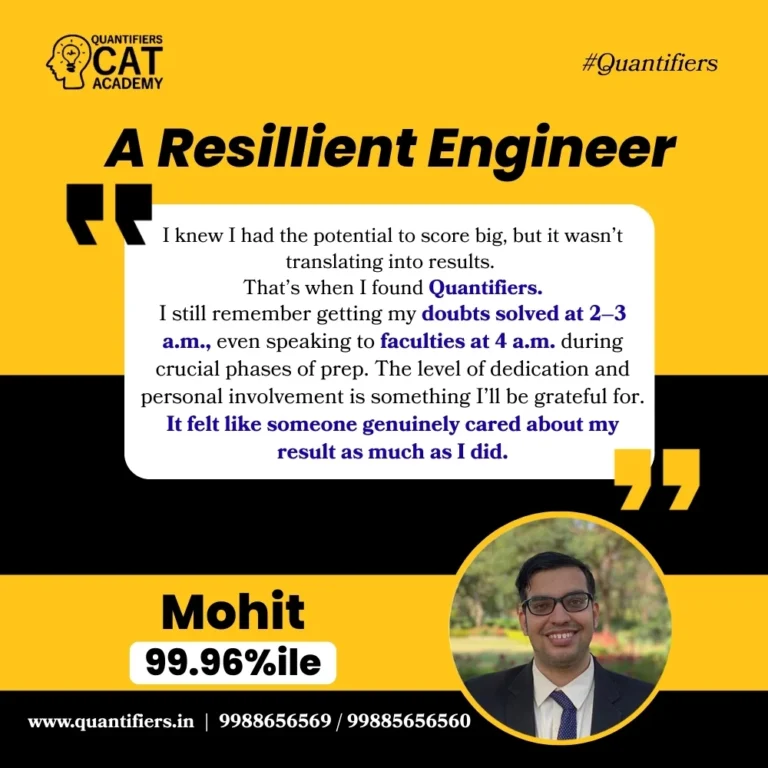
99.97%ile
Mohit — Top IIM
“Working professional who cracked CAT with Quantifiers’ personal mentorship. The structured approach Sahil Sir gave me — both for CAT and for what comes after — was invaluable.”
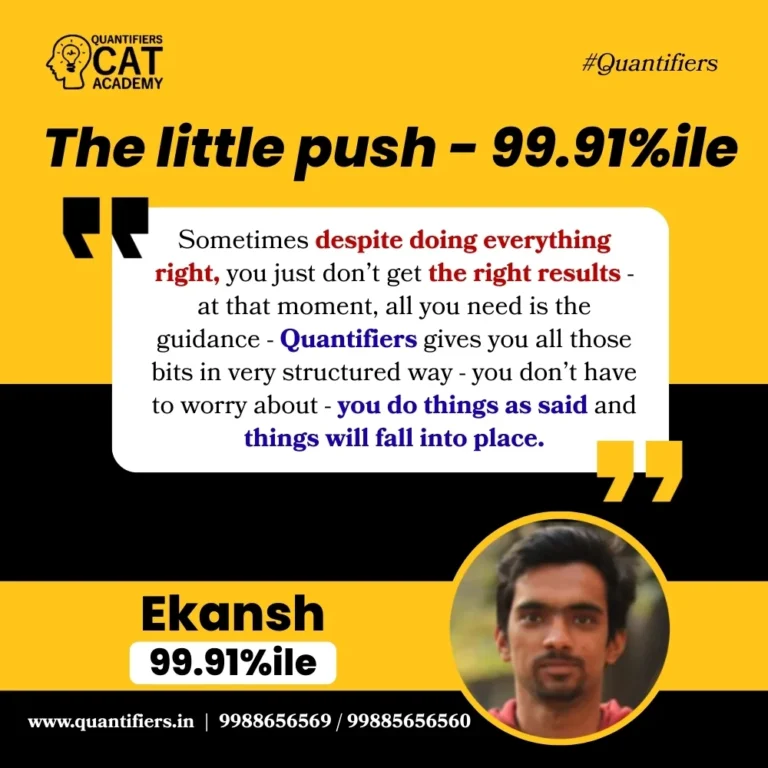
99.91%ile
Ekansh — Top IIM
“The structured daily timetable Sahil Sir gave me was a game changer — not just for CAT, but for building the discipline I needed for MBA.”
Still Preparing for CAT? Get Personalised Guidance from Sahil Sir.
Quantifiers offers small batch coaching with personalised timetables, 24/7 doubt support, and a track record of 99.98%ile results. If you are targeting CAT 2026 or 2027, now is the right time to start.
Join Quantifiers — quantifiers.in
📞 9988656569 / 99885656560
7. Frequently Asked Questions
Q1. Is it really necessary to do online courses before MBA?
Not strictly necessary — but highly beneficial. MBA programs move fast, and professors assume a baseline. Students who prepare in advance spend less time catching up on basics and more time on extracurriculars, networking, and building their profile. These pre-MBA months are often the only free time you will have before two very intense years begin.
Q2. Are these courses free?
Most of the courses listed — especially on Coursera — can be audited for free. You get access to all video content and readings without paying. If you want the graded assignments and a shareable certificate, there is usually a fee. For resume purposes, it is worth paying for at least one or two certificates in your priority areas.
Q3. How many courses should I realistically do before MBA?
Focus on completing 3–4 courses properly rather than starting 10 and finishing none. Prioritise based on your background gap and target specialisation. The Business Foundations course from Wharton is a good starting point for almost everyone — it covers multiple areas in one structured programme.
Q4. What is Unstop and why should I use it before MBA?
Unstop (previously Dare2Compete) is the leading platform for MBA-level case competitions in India. Companies like HUL, Mahindra, and many others host competitions here. Participating before college gives you early exposure to case-solving, builds your resume, and puts you on the radar of companies and placement committees. You can register and participate individually or in teams — it is free to participate.
Q5. I come from an engineering background. Which course should I start with?
Start with Introduction to Financial Accounting (Wharton, Coursera). As an engineer, your quantitative skills are already strong — your gap is in accounting and finance language. Once you complete Financial Accounting, move to Corporate Finance and then to the Business Foundations Specialisation for broader coverage.
Q6. I am a commerce graduate. What should I focus on?
Your finance and accounting basics are likely solid. Focus on Operations Management and any math or statistics foundation for Operations Research — these are areas where commerce students often struggle in MBA. Also look at Digital Marketing Analytics if Marketing interests you, or People Analytics if you are considering HR.
Q7. Will these certifications actually help during MBA placements?
Directly, certificates from Wharton or University of Illinois on your LinkedIn profile and resume do add credibility — especially for freshers who have limited work experience to show. More importantly, the knowledge itself helps you contribute meaningfully in group discussions, case competitions, and internship projects, which is ultimately what shapes your placement outcome.
Want Personalised Guidance from Sahil Sir?
Quantifiers offers small batch coaching with personalised timetables, 24/7 doubt support, and a track record of 99.98%ile results. Seats are limited.
Join Quantifiers — quantifiers.in
📞 9988656569 / 99885656560