


The Actual Cost of CAT 2026 — Registration Fee, Hidden Charges & What the Exam Really Costs You
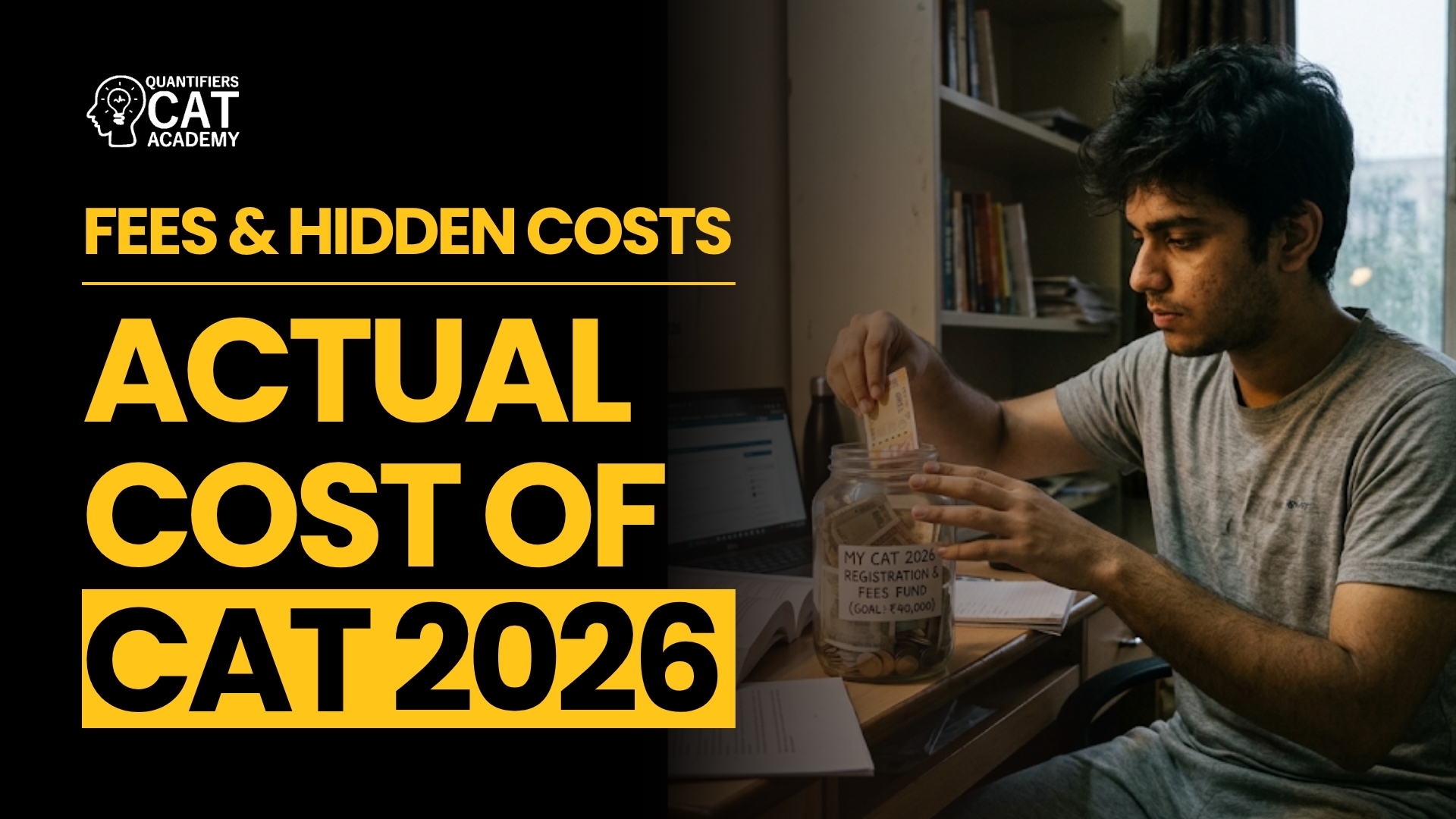
₹2,600 is the number every CAT 2026 aspirant repeats when asked what the exam costs. It’s also, by a wide margin, the smallest number in the real total. Here’s what CAT actually costs once you add payment gateway charges, coaching, mocks, books, and everything else that shows up between registration day and results day.
-
- The Registration Fee — What It Actually Is
- The Part Nobody Mentions — Payment Gateway Charges
- How the Registration Fee Has Climbed Over the Years
- Refund & Cancellation Policy — Read This Before You Pay
- The Real Cost of CAT — Everything Beyond Registration
- Self-Study vs Coaching — Two Very Different Cost Pictures
- What CAT Costs After the Exam — GD-PI-WAT & Beyond
- Building a Realistic CAT 2026 Budget
Watch Our Latest Youtube Video
1. The Registration Fee — What It Actually Is
Start with the number everyone quotes. The CAT 2026 registration fee is expected to stay at ₹2,600 for General, EWS, and NC-OBC candidates, and ₹1,300 for SC, ST, and PwD candidates — figures based on CAT 2025’s fee structure and typically confirmed only when the official notification releases on iimcat.ac.in, the official CAT registration portal, in late July.
Table 1 — CAT 2026 Expected Registration Fee
| Category | Fee |
|---|---|
| General | ₹2,600 |
| EWS | ₹2,600 |
| NC-OBC | ₹2,600 |
| SC | ₹1,300 |
| ST | ₹1,300 |
| PwD | ₹1,300 |
2. The Part Nobody Mentions — Payment Gateway Charges
The ₹2,600 (or ₹1,300) headline figure is what shows up on the registration page. What actually leaves your account is slightly higher, because every online payment mode carries its own processing charge on top of the base fee.
Table 2 — Payment Gateway Charges on Top of the Base Fee
| Payment Mode | Additional Charge |
|---|---|
| Net Banking | ~₹20 flat per transaction |
| Debit Card (Visa/Mastercard) | ~0.90% of the fee if above ₹2,000; ~0.75% plus a small flat charge if near ₹2,000 |
| Credit Card (Visa/Mastercard) | ~1.20% of the fee, minimum ₹5 |
| Credit Card (American Express) | ~2.85% of the fee, minimum ₹5 |
| UPI | Typically no additional charge |
💡 A Small Charge, But Worth Knowing Before You Pay
None of these gateway charges are large enough to change anyone’s decision to register. But candidates paying by American Express credit card, for instance, should expect a noticeably higher add-on than someone paying by UPI — worth knowing so a slightly different final deduction on your statement doesn’t look like an error.
3. How the Registration Fee Has Climbed Over the Years
The registration fee isn’t static — it’s revised most years, generally upward, in modest increments.
Table 3 — CAT Registration Fee, Year-on-Year
| CAT Year | General/EWS/NC-OBC | SC/ST/PwD |
|---|---|---|
| 2020 | ₹2,000 | ₹1,000 |
| 2021 | ₹2,200 | ₹1,100 |
| 2022 | ₹2,300 | ₹1,150 |
| 2023 | ₹2,400 | ₹1,200 |
| 2024 | ₹2,500 | ₹1,250 |
| 2025 | ₹2,600 | ₹1,300 |
4. Refund & Cancellation Policy — Read This Before You Pay
The registration fee is non-refundable under standard circumstances, and there’s no option to cancel your registration and reclaim the amount once paid. Treat the payment step as final — there’s no “change your mind” window afterward.
- The only recognised refund scenario is a duplicate payment. If a technical glitch causes your card or account to be charged twice for the same registration, contact the CAT Helpdesk with proof of both transactions. You can then request a refund of the extra charge.
- A failed transaction where no money was actually deducted doesn’t need a refund request at all — simply retry the payment, ideally after waiting a few minutes rather than attempting again immediately.
- There’s no fee for the correction window that opens a few weeks after registration closes. Corrections to your photograph, signature, or test city preference don’t cost anything extra. The window itself, though, is time-limited to just a few days.
⚠ Don’t Attempt Multiple Payments if a Transaction Seems Stuck
If your payment appears to hang or doesn’t show immediate confirmation, resist the urge to immediately try again. Retrying too quickly is one of the most common causes of accidental double payment — which then requires a refund claim and helpdesk back-and-forth to resolve. Wait, check your bank statement or SMS for a deduction, and only retry if you can confirm no amount was actually deducted.
5. The Actual Cost of CAT — Everything Beyond Registration
Here’s where the ₹2,600 headline figure stops being the useful number. A serious CAT attempt involves several cost categories that rarely get totalled up in one place.
Table 4 — The Full Cost Picture of a CAT 2026 Attempt
| Cost Category | Typical Range | Notes |
|---|---|---|
| Registration Fee | ₹1,300 – ₹2,600 | Fixed, category-dependent, non-refundable |
| Payment Gateway Charge | ₹0 – ₹75 | Varies by payment mode; UPI usually adds nothing |
| Study Material / Books | ₹500 – ₹3,000 | Standard prep books (Arun Sharma, Nishit Sinha, etc.) if self-studying |
| Mock Test Series | ₹0 (free series) – ₹5,000 | Several credible free options exist; paid series generally offer deeper analytics |
| Coaching (Online) | ₹8,000 – ₹25,000 | Wide range depending on institute reputation and course depth |
| Coaching (Offline/Classroom) | ₹25,000 – ₹60,000+ | Typically includes classroom hours, mock series, and personal mentoring |
| Exam-Day Travel & Stay | ₹0 – ₹5,000+ | Depends heavily on whether your allotted test city is your home city |
| GD-PI-WAT Prep & Travel | ₹2,000 – ₹15,000+ | Only for shortlisted candidates; includes interview coaching and travel to interview cities |
6. Self-Study vs Coaching — Two Very Different Cost Pictures
The single biggest lever on your total CAT spend isn’t the registration fee — it’s whether you self-study or enrol in structured coaching.
- Self-study route: registration fee + a few standard books + a free or low-cost mock series. This can realistically stay in the ₹3,000–₹8,000 range for the entire prep cycle. It demands more self-discipline and structure on your part, since there’s no external schedule or mentor pushing you.
- Online coaching route: registration fee + an online course (live or recorded classes, structured curriculum, sectional tests, mentor support) typically in the ₹8,000–₹25,000 band. This adds structure and accountability without the cost of a physical classroom.
- Offline/classroom coaching route: registration fee + classroom fees, which commonly run ₹25,000 to ₹60,000+ depending on the institute and city. This is the most expensive route but often bundles in-person doubt-solving, peer cohorts, and more intensive mock analysis.
💡 Coaching Cost Doesn’t Determine Your Percentile — Consistency Does
Every year produces 99-percentile scorers from all three routes above. A more expensive coaching package buys structure, accountability, and faster doubt resolution — genuinely useful for some learning styles — but it doesn’t buy a guaranteed outcome. Before committing a large sum to a coaching program, honestly assess whether your gap is content (which paid coaching directly addresses) or consistency (which a free mock series and a personal study schedule can address just as well).
Whichever route you pick, the mock series is where a large share of your remaining budget — paid or free — ends up going. If you’re still deciding how many mocks you actually need and how to get the most out of each one, our guide on how many CAT 2026 mocks to take and how to analyze them breaks that down by aspirant type.
7. What CAT Costs After the Exam — GD-PI-WAT & Beyond
The costs most aspirants forget to budget for are the ones that only apply if you clear the cutoff — which is, of course, the outcome you’re hoping for.
- GD-PI-WAT preparation. Many coaching institutes offer separate, paid interview-preparation packages once results are out. These cover mock interviews, group discussion practice, and written-ability test guidance, typically ranging from ₹2,000 to ₹10,000+ depending on depth and duration.
- Travel to interview cities. IIMs and other B-schools conduct their GD-PI-WAT rounds across select cities, and your allotted city may not be your home city. Multiple shortlists at different institutes, held on different dates, can mean multiple separate trips.
- Document verification and admission formalities. Once you have an offer, there are further costs — seat acceptance fees and document processing. Eventually there’s the tuition fee itself, which sits in a completely different financial bracket from anything discussed here.
8. Building a Realistic CAT 2026 Budget
Rather than treating “how much does CAT cost” as a single number, it’s more useful to build a simple three-tier budget based on your prep route.
Table 5 — Three Realistic CAT 2026 Budget Scenarios
| Budget Tier | What It Includes | Approximate Total (Pre-Result) |
|---|---|---|
| Lean Self-Study | Registration fee + 2–3 books + free mock series | ₹3,000 – ₹6,000 |
| Structured Online Coaching | Registration fee + online course + paid mock series add-ons | ₹12,000 – ₹28,000 |
| Full Classroom Coaching | Registration fee + classroom program + travel for classes if applicable | ₹30,000 – ₹65,000+ |