
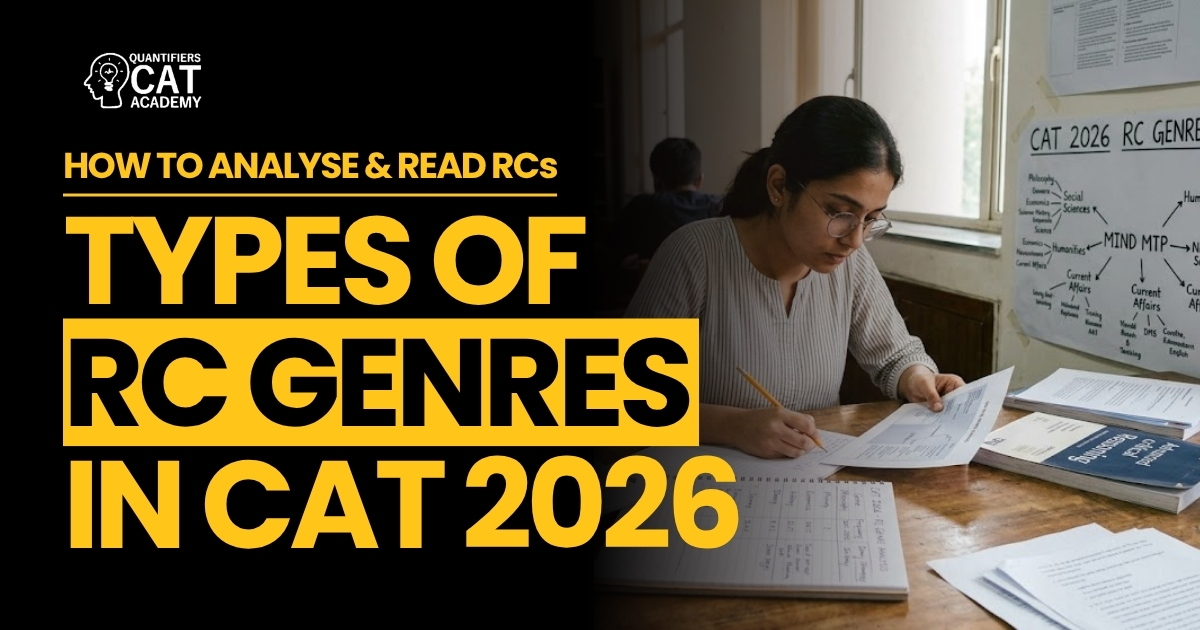

CAT RC Genres 2026: How to Read Every Passage Type Without Losing Time
CAT doesn’t tell you what a passage is about before you start reading it. But once you know the small set of CAT RC genres it keeps drawing from, you stop reading blind — and that alone changes how fast you get through VARC.
- 1. Watch: How to Approach CAT RC Genre-Wise
- 2. Why Genre Recognition Actually Saves You Time
- 3. The Five CAT RC Genres You’ll Keep Running Into
- 4. Genre Isn’t Question Type — Don’t Confuse the Two
- 5. How Your Reading Posture Should Shift by CAT RC Genre
- 6. Building a Genre-Wise Practice Routine That Actually Works
- 7. Where Genre-Wise Practice Goes Wrong
- 8. FAQ
1. Watch: How to Approach CAT RC Genre-Wise
Before we get into the breakdown, it helps to see this applied to an actual passage. Here’s a walkthrough on reading CAT RC passages by genre:
2. Why Genre Recognition Actually Saves You Time
Most students treat every CAT RC genre the same way: read start to finish at one fixed pace, then go back and forth between the passage and the options. That works, but it’s slow, and slow is expensive when VARC gives you roughly a minute a question across 24 questions, per the official CAT exam pattern.
What genre recognition actually buys you isn’t foreknowledge of the topic — CAT will still give you passages you’ve never specifically seen before. What it buys you is a template for how to read. A philosophy passage needs you tracking the argument’s turns; a science passage needs you tracking cause and effect; a society passage needs you tracking the author’s stance across examples. Knowing which template to load the moment you scan the first two lines is the actual time-saver — not familiarity with the subject matter.
3. The Five CAT RC Genres You’ll Keep Running Into
Rather than splitting hairs into eight or nine micro-categories, it’s more useful to group CAT RC genres into five broad reading modes — because that’s really what determines your approach, not the exact subject label.
Table 1 — CAT RC genres and what they’re actually testing
| Genre | What It Usually Covers | What It’s Really Testing |
|---|---|---|
| Society & Culture | Education, language, gender, tradition, identity, institutions | Whether you can separate the author’s stance from the examples used to support it |
| Science & Technology | AI, genetics, space, neuroscience, climate systems | Whether you can follow a mechanism or process without needing prior subject knowledge |
| Philosophy & Abstract Ideas | Ethics, consciousness, free will, knowledge, meaning | Whether you can track an argument through its qualifications and reversals |
| Behaviour, Politics & Economics | Decision-making, policy, markets, governance, trade | Whether you can separate fact from opinion and follow a conclusion back to its evidence |
| History, Art & Literature | Historical developments, criticism, artistic movements | Whether you can track sequence, tone, and the author’s evaluative stance |
4. Genre Isn’t Question Type — Don’t Confuse the Two
This distinction trips up more students than it should when it comes to CAT RC genres. Genre is what the passage is about. Question type is what you’re asked to do with it — find the main idea, make an inference, identify the author’s tone, or pick the detail that’s explicitly stated. Every genre can carry every question type. A philosophy passage can still ask a simple detail-based question, and a science passage can still ask you to infer the author’s implicit stance.
The mistake is preparing only by genre and assuming that’s enough. It isn’t. Genre-wise practice builds your reading speed and comfort; question-type practice builds your accuracy once you’re inside the passage. You need both, and treating genre recognition as a substitute for careful option elimination is how strong readers still lose marks on inference questions.
5. How Your Reading Posture Should Shift by CAT RC Genre
Here’s the practical part — what to actually do differently once you’ve clocked the genre in the opening lines:
- Society & Culture: Don’t get pulled into memorising every example. Track only what each example is being used to prove.
- Science & Technology: Don’t stall on unfamiliar terms. Follow the relationship between cause and effect — that’s almost always where the questions live.
- Philosophy: Watch for pivot words — however, although, yet, therefore. These mark exactly where the author’s real position is being built or reversed.
- Behaviour, Politics & Economics: Separate what’s presented as fact from what’s presented as the author’s opinion — CAT loves testing whether you can tell the two apart.
- History, Art & Literature: Track tone and sequence over detail. These passages are usually more about how the author evaluates something than what literally happened.
Key takeaway
CAT RC genre recognition isn’t about predicting the topic — CAT will still surprise you. It’s about loading the right reading template within the first two lines so you’re not deciding your approach and reading the passage at the same time.
6. Building a Genre-Wise Practice Routine That Actually Works
CAT RC genre-wise practice only helps if it’s paired with disciplined review, not just volume. A simple structure that works well:
- Pick the genre you consistently perform worst on — don’t default to practicing what you already enjoy.
- Solve 3–4 passages from that genre under timed conditions before checking any answers.
- For every wrong answer, identify whether the mistake was in reading (missed the argument) or in elimination (picked an option that overreaches the passage) — these need different fixes.
- Once a genre stops being your weak point, fold it back into mixed practice. The exam won’t sort passages by genre for you, so your final weeks of prep shouldn’t either.
Quantifiers’ VARC video resources are organised to support exactly this — RCs with video solutions, common traps by question type, and structured practice you can slot into a genre-wise routine before shifting to mixed sets closer to the exam.
7. Where Genre-Wise Practice Goes Wrong
The trap most students fall into
Practicing only the genres you already like, avoiding philosophy or science because they feel harder, and never actually returning to mixed practice. CAT doesn’t announce the genre before the passage begins — if your last month of prep is still sorted by CAT RC genre, you’re training for a test that doesn’t exist.
The other common mistake is assuming a genre predicts difficulty. A dense, jargon-heavy science passage can be far easier to score on than a deceptively simple-sounding society passage with a subtly qualified argument. Difficulty comes from how the author builds the argument, not from the subject label — genre tells you how to read, not how hard the passage will be.
Want VARC built into a structured CAT 2026 plan?
The Sangharsh CAT Crash Course treats VARC as a genuine scoring lever — daily reading practice, sectional tests, and question-type strategy, not an afterthought behind Quant and DILR.
Explore the Crash Course8. Frequently Asked Questions
What are the main CAT RC genres?
CAT RC passages generally fall into five broad reading modes: society and culture, science and technology, philosophy and abstract ideas, behaviour/politics/economics, and history, art and literature.
Does knowing the genre make a CAT RC easier?
Not automatically — a genre is not a difficulty predictor. What it does is tell you which reading posture to use, which saves time and reduces re-reading.
Is genre-wise RC practice better than mixed practice?
Neither alone is enough. Genre-wise practice builds comfort and speed early on; mixed practice closer to the exam builds the ability to switch reading modes on the fly, which is what CAT actually demands.
Which CAT RC genre do students struggle with most?
Philosophy and other abstract-argument passages tend to trip up the most students, mainly because the author’s real position often only emerges after several qualifications and reversals in the argument.
How is RC genre different from RC question type?
Genre is what the passage is about; question type is what you’re asked to do with it, such as identifying the main idea, making an inference, or spotting the author’s tone. Every genre can carry every question type.