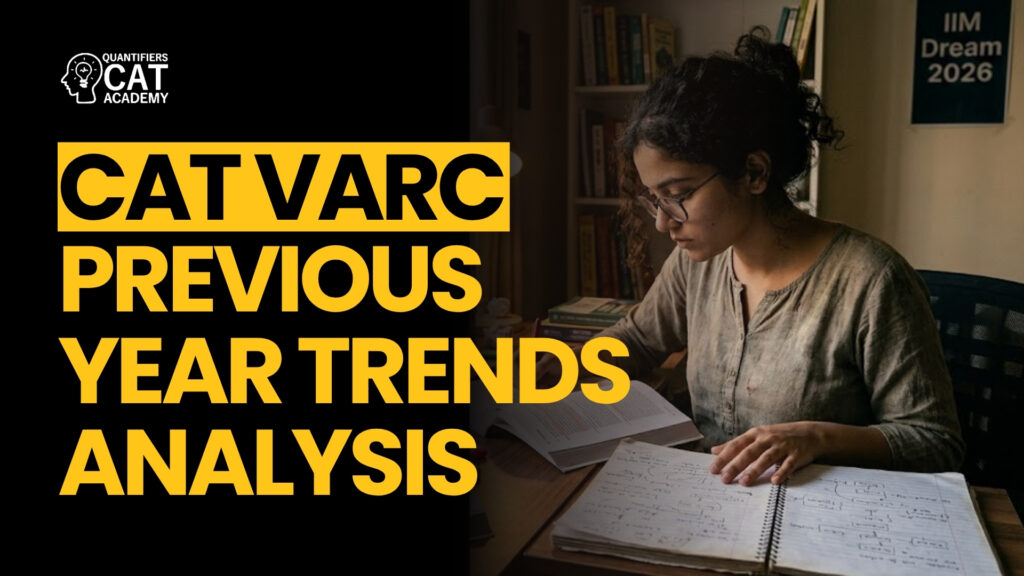



CAT VARC Past Year Trend Analysis 2026: RC Types, Sources, Question Patterns & Strategy
10 years of VARC papers. One pattern. Most aspirants still miss it. This is the X-ray of CAT VARC — what has changed, what has not, what is coming in 2026, and exactly how to prepare for it.
- VARC Exam Pattern — 5-Year Trend at a Glance
- Types of RC Passages in CAT
- RC Sources — Where CAT Passages Come From
- Year-wise RC Source Data (2021–2025)
- Question Types in VARC
- VA Trend — Para Jumbles, Para Summary & Odd One Out
- How to Eliminate Options & Read RCs
- The Quantifiers VARC Strategy for CAT 2026
1. VARC Exam Pattern — 5-Year Trend at a Glance
The structure of VARC has been stable since 2022. But “stable structure” does not mean “predictable exam.” What has changed is the inside — passage topics, option design, difficulty level, and the balance between RC and VA.
Table 1 — CAT VARC Pattern Evolution: 2020–2025
| Year | RC Questions | VA Questions | Total | Difficulty | Key Change |
|---|---|---|---|---|---|
| 2020 | 18 (4 RCs) | 8 | 26 | Difficult | New 2-hour pattern introduced. Fewer questions, same pressure. |
| 2021 | 16 (4 RCs) | 8 | 24 | Moderate–Difficult | Overall Q count reduced. RC-to-VA ratio unchanged. |
| 2022 | 16 (4 RCs) | 8 | 24 | Moderate | Fewer TITA questions. Sentence Insertion introduced. Odd One Out removed. |
| 2023 | 16 (4 RCs) | 8 | 24 | Moderate–Difficult | Odd One Out reintroduced. Abstract topics increased. |
| 2024 | 16 (4 RCs) | 8 | 24 | Moderate–Difficult | Para Jumbles absent. Options deliberately close. 500–550 word passages. |
| 2025 | 16 (4 RCs) | 8 | 24 | Moderate–Difficult | Diverse genres. Abstract philosophical/legal/ecological themes. Higher inference load. |
What the Pattern Tells You
Since 2022, 4 RCs × 4 questions each = 16 RC questions + 8 VA questions = 24 total. This hasn’t changed. What HAS changed: RC passages are getting longer and more abstract, answer options are getting closer, and VA question types keep rotating (Parajumbles absent in 2024, Odd One Out absent in 2022, reintroduced in 2023). The only safe assumption for 2026: 4 RCs with 16 questions. Everything else is in play.
2. Types of RC Passages in CAT
CAT does not use random passages. Over 10 years, a clear genre fingerprint has emerged. Knowing the type of passage you are reading — before you finish reading it — changes how you approach the questions.
Genre A — Analytical / Argumentative
The author makes a claim and builds a case for it. Think economics, policy, philosophy, social commentary. Most common in CAT. Questions focus on author’s tone, central argument, and what would weaken/strengthen the claim.
Genre B — Scientific / Descriptive
A phenomenon is explained: animal behaviour, ecology, technology, medicine. Less argumentative, more informational. Questions test comprehension of cause-effect relationships, definitions, and factual inference.
Genre C — Abstract / Literary
The most challenging. Philosophy, aesthetics, cultural theory. The author’s position is often ambiguous. Dense language. Questions require identifying implied stance, not stated facts. Increasingly common since 2022.
Genre D — Historical / Sociological
Historical events, cultural practices, civilisation studies. Narrative structure but with implied arguments. Questions mix factual comprehension with inference.
Table 2 — RC Genre Distribution by Year (Compiled from 3 slots each)
| Year | Analytical / Argumentative | Scientific / Ecological | Abstract / Literary | Historical / Sociological |
|---|---|---|---|---|
| 2020 | ★★★★ | ★★★ | ★★ | ★★★ |
| 2021 | ★★★★ | ★★★ | ★★ | ★★ |
| 2022 | ★★★★ | ★★★ | ★★★ | ★★ |
| 2023 | ★★★★ | ★★ | ★★★★ | ★★★ |
| 2024 | ★★★ | ★★★ | ★★★★ | ★★ |
| 2025 | ★★★ | ★★★ | ★★★★ | ★★★ |
3. RC Sources — Where CAT Passages Come From
CAT RC passages are always sourced from real publications — not fabricated. The IIMs select them from specific outlets that reflect the kind of analytical, evidence-based writing they want future managers to engage with.
Tier 1 Sources — Appear Repeatedly
Tier 2 Sources — Occasional Appearance
Books & Academic Sources
The Reading Habit Hack
Reading The Economist, Aeon, and The Guardian daily for 30 minutes is not just “general awareness” prep — it is direct VARC preparation. These three sources alone have appeared in 8 of the last 12 CAT papers (3 slots each). If you read one article from each per day for 90 days before CAT, you will have covered the exact writing style, vocabulary register, and argument structure that CAT RC tests.
4. Year-wise RC Source Data (2021–2025)
Table 3 — CAT 2025: RC Passages & Sources (All 3 Slots)
| Slot | RC Topic | Source | Words |
|---|---|---|---|
| Slot 1 | Electronic Music | JSTOR | 507 |
| Uncertain Times | Aeon Magazine | 540 | |
| Legal & Criminal Responsibility | Internet Archives | 535 | |
| Income Inequality | Semantic Scholar | 516 | |
| Slot 2 | ChatGPT and OpenAI | The Guardian | 508 |
| Astronomy | NA | 514 | |
| Cave Fish (Biology) | Knowledgeable Magazine | 534 | |
| Literature | NA | 485 | |
| Slot 3 | Forest Act | Forest Act Document | 510 |
| Tribal Verse | NCERT | 508 | |
| Dam (Environmental) | Boston Review | 506 | |
| AI Morality | Aeon | 499 |
Table 4 — CAT 2024: RC Passages & Sources (All 3 Slots)
| Slot | RC Topic | Source | Difficulty |
|---|---|---|---|
| Slot 1 | Craftsmanship & Creativity | The Economist | Medium |
| Bandicoots in Australia | The Smithsonian | Medium | |
| Digital Rights of Content | The Guardian | Easy | |
| Behavioural Economics | Public Books | Medium | |
| Slot 2 | Spice Trade | Yale Global | Medium |
| Consequences of Technology | NY Times Magazine | Medium | |
| Peer Review of Research | Nature.com | Medium | |
| Animals vs Humans | Vijesti.me | Difficult | |
| Slot 3 | AI Regulation | The Economist | Medium |
| Contamination of Space | Foreign Policy | Medium | |
| Moutai Madness (China) | The Economist | Medium–Difficult | |
| Languages | HuffPost | Medium–Difficult |
Table 5 — CAT 2023: RC Passages & Sources
| Slot | RC Topic | Source | Source Type |
|---|---|---|---|
| Slot 1 | Wolf | The Economist | Magazine |
| Change in Work Culture | Jared Diamond (essay) | Online Article | |
| Indian Ocean | The Conversation | Online News | |
| Human Behaviour | Public Books | Academic | |
| Slot 2 | Fast Fashion & Pollution | Prospect Magazine | Magazine |
| Translated Netflix in Europe | The Economist | Magazine | |
| Falling of Liberalism | The Economist | Magazine | |
| Historical Facts & Interpretations | What is History (book) | Book | |
| Slot 3 | Global Warming & Colonialism | The Wire Science | Magazine |
| Romantic Aesthetics | Stanford Encyclopedia of Philosophy | Academic Journal | |
| Archaeology Paradox | Los Angeles Times | Newspaper | |
| Rationality | The Washington Post | Newspaper |
Table 6 — CAT 2022: RC Passages & Sources
| Slot | RC Topic | Source | Difficulty |
|---|---|---|---|
| Slot 1 | Stoicism | Aeon Essays | Easy |
| Critical Theory | Encyclopedia of Emotions | Easy | |
| The Undead | Encyclopedia of the Undead | Easy | |
| Copies of Copies | University of Witwatersrand Journal | Medium | |
| Slot 2 | Octopuses | Scientific American | Easy |
| Engineering Problems | Book excerpt | Medium | |
| Music | A Million Years of Music (book) | Medium | |
| Social Institutions | SAGE Handbook of Philosophy | Medium | |
| Slot 3 | Sociology of Crime | Wall Street Journal | Easy |
| Logic of Bios | Penguin History of Early India | Medium | |
| Orientalism | Out of Control (book) | Medium | |
| Automation | i-Researchnet (journal) | Medium |
5. Question Types in VARC
Every RC has 4 questions. Knowing what type of question is being asked before you start answering changes everything — because each type has a different answer strategy.
Table 7 — RC Question Types and How to Approach Each
| Question Type | What It Tests | Frequency | The Right Approach |
|---|---|---|---|
| Main Idea / Central Theme | What is the passage ultimately saying? | Very High — 1 per RC usually | Look for the author’s conclusion, not just the subject. The answer must cover the entire passage, not one paragraph. |
| Inference | What can be logically concluded from the passage? | High — 1–2 per RC | The answer must be supported by the text — not just plausible. If you need outside knowledge to validate it, it is wrong. |
| Author’s Tone / Attitude | How does the author feel about the subject? | Medium — often combined with other Qs | Look for evaluative words (criticises, celebrates, dismisses, argues). Avoid extreme choices (outraged, ecstatic) unless clearly supported. |
| Specific Detail / Fact-Based | What does the passage say about X? | Medium — 1 per RC usually | Go back to the specific paragraph. Do not rely on memory. The answer is directly in the text — paraphrase, not fabrication. |
| Strengthen / Weaken | What would support or undermine the author’s argument? | Low–Medium — occasional | First identify the core argument. Then find the option that directly affects it — not peripherally related to the topic. |
| Title / Best Summary | Which title best fits the passage? | Low — occasional | Same logic as Main Idea. Correct title captures the full scope — not just the opening topic or one example. |
6. VA Trend — Para Jumbles, Para Summary & Odd One Out
VA questions (8 per paper) are the wildcard. The types keep rotating. Here is what the data shows:
Table 8 — VA Question Type Trend: 2020–2025
| Year | Para Jumbles (PJ) | Para Summary (PS) | Odd One Out (OOO) | Sentence Insertion | TITA Questions |
|---|---|---|---|---|---|
| 2020 | ✅ Present | ✅ Present | ✅ Present | ❌ Absent | High |
| 2021 | ✅ Present | ✅ Present | ✅ Present | ❌ Absent | High |
| 2022 | ✅ Present | ✅ Present | ❌ Absent | ✅ Introduced | Reduced |
| 2023 | ✅ Present | ✅ Present | ✅ Reintroduced | ✅ Present | Moderate |
| 2024 | ❌ Absent | ✅ Present | ✅ Present | ✅ Present | Moderate |
| 2025 | ✅ Returned | ✅ Present | ✅ Present | ✅ Present | Moderate |
The VA Zero-Negative-Marking Strategy
All 4 VA question types (PJ, PS, OOO, Sentence Insertion) are TITA in most years — no negative marking. Even if you are unsure, attempt every VA question. A 50% accuracy on TITA VA questions = net +12 marks (4 right × 3 = 12). A 50% accuracy on MCQ RC questions = 4 right × 3 − 4 wrong × 1 = 8 net marks. TITA is more forgiving. Never skip VA questions on a time crunch — they are your free marks.

7. How to Eliminate Options & Read RCs
The single biggest reason aspirants lose marks in VARC is not lack of comprehension — it is poor elimination strategy. CAT RC answer options are designed to be close. Two options will often both seem right. One is. One is slightly off. Here is how to tell them apart.
The 4 Types of Wrong Options in CAT RC
Too Extreme / Too Absolute
Uses words like “always,” “never,” “completely,” “proves,” “entirely.” CAT passages are nuanced — authors rarely make absolute claims. If an option sounds extreme, it is almost always wrong. Eliminate immediately.
True But Not from the Passage
The statement might be factually correct in the real world, but the passage does not say it. RC questions test what the passage says, not what you know. If you are relying on outside knowledge to validate an option, that option is wrong.
Partially Correct / Scope Error
The option captures one detail or one paragraph of the passage but misses the broader point. Most common on Main Idea and Title questions. The correct answer must cover the entire passage scope — not just the first paragraph.
Opposite / Distortion
The option reverses the author’s position or subtly distorts the argument. Most dangerous because it sounds logical. Check against the exact wording of the relevant passage section before selecting.
The 3-Step RC Reading Method
- Step 1 — Read for purpose, not for detail: Your first pass should answer one question: what is this author trying to say? Do not memorise facts. Understand the argument structure: what is the claim, what is the evidence, what is the conclusion?
- Step 2 — Map the passage mentally: After reading, before looking at questions, summarise the passage in 1 sentence. “The author argues that X, using Y as evidence, and concludes Z.” If you can do this, you will eliminate 80% of wrong options immediately.
- Step 3 — Answer before reading options: For Main Idea and Inference questions, form your answer in your head before looking at the four options. Then find the option closest to your answer. This prevents you from being seduced by a cleverly worded wrong option.
The 4-4 Time Strategy
40 minutes · 4 RCs · 8 VA questions. The golden ratio: spend 8 minutes per RC (4 minutes reading + 4 minutes answering). Leave 8 minutes for VA. That is 8 × 4 = 32 min for RC + 8 min for VA = exactly 40. If you go over 10 minutes on any single RC, skip one question and move on — do not blow your entire section time on one passage.
8. The Quantifiers VARC Strategy for CAT 2026
Everything above is data. This is what to do with it.
- Read every day — the right sources: The Economist, Aeon Essays, The Guardian. One article per day, 30 minutes. Not for vocabulary. For argument structure fluency. After 90 days, you will recognise the writing style of your actual CAT passages before you finish the first paragraph.
- Prepare all 4 VA types — PJ, PS, OOO, Sentence Insertion: Do not bet on which three will appear. The exam rotates them. Practise all four, with special emphasis on Para Summary (appeared every year without exception since 2020) and TITA strategy.
- Do not leave VA blank: TITA = no negative marking. Attempt all 8 VA questions. Even a 40% accuracy on TITA is net positive. This is non-negotiable.
- Abstract passages need a different mental gear: When you encounter a philosophical or literary passage, slow down by 20%. The density is higher. Rushing causes misinterpretation. Two minutes extra on a dense passage is cheaper than getting 3 questions wrong on it.
- Practice with real sources: Download Quantifiers’ free VARC study material — RC passages curated from the exact sources CAT uses. Reading random passages online does not build the specific comprehension muscle CAT tests.
- Mock → Analyse → Mock again: After every mock, review every RC question you got wrong. Identify which Wrong Option Type (1–4 above) trapped you. If you are consistently falling for “Partially Correct” options, your scope-mapping needs work. If you are falling for “True But Not from Passage,” you are over-relying on knowledge instead of the text.