


Skills You Must Build Before Your MBA — The Honest 2026 Checklist
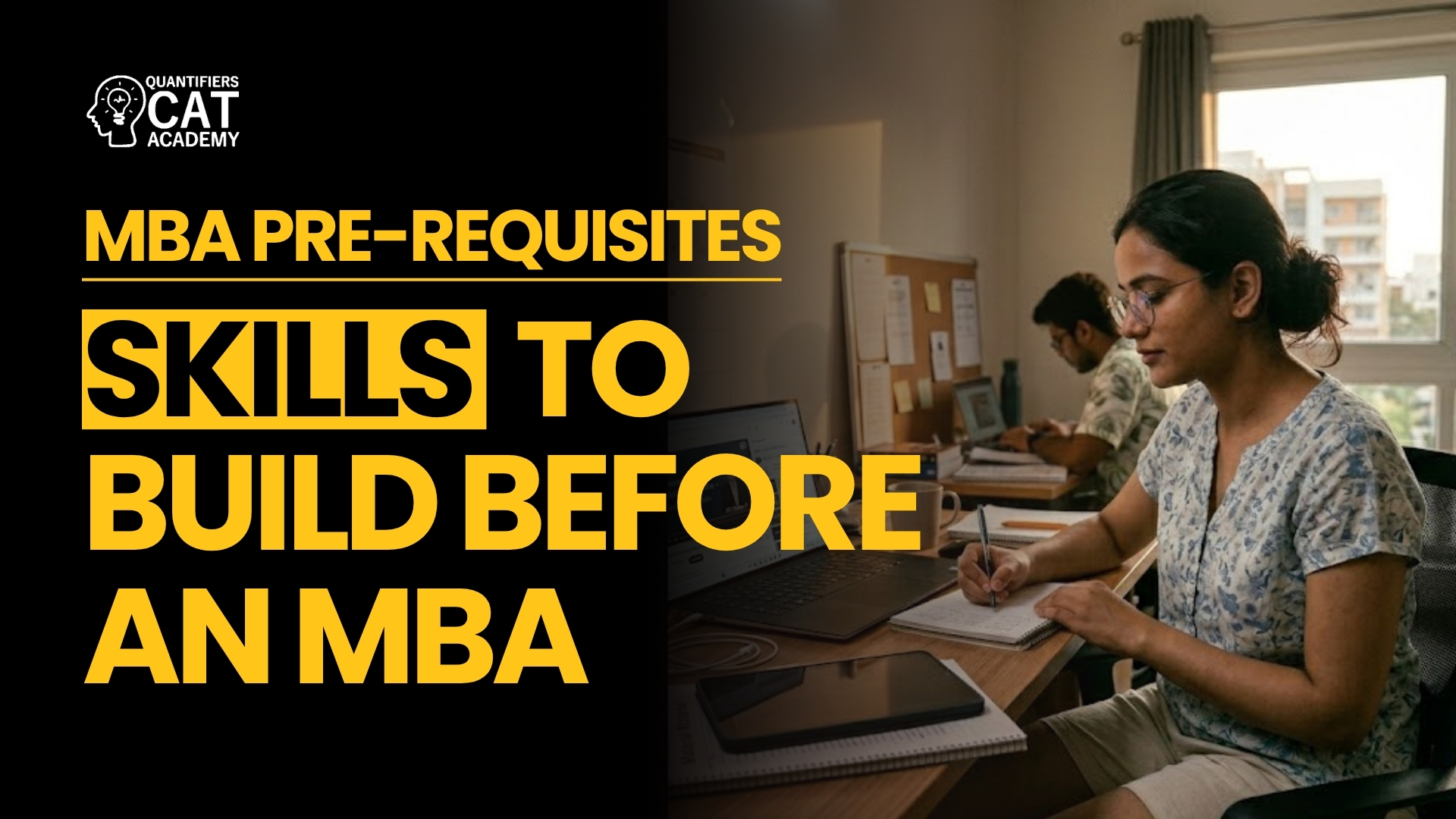
Your resume is just lines of text until experience makes it real. Every skill you build before your MBA gives you a head start in class, an edge in internships, and a story to tell in every interview. Here is the no-nonsense list — with exactly where to learn each one, for free.
- Why Build Skills Before MBA? The Real Reason
- Excel & Data Tools — The MBA Survival Skill
- AI Literacy & Prompt Engineering — The 2026 Non-Negotiable
- Financial Statement Basics — For Non-Finance Backgrounds
- Communication & Storytelling — The Placement Multiplier
- Build One Real Passion — Not for the Resume, for the Interview
- Pick Up a Language — The Underrated Edge
- The Certification Cheatsheet: What’s Actually Worth It
You worked hard to crack CAT. You got into a top B-school. And now, before the chaos of trimester 1 hits, you have a window — maybe 60 to 90 days — to build the skills that will quietly separate you from your batchmates before orientation week ends.
This is not about cramming certificates. It is about arriving with skills that make you genuinely more capable. The MBA curriculum assumes you can handle Excel. Placement panels assume you can talk about AI. The PI room assumes you have something real to say beyond your academic performance. This list fixes all three.
1. Why Build Skills Before MBA? The Real Reason
Here is something B-schools do not advertise: the first trimester is brutal. Three courses running simultaneously, mandatory group projects, case study submissions at 2 AM, club applications, networking events, and the first placement season creping in faster than anyone expects. The students who thrive in this environment are not necessarily the smartest — they are the ones who arrive the most prepared.
- Excel in class: If you already know Excel, one entire subject becomes revision instead of panic. That freed bandwidth goes to the subjects that actually challenge you.
- Edge in internships: Summer internship interviews happen in trimester 2. Recruiters from consulting and finance firms ask about financial models, data analysis, and case frameworks — all learnable before you enter.
- Stories in the PI room: Interviewers run out of resume questions fast. What keeps them engaged is the unusual project, the NGO month, the language, the passion. These are the lines that convert interview calls into offers.
- Confidence in the cohort: Walking into a room of IITians and CAs when you have built real skills is a completely different experience from walking in empty-handed.
The One-Skill-Per-Month Rule
You are Gen Z. Your attention span is made fun of. Use it as a feature: every month, commit to one skill, go deep, then move on. Four months before MBA = four real skills. That is four stories in every interview. That is four lines on your resume that are not just certificates — they are evidence of curiosity.
2. Excel & Data Tools — The MBA Survival Skill
Microsoft Excel & Data Analysis
Difficulty: Beginner–Intermediate · Time: 3–4 weeks · Impact: Immediately in Trimester 1If you do not know VLOOKUP, INDEX-MATCH, Pivot Tables, and Solver going into an MBA, you will spend your first semester fighting a tool while your batchmates use it to actually solve problems. Every finance, operations, and quant course leans on Excel. It is the single skill with the fastest ROI before B-school.
Beyond Excel, Power BI and basic SQL are increasingly expected at internship stage — especially in consulting and analytics. Learn one, then add the other.
3. AI Literacy & Prompt Engineering — The 2026 Non-Negotiable
AI Fluency & Prompt Engineering
Difficulty: Beginner · Time: 2–3 weeks · Impact: Every subject, every internship, every interviewYou understand AI faster than people who have been in the industry for 20 years. This is not a compliment — it is a structural advantage. Use it. Prompt engineering is now a legitimate professional skill: the ability to get consistent, high-quality output from AI tools transforms how fast you can research, draft, analyze, and present.
Anthropic launched Anthropic Academy on 2nd March 2026 — a free platform with 16 self-paced courses covering AI fundamentals, prompt engineering, Claude APIs, and agentic AI. Every course issues a certificate. No paid subscription needed. This is the most underutilized competitive advantage for MBA aspirants right now.
Table 1 — Best Free AI Certifications in 2026 for MBA Aspirants
| Certification | Provider | Cost | Time | Best For |
|---|---|---|---|---|
| Anthropic Academy — AI Fluency Track | Anthropic (Claude) | Free | 1–4 hrs/course | Anyone — start here; built by the team that builds Claude |
| Google AI Essentials | Google / Coursera | Free (audit) | ~5 hrs | Business users who want Google’s AI ecosystem |
| Generative AI for Everyone | DeepLearning.AI / Coursera | Free (audit) | ~6 hrs | Non-technical MBA aspirants wanting a solid foundation |
| IBM AI Fundamentals | IBM / Coursera | Free (audit) | ~10 hrs | Those who want an IBM badge for LinkedIn |
| Claude Certified Architect (CCA-F) | Anthropic | $99 (free for partners) | Exam: 120 min | Techies & future consultants building with AI professionally |
Why AI Literacy is an Interview Topic Now
McKinsey, BCG, Bain, Deloitte — every consulting firm is building AI practices. When the interviewer asks “how are you using AI in your workflow?” — and they will ask — the answer cannot be “I use ChatGPT sometimes.” Having a structured understanding of prompt engineering, AI limitations, and use-case identification is the answer that lands.
4. Financial Statement Basics — For Non-Finance Backgrounds
Reading Financial Statements
Difficulty: Moderate · Time: 3–4 weeks · Critical for: Engineers, Arts graduates, anyone without CA/Commerce backgroundWalk into an MBA without knowing the difference between a P&L and a Balance Sheet, and your first finance course will be a crash — not a class. CA and Commerce graduates will sail through this semester. Engineers will drown — unless they prepare.
You need to understand: the three financial statements (Income Statement, Balance Sheet, Cash Flow), how they connect, basic ratios (ROE, ROCE, D/E), and how to read an annual report. It sounds intimidating. It takes three weeks to get comfortable. Start before orientation week.
5. Communication & Storytelling — The Placement Multiplier
Articulation, Presentation & Structured Communication
Difficulty: Ongoing · Time: Daily practice · Impact: Every PI, every presentation, every placement interviewThere is no shortcut. But there is a system. Communication is the one skill that directly determines your placement outcome regardless of which B-school you attend. Students at Tier-2 MBA colleges with strong communication land better placements than Tier-1 graduates who cannot hold a room for three minutes.
The practice method is embarrassingly simple — and almost nobody does it:
- Record yourself for 3 minutes daily: Pick any topic. Talk about it. Watch the video. Count filler words (um, like, basically, actually). Your goal is zero fillers in 90 days. This is how every top consultant trained before their first interview.
- Summarize one article per day: Read any editorial. Close the tab. Explain the article in 60 seconds out loud. No notes. This builds structured recall — exactly what PI panels test.
- Practice with AI: Use Claude or ChatGPT’s voice feature for mock PI conversations. Ask it to challenge your answers, point out logical gaps, and score your communication. It will not judge you — and its feedback is genuinely useful.
- PowerPoint basics + template bank: Learn the basics of Microsoft PowerPoint and Canva. More importantly, build a folder of 20–30 clean presentation templates before B-school. You will thank yourself in trimester 1 when a submission is due in 4 hours.
The PI Room Rule
Interviewers do not read every line of your resume before walking in. They read three lines, pick one, and ask you to tell them about it. The candidate who can speak clearly, structure an answer in under 90 seconds, and hold eye contact while doing it — gets the offer. The one who knows more but communicates it poorly — does not. Build this skill like you build a CAT section: daily practice, tracked progress, honest self-review.
6. Build One Real Passion — Not for the Resume, for the Interview
One Genuine Passion + One Month of Real Work
Difficulty: Entirely personal · Time: Ongoing · Impact: The interview question nobody else can answerInterviewers get bored. After 15 candidates who all played cricket and watched Netflix, the one who cycled 300 km across a state, taught underprivileged kids for a month, or ran a student-led event that raised ₹2 lakh — that person is remembered.
Two things to build before your MBA:
One Real Passion — Not PS5, Not Netflix
Swimming. Theatre. Long-distance running. Photography. Cooking with actual technique. It should be something you can talk about for 10 minutes without running out of content — and something you are actively getting better at. Why? Because when the interviewer asks “tell me something you are passionate about” and you say “I am training for a half-marathon” — they ask you about training science, mental toughness, and goal-setting. Those answers reveal character. “I like watching web series” reveals nothing. Build one passion that is genuinely yours before you walk into any interview room.
One Month of Real NGO or Social Work
Not fake. Not “I volunteered at my college fest.” One month of genuinely teaching kids, working with a nonprofit, or solving a community problem. It makes you humble — a quality that is immediately visible in interviews and immediately valued by MBA panels. It also gives you the kind of answer nobody else in the room has. When you say “I spent a month teaching Class 5 Maths to 30 children in a rural school,” the follow-up is always “what did you learn?” — and the answer to that question is more revealing than any CAT score.

7. Pick Up a Language — The Underrated Edge
A Second Language — Spanish, French, Japanese, or Mandarin
Difficulty: Moderate · Time: Ongoing (start with 30 days) · Impact: Global roles, luxury brands, trading, translation, international placementsLanguages do not immediately light up a standard resume. But here is what they quietly do: they signal curiosity, discipline, and global-mindedness — the exact qualities that senior interviewers are trying to filter for. And in specific roles, they are directly valuable.
Table 2 — Which Language to Pick and Why
| Language | Why MBA-Relevant | Job Opportunities in India | Start With |
|---|---|---|---|
| Spanish | 600M+ speakers across Latin America & Spain; FMCG, consulting, luxury brands | MNCs with LATAM operations, luxury goods, global consulting firms | Duolingo + SpanishPod101 |
| French | Official UN language; French luxury houses, EU firms, African markets | LVMH, L’Oréal, BNP Paribas, Société Générale | Duolingo + TV5Monde free lessons |
| Mandarin (Chinese) | World’s largest economy; manufacturing, trade, fintech | Chinese MNCs, trade finance, EXIM bank roles | HelloChinese app + Yoyo Chinese YouTube |
| Japanese | Premium manufacturing, automotive, electronics; strong translation demand | Toyota, Sony, Hitachi, Japanese bank branches, translation | Duolingo + JLPT N5 prep |
8. The Certification Cheatsheet: What’s Actually Worth It
Let us be blunt: most certifications are not worth the money or the time. You know how Coursera certifications are done — Next, Next, Complete, Next, Next, Complete. They teach you nothing and signal nothing to a smart interviewer. The ones below are different — either because they are genuinely rigorous, widely recognized, or come from a source with institutional credibility.
Table 3 — MBA Aspirant Certification Guide 2026: What to Do and What to Skip
| Certification | Provider | Cost | Time | Worth It? | Best For |
|---|---|---|---|---|---|
| Anthropic Academy — AI Fluency | Anthropic | Free | 1–4 hrs each | ✅ Yes — from source | Everyone. Do this first. |
| Google AI Essentials | Free (audit) | ~5 hrs | ✅ Yes — brand recognition | Non-technical aspirants | |
| Excel / Google Sheets | Microsoft / Google | Free | 20–40 hrs | ✅ Yes — immediate utility | Everyone, especially engineers |
| IBM Data Analyst Certificate | IBM / Coursera | Free (audit) / ₹3,000 for cert | ~170 hrs | ✅ Yes — rigorous, respected | Analytics/consulting track |
| Google Data Analytics Certificate | Google / Coursera | Free (audit) / ~₹3,200 | ~180 hrs | ✅ Yes — widely recognized | Data-heavy internship targets |
| CFA Level 1 | CFA Institute | ~₹40,000+ | 300 hrs | ✅ Yes — if finance career | Investment banking, PE, equity research |
| Meta Blueprint (Digital Marketing) | Meta | Free | 10–40 hrs | ✅ Yes — if marketing track | Marketing, brand management aspirants |
| Coursera generic certificates | Various universities | ₹2,000–5,000 | Variable | ❌ Mostly no — surface level | Skip unless from a top institution |
| Random LinkedIn Learning badges | Paid subscription | <2 hrs each | ❌ No — not credible | Do not bother |
Preparing for CAT 2026 While Building Your Profile?
Quantifiers’ June-Oon IIMs Batch starts 2nd June 2026 — live + recorded classes, 1:1 mentorship, CAT + OMETs + GDPI. Upto 20% off. Batch size under 25. Your profile is built in the gap between sessions — your percentile is built inside them.