


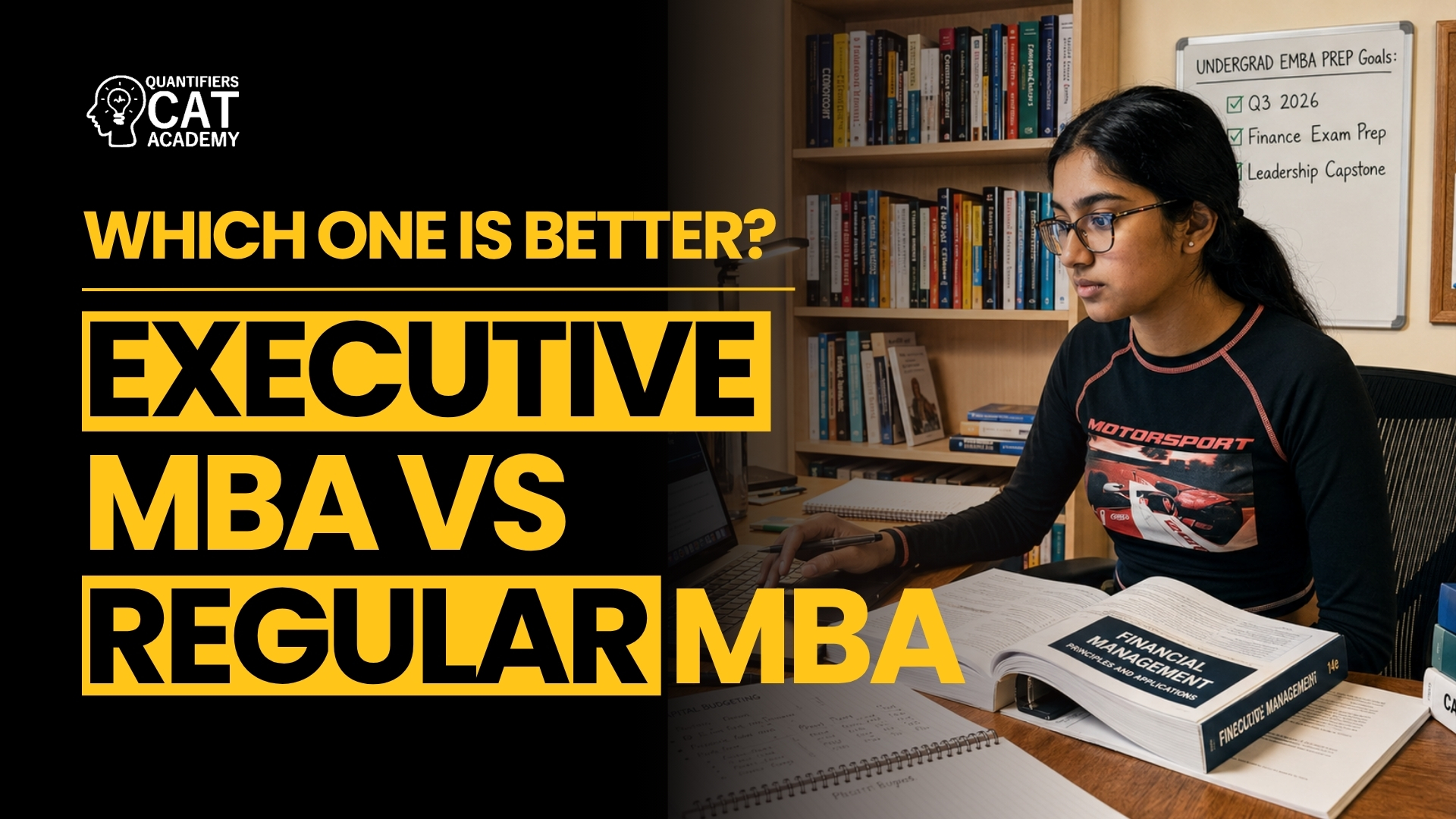

Executive MBA vs Regular MBA in India 2026 — Which One is Right for You?
Executive MBA is not a consolation prize for missing regular MBA. It is a completely different tool — built for a different career stage and a different purpose. Here is the complete, honest comparison so you choose the right one for where you actually are.
-
- The 4 Types of Executive MBA Programs in India
- Executive MBA vs Regular MBA — The Key Differences
- Full-Time Residential Executive MBA — The Closest Alternative
- Weekend, Online & Hybrid Executive MBA Programs
- Realistic Salary Expectations — Executive MBA vs Regular MBA
- Eligibility & Admission Requirements
- Who Should Do an Executive MBA — and Who Should Not
1. The 4 Types of Executive MBA Programs in India
Before comparing Executive MBA with regular MBA, you need to know that “Executive MBA” is not one thing. There are four fundamentally different types — each designed for a different professional profile and career goal.
Table 1 — Types of Executive MBA Programs in India 2026
| Type | Format | Examples | Work Ex Required | Leave Job? |
|---|---|---|---|---|
| Full-Time Residential | 1-year on-campus, full-time | PGPX (IIM-A) · EPGP (IIM-B) · Executive MBA (IIM-C) · IPMX (IIM-L) | 5–8 years (avg 7–8 yrs) | Yes — leave job |
| Weekend / Part-Time | Weekend campus visits (Fri–Sat), part-time | PGPEM (IIM-B) · Various IIM weekend programs | 3–5 years | No — keep job |
| Hybrid / Online | Mostly online, 1–2 short campus immersions/year | MBA for Working Executives (IIM-K) · PGP PRO (ISB) | 2–5 years | No — keep job |
| Senior Executive MBA | Part-time / online, leadership-focused | PGP MAX (ISB) | 10+ years | No — keep job |
2. Executive MBA vs Regular MBA — The Key Differences
Table 2 — Executive MBA vs Regular MBA: Complete Comparison
| Parameter | Regular MBA (CAT/XAT) | Full-Time Executive MBA | Part-Time / Online Exec MBA |
|---|---|---|---|
| Duration | 2 years | 1 year | 1.5–2 years |
| Work Experience | 0–2 years (freshers welcome) | 5–8 years (avg 7–8) | 2–5 years minimum |
| Entry Test | CAT / XAT / GMAT | GMAT / GRE / institute exam | GMAT / GRE / institute exam |
| Campus Life | Full 2-year immersion | Full 1-year immersion | Minimal / none |
| Placement Drive | Yes — structured, company visits | Yes — structured placement | Placement support only (no drive) |
| Career Reset? | Yes — strong career trajectory change | Partial — builds on existing profile | No — primarily career progression |
| Avg Fee | ₹20–27L (Tier-1 IIMs) | ₹35–38L (IIM-A PGPX) | ₹8–15L |
| Post-MBA Avg CTC | ₹25–36 LPA (Tier-1 IIMs) | ₹30–34 LPA (Tier-1 IIMs) | Career growth within existing trajectory |
| Best For | Career reset, entry to new domain | Mid-career pivot, seniority jump | Promotion, skill upgrade, same industry |
The One Line That Changes Everything
A regular MBA can erase your past. An Executive MBA cannot. If your academics were weak, your early career was unclear, or you want to completely pivot domains — a regular MBA from a top IIM does that. An Executive MBA builds on what you already have — it accelerates a trajectory that already exists. Neither is superior. They are tools for different jobs.
3. Full-Time Residential Executive MBA — The Closest Alternative
Of all the Executive MBA formats, this one is the most comparable to a regular MBA. You leave your job, live on campus, attend classes full-time, and go through a structured campus placement drive. The difference is the duration (1 year vs 2), the cohort profile (7–8 years experience vs 0–2 years), and the type of roles you are placed into.
Table 3 — Top Full-Time Residential Executive MBA Programs in India 2026
| Program | Institute | Duration | Fee (Approx) | Avg / Median CTC | Avg Work Ex |
|---|---|---|---|---|---|
| PGPX | IIM Ahmedabad | 1 year | ₹35–38L (incl. accommodation) | ₹34 LPA median | ~8 years |
| EPGP | IIM Bangalore | 1 year | ₹31–34L | ₹33 LPA median | ~7 years |
| Executive MBA | IIM Calcutta | 1 year | ₹28–32L | ₹30 LPA median | ~7 years |
| IPMX | IIM Lucknow | 1 year | ₹22–26L | ₹27–30 LPA | ~7 years |
- Regular MBA cohort: Average 0–2 years experience. Entry-level to mid-level roles. Can completely reset career trajectory from any background.
- Executive MBA cohort: Average 7–8 years experience. Mid-level to senior-level roles. Builds on existing professional identity — does not replace it.
- Who benefits most: Mid-career professionals (5–8 years) who want to change industries, move into leadership, or accelerate trajectory without spending 2 years off the market.
4. Weekend, Online & Hybrid Executive MBA Programs
These programs allow you to keep your job, keep your salary, and earn a degree or credential while continuing to work. That flexibility is genuine — but so are the limitations.
The Real Advantage
- No income disruption — you continue earning throughout the program
- Significantly lower cost — most programs under ₹15 lakh vs ₹35+ lakh for full-time
- Apply learning in real-time at your current job — immediate practical relevance
- Suitable for sole earning members of a family who cannot leave their income source
The Honest Limitation
No structured campus placement drive. This is the critical difference most aspirants miss. Online and weekend Executive MBA programs provide placement support — networking events, alumni introductions, recruiter outreach — but companies do not visit campus and make structured offers the way they do for full-time programs. Your career outcome depends heavily on your own proactivity, your existing profile, and how well you leverage the alumni network.
These programs work best for:
- Professionals seeking promotion within their current organisation or industry
- Company-sponsored employees building management credentials for internal advancement
- Specialists who want a formal management education without leaving their field
- Professionals who genuinely cannot leave their current income for 1–2 years
They work poorly for professionals hoping to completely switch industries or dramatically reset their career trajectory — because without a placement drive and a full-time cohort experience, the network and recruiter access that enable those career jumps are simply not there in the same way.

5. Realistic Salary Expectations — Executive MBA vs Regular MBA
The salary conversation is the one where most aspirants have unrealistic expectations — in both directions. Here is what the data actually shows.
Table 4 — Salary Comparison: Regular MBA vs Executive MBA by Program Type
| Program Type | Post-MBA Avg CTC (Tier-1) | Roles | Salary Jump Potential |
|---|---|---|---|
| Regular MBA — Tier-1 IIM | ₹25–36 LPA | Entry to mid-level (Analyst, Consultant, AM) | Transformational — 3–5x pre-MBA for most |
| Full-Time Exec MBA — Tier-1 IIM | ₹30–34 LPA | Mid to senior (Manager, VP, Director) | Significant — 1.5–2.5x pre-MBA |
| Weekend / Online Exec MBA | Varies widely | Promotion within same company/industry | Moderate — ₹6L → ₹12–13L typical jump |
| Senior Exec MBA (10+ yrs) | Depends on prior level | Senior leadership, C-suite adjacent | Leadership acceleration, not salary jump |
6. Eligibility & Admission Requirements
Table 5 — Eligibility Criteria by Executive MBA Type
| Program Type | Work Experience | Test Required | Selection Process |
|---|---|---|---|
| Full-Time Residential Exec MBA | Minimum 5 years (avg 7–8 years) | GMAT / GRE / institute-specific exam | Application + shortlist + interview |
| Weekend / Part-Time Exec MBA | Minimum 3–5 years | GMAT / GRE or institute entrance | Application + interview (less competitive than full-time) |
| Hybrid / Online Exec MBA | Minimum 2–5 years | GMAT / GRE or institute-specific | Application + interview |
| Senior Executive MBA | 10+ years minimum | Usually interview-only, no exam | Application + leadership profile review + interview |
7. Who Should Do an Executive MBA — and Who Should Not
Executive MBA IS right for you if:
- Specialists moving into management: A functional expert (engineer, doctor, lawyer, finance professional) who wants formal management training to transition into leadership roles.
- Mid-career professionals targeting a pivot: 5–8 years in, you want to change industry or function. The full-time residential Executive MBA is the most effective tool — it gives you a cohort, a placement drive, and a campus credential without a 2-year gap.
- Working professionals who cannot leave their job: Weekend and online formats give you a credential while preserving your income. Particularly suitable for sole earning members of a family.
- Experienced professionals building their network: The Executive MBA cohort (averaging 7–8 years experience) is a more senior, more diverse network than a regular MBA cohort. If network quality is your primary goal, this is a genuine advantage.
Executive MBA is NOT right for you if:
- You want only the IIM tag without substance: Recruiters understand the difference between a 2-year regular MBA and a 1-year Executive MBA. Skills and experience matter significantly more in Executive MBA hiring than the brand name alone.
- You are already earning ₹40–50 LPA+: A full-time Executive MBA requires leaving your job for a year. The opportunity cost — plus the fee — may not be justified by the incremental salary gain at that level. Leadership programmes or niche credentials may be a better investment.
- You expect guaranteed placements: Executive MBA programs provide placement support, not guaranteed placement. Even with a placement drive, shortlisting depends on your experience, your skills, and whether your profile matches recruiter requirements. The degree alone does not place you.
- You want a complete career transformation from scratch: If you are starting from a weak profile, weak academics, or an early career that did not go as planned — a regular MBA through CAT is the more powerful option. It can completely reset your trajectory in a way an Executive MBA cannot.
The One Question to Answer Before Deciding
Do you want to build on what you have — or replace what you have?
If your current professional foundation is strong and you want to accelerate it: Executive MBA. If you want to fundamentally change your professional direction and start a new trajectory: Regular MBA through CAT. The degree title is less important than which tool actually solves your specific career problem.

A regular MBA is a 2-year full-time program primarily for freshers and early-career professionals (0–2 years experience), accessed through CAT/XAT. It can completely reset your career trajectory. An Executive MBA is for working professionals (typically 5+ years experience), comes in multiple formats (full-time residential, weekend, online), and builds on your existing professional profile rather than replacing it. The full-time residential Executive MBA (PGPX, EPGP, IPMX) is the closest in structure to a regular MBA — 1-year on-campus with a placement drive.
It depends entirely on which type of Executive MBA and what your goal is. A full-time residential Executive MBA from IIM Ahmedabad (PGPX), IIM Bangalore (EPGP), or IIM Calcutta is worth it for mid-career professionals (5–8 years experience) seeking a structured career pivot — median salaries are ₹30–34 LPA, comparable to regular MBA. Weekend and online formats are worth it for career progression within your existing company or industry. They are not worth it if you expect guaranteed placements or a dramatic career transformation from scratch.
Only if you have the work experience required — typically 5+ years for full-time programs. For freshers and early-career professionals, a regular MBA through CAT is the appropriate path. The two are not interchangeable — they are built for different career stages. If you are early in your career and considering an MBA, preparing for CAT 2026 and targeting a top IIM gives you the career-reset potential that an Executive MBA cannot provide at that stage.
Full-time residential Executive MBA fees at top IIMs: IIM Ahmedabad PGPX: ~₹35–38 lakh (including accommodation), IIM Bangalore EPGP: ~₹31–34 lakh, IIM Calcutta Executive MBA: ~₹28–32 lakh, IIM Lucknow IPMX: ~₹22–26 lakh. Weekend, online, and hybrid programs cost significantly less — most under ₹15 lakh.
Full-time residential programs (PGPX, EPGP, IPMX) have structured campus placement drives — companies visit campus and make offers, similar to regular MBA. Weekend, online, and hybrid programs do not have structured placement drives — they provide placement support through alumni networking, recruiter outreach, and job notifications. If placement access is a priority for you, only the full-time residential format delivers it.
If you have less than 4–5 years of work experience and want a major career change or reset — CAT 2026 and a regular IIM MBA is the better choice. It gives you 2 years of full campus immersion, a structured placement drive, and the ability to completely redefine your professional trajectory. Quantifiers CAT Academy helps you target the right IIM for your profile — with students like Akshita (98.95%ile, non-engineer), Mridul (99.98%ile), and Karan (99.6%ile, from the 80s percentile range) as proof that the right preparation makes the top IIM path accessible regardless of starting point.