



Gender Ratio in IIMs — Latest Trends, Diversity Points & What It Means for Your Application
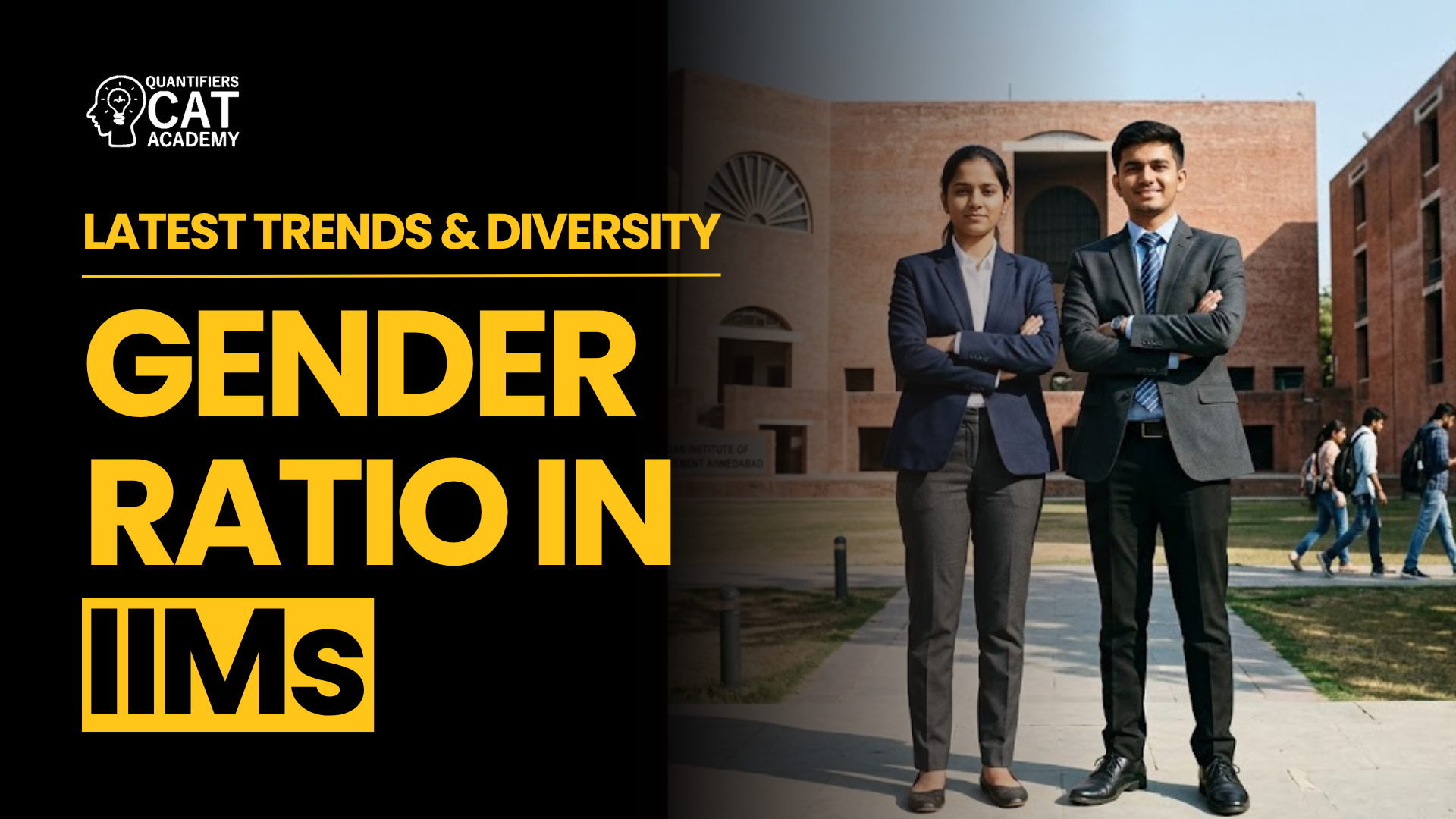
IIM classrooms today look very different from a decade ago, and a big part of that shift shows up in who’s sitting in them. Here’s where the gender ratio in IIMs stands across old, new, and newer institutes, how diversity points actually factor into shortlisting, and what any applicant — regardless of gender — should understand about this part of the admission process.
- The Broader Shift in IIM Classroom Composition
- Gender Ratio in the Older, Established IIMs
- Gender Ratio in the Newer-Generation IIMs
- Gender Ratio in the Newest IIMs
- Which IIMs Report the Highest Female Representation
- Why IIMs Build Gender Diversity Into Admissions at All
- How the Diversity Weightage Actually Works, Institute by Institute
- What This Actually Means If You’re Applying
- Frequently Asked Questions
1. Gender Ratio in IIMs — The Broader Shift in Classroom Composition
A generation ago, MBA classrooms at India’s top management institutes skewed heavily male — a pattern that mirrored broader trends in who was sitting for CAT in the first place. The gender ratio in IIMs has changed substantially since then. Rising female participation in CAT, evolving career preferences, and deliberate diversity-linked admission policies at individual IIMs have together pushed classroom composition toward something far closer to balanced, and in a handful of institutes, past the halfway mark in the other direction.
This isn’t a uniform story across every campus — older, larger IIMs have generally moved more slowly than some of the newer ones, and the reasons behind that gap are worth understanding on their own. But the direction of travel is consistent: virtually every IIM has seen its female intake rise over the past several admission cycles.
2. Gender Ratio in the Older, Established IIMs
The oldest and most selective IIMs — Ahmedabad, Bangalore, Calcutta, Lucknow, Kozhikode, and Indore — draw from the widest and most competitive applicant pool of any group on this list, which historically translated into a slower shift toward gender balance. That’s shifted meaningfully in recent cycles.
Table 1 — Gender Ratio in Established IIMs
| Institute | Male Share | Female Share | Recent Trend |
|---|---|---|---|
| IIM Ahmedabad | 55–60% | 40–45% | Steady climb in female intake |
| IIM Bangalore | 55–60% | 40–45% | Increasingly balanced recent batches |
| IIM Calcutta | 65–70% | 30–35% | Gradual, slower-paced improvement |
| IIM Lucknow | 55–60% | 40–45% | Diversity-linked policy driving change |
| IIM Kozhikode | 30–35% | 65–70% | Among the most female-heavy batches of any IIM |
| IIM Indore | 45–50% | 50–55% | Near-perfect gender parity |
3. Gender Ratio in the Newer-Generation IIMs
The second wave of IIMs — Udaipur, Trichy, Raipur, Ranchi, Rohtak, and Kashipur — has generally reached comparable or stronger female representation than the older cohort, often faster.
Table 2 — Gender Ratio in Newer-Generation IIMs
| Institute | Male Share | Female Share | Recent Trend |
|---|---|---|---|
| IIM Udaipur | 55–60% | 40–45% | Rising female participation |
| IIM Trichy | 60–65% | 35–40% | Moderate, steady representation |
| IIM Raipur | 55–60% | 40–45% | Improving year over year |
| IIM Ranchi | 55–60% | 40–45% | Consistent, balanced participation |
| IIM Rohtak | 35–40% | 60–65% | One of the most female-skewed IIM batches nationally |
| IIM Kashipur | 60–65% | 35–40% | Female intake rising gradually |
4. Gender Ratio in the Newest IIMs
The most recently established IIMs — Amritsar, Bodh Gaya, Jammu, Sambalpur, Sirmaur, and Nagpur — are still building multi-year track records, but early data shows female participation rising in step with the broader national trend.
Table 3 — Gender Ratio in the Newest IIMs
| Institute | Male Share | Female Share | Recent Trend |
|---|---|---|---|
| IIM Amritsar | 60–65% | 35–40% | Gradual improvement |
| IIM Bodh Gaya | 55–60% | 40–45% | Rising female participation |
| IIM Jammu | 60–65% | 35–40% | Moderate diversity levels |
| IIM Sambalpur | 50–55% | 45–50% | Close to gender balance |
| IIM Sirmaur | 55–60% | 40–45% | Improving steadily |
| IIM Nagpur | 60–65% | 35–40% | Female share increasing each cycle |
5. Gender Ratio in IIMs — Which Institutes Rank Highest for Female Representation
Ranked across the full gender ratio in IIMs picture, two institutes stand well ahead of the rest on female representation, with a broad middle tier clustered close to gender balance.
Table 4 — IIMs Ranked by Female Representation
| Rank | Institute | Female Share |
|---|---|---|
| 1 | IIM Kozhikode | 65–70% |
| 2 | IIM Rohtak | 60–65% |
| 3 | IIM Indore | 50–55% |
| 4 | IIM Sambalpur | 45–50% |
| 5 | IIM Shillong | 45–50% |
| 6 | IIM Mumbai | 45–50% |
| 7 | IIM Guwahati | 45–50% |
| 8–15 | IIM Ahmedabad, Bangalore, Lucknow, Udaipur, Visakhapatnam, Ranchi, Sirmaur, Bodh Gaya | 40–45% |
| 16–21 | IIM Raipur, Kashipur, Nagpur, Amritsar, Jammu, Trichy | 35–40% |
| 22 | IIM Calcutta | 30–35% |
6. Why IIMs Build Gender Diversity Into Admissions at All
Gender diversity weightage — the mechanism behind much of the gender ratio in IIMs shift documented above — isn’t a blanket rule imposed from outside. Each IIM designs and discloses (to varying degrees) its own version of it, generally for a few consistent reasons.
- Classroom quality. Management education leans heavily on case discussions, group projects, and peer debate — formats that benefit from a genuine range of perspectives in the room, not a narrow one.
- Correcting a historical imbalance. MBA programmes in India, like many technical and quantitative fields, have historically drawn a larger share of male applicants. Diversity weightage is one lever institutes use to counter that imbalance at the admissions stage rather than waiting for the applicant pool to shift on its own.
- Aligning with what recruiters increasingly expect. Corporate recruiters have leaned harder into diversity and inclusion goals over the past decade, and IIMs position their own graduating batches, in part, as a pipeline that reflects that shift.
7. How the Diversity Weightage Actually Works, Institute by Institute
The specifics vary considerably from one IIM to another — in how much weight is assigned, at which stage it applies, and how transparently each institute discloses it.
Table 5 — Gender Diversity Weightage by Institute
| Institute | Approx. Weightage | Stage Applied |
|---|---|---|
| IIM Ahmedabad | 3 points of ~100 (Application Rating) | Pre-interview shortlisting |
| IIM Bangalore | 5 points of 100 | Pre-interview shortlisting only |
| IIM Calcutta | 4 points of 85 | Shortlisting + final composite |
| IIM Lucknow | 5 points of 100 (10 combined with academic diversity) | Shortlisting + final selection |
| IIM Indore | ~6.4% of composite (combined diversity factor) | Shortlisting |
| IIM Kozhikode | 5% of total score | Shortlisting + final selection |
| IIM Rohtak | 10 points of 100 | Final selection composite |
| IIM Nagpur | 10 points of 100 (0 for male candidates) | Final selection |
| IIM Jammu | 8 points of 100 | Shortlisting + final selection |
| IIM Sambalpur | 5% cutoff relaxation for female candidates | Interview shortlisting stage |
| IIM Kashipur / Raipur / Ranchi / Trichy / Udaipur | ~5 points of 100 (typical across the CAP-aligned group) | Shortlisting + final selection |
💡 A Diversity Point Doesn’t Override a Weak Overall Profile
Even at institutes with a 10-point diversity weightage, that’s still a fraction of a 100-point composite dominated by CAT percentile, academics, and interview performance. A candidate who clears the qualifying cutoff and has a genuinely strong overall profile can see a real, meaningful boost from diversity weightage — but the weightage isn’t large enough anywhere to compensate for a weak score or a poor interview on its own. Always confirm current-cycle weightage and criteria on the official CAT admission portal and each institute’s own published admission policy before finalising your application strategy.
8. What This Actually Means If You’re Applying
- Don’t treat diversity weightage as a strategy — treat your overall profile as the strategy. Since it’s a modest slice of a much larger composite everywhere it applies, the highest-leverage thing any applicant can control is still their CAT percentile, academic consistency, and interview preparation.
- Check each target institute’s specific policy, not a generalised assumption. The weightage, and the stage it applies at, genuinely differs institute to institute — what’s true at IIM Rohtak isn’t necessarily true at IIM Ahmedabad.
- Male candidates aren’t at a structural disadvantage they can’t compensate for. Diversity weightage shifts the composite by a few points at most institutes — a stronger CAT score, academic record, or interview performance comfortably outweighs that gap in the vast majority of cases.
- If a specific institute’s classroom diversity matters to your own learning preferences, the gender ratio in IIMs tables in this article are a reasonable starting point for comparing options — but confirm current figures against each institute’s own recent admission brochure before treating any specific number as final.