



When to Start Giving Mocks for CAT 2026 — The Complete Mock Test Schedule
Most CAT aspirants start mocks too late, panic in October, and ruin their preparation. This is the mock schedule that actually works — from chapter-wise tests in Month 1 to full-length mocks in Month 4, built around how the exam actually tests you.

1. Academic vs Strategic Preparation — The Difference That Decides Percentile
Here is a pattern every CAT aspirant recognises: you solve 6–7 questions out of 10 in class. You sit for a mock. You attempt 2. What changed? The content did not change. The time did.
There are two phases of CAT preparation that most aspirants conflate into one:
Academic Preparation
Learning concepts, solving questions at your own pace, understanding how to approach different problem types. This is what class time, assignments, and PYQs are for. No time pressure. Ego-boosting. Necessary — but not sufficient.
Strategic Preparation
Learning which questions to attempt, which to leave, and how to allocate 40 minutes across a section. This is what mocks teach. A 4-line question might be solvable in 8 minutes — but in CAT, that question should have been left in 30 seconds. The examiner designs traps like this deliberately. Only mock practice builds the judgement to spot them.
The student who knows when to leave a question always outperforms the student who knows how to solve it. Academic preparation teaches solving. Strategic preparation teaches leaving. You need both — and they must run in parallel, not sequentially.
The October Panic Trap
Most aspirants plan to start mocks in September or October. September arrives. Scores don’t come. Two months of panic. CAT goes badly. The fix is simple: start sectional mocks after one month of prep — not after the entire syllabus is “done.” The syllabus is never fully done. Mocks are the tool that makes what you know usable under pressure.
2. The 3 Types of CAT Mocks and What Each One Does
Table 1 — CAT Mock Types, Purpose & When to Start
| Mock Type | What It Tests | When to Start | How Many |
|---|---|---|---|
| Chapter-wise / Topic Tests | Accuracy and speed on a specific topic — Averages, Algebra, Parajumbles, DILR set types | Day 1 — start alongside every topic you study | As many as available. Do at least 1–2 per topic chapter. |
| Section-wise / Sectional Tests | Full section performance under real time pressure: 40 min QA / 40 min DILR / 40 min VARC | VARC: after 1 month of prep DILR: after ~100 sets practised QA: after 2 of 3 units done |
Minimum 20–30 sectionals per section before the full mock phase |
| Full-Length Mocks | Complete 2-hour CAT simulation — all 3 sections, real percentile benchmarking | When any 2 of 3 QA units (Arithmetic / Algebra / Geometry) are complete | 40–50 mocks minimum for 95%ile+. 50+ for 99%ile. |
3. The Complete Mock Schedule — Month by Month
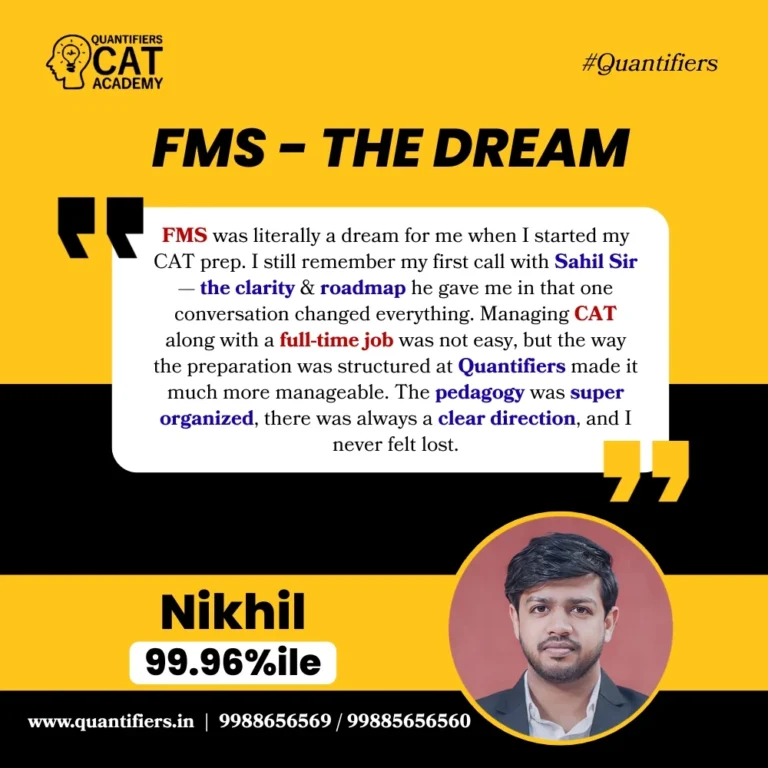
This is the framework used by Quantifiers students — the same structure that produced Nikhil (99.96%ile), Mridul (99.98%ile), and Ekansh (99.91%ile).
Table 2 — CAT 2026 Mock Schedule (June to November)
| Month | Mock Focus | Chapter-wise | Sectionals | Full Mocks |
|---|---|---|---|---|
| June | Academic foundation + chapter tests | Every topic studied → test immediately | VARC sectionals begin (end of month) | None |
| July | Sectional ramp-up | Continue chapter tests for new topics | VARC + DILR sectionals (post 100 sets). QA sectionals if 2 units done. | Start if Arithmetic + Algebra complete |
| August | Full mock momentum | Weak areas only | 1–2 sectionals/week per section | 1 per week minimum |
| September | Mock acceleration | Only as review tool after mock errors | Targeted sectionals for weak sections | 2 per week |
| October | Peak mock phase | Minimal — error revision only | 1 sectional/week for weakest section | 2–3 per week |
| November | Final calibration | None | None (save energy) | 1 every 2–3 days. Stop 1 week before CAT. |
For chapter-wise and sectional tests, Quantifiers enrolled students get access to topic-specific tests built to CAT pattern. Just search any topic on the portal and the relevant tests appear — Averages, Algebra, Arrangement, RC sets. All with video solutions.
Not enrolled yet? Quantifiers also offers 100 free sectional tests and 60 DILR sectionals — based on the CAT pattern, with video solutions. The DILR sectionals are available at ₹19. These alone can take your DILR from plateau to percentile.
4. The Quantifiers Mock Ecosystem — Everything You Need in One Place
You do not need to hunt across five different platforms for mock tests. Quantifiers has built a complete mock ecosystem — from chapter-wise tests to sectionals to full-length mocks — designed specifically around the CAT pattern. Here is what is available and when to use each.
Table 3 — Quantifiers Mock Resources: What to Use & When
| Resource | What It Covers | When to Use | Access |
|---|---|---|---|
| Chapter-wise Tests | Topic-specific tests for every QA, DILR & VARC chapter — Averages, Algebra, Arrangement, RC sets, Para Jumbles and more | Day 1 — alongside every topic you study | Enrolled students — search any topic on the portal |
| 100 Free Sectional Tests | Full-section tests for QA, DILR & VARC — 40 minutes each, CAT-pattern questions | After 1 month of prep (VARC). After 100 DILR sets. After 2 QA units (QA sectionals). | Free — available at quantifiers.in/cat-test-series |
| 60 DILR Sectionals | 60 CAT-pattern DILR sets with video solutions — Arrangement, Condition-Based, Games & Tournaments, Venn Diagrams, Miscellaneous | After completing ~100 DILR practice sets (sets 1–30 without timer, 31–100 with timer) | ₹19 — quantifiers.in/cat-test-series |
| Daily Targets | Daily QA questions with video solutions + DILR set + RC passage (text & video solutions alternating) | Every single day — builds consistency and daily problem-solving habit | Free — quantifiers.in → Daily Targets |
🎯 The Mock Review Rule
Taking a mock is not the preparation. Reviewing the mock is the preparation. Spend at least as much time reviewing each mock as you spent taking it. For every wrong answer: was it a concept gap, a time trap, or a silly mistake? For every question you left: should you have attempted it? This analysis is what converts mock scores into actual percentile improvement. For Quantifiers enrolled students, mentors review daily scores and flag exactly where the pattern is breaking — so you fix the right thing, not just work harder.
5. What to Do When Your Score Stops Moving
Every serious CAT aspirant hits a plateau — a point where mock scores stagnate across 3–4 consecutive attempts. This is not a signal to panic. It is a signal to change the stimulus.
- Reduce mock frequency, increase analysis depth: If you are taking 3 mocks a week and scores are flat, drop to 1 mock a week and spend the remaining time in deep review. Volume without analysis creates a false sense of progress.
- Take a 10-day practice-only mode: Stop full mocks entirely. Focus exclusively on chapter-wise tests and targeted practice on your weakest topics. This resets your approach and breaks the pattern that is keeping scores stagnant.
- Identify the specific leak: Is the plateau in QA, DILR, or VARC? Is it accuracy or attempt rate? Two different problems with two different solutions. Do not treat the symptom (low score) — treat the cause (low QA accuracy from rushing).
- Change the attempt order: If you always do QA → DILR → VARC, try starting with VARC. A different order can break time-management habits that are costing you marks without you realising it.
- Talk to your mentor: For Quantifiers enrolled students, this is exactly what daily score reporting and 1:1 mentorship is for. Your mentor sees where the plateau is coming from before you do — because they have seen it happen to dozens of students at the same stage.
Every student has different needs at the plateau stage. Some need more mocks. Some need fewer. Some need 10 days away from full tests entirely. The key is recognising that a plateau is information, not failure — and acting on it methodically rather than emotionally.