Ratio & Partnership
Ratio & Partnership is one of the most repeated and high-scoring topics in Arithmetic for CAT 2026. This page includes carefully selected CAT arithmetic important questions covering ratios, proportions, and partnership-based profit distribution problems aligned with real CAT exam patterns. These questions strengthen your ability to handle both direct and application-based CAT Quant problems.
Arithmetic
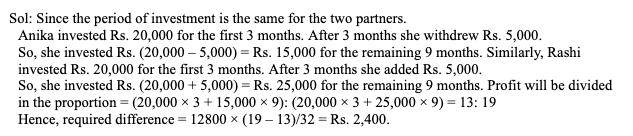
Q1. Anika and Rashi initiated a business together by investing Rs. 20,000 each. However, after 3 months, Anika decided to withdraw Rs. 5,000 from her investment, while Rashi contributed an additional Rs. 5,000. If they accumulated a profit of Rs. 12,800 by the end of the year, what is the difference in profit shares (in Rs.) between Rashi and Anika?

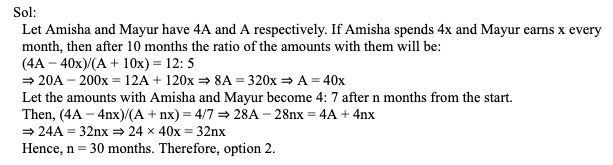
Q2. Amisha has four times as much money as Mayur does. Every month, Amisha spends a constant amount of money, while Mayur earns one-fourth the amount of money that Amisha spends. After 10 months, the ratio of the amounts held by Amisha and Mayur is 12: 5. How many months from the start will the ratio of the amounts held by Amisha and Mayur become 4: 7?
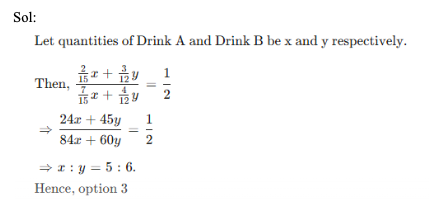
Q3. Drink A is made by mixing cola, lemon juice and sugar syrup in the ratio 2: 6: 7, while Drink B is made by mixing them in the ratio 3: 5: 4 respectively. Which of the following could be the ratio of Drinks A and B to be mixed for making a new drink in which the ratio of cola and sugar syrup is 1: 2?
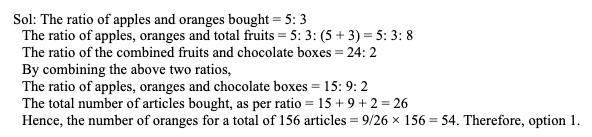
Q4. Naman buys apples and oranges in the ratio of 5: 3. For every 24 fruits of the combined lot of apples and oranges bought by him, he buys 2 chocolate boxes. If the total number of all three types of articles bought by him is 156, what is the number of oranges bought by him?
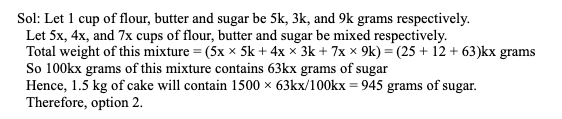
Q5. A cake is prepared by mixing flour, butter, and sugar in the ratio 5: 4: 7 by volume. The weights of equal volumes of flour, butter, and sugar are in the ratio 5: 3: 9. What will be the weight of sugar in 1.5 kg of cake?
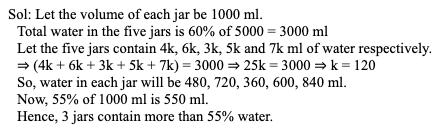
Q6. There are five similar jars kept on a table such that there is water in each of them in the ratio 4: 6: 3: 5: 7 respectively. If the volume of water in all these jars is 60% of the total volume of all the jars, then the water in how many jars is more than 55% of the volume of the jar?
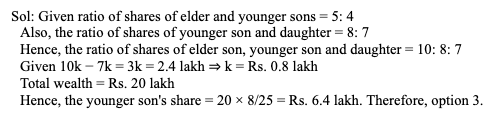
Q7. Mr. Kumar wrote a will to split his wealth among his two sons and daughter, such that the ratio of the shares of the elder and younger sons is 5 : 4, while the ratio of the shares of younger son and daughter is 8 : 7. If the difference between the share of the wealth between his eldest son and daughter is Rs.2.4 lakh, then what is the share (in Rs. lakh) of his younger son?
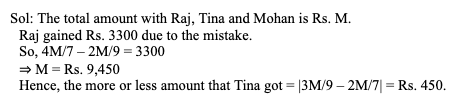
Q8. Raj, Tina, and Mohan were supposed to divide a certain amount, M, among themselves in the ratio 2: 3: 4 respectively. However, they made a mistake and divided the amount in the ratio 4: 2: 1 instead. As a result, Raj gained Rs. 3,300. In the process, how much more or less (in Rs.) did Tina get?
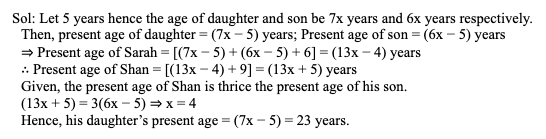
Q9. Sarah’s age 6 years ago was equal to the sum of the present ages of her son and her daughter. Five years hence, the ratio between her daughter’s age and her son’s age will be 7: 6 respectively. Sarah’s husband, Shan, is 9 years older than her. Shan’s present age is thrice the present age of his son. What is his daughter’s present age (in years)?
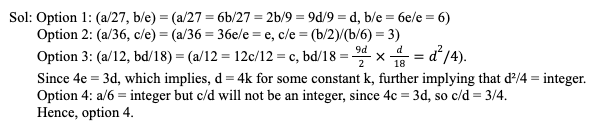
Q10. Let a, b, c, d and e be integers such that a = 6b = 12c and 2b = 9d = 12e. Then which of the following pairs contain a number that is not an integer?
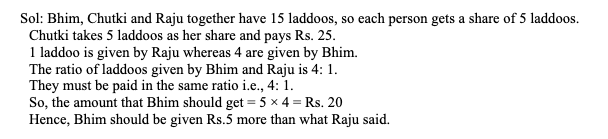
Q11. Bhim has 9 laddoos and Raju has 6 laddoos whereas Chutki has Rs. 25 but no laddoos. They decide to share the laddoos equally among themselves and Chutki offers to pay for the laddoos that she gets. Raju says that he should get Rs. 10 and the rest of the money can be given to Bhim whereas Bhim disagrees. How much more (in Rs.) money should Bhim get?
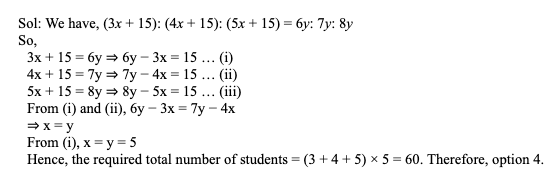
Q12. The number of students in three sections in a school are initially in the ratio of 3: 4: 5. If the number of students in each section is increased by 15, the new ratio becomes 6: 7: 8. The total number of students in the three sections before the increase was:
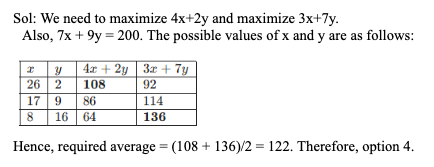
Q13. In a class of 200 students, the ratio of boys who play cricket to those who play badminton is 4: 3, while the ratio of girls who play cricket to those who play badminton is 2: 7. Each student plays exactly one game. What is the average of the maximum possible number of students who play cricket and the maximum possible number of students who play badminton?
Q15. A sum of money is divided among Ketan, Lalit and Jatin so that the ratio of the shares of Ketan and Lalit is 3: 5, while the ratio of the shares of Lalit and Jatin is 2: 5. If the difference between the largest and the smallest of these three shares is Rs. 570, then Ketan’s share, in rupees, is:
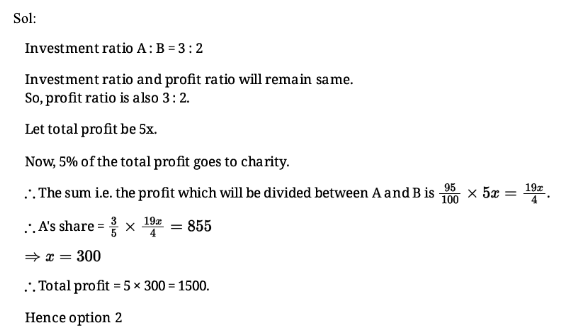
Q16. A and B invested in a business in the ratio 3: 2. If 5% of the total profit earned in the business goes to charity and A’s share of profit is Rs 855, then the total profit (in Rs.) earned is:
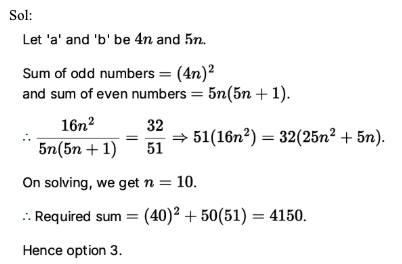
Q17. The ratio of the sum of the first ‘a’ odd natural number to the sum of first ‘b’ even natural numbers is 32: 51. If a and b are in ratio 4: 5, then find the sum of all ‘b’ even numbers and all ‘a’ odd numbers.
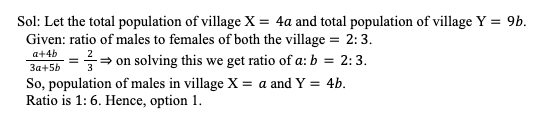
Q18. In a village ‘X’, the ratio of male to female population is 1: 3, whereas in another village ‘Y’, ratio of male to female population is 4: 5. If the ratio of male to female population of both the villages taken together is 2: 3, then find the ratio of males in village ‘X’ to males in village ‘Y’.
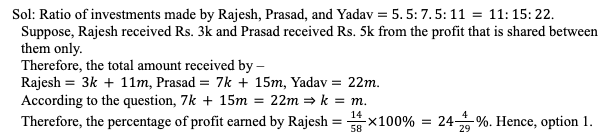
Q19. Rajesh, Prasad, and Yadav started a business by investing Rs. 5.5 lakhs, Rs. 7.5 lakhs, and Rs. 11 lakhs. A part of the profit is shared between Rajesh and Prasad in the ratio of 3: 7, and the remaining profit is divided among Rajesh, Prasad, and Yadav in the ratio of their initial investments. If the total earnings of Prasad and Yadav from the business are the same then the percentage of profit earned by Rajesh is:
Q20. A company has two branches in India – one in Mumbai and the other one in Kolkata. Each branch has three departments viz. Finance, Marketing and Operations. The number of employees in these three departments in the given order are in ratio 1: 3: 2 in the Mumbai branch and 3: 7: 5 in the Kolkata branch. If both the branches have same number of employees, then the ratio of number of employees in Mumbai in Finance department to that in Kolkata in Operations department is:
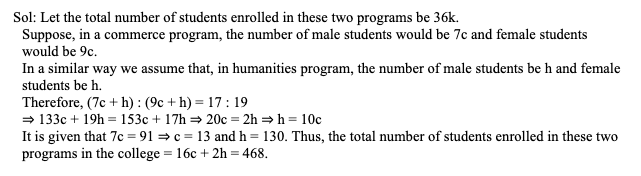
Q21. The ratio of male and female students in a college is 17: 19. The students of the college can opt any one of the two programs for their graduation – Humanities or Commerce. Half of the students enrolled in the Humanities program are female, and in the Commerce program, the ratio of male to female students is 7: 9. How many students are there in the college enrolled in these two programs if the number of male commerce students is 91?
Q22. In a school, the ratio of the number of boys to the number of girls is 10: 11. Among the students who pass, the ratio of the number of boys to the number of girls is 3: 4 and among those who fail, the ratio of the number of boys to the number of girls is 5: 2. If 34 girls fail, how many boys are there in the school?
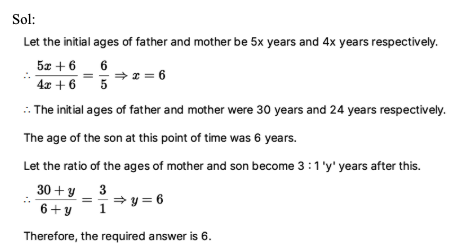
Q23. In a family of three members, the ratio of ages of father and mother was 5: 4 when their son was born. Six years later, the ratio became 6: 5. After how many more years will the ratio of the ages of mother and son become 3: 1?
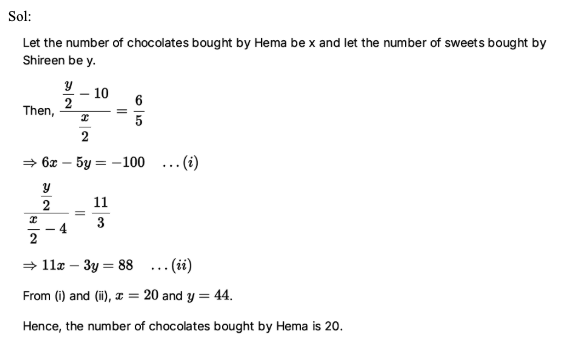
Q24. Hema bought some chocolates and gave half of them to Shireen. Shireen bought some sweets and gave half of them to Hema. Hema ate 10 sweets and Shireen ate 4 chocolates. After that, the number of sweets and chocolates Hema had, were in the ratio 6:5 and the number of sweets and chocolates Shireen had, were in the ratio of 11:3. How many chocolates did Hema buy?
Q25. A group of friends wants to contribute towards buying a new computer for their community centre. The computer costs Rs. 42,000. They decide that the total contribution of the adults in the group will be 50% more than the total contribution of children, and a local business owner is willing to donate three times the total amount contributed by the adults. How much should be the total contribution of the adults (in Rs.)?
Q26. In a garden, there are three types of flower pots: roses, tulips, and daisies. The ratio of the number of flower pots of roses to that of tulips is 3:5, and the ratio of the number of flower pots of tulips to that of daisies is 8:7. If there are 315 flower pots of daisies in the garden, how many flower pots of roses are there?
Q27. There are four salesmen – A, B, C, and D. In the first month, they received a total commission of Rs. 21,000 from their company and divided it in the ratio 2: 3: 4: 5. In the next month, the commission tripled and the amount was divided in the ratio 3: 4: 5: 2. What was the ratio of the total commission earned by A and D during the two months respectively?
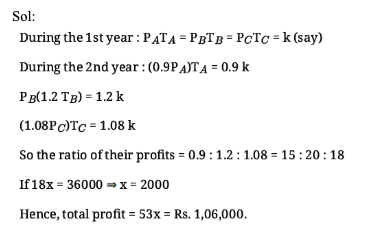
Q28. Three business partners A, B, and C invest different amounts for different durations during the first year and at the end of the first year, they receive profits in the ratio 1: 1: 1. In the second year, A reduces his investment by 10%, B increases his duration of investment by 20% and C increases his investment by 8%. If C receives Rs. 36,000 as his share during the second year, what was the total profit (in Rs.) distributed in the second year?
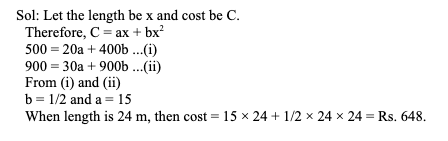
Q29. The cost of laying a road is given by the sum of two terms. The first term is directly proportional to the length of the road and the second is directly proportional to the square of the length of the road. The cost of laying 20 m and 30 m of the road was Rs.500 and Rs.900 respectively. Find out the cost (in Rs.) of laying the road when its length was 24 m.