300+ Most Important Arithmetic Questions for CAT

Simple and Compound Interest

Simple and Compound Interest is a consistently tested and high-scoring topic in Arithmetic for CAT 2026. This page provides structured CAT arithmetic important questions covering SI vs CI comparisons, installment problems, and application-based interest calculations aligned with CAT exam difficulty levels. The focus is on building formula fluency, speed, and accuracy for Quant improvement.

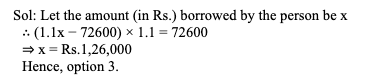
Q1. A person borrows some money from the bank at 10% per annum compounded annually for two years. At the end of each year he pays Rs.72,600. Find the amount (in Rs.) borrowed by him, if the bank charges interest on the balance amount to be repaid.
1,43,200
1,25,400
1,26,000
1,30,000

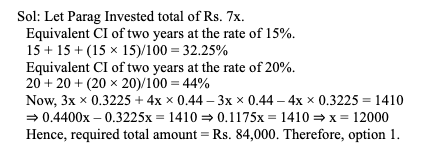
Q2. Parag invested some money into two parts in the ratio of 3: 4. He earned compound interest on both parts for two years, one at a 15% rate and the other at a 20% rate compounded annually, respectively. If he swaps the interest rates, he’ll get Rs. 1,410 less in interest than earlier interest. Find the total money (in Rs.) Parag invested.

84,000
1,25,000
56,000
45,000

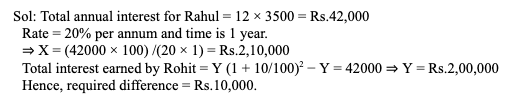
Q3. Rahul invests Rs. X in a scheme and earns a monthly interest of Rs.3,500 at 20% per annum at simple interest. Rohit invests Rs. Y in another scheme at compound interest compounded semi-annually and he earns the same annual interest as Rahul. If Rohit’s scheme has the same rate of interest per annum as Rahul’s, then the difference (in Rs.) between X and Y is:

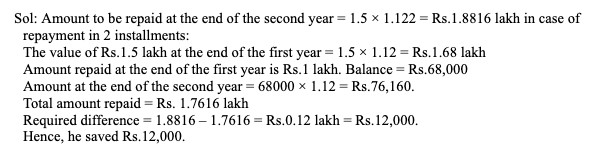
Q4. Suman borrowed Rs.1.5 lakh at 12% per annum compound interest for two years. Instead of repaying the entire amount at the end of the second year, he repaid an installment of Rs.1 lakh at the end of the first year and the remaining at the end of the second year. Find the amount (in Rs.) that saved in this manner.

18,000
11,440
11,616
12,000

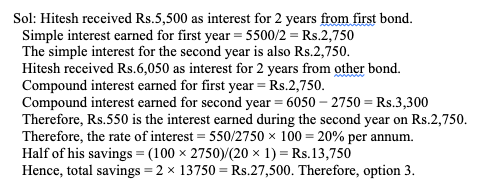
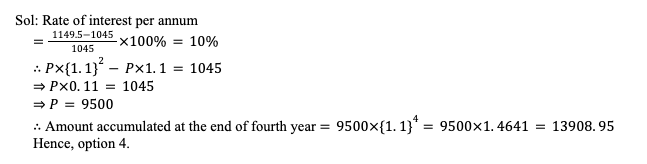
Q5. Hitesh invested half his savings in a bond that paid simple interest for 2 years, receiving Rs.5,500 as interest. The remaining amount was invested in another bond that paid compound interest for 2 years at the same rate, yielding Rs.6,050 as interest. What was the initial value of Hitesh’s savings (in Rs.)?

55,000
13,750
27,500
41,250

Q6. Rashmi had a capital of Rs. 1,60,000. She invested half of it in a business and the other half in a bank at a 10% p.a. compound interest for two years. In the business, during the first year, Rashmi made a profit of 30% and added it to the capital. In the second year, she incurred a 10% loss and deducted it from the capital. What is the difference between the returns (in Rs.) from the two investments made by Rashmi?

3,200
3,000
3,400
4,000

Q7. Jashan invests Rs 2.4 lakh in a scheme that pays 9% interest, compounded annually, and Rs.2 lakh in another scheme that pays 10% interest, compounded semi-annually. Karan invests some money in a different scheme that pays interest at the rate of 8% simple interest per annum. After one year both Jashan and Karan withdrew their amounts from the schemes. If both received the same amount of interest, then how much did Karan invest (in Rs.)?

6,02,200
5,80,000
5,26,250
4,96,550

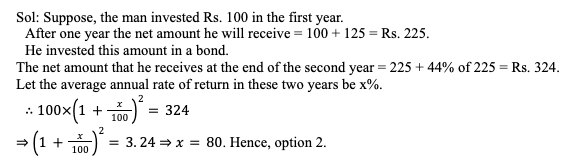
Q8. A man invested some amount in the stock market. After one year, he sold all his shares and his effective gain (after paying brokerage and taxes) was 125%. He then invested the proceeds received from his stock market transactions into another investment that offered him an effective annual return of 44% after deducting taxes and other charges. What is the average annual compounded return (in %) that he earned in these two years?

84.5
80
75
72.25

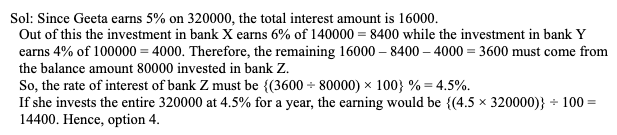
Q9. Geeta has an initial capital of ₹ 3,20,000. Out of this, she invests ₹ 1,40,000 at 6% in bank X, ₹ 1,00,000 at 4% in bank Y and the remaining amount at x% in bank Z, each rate being simple interest per annum. Her combined annual interest income from these investments is equal to 5% of the initial capital. If she had invested her entire initial capital in bank Z alone, then interest income after a year, in rupees, would have been:

16000
12800
11200
14400

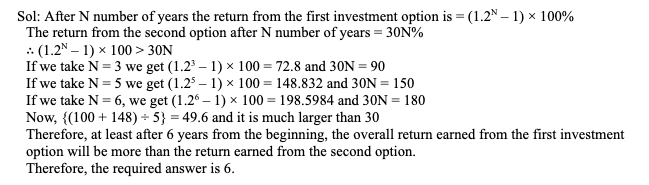
Q10. Mr. Kumar has two options for investments – the first option offers an annual return of 20% per annum compounded annually and the second option is 30% per annum with simple interest. He wishes to invest the entire investable amount with him in one of the two options. The financial adviser says that the first option becomes a better option in comparison to the second option only when the amount remains invested for at least N number of years (N is an integer). The value of N is:

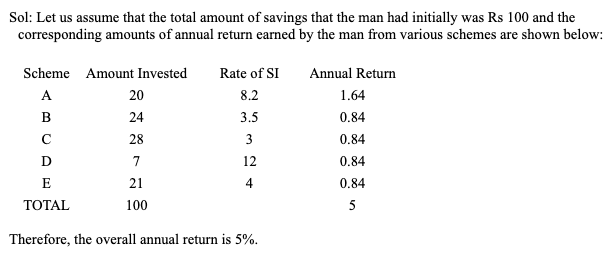
Q11. A man invests 20% of his total savings at 8.2% in scheme-A, 30% of the remaining savings at 3.5% in scheme-B, 50% of the remaining savings at 3% in scheme-C, 25% of the remaining savings at 12% in scheme-D, and the remaining savings at 4% in scheme-E, each rate being simple interest per annum. What is the overall annual return (in percentage) the man earns?

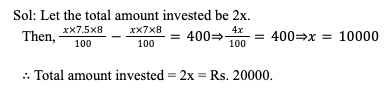
Q12. Manish invested two equal amounts at 7.5% and 7% rate of simple interest. If the difference between the interests earned on these two investments after 8 years is Rs. 400, then find the total amount (in Rs) invested by Manish.

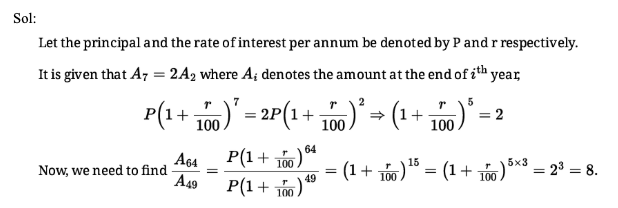
Q13. If a certain sum, invested under compound interest, amounts to twice as much at the end of
the seventh year as it would at the end of the second year, then the amount at the end of the
64th year will be how many times of the amount that was at the end of the 49th year?

Q14. Mr. Dube invests half of his capital at r%, two-fifth at 12.5% and the remaining at 25%, each rate being simple interest per annum. His cumulative interest income from these investments equals his total capital in 8 years. Find the value of r.

Q15. Dr. Chadha invests one-third of his capital at 6%, one-fourth of the rest at 4% and the remaining at 8%, each rate being simple interest per annum. After completion of ‘n’ years, the cumulative interest income from these investments turned out to be equal to his initial investment. Find ‘n’.

Q16. Tarun has invested a total of Rs. 78000 in three different schemes- A, B and C. Scheme A offers 5% simple interest per annum, scheme B offers 10% compound interest per annum compounding annually, and scheme C offers 20% compound interest per annum compounding annually. If the amounts invested by Tarun in schemes A, B and C are in the ratio 4: 6: 3, then the ratio of interest earned from these three schemes after three years in the order of A, B, and C will be:

100: 331: 364
120: 331: 364
120: 331: 336
100: 333: 336

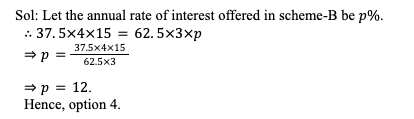
Q17. A man has invested 37.5% of his total savings in scheme-A for 4 years and the rest of the savings in scheme-B for 3 years. Both the schemes offer simple interest and the total interest earned from both the schemes is the same. Find the annual rate of interest offered in scheme-B if the annual rate of interest offered in scheme-A is 15%.

8%
10%
11.25%
12%

Q18. Resham invested Rs. 100000 at 6% for 5 years and Reshma invested Rs. 90000 at 7% for 4 years, both on simple interest schemes. How much money has to be invested for 8 years at 15% simple interest rate to earn total interest earned by both Resham and Reshma?

Rs. 45500
Rs. 45000
Rs. 46000
Rs. 46500

Q19. Sakshi invested her savings in 3 different investment schemes; all under simple interest. The amount earned on the first scheme at 12% per annum for 5 years equalled the amount earned on the second scheme at 15% interest for 4 years and also equalled the amount earned on the third scheme at 10% per annum for 3 years. Then, the percentage of her savings invested in the third scheme is:

50
40
25
20

Q20. Bhanu borrowed Rs.80,000 at a certain rate of simple interest payable at the end of 7 years. After 2 years, he repaid Rs.60,000 towards the principal and after 5 more years, he repaid Rs.72,000 to settle his loan. Find the rate of interest per annum.

10%
15%
12%
20%

Q21. The annual rate of interest on Rs.20,000 lent at simple interest, is 2.5 times the number of years for which it is lent. If the total interest for the given period is 10% of the principal, then find the total amount (in Rs.) at the end of the time period had the interest been compounded annually.

21,050
22,050
22,350
21,250

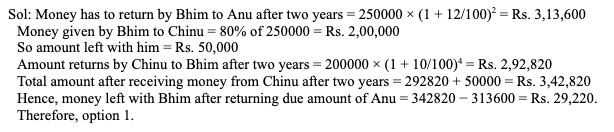
Q22. Anu gives Rs. 2,50,000 to Bhim at 12% p.a. compound interest for two years. Bhim gives 80% of the money received from Anu to Chinu at 20% p.a. interest, compounded half yearly for two years. Two years hence when he receives his due amount from Chinu, Bhim gives Anu her due amount. What is the amount (in Rs.) left with Bhim?
29,220
28,440
29,840
22,780

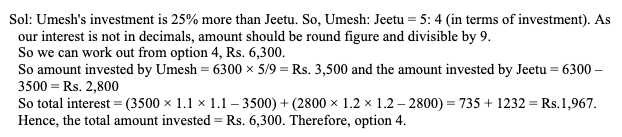
Q23. Umesh and Jeetu invested some money at 10% and 20% per annum, respectively, with interest being compounded annually. Together, they receive Rs. 1,967 as interest at the end of 2 years. If Umesh has invested 25% more than Jeetu, then what is the total amount (in Rs.) that both have invested?
5700
6000
7200
6300

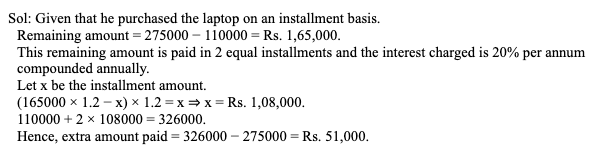
Q24. Bhavik can buy a laptop for Rs.2,75,000 by paying cash or he can pay a down payment of Rs.1,10,000 and the remaining amount along with the interest in two equal annual installments. If the finance company charges interest at 20% per annum compound interest and he purchased the laptop on an installment basis, how much more did he pay (in Rs.) as compared to an outright purchase?

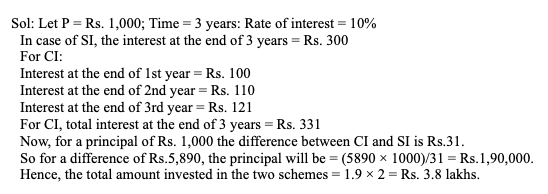
Q25. Kiran invested equal amounts in two schemes at a bank at 10% rate of interest for both schemes. In the first, the rate of interest is compounded annually whereas in the second it is simple interest per annum. If the difference between the amounts received at the end of 3 years is Rs.5,890, then what was the total amount (in Rs. lakhs) invested by Kiran in the two schemes?

3.4
3.8
4.2
5.4

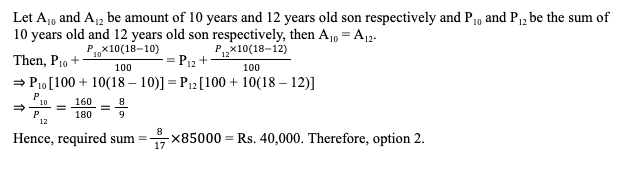
Q26. A father left a will of Rs. 85,000 to be divided between his two sons aged 10 years and 12 years such that they may get equal amount when each attains the age of 18 years. If the money is invested at 10% p.a. simple interest, then find how much (in Rs.) would the son aged 10 years gets at the time of the execution of the will.
30000
40000
45000
48000

Q27. A sum of money invested compounds to Rs.2.5 lakh after 2 years and Rs.3 lakh after 5 years. If compounding is done annually, the compound interest earned in 9 years as a percentage of the principal invested at the outset, is:

20%
44%
72.8%
80%

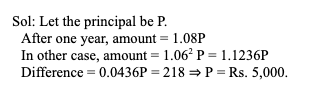
Q28. A sum of money is kept in a bank at 8% interest compounded annually. Had the interest been 12% per annum compounded semi-annually, the amount after 1 year would have been Rs. 218 more. What was the principal amount (in Rs.) kept in the bank?

Q29. Amit decides to invest a certain amount of money in a savings account of a bank that pays 20% compound interest per annum for a period of two years. In return Amit wanted payments of Rs. 250 at the end of first year and Rs. 420 at the end of second year from the bank. What is the sum of money (in Rs.) that should be invested by Amit to achieve this?

best CAT Coaching

We at Quantifiers understand and deliver on the personal attention each of our students requires. Whether it is through our pedagogy that enables non-engineers or non-math background students, our constant effort to proactively provide solutions, or our focus on our student’s goals.