Time and Work is a high-frequency and high-impact topic in Arithmetic for CAT 2026, with repeated appearances across CAT Quant sections in various formats. This page includes targeted CAT arithmetic important questions covering individual work rates, pipe and cistern problems, and combined efficiency-based applications. These are designed around repeated CAT concepts for exam-level practice and conceptual clarity.
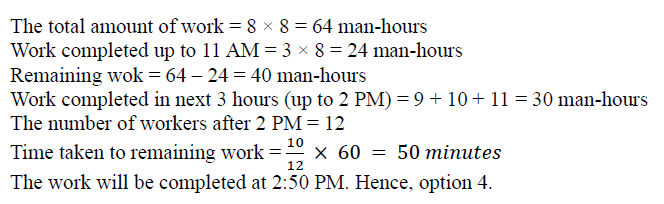
66. A team of 8 workers can finish a work in 8 hours, working together. The team of 8 started working at 8:00 AM and from 11:00 AM onwards, one worker was added to the team every hour. The entire work will be completed at:
2:10 PM
2:30 PM
3:10 PM
2:50 PM
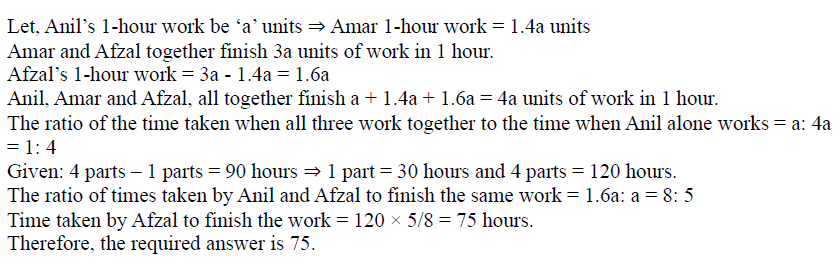
67. Anil takes 40% more time than Amar to finish a job. Amar and Afzal together finish the same job in one-third of the time taken by Anil alone to do the same. If all three work together, they will take 90 hours less time to finish the job than that taken by Anil alone. The time taken by Afzal to finish the job alone, in hours, is:
68. Hari started work and Paban joined him after 6 days. The work was completed on the end of 18th day from the day Hari started working. If both of them started together, the work would have been completed in 15 days. Working alone, the time Paban would have taken, in days, to complete the work is:
24
27
28
30
69. Birbal takes 20% more time to complete a job than Akbar. They finish a job in the following manner: Akbar and Birbal work on alternate days for the first 6 days, then Akbar alone works for 2 days, and finally Birbal works alone for 3 days to finish the job. What percentage of the total job was finished by Akbar?
30
40
45
50
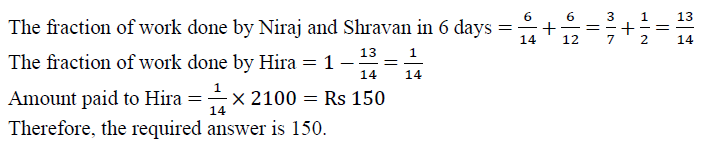
70. Niraj can weave a handloom saree in 14 days whereas Shravan can weave it in 12 days. If Hira joins them, a saree can be woven in 6 days. A total of Rs 2100 is paid for weaving a saree. If all of them are working together and everybody is paid in proportion to the work done by him, then the amount, in INR, received by Hira is:
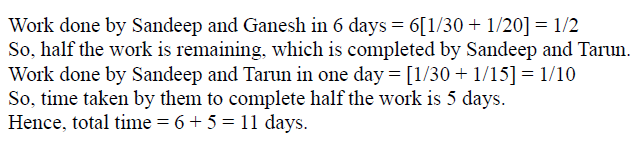
71. Sandeep and Ganesh can complete a piece of work in 30 days and 20 days respectively. Both of them work for 6 days and then Ganesh leaves. Now Tarun, who can complete the same work in 15 days joins Sandeep to complete the remaining work. In how many total days was the total work completed?
10
11
12
13
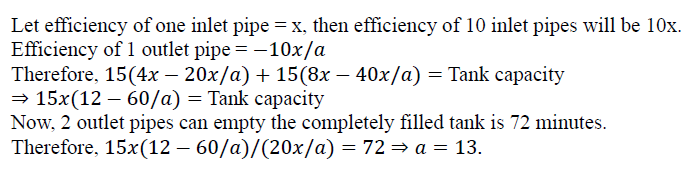
72. Ten inlet pipes of same capacity fill a tank in same time in which ‘a’ outlet pipes of same capacity can empty it. Alternatively, 4 inlet and 2 outlet pipes is opened for first minute and 8 inlet and 4 outlet pipes open for 2nd minute and process continues till tank is completely filled in 30 minutes. If the time in which 2 outlet pipes can empty the completely filled tank is 72 minutes, then what is the value of ‘a’?
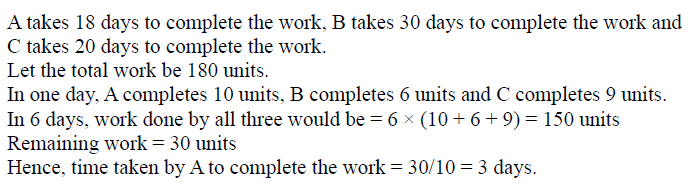
73. A completes 2/3 of a certain job in 12 days. B can complete 1/3 of the same job in 10 days and C can complete 3/4 of the work in 15 days. All of them work together for 6 days and then B and C quit. How long (in days) will it take for A to complete the remaining work alone?
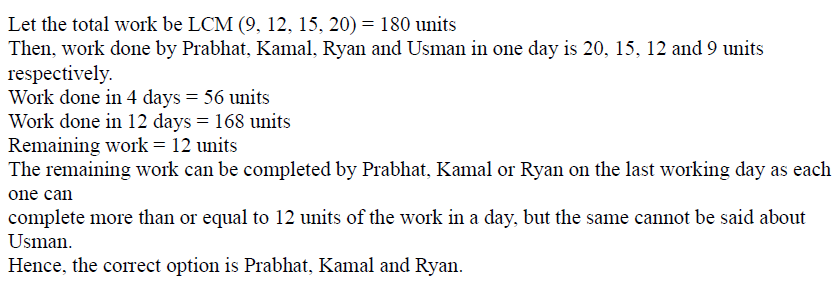
74. Four persons Prabhat, Kamal, Ryan and Usman can complete a work in 9, 12, 15 and 20 days respectively. One of them starts the work and it is continued on a rotation basis, with all the four taking turns and only one person working per day. Any one of the four can start work on the first day. Which of the following is the complete set of people, who can work on the first day such that the work begins and ends with the same person?
Prabhat, Kamal
Kamal, Ryan
Prabhat, Kamal, Ryan
Prabhat, Kamal, Usman
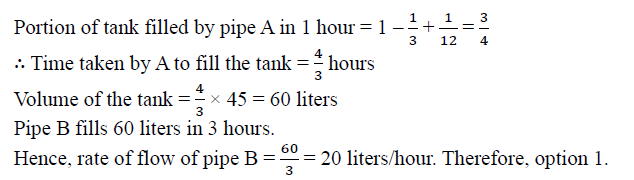
75. Pipes A and B are inlet pipes while pipe C is an outlet pipe. Pipe A supplies water at 45 liters/hour. Pipe B can fill a tank in 3 hours while pipe C can empty it in 12 hours. All the pipes are simultaneously opened and the tank gets filled in 1 hour. What is the rate of flow of pipe B?
20 liters/hour
30 liters/hour
24 liters/hour
25 liters/hour
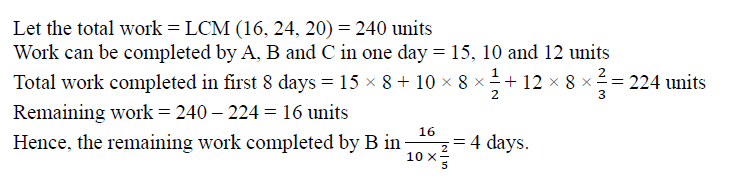
76. Three persons A, B and C working alone can complete a piece of work in 16 days, 24 days and 20 days respectively. Every day B works half a day with A, who works full day, while C works 2/3rd day. After 8 days A and C stop working, then how much time (in days) will take by B to complete the remaining work while working for 2/5th day?
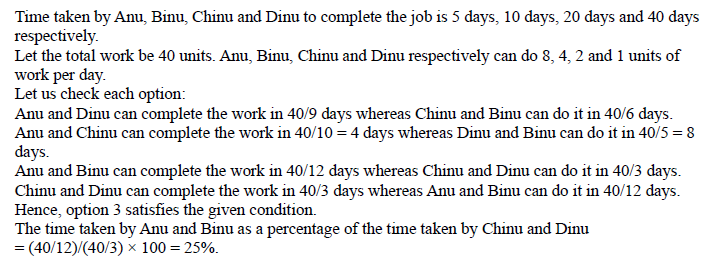
77. Anu takes 5 days to complete a job. Binu takes twice the time as Anu to complete the job. Chinu takes twice the time as Binu to complete the job. Dinu takes twice the time as Chinu to complete the job. Two of the four when working together take 25% of the time to complete the job that the other two would take working together. Find the faster pair.
Anu, Dinu
Anu, Chinu
Anu, Binu
Chinu, Dinu
78. Raman can complete a job in 18 days and Aman can complete it in 24 days. Aman, Raman and Boman together can complete the same job in 8 days. A total sum of Rs. 9000 is paid to three of them as remuneration. If this amount is shared by them in proportion to their work, then Boman’s share, in rupees, is:
1800
2000
2400
2500
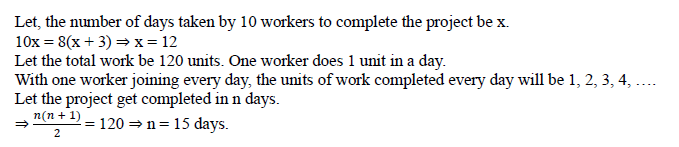
79. A project can be completed by ten workers in a certain number of days. If there were two workers less, it would have taken three more days to complete the project. If one worker starts the project and every day a new worker joins, then in how many days will the project be completed?
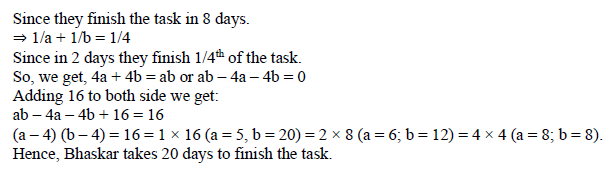
80. Aman, Bhaskar takes a, b days to complete a job independently. If they take turns to work independently on the job, on alternate days the task is completed in 8 days. If a + b > 20 days, find the time taken by Bhaskar to finish the task if he is the slower among the two.
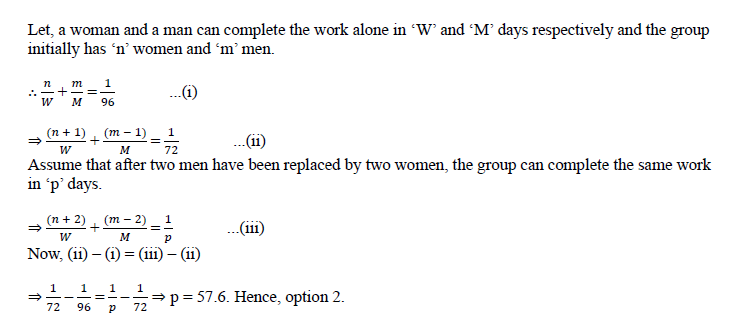
81. A group comprising some women and men can complete a piece of work in 96 days. If a man in the group is replaced by a woman, the resulting group can complete the same work in 72 days. If two men in the original group are replaced by two women, then in how many days can the resulting group complete the work?
48
57.6
60
67.6
82. Anuj can complete a piece of work in 8 days, Bhanu in 12 days and Chetan in 16 days. All of them started the work together but Chetan left when he realised that the remaining work will be completed without him in the next three days, and Bhanu left when he realised that the remaining work will be completed without him in the next two days. Find the total number of days taken to complete the work.
4
5
6
10
83. Raju can do a piece of work in 10 hours. He starts the work on Monday at 10:00 AM, and after each successive hour, starting from 11:00 AM, a man, of half the efficiency of the man who started working just before, joins the existing member(s). By what time the work will be completed on that day?
1:00 PM
2:00 PM
4:00 PM
3:00 PM
84. Asha, Usha and Nisha can individually complete a particular job in 20, 30 and 40 days respectively. Initially Asha starts working alone and after 10% of the work is finished, Usha joins her. Both Asha and Usha then work together for 3 more days. Then the remaining job was done by Nisha alone. How many days would Nisha take to complete the job?
14
20
26
28
85. 8 women and 5 men complete a task of laying bricks in 5 days working 9 hours a day. Three such tasks are to be completed. If the work done by 5 men is equal to that done by 6 women, then how many women should help 10 men to complete three such tasks in 10 days working 9 hours per day?
9
12
16
20
86. Ajay initially starts working on an assignment. After he completes half the work, he quits and Vijay completes the remaining work. The work is completed in 18 days. If Ajay quits after completing 1/3rd work and Vijay completes the remaining work, the work is completed in 16 days. In how many days will the work be completed if both Ajay and Vijay work together right from the beginning and complete the work together?
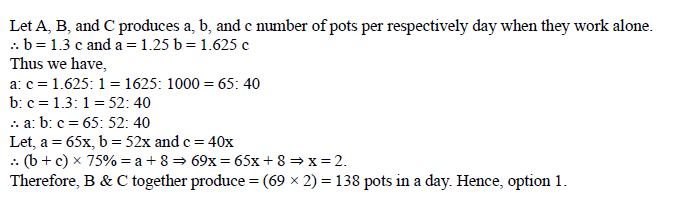
87. A, B and C are three friends who make earthen pots. A is 25% more efficient than B and B is 30% more efficient than C. If they work alone, each of them manufactures integral number of pots per day. As B and C are very good friends, they chat a lot during the time they work together and as a result their productivity reduces by 25%. A has no such problem and always maintains his productivity at the same level. How many pots are produced by B & C together in a day if they produce 8 pots more than A per day?
138
158
143
130
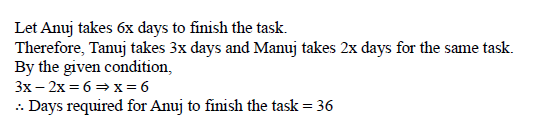
88. Tanuj is twice as efficient as Anuj. Manuj is thrice as efficient as Anuj. Manuj can finish a certain task in 6 days less as compared to Tanuj. In how many days would Anuj finish the same task?
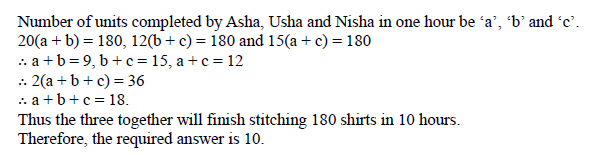
89. Asha and Usha stitch 180 shirts in 20 hours, Usha and Nisha can stitch them in 12 hours while Asha and Nisha take 15 hours. How much time (in hours) will be required by the three together to stitch 180 shirts?
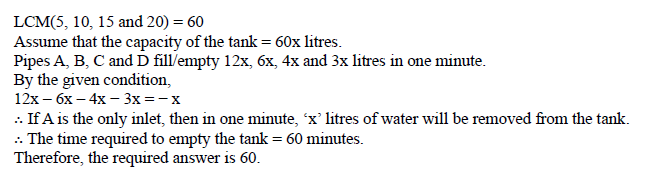
90. Four pipes A, B, C and D are attached to a tank that can operate as inlet as well as outlet pipes. A, B, C and D can completely fill or completely empty the tank in 5, 10, 15 and 20 minutes respectively. How much time will it take to empty the completely filled tank if only A operates as inlet and B, C and D as outlets?
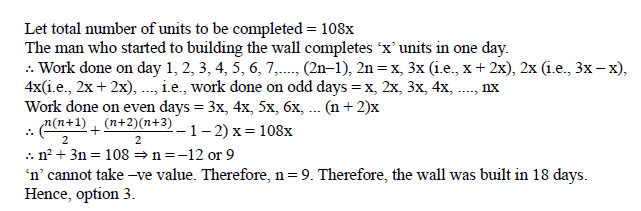
91. A wall is to be built in 108 days. One man takes 108 days to build the wall. The man started building the wall on day 1. He was then joined by two more men on day 2, day 4, day 6, …… and so on and one man each left the work on day 3, day 5, day 7……and so on. If the wall was completed in even number of days, which of the following options gives the number of days taken to build the wall? (Assume that all men are equally efficient.)
20
25
18
10
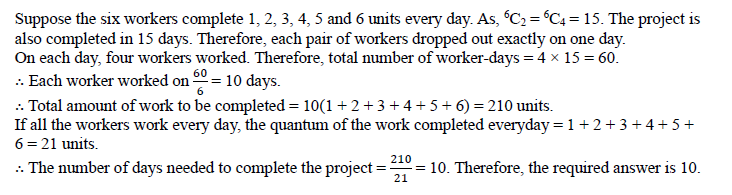
92. Six workers with efficiencies in the ratio 1: 2: 3: 4: 5: 6 work on a project. However, not all six workers but only four workers work on any given day, with no group of the same 4 workers working on the project on more than one day. Eventually the project is completed in 15 days. If all the six workers had worked every day, how many days would they have taken to complete the project?
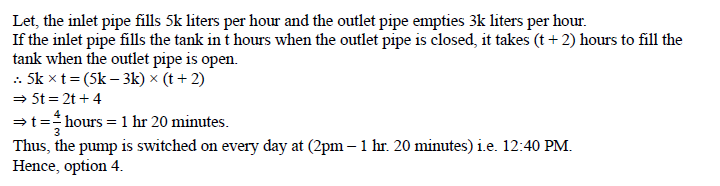
93. A water tank is connected with a water pump through an inlet pipe. Every morning the tank is emptied with the outlet pipe. Once the tank is completely empty, the pump is switched on at a fixed time every day to fill the tank. If the outlet pipe remains closed, the tank becomes full by 2:00 PM, whereas, if the outlet pipe remains open the tank becomes full by 4:00 PM. If the ratio of the capacity of the inlet to the outlet pipe is 5: 3 then at what time every day the pump is switched on?
12:10 PM
12:20 PM
12:30 PM
12:40 PM
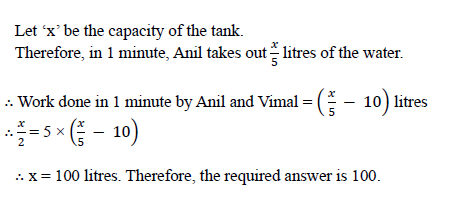
94. Anil can empty a completely filled water tank using a bucket in 5 minutes. Vimal pours 10 litres of water in the tank per minute. If the tank is initially half filled and both Anil and Vimal start their work, the tank will be completely emptied in 5 minutes. Find the capacity (in litres) of the tank.
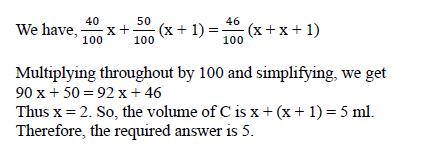
95. Two solutions of acid, A and B, have concentrations of 40% and 50% respectively. When x ml of A are mixed with (x + 1) ml of B, the resultant solution C has a concentration of 46%. Find the volume of C.
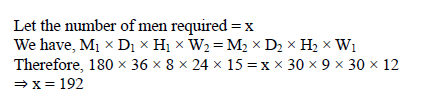
96. If 180 men working 8 hours a day take 36 days to harvest 30 fields of 12 acres each, how many men will be needed to harvest 24 fields of 15 acres each in 30 days, working 9 hours a day?
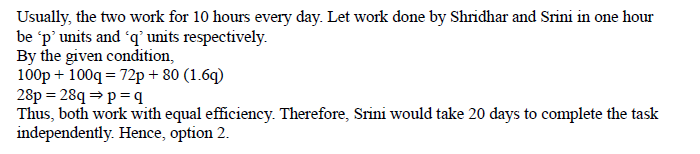
97. Shridhar and Srini together complete one task in 10 days, when both work for 10 hours a day at their usual efficiencies. If Shridhar works for 9 hours every day at his usual efficiency but Srini works for 10 hours every day at 60% more efficiency than usual, the task would be completed in 8 days. Find the number of days Srini alone would take to complete the task with his usual efficiency if he works for 10 hours every day.
18
20
22
24
98. A, B, C and D can prepare one unit of industrial widget independently in 8 days, 4 days, 2 days and 1 day respectively. On Day 1, A started preparing a widget. On Day 2, B joined A and both worked together for 4 days. After B leaves, C joined A and both worked together for 2 days. After C leaves D joined A and both worked together for one day. How many such widgets would they have completed by now?
3.875
4
4.75
5.125
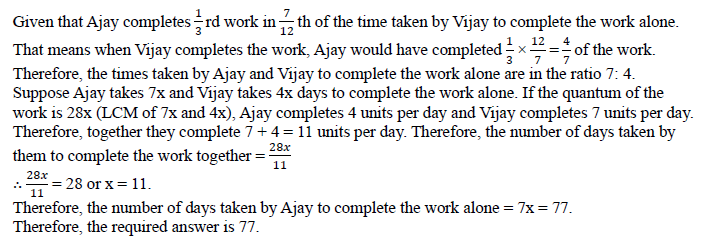
99. Ajay completes 1/3rd of a piece of work alone in 7/12th of the time taken by Vijay to complete the entire work alone. If they together can complete the work in 28 days, then in how many days can Ajay working alone complete the work?
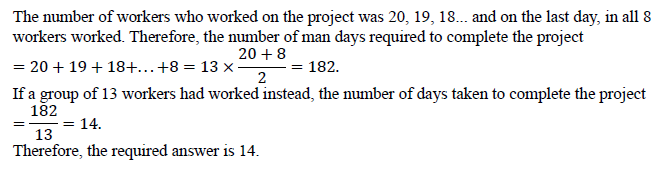
100. A group of 20 workers started working on a project. On the first day, all the 20 workers were present but from the second day onwards, one worker dropped out every day. Eventually the work was completed in 13 days. How many days would a group of 13 workers take to complete the project?
We at Quantifiers understand and deliver on the personal attention each of our students requires. Whether it is through our pedagogy that enables non-engineers or non-math background students, our constant effort to proactively provide solutions, or our focus on our student’s goals.