Time and Work is a high-frequency and high-impact topic in Arithmetic for CAT 2026, with repeated appearances across CAT Quant sections in various formats. This page includes targeted CAT arithmetic important questions covering individual work rates, pipe and cistern problems, and combined efficiency-based applications. These are designed around repeated CAT concepts for exam-level practice and conceptual clarity.
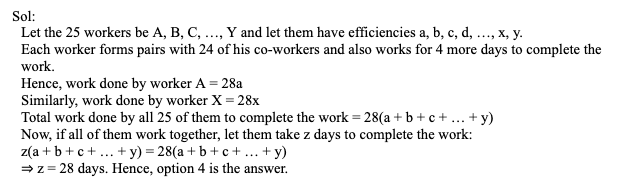
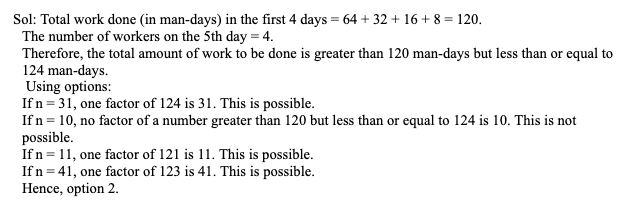
1. A job was assigned to be completed by 25 workers. Every day exactly two workers come for work and the same pair of workers did not work for more than one day. The work was not completed even after all the possible pairs had put in a day’s work. So, the contractor got all the 25 of them to work together for 4 days to complete the remaining work. Find the number of days it would take to finish the work if all 25 of them work together on all the days.
24
26
25
28
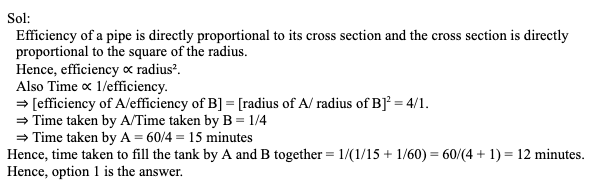
2. There are two pipes – A and B – having circular cross sections that are used to fill a tank. The radius of A is twice that of B. If B fills the tank in 60 minutes, then find the time (in minutes) taken by both the pipes together to fill the tank. (Assume speed of water in both pipes is the same.)
12
9
10
8
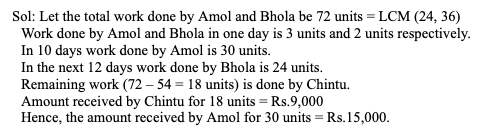
3. Amol and Bhola can complete a piece of work in 24 and 36 days, respectively. Amol worked for the first 10 days and then left, and then Bhola continued for the next 12 days and left. The remaining work is completed by Chintu. If Chintu received Rs.9,000 for the work done by him, then what was the amount (in Rs.) received by Amol?
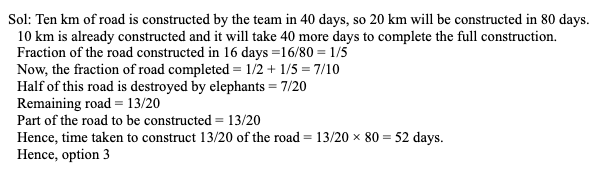
4. Ten kilometres of a highway stretch had already been constructed and an additional 10 km stretch was supposed to be built by a team of workers in 40 days. After 16 days of work, a herd of elephants destroyed half of the existing road. How much time will it take to complete the construction of the road now?
40
42
52
60
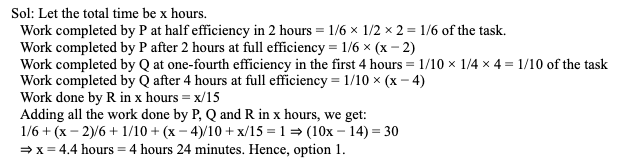
5. P, Q, and R are three workers who can complete a task in 6, 10, and 15 hours respectively. All the three are assigned simultaneously to the task but P works at half his normal efficiency for the first 2 hours and Q works at 1/4th his normal efficiency for the first 4 hours. In how many hours will the task be completed?
4 hours 24 minutes
4 hours 40 minutes
3 hours 34 minutes
3 hours 18 minutes
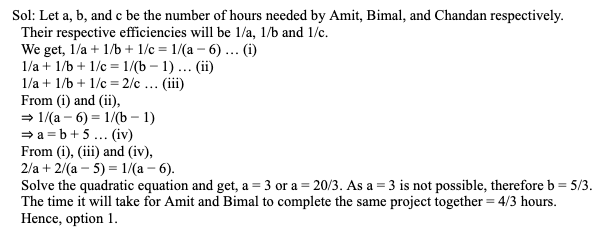
6. Three employees, Amit, Bimal, and Chandan, collaborate on a project. They complete the project in 6 hours less time than what Amit takes to finish it working alone, in 1 hour less than the time taken by Bimal working alone, and in half the time it takes Chandan when he works alone. Find the time (in hours) it will take for Amit and Bimal to complete the same project together.
4/3
3/2
7/3
8/3
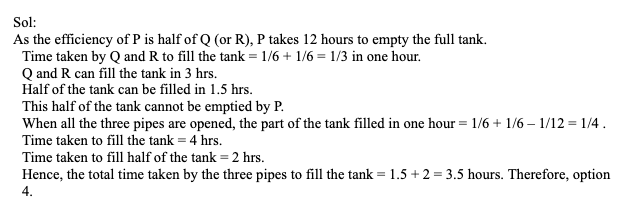
7. Pipes P, Q, and R are fitted to a cylindrical tank. Each of Q and R can fill the tank in 6 hours. P, which is a draining pipe, works at a rate that us half of that of the filling rate of Q. P is fitted at a point which is at half the height of the tank from the base. If all the pipes are opened simultaneously, what will be the time (in hours) taken to fill the empty tank?
2.75
3
3.25
3.5
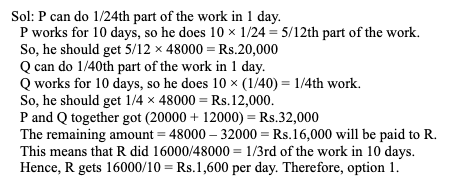
8. Two men, P and Q, undertake a project for Rs.48,000, they can do the work individually in 24 days and 40 days respectively. If they complete the project in 10 days with the help of a friend, R, then what is the daily wages (in Rs.) of R?
1600
1650
1550
1500
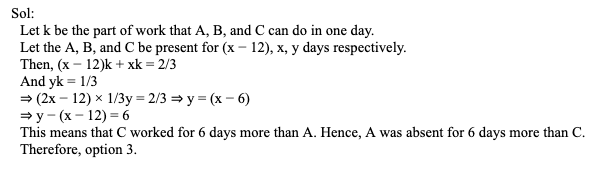
9. Three labourers – A, B, and C with equal efficiencies worked together for N days. During the course of work, all of them remained absent for a few days. A was absent for 12 days more than B, and C did one-third of the total work. How many days more than C was A absent?
9
5
6
8
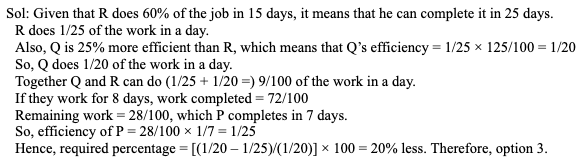
10. Three friends P, Q, and R are assigned a job. R can do 60% of the job in 15 days. The efficiency of Q is 25% more than that of R. Both Q and R started working together and left the work after eight days. P completed the remaining work in 7 days. The efficiency of P is what percent more or less than that of Q?
25%
15%
20%
24%
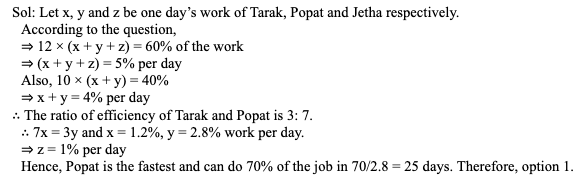
11. Three workers Tarak, Popat and Jetha are appointed to do a job. They started the job together but Jetha left after 12 days when 60% of the job was done. The remaining job was completed by Tarak and Popat in 10 days. The ratio of efficiency of Tarak and Popat is 3: 7. Find the number of days required by the fastest worker to complete 70% of the job alone.
25
28
20
30
12. A class of students decided to do a work in 5 hours. But since 6 students left after the first hour, 2 more students left after the second hour, 2 more students left after the third hour and so on, the work was completed after 8 hours. How many students were there in the class?
13. There are three workers A, B and C. A takes thrice as much time as B and C together to do a task. B takes twice as much time as A and C together to do the task. If working together the three of them require 10 hours to complete the task, then in how many days will C complete the task working 6 hours a day?
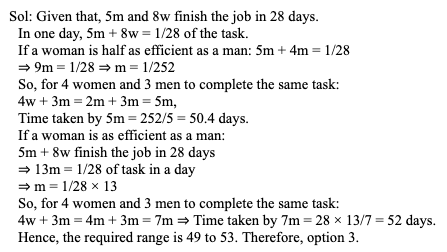
14. Five men and eight women complete a task in 28 days. If the women are at least half as efficient as the men, but not more efficient than the men, then the possible number of days for 4 women and 3 men to complete the same task lies in the range?
30 to 42
40 to 48
49 to 53
55 to 60
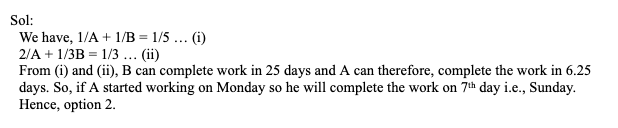
15. Two workers A and B working together completed a job in 5 days. If A worked twice as efficiently as he actually did and B worked 1/3 as efficiently as he actually did, the work would have been completed in 3 days. If A starts the work alone on Monday of a month, then on what day will he complete the work?
Monday
Sunday
Tuesday
Saturday
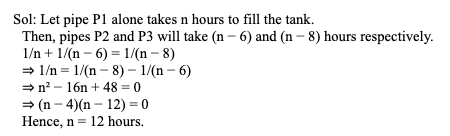
16. A tank is filled by three pipes P1, P2 and P3 with uniform flow. Pipes P1 and P2 operating simultaneously fill the tank in the same time during which the tank is filled by pipe P3 alone. Pipe P2 fills the tank 6 hours faster than pipe P1 and 2 hours slower than pipe P3. What is the time (in hours) required by pipe P1 to fill the tank?
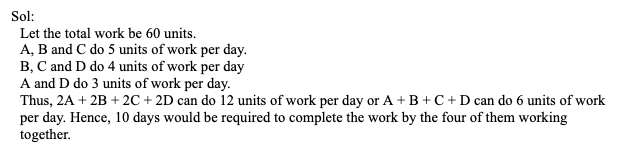
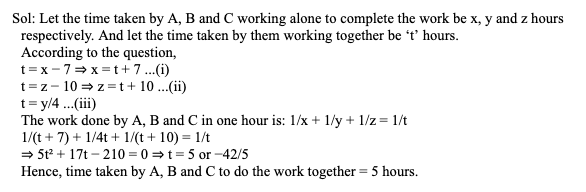
17. A contractor has employed four workers A, B, C, and D for painting a building. A, B, and C can complete the work in 12 days. B, C, and D can complete the work in 15 days, and A and D can complete it in 20 days. How many days will it take all four workers together to paint the building?
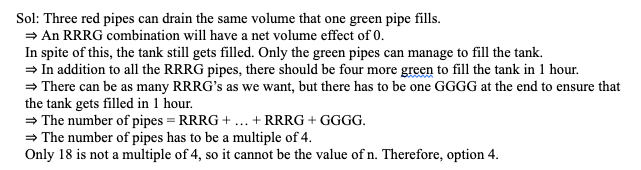
18. There are a few red pipes and a few green pipes attached to a tank. Each red pipe can drain the tank in 12 hours, and each green pipe can fill the same tank in 4 hours. A total of n pipes, which include a few red pipes and a few green pipes, can fill the tank in 1 hour. Which of the following cannot be the value of ‘n’?
20
16
12
18
19. The efficiencies of Ajay, Guatam, and Hitesh are in the ratio of 2: 3: 5. Ajay can complete the work in 40 days. They all worked together for 3 days, and then Hitesh left. How many days will it take for Ajay and Guatam to complete the remaining work?
20. All the factory workers in a factory are equally efficient. However, the daily efficiency of each worker reduces by n/10%, if ‘n’ workers are working together. If the working hours are the same for every type of work performed in the factory and 10 workers together can finish a job in 100 days then in how many days can the same job be finished by 100 workers working together?
11
12
15
18
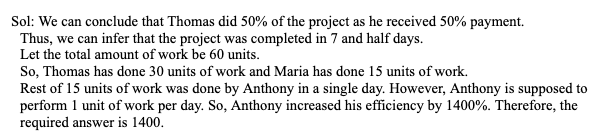
21. Thomas, Maria, and Anthony started working together on a project. On the first day, Anthony worked more than his capacity on a single day but fell seriously ill. So, the rest of the work was completed by the other two. Working alone Thomas, Maria, and Anthony can finish the project in 15 days, 30 days, and 60 days respectively. After the work got over, all three were paid Rs. 8,00,000, out of which, Thomas was paid Rs. 4,00,000. By what percent did Anthony increase his efficiency on the only day that he had worked?
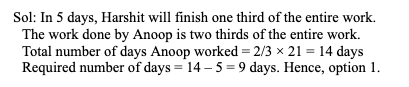
22. A work can be completed by Harshit alone in 15 days. The same work can be completed by Anoop alone in 21 days. Both of them started the work together but after 5 days Harshit left the work. In how many more days can Anoop alone finish the remaining work?
9
14
7
8
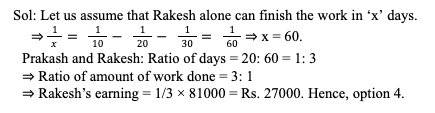
23. Prakash, Kumar and Rakesh together can complete a project in 10 days. While working alone, Prakash and Kumar can finish the project in 20 days and 30 days respectively. They are to be paid in proportion of the amount of work done. If all three work together and Prakash earned Rs. 81000, the amount earned by Rakesh (in Rs.).
81000
54000
40500
27000
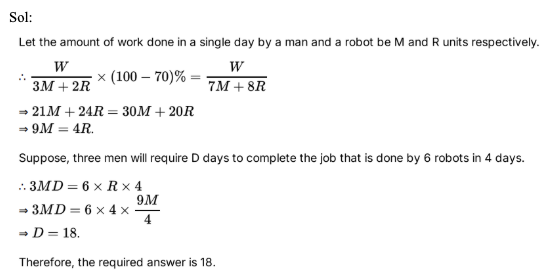
24. Time taken by 7 men and 8 robots to complete a job working together is 70% less than the same job done by 3 men and 2 robots. If 6 robots finish a job in 4 days, then the number of days required by a group of three men to finish the same job is:
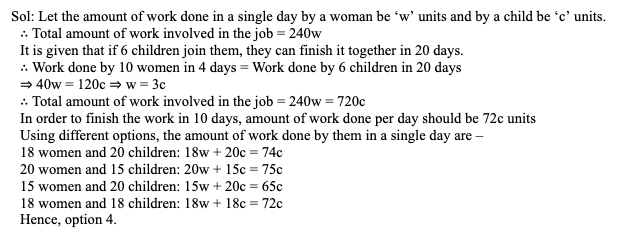
25. 10 women can finish a job in 24 days. If 6 children join them, they can finish it together in 20 days. Which of the following combinations will finish the job in 10 days?
18 women and 20 children
20 women and 15 children
15 women and 20 children
18 women and 18 children
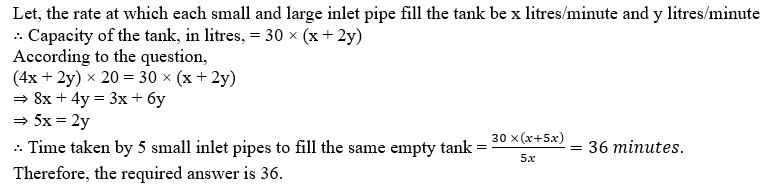
26. A tank is attached with two types of inlet pipes – small and large. One small and two large pipes together fill an empty tank in 30 minutes. Two large and four small pipes together fill the same empty tank in 20 minutes. How much time, in minutes, 5 small inlet pipes will take to fill the same empty tank?
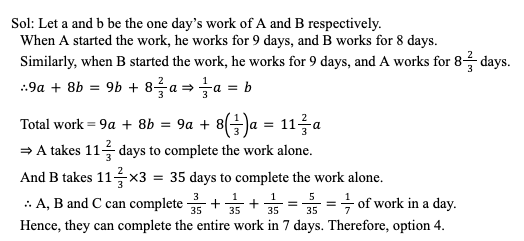
27. A and B can finish a work, working on alternate days, in 17 days, where A works on the first day. Similarly, they can finish the work, working on alternate days, in 1723 days, where B works on the first day. If C, working alone, can complete the work in 35 days, in how many days can the work be completed when A, B and C work together?
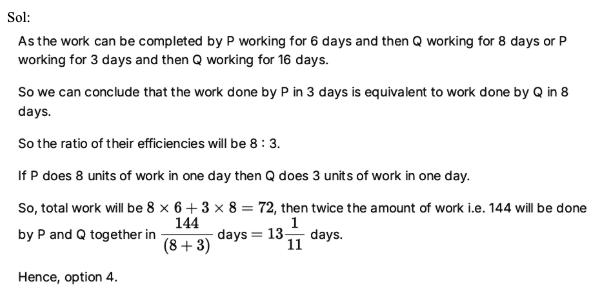
28. P and Q can complete a task either by P working for 6 days and then Q working for 8 days or by P working for 3 days and then Q working for 16 days. In how many days can P and Q together complete twice the amount of task?
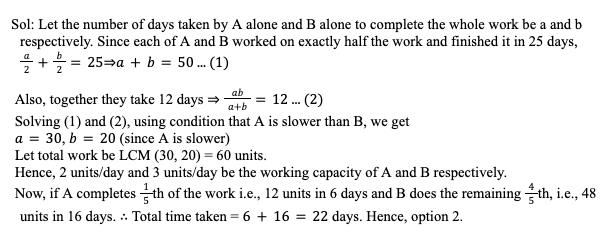
29. A starts a certain work and leaves after completing exactly half of the work, then B takes up the remaining work. In this way, the work is completed in 25 days. If A and B would work together, the same work get completed in 12 days. It is known that A is slower than B. Find the number of days in which the work will be completed, if A alone first works on exactly one-fifth of the work and then B alone completes the rest of the work.
20
22
25
30
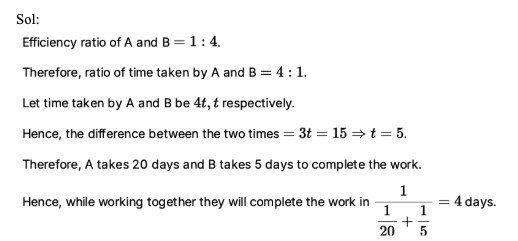
30. If A is 25% as efficient as B and can complete a certain work taking 15 days more than that taken by B, then in how many days will both A and B together complete the work?
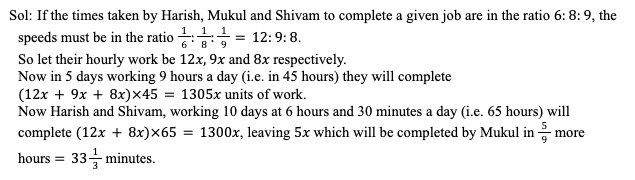
31. The times taken by Harish, Mukul and Shivam to individually complete a job are in the ratio 6: 8: 9. They accept a job which they can finish in 5 days if they all work together for 9 hours every day. However, initially only Harish and Shivam start working together. They work for 6 hours 30 minutes every day for 10 days and at the end of the 10th day, they stop working. How many minutes will Mukul take to complete the job if he now works alone?
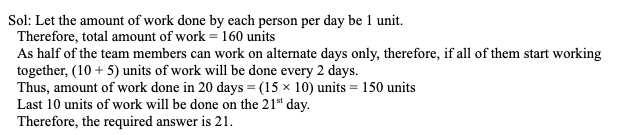
32. 10 persons of equal efficiency work in a team and each of them can individually complete a job in 160 days. While working in a team, half of them work every day and the others work only on alternate days. How many days are required to complete the job if all of them start the work simultaneously?
33. A group of N people worked on a project. They finished 42% of the project by working 7 hours a day for 8 days. Thereafter, 14 people left the group and the remaining people finished the rest of the project in 16 days by working 6 hours a day. Then the value of N is:
36
70
65
72
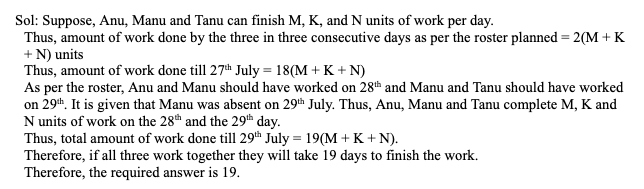
34. Three factory workers, Anu, Manu, and Tanu decided to finish a piece of work by working only two of them together in a day. They started working on 1st July. It was planned that Anu and Manu will work on day-1, Manu and Tanu will work on day-2, and Tanu and Anu will work on day-3. This three-day roster was repeated in the same order till 28th July. On 29th July Manu was absent and the work was finished by the other worker working alone. If it is known that the duration of work per day is fixed in the factory, then how many days will be required to finish the work if all three of them work together?
35. 50 people of the same efficiency can finish a job in 13 days by working 8 hours a day. Find the value of N if N number of people of the same efficiency can finish 90% of the job by working 10 hours a day in 12 days.
39
40
42
45
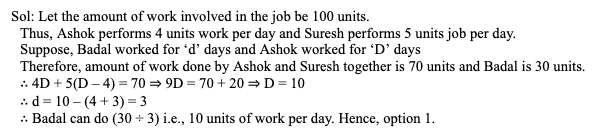
36. Ashok alone can finish a job in 25 days while Suresh alone can finish it in 20 days. Ashok starts the job, and after 4 days Suresh joins him. After 3 more days, Badal joins them and they finish the job together. If Badal has done 30% of the total job, then in how many days Badal alone can complete the job?
10
12
15
20
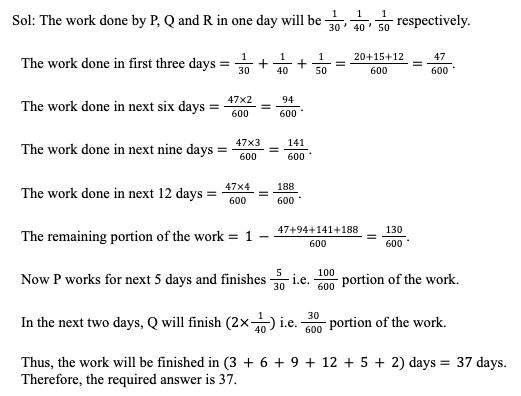
37. While working individually, P, Q and R take 30, 40 and 50 days respectively to complete a piece of work. For the first three days, P, Q and R alone work for one day each in that order in the first cycle. From the 4th to the 9th day, P, Q and R alone work for two consecutive days each, in that order in the second cycle. From 10th to 18th day, P, Q and R alone work for three consecutive days each, in that order in the third cycle. Thus, P, Q and R continue working in this fashion such that the number of days they individually work continues to increase by one in each cycle. In how many days will the work be finished?
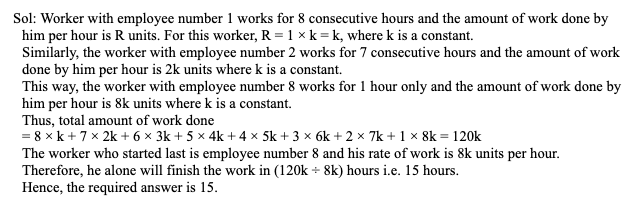
38. A factory has only 8 workers and their employee numbers are 1, 2, 3, …, 8. A worker with employee number n works for (9 – n) consecutive hours per day and the fixed amount of work he finishes every hour is proportional to n. How much time (in hours) will employee number 8 alone take to finish the job if the same job is finished by all 8 workers together working for one day each?
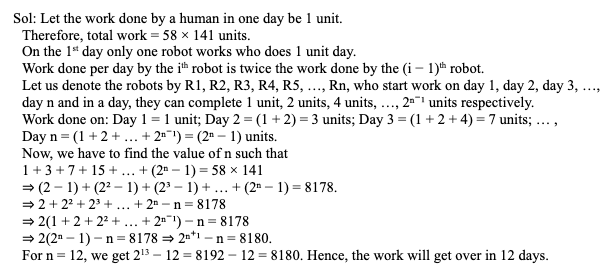
39. A job which 58 workers take 141 days to complete is given to some robots. On the first day one robot whose rate of doing work is the same as that of a worker starts the work. Then on each day starting from the second day, one more robot joins the team of robots. If the ith robot is twice as efficient as the (i – 1)th robot, then in how many days does the job get completed?
13
10
11
12
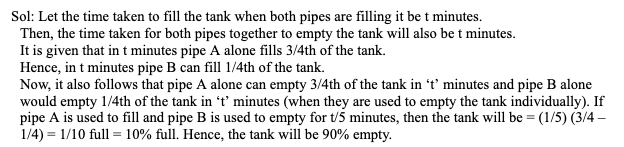
40. A tank has two pipes A and B both of which can fill and also drain. For both the pipes the rate of filling is same as the rate of draining. Both pipes together take ‘t’ minutes to fill the tank and A can fill 3/4th of the tank in ‘t’ minutes. If the tank is empty and pipe A is used to fill the tank while B is used to empty it, then what percent of the tank will be empty after ‘t/5’ minutes?
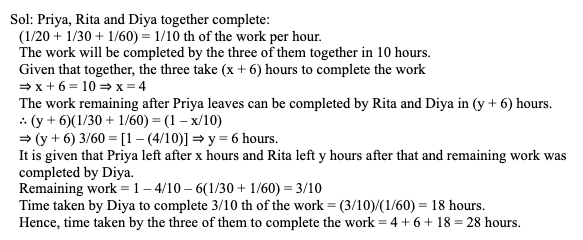
41. Priya, Rita, and Diya working alone can do a piece of work in 20, 30, and 60 hours respectively. All three of them start the work together, but after x hours Priya leaves and then after y more hours Rita leaves and Diya completes the remaining work. If Rita had not left, Diya and Rita would have completed the remaining work in (y + 6) hours after Priya had left. If both Priya and Rita had stayed, the work would have been completed in (x + 6) hours. What is the total number of hours taken to complete the work?
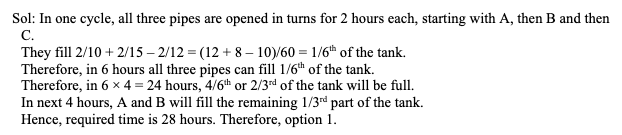
42. A, B, and C are three pipes which are attached to a tank. A and B fill the tank in 10 and 15 hours respectively and C empties it in 12 hours. If A, B, C are opened in that order for 2 hours each till the tank gets filled, then how many hours will it take for the tank to get filled?
28 hours
31 hours 40 minutes
32 hours
30 hours 20 minutes
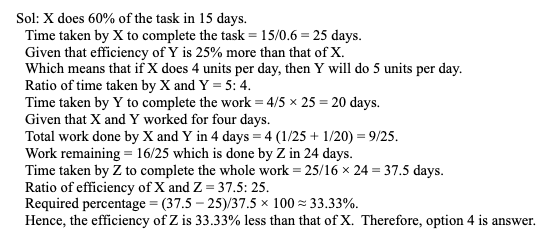
43. X can do 60% of a task in 15 days. Efficiency of Y is 25% more than that of X. Both X and Y started working together and left the task after four days. Z completed the remaining task in 24 days. Efficiency of Z is what percent more/less than that of X?
20% more
25% more
50% less
33.33% less
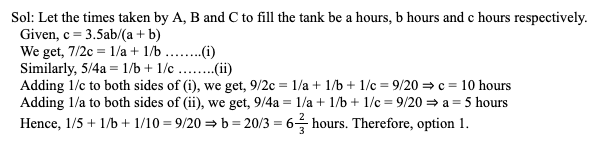
44. Three taps A, B and C are connected to a tank. Time taken by C to fill the tank is 3.5 times the time taken by A and B to fill it. The time taken by A to fill it is 1.25 times the time taken by B and C to fill it. A, B and C take 229 hours to fill it. Find the time taken by B to fill it (in hours).
6 2/3
7 1/2
6 1/3
8 1/6
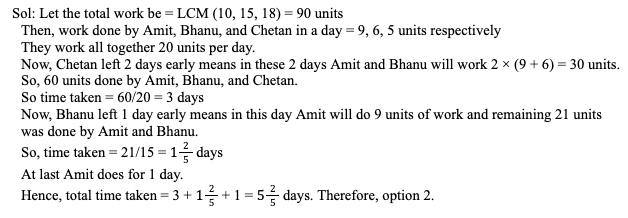
45. Amit can complete a work in 10 days, Bhanu in 15 days, and Chetan in 18 days. They all start together, but Chetan leaves when he is sure that the job will be done without him in the next two days. Then Bhanu also leaves when he is sure that the job will be done without him in the next one day. What is the total number of days taken to complete the work?
4 3/5
5 2/5
4 9/20
5 11/20
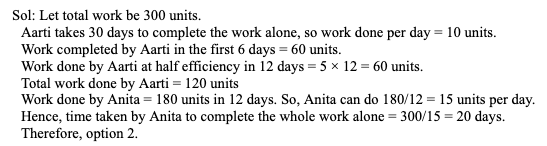
46. Aarti can complete a particular task in 30 days. After working for six days, she went on leave and resumed the work after 3 days but with half of her original efficiency. She completed the task in another 12 days with the help of Anita who joined her when she came back after her leave. The number of days required by Anita to complete the task alone would be:
18
20
24
25
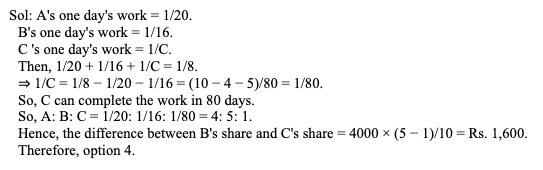
47. A can complete a job in 20 days working alone, and B can complete it in 16 days working alone. When A, B, and C work together, they complete the job in 8 days and are paid a total amount of Rs.4,000 as remuneration. If this amount is shared by them in proportion of the work done by them, then what is the difference (in Rs.) between the B’s share and C’s share?
400
800
1200
1600
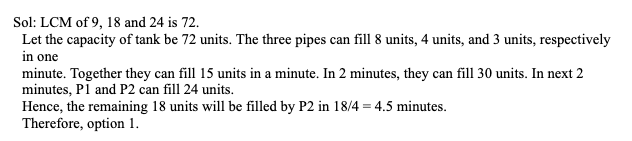
48. There are three pipes, namely P1, P2, and P3, that can fill a tank in 9 minutes, 18 minutes, and 24 minutes, respectively. The tank is empty when all the 3 pipes are opened. After 2 minutes, the third pipe, P3, is closed. Two minutes later, pipe P1 is also closed. How much time, in minutes, will it take for the tank to become full after the closure of P1?
4.5
4
3.5
5
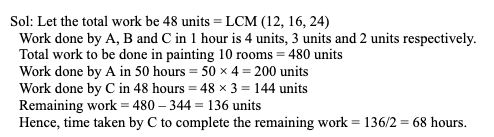
49. A can paint a room in 12 hours, B can paint the same room in 16 hours, and C can do it in 24 hours. There are 10 rooms of same size in a guesthouse that are to be painted. A started alone and worked for 50 hours and then B worked alone for 48 hours. Then C started painting and completed the work. How many hours did C take to complete the remaining work?
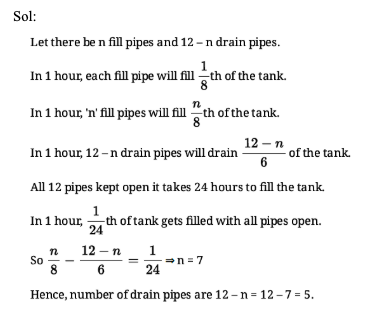
50. Among 12 pipes attached to a tank, some serve as fill pipes and others are drain pipes. Each fill pipe takes 8 hours to fill the empty tank, while each drain pipe takes 6 hours to empty the full tank. When all pipes are opened together, the empty tank fills in 24 hours. How many pipes are drain pipes?
5
6
7
8
51. A group of men, all of equal efficiency, were hired to work for Rs. 20,000. The group work started with one man starting the work, joined by another on the second day, then by one more on the third day and …so on till the last man joined on the last day when the work was completed. If every man worked at half of his normal efficiency, then the work was completed in exactly 15 days. Find the maximum amount (in Rs.) earned by any man in the group.
52. Amrit can do a piece of work in 10 days while Neha could complete the same in 20 days. If both of them start working simultaneously and Neha takes a break every second day, then in how many days would they finish the work?
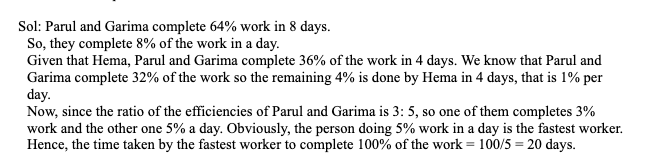
53. Hema, Parul, and Garima completed a task in 12 days in such a way that they worked together for 4 days in which they completed 36% of the total task, then Hema left. If the work done by Parul in 3 days is equal to the work done by Garima in 5 days, then what is the time taken, in days, by the fastest worker to complete the whole work alone?
54. When they work alone, Rohit needs 20% more time to finish a work than Yatin does. They two finish the work in 20.3 days in the following manner: Yatin works alone till half the work is done, then Yatin and Rohit work together for six days, and finally Rohit works alone to complete the remaining 6% of the work. In how many days can Rohit alone finish the entire work?
32
30
28
25
55. Three flexible pipes that can serve as inlet as well as outlet pipes have been attached to a tank. The rates of filling or emptying the tank by these three pipes are in the ratio 1: 2: 4. The largest pipe can alone fill the empty tank in 7 hours. Initially the tank is full and the three pipes were used as outlet pipes for ‘M’ hours. After the tank is emptied, later the smallest pipe alone filled the entire tank in 28 hours. Find the value of ‘M’.
56. In all 64 workers start digging a trench. On every subsequent day, only half as many workers as had worked on the previous day worked. Finally, the work was completed on the 5th day. If instead ‘n’ workers had worked on each day and finished the work in integer number of days, which of the following cannot be the value of ‘n’? (Assume all workers are equally efficient)
31
10
11
41
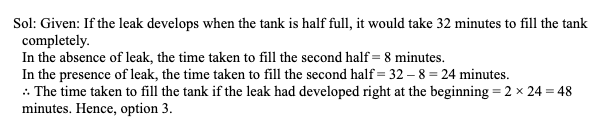
57. An empty tank can be filled completely in 16 minutes. If the tank develops a leak when the tank is half full, the tank can be completely filled in 32 minutes. Had the tank developed the leak right at the beginning when the tank started getting filled, how many minutes would it take for the tank to be filled completely?
60 minutes
36 minutes
48 minutes
The tank will never be full
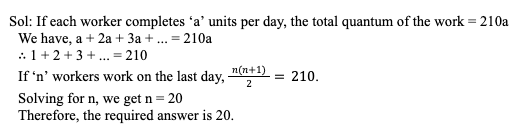
58. Each worker alone can complete a job in 210 days. On the first day, one worker starts working. On each of the following days, one more worker joins the work. How many workers will be working on the job on the day when it gets completed?
59. Three friends A, B and C work together to complete a piece of work. The time it takes for them to do the work together is 7 hours less than what A would have taken working alone, 10 hours less than what C would have taken working alone and one-fourth the time B would have taken working alone. How long (in hours) does it take for them to complete the work working together?
60. A tank has a leak at its bottom which empties it at 8 liters/minute. It also has a filling tap which can fill the tank in 8 hours. If the tank takes 20 hours to become full, then find the capacity of the tank (in liters).
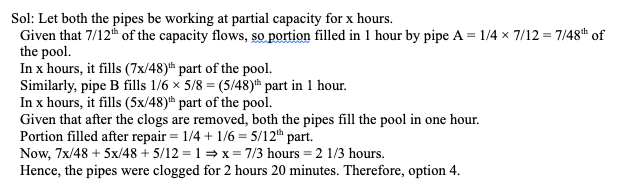
61. A swimming pool can be filled by two pipes A and B in 4 hours and 6 hours respectively. Both pipes are opened together for a certain time but due to some clogging in the pipes, only 7/12th of the full quantity of water flows through pipe A and only 5/8th through pipe B. The clogs are detected and removed. The remaining part of the pool is filled in one hour after repair. How long was it before the clogs were removed?
2 hours 40 minutes
1 hour 40 minutes
1 hour 20 minutes
2 hours 20 minutes
62. A alone can complete a job in 18 days and B alone in 27 days. If C takes five-sixth the time that A and B together take to complete the job, how long (in days) will A and C together take to complete the same work?
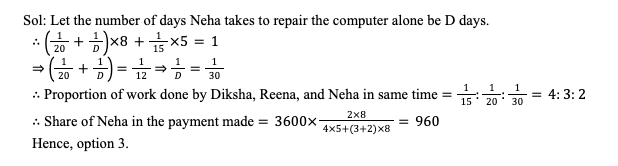
63. Diksha can repair a computer in 15 days while Reena can repair the same computer in 20 days. Neha and Reena start repairing the computer together and after 3 days, Diksha joins them. Together, they complete the repairing job in 5 more days. If they are paid a total of 3600 for the job, then the share of Neha, in INR, proportional to the work done by her, is:
1230
1020
960
800
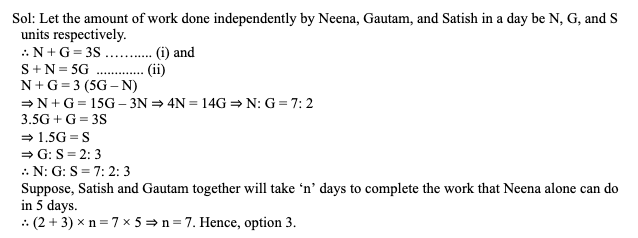
64. A factory pays wages to its workers proportional to their outputs. The amount Neena and Gautam together earn in a day equals what Satish alone earns in 3 days. The amount Satish and Neena together earn in a day equals what Gautam alone earns in 5 days. What would be the number of days required for Satish and Gautam together to complete the same amount of work that Neena alone could have completed in 5 days?
5
6
7
8
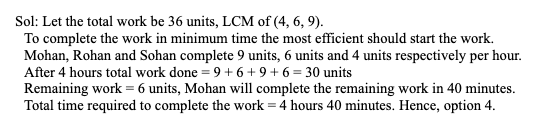
65. Mohan, Rohan and Sohan can paint a room in 4, 6 and 9 hours, respectively. At the most only one person can work each hour and nobody can work for two consecutive hours. Find the minimum number of hours that they will be required to paint the room.
We at Quantifiers understand and deliver on the personal attention each of our students requires. Whether it is through our pedagogy that enables non-engineers or non-math background students, our constant effort to proactively provide solutions, or our focus on our student’s goals.