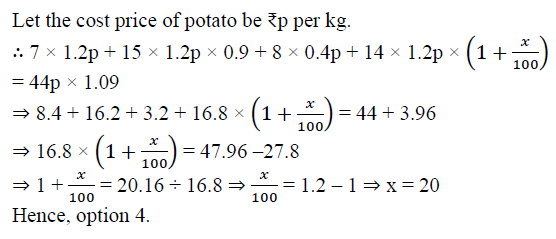
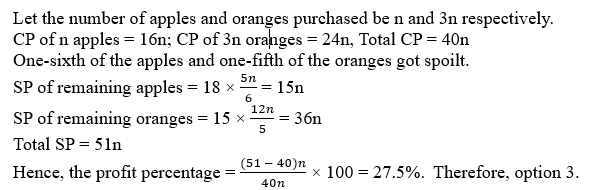
Q57. A trader bought 44 kg of potato and marked the price up by 20%. He sold 7 kg of potato at the marked price and 15 kg of potato at 10% discount. Unfortunately, 8 kg of potato was partly rotten in transit and hence had to be sold at a price which was 60% lower than the cost price. The remaining potatoes were sold by raising the marked price by x% so as to earn an overall profit of 9%. The value of x is:
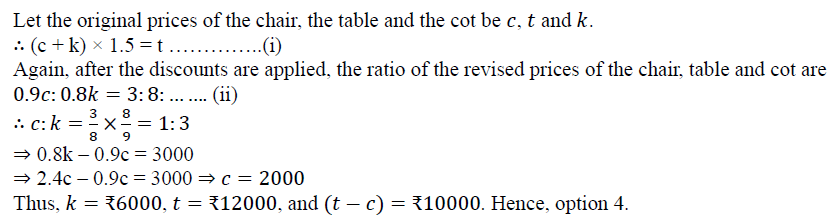
Q58. A furniture shop has a chair, a table and a cot on sale. The price of the table is 50% more than the combined price of the chair and the cot. The shop owner offers discounts of 10% on chair, 20% on cot and 25% on table. The revised prices of the chair and the cot are in the ratio 3: 8. If the difference of the revised prices of the chair and the cot is Rs 3000, then the difference of the original prices of the table and the chair, in Rs, is:
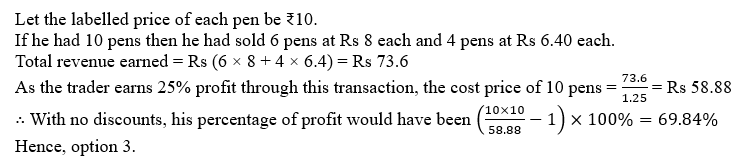
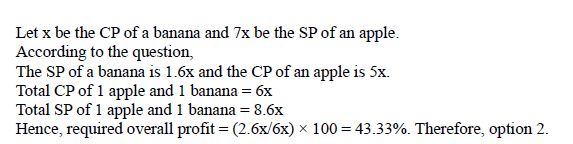
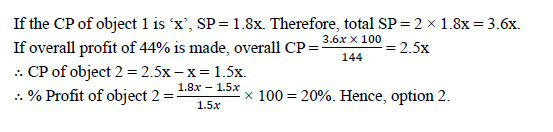
Q59. A trader sells identical pens. He sold 60% of his stock at 20% discount on the labelled price and sold the rest of the stock at an additional 20% discount on the discounted price. Overall, the trader makes a 25% profit. With no discounts, his percentage of profit would have been nearest to:
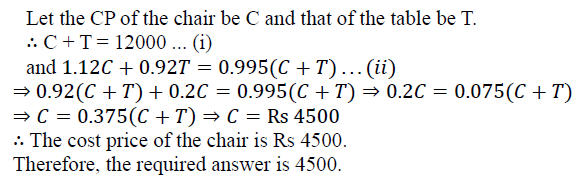
Q60. A carpenter manufactured a chair and a table. The cost of the chair and table together is Rs 12000. He sold the chair at 12% profit and the table at 8% loss. If overall he incurs a loss of 0.5% then find the cost price of chair (in Rs).
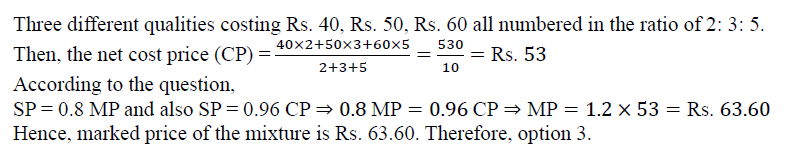
Q61. A person mixes coffee of 3 different qualities at prices Rs. 40, Rs. 50, Rs. 60 per kg in the ratio of 2: 3: 5. If he offers a discount of 20% on the marked price and incurs a loss of 4%. What is the marked price (in Rs.) of the mixture?
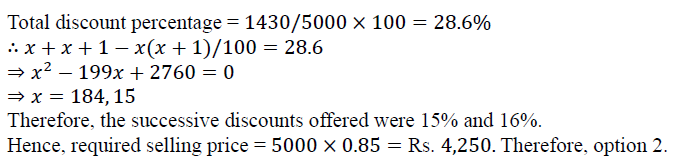
Q62. The marked price of an article is Rs. 5,000. If two successive discounts of x% and (x + 1)%, on the marked price is equal to a single discount of Rs. 1,430, then what will be the selling price (in Rs.) of the article if a single discount of x% is given on the marked price?
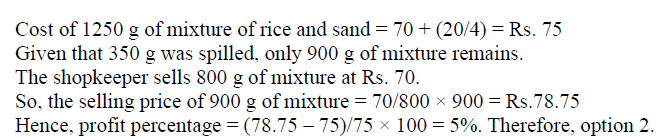
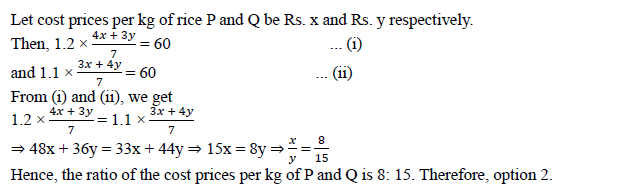
Q63. A dishonest shopkeeper mixes 250 grams of sand in 1 kilogram of rice. 350 grams of the mixture is spilled during transportation. He then uses a faulty balance that reads 1 kilogram for 800 gram while selling the mixture which is listed at the cost price of rice. If rice costs Rs. 70 per kg and sand costs Rs. 20 per kg, what is his overall profit/loss percentage during the entire transaction?
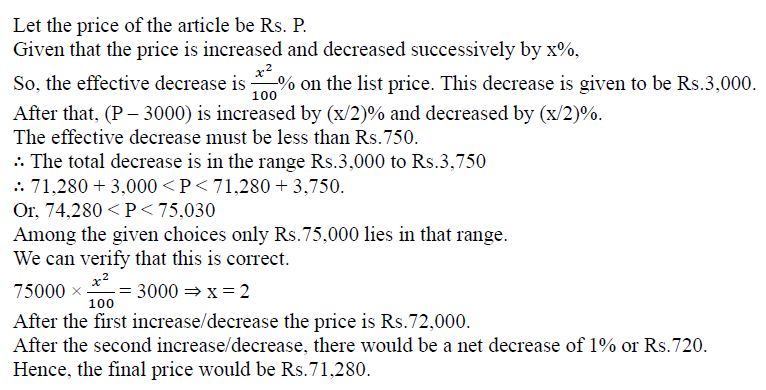
Q64. A shopkeeper hiked the price of an article by x% and then gave x% discount and the price of the article decreased by Rs.3,000. Once again, the price of the article was increased by x/2% and then decreased by x/2% and it was finally sold at Rs.71,280. What can be the initial price of the article?


We at Quantifiers understand and deliver on the personal attention each of our students requires. Whether it is through our pedagogy that enables non-engineers or non-math background students, our constant effort to proactively provide solutions, or our focus on our student’s goals.