101. A shopkeeper buys 50 kg of apples for Rs.6,000. He marks up the price of the apples such that even after giving a discount of 10%, he will still earn a profit of 12.5%. Later he decides to donate 10% of his apples to an orphanage. He increases his marked price and offers a discount of 6.25% on his remaining apples such that he still earns the same profit. What percentage above the cost price is his new marked price?
102. On giving 3 candies free with every 5 chocolates bought, a shopkeeper makes a profit of 20% and on giving 6 candies free with every 2 chocolates bought, he suffers a loss of 25%. Find the approximate profit percent made by the shopkeeper when he gives 5 candies free with every 7 chocolates bought, if the selling price of 1 chocolate remains the same. (Assume that the candies are identical and the same applies to the chocolates.)
103. A farmer sells one type of rice at Rs. 40 per kg and loses 20% and other type of rice at Rs. 50 per kg and gains 25%. If he mixes the two types in equal proportions and sells the mixture at Rs. 55 per kg, then the profit percentage is:
104. A trader has three types of rice – Rs. 37 per kg, Rs. 40 per kg, and Rs. 42 per kg. The quantity of rice the trader has is a positive integral multiple of 10 kg weight for each variety. The trader has mixed all three varieties and sold the mixture at Rs. 45 per kg. What is the maximum amount of profit the trader can earn by selling all the mixture if the weight of the mixture is 40 kg?
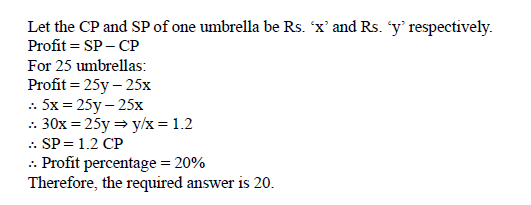
105. A shopkeeper sells 25 umbrellas at a profit equal to the cost price of 5 umbrellas. What is the percentage profit earned by the shopkeeper in this transaction?
106. In place of a 1 litre container, a dishonest milkman uses a 1050 ml container while buying, but uses a 900 ml container while selling the same milk. What is his overall profit percentage if he sells the milk at the same rate at which he was supposed to buy and offers a discount of 10% on cash payment?
107. A fruit vendor has bought some mangoes for selling. The cost price of 25 mangoes is equal to the selling price of 20 mangoes. Due to x% wastage, the vendor could not sell a few mangoes and earned 20% profit only by selling the rest of the mangoes. Find the value of x.


We at Quantifiers understand and deliver on the personal attention each of our students requires. Whether it is through our pedagogy that enables non-engineers or non-math background students, our constant effort to proactively provide solutions, or our focus on our student’s goals.