Inequalities play a crucial role in Algebra for CAT 2026, especially in higher-difficulty CAT questions. Practice exam-oriented CAT algebra important questions covering linear, quadratic, and modulus inequalities. These are built around repeated CAT concepts and logical reasoning patterns. For complete preparation, also practice Quadratic Equations, Functions, and Logarithms, as they often integrate with inequalities in CAT.
Q3. Let f and g be a real valued functions defined as f(x) = x2 + 8 and g(x) = f(x – 2) + f(x + 2) – 36. For how many integral values of ‘x’, g(x) < 0?
3
4
2
5
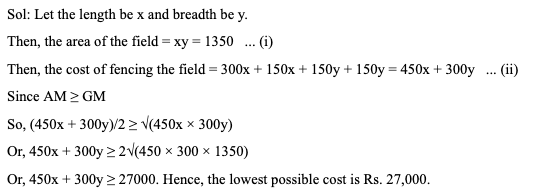
Q5. A farmer wants to fence his rectangular field to protect his crops from animals. The cost of fencing the field is Rs. 300 per meter on one side, and Rs. 150 per meter along three other sides. If the area of the rectangular field is 1350 sq. m, then what is the lowest possible cost (in Rs.) of fencing the field?
24000
27000
30000
22000
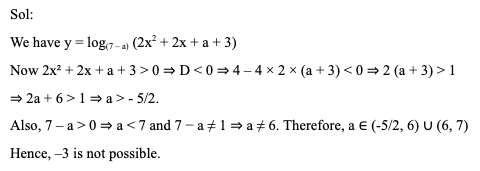
Q6. If y = log(7 – a) (2x2 + 2x + a + 3) for all real values of x, then which of the following is NOT a possible integral value of ‘a’?
4
5
-2
-3
1
1/2
1/4
2/5
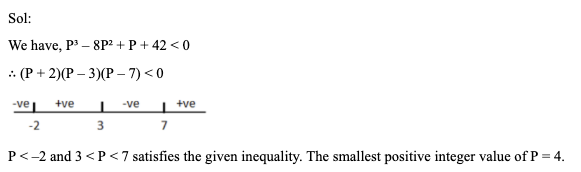
Q9. If P3 – 8P2 + P + 42 < 0, then what is the smallest positive integer value of P?
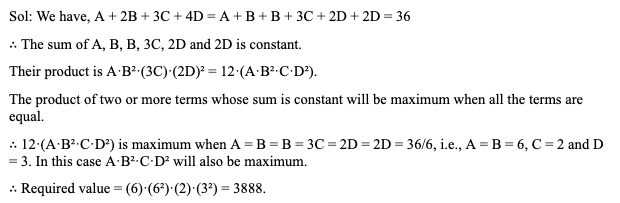
Q10. A, B, C and D are four positive numbers which satisfy the equation A + 2B + 3C + 4D = 36. Find the maximum possible value of AB2CD2.
3744
4180
3188
3888
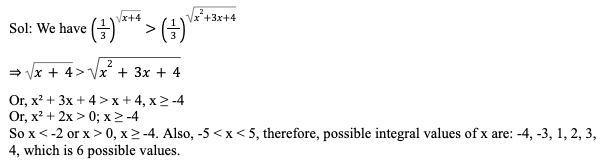
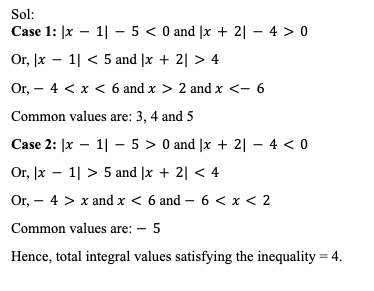
Q11. Find the number of integral solutions for the inequality (|x – 1| –5)(|x + 2| –4) < 0.
1
2
3
4
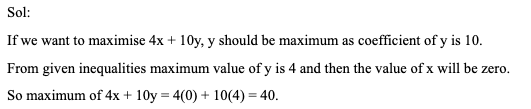
Q12. For non-negative real numbers x and y, 3x + 4y ≤ 16 and 5x + 2y ≤ 10. What is the maximum possible value of (4x + 10y)?
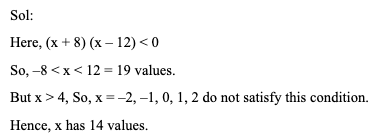
Q13. How many integral values of ‘x’, which is a real number, satisfy the equations x2 – 4x – 96 < 0 and x2 > 4?
10
12
14
0
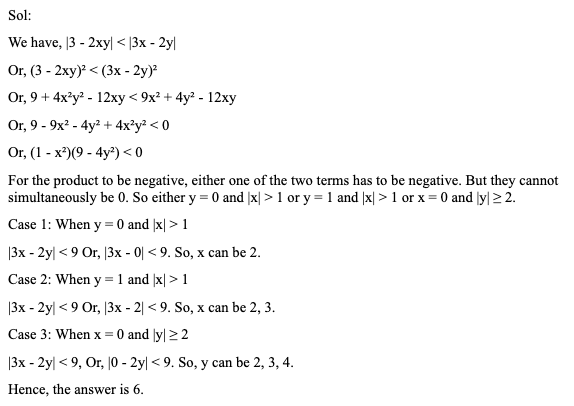
Q14. Find the number of distinct pairs of non-negative integers (x, y) satisfying |3 – 2xy| < |3x – 2y| < 9.
4
5
6
8
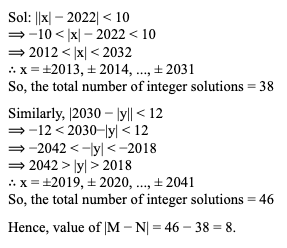
Q15. Let M and N be number of integral solutions to ||x| – 2022| < 10 and |2030 – |y|| < 12. What is the value of |M – N|?
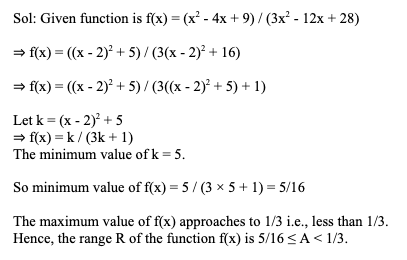
1/4 ≤ A < 1/2
5/16 ≤ A < 1/3
5/8 ≤ A < 1/2
5/16 ≤ A ≤ 1/3
9
10
11
12
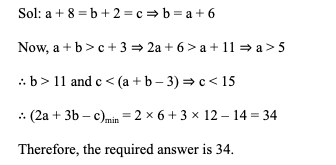
Q18. If a and b are non-negative integers such that a + 8 = c, b + 2 = c and a + b > c + 3, then the minimum possible value of (2a + 3b – c) equals:
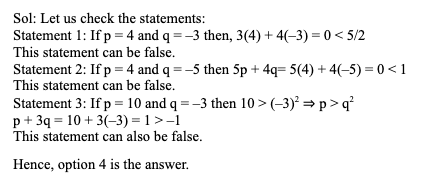
Q19. If p > 3 and q < ‒1, then which of the following statements is always true?
3p + 4q > 5/2
If p < -q then 5p + 4q > 1
If p < q2 then p + 3q < -1
None of these
0
-2
3
-3
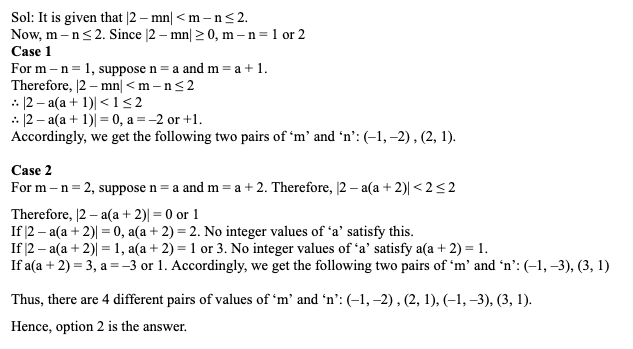
Q22. The number of distinct pairs of integers (m, n) satisfying |2 – mn| < m – n ≤ 2 is:
3
4
5
6
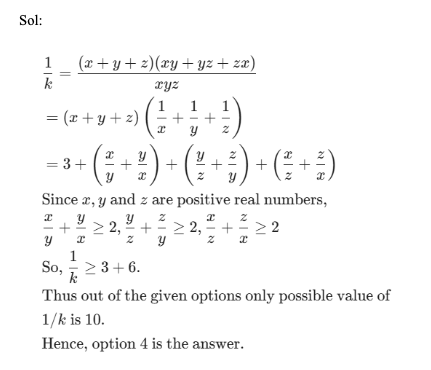
1/2
2
-2
-1/2
4
3
2
1
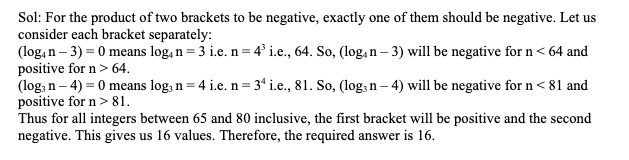
Q26. If ‘n’ is an integer such that (log4 n – 3) (log3 n – 4) < 0, then the number of possible values of ‘n’ is:
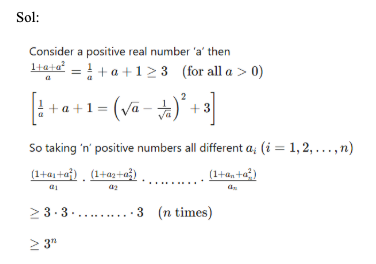
< 3n
< 2n
≥ 3n
≤ 2n
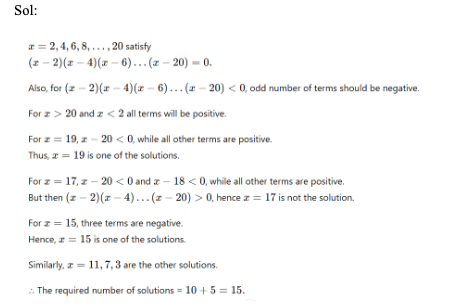
Q28. (x – 2) (x – 4) (x – 6) (x – 8) …………….. (x – 20) ≤ 0. How many integer values of x satisfy the given equation?
10
15
20
More than 20
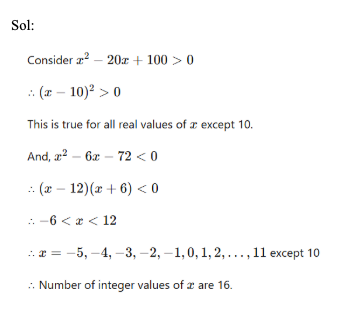
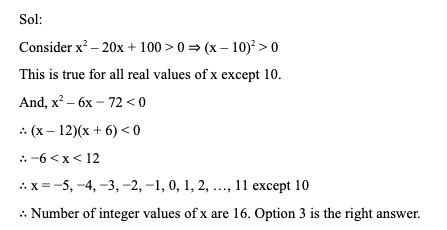
Q29. What is the number of integer values that x can take for both the inequations x2 – 6x – 72 < 0 and x2 – 20x +100 > 0?
15
16
14
infinite
Q30. If w + x + y + z = 1, where w, x, y, z are non-negative, then the maximum value of wxyz/(1 – w) (1 – x)(1 – y)(1 – z) is:
81/256
1/81
1/27
64/27
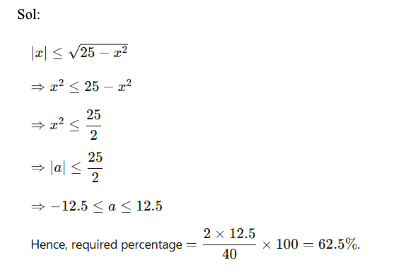
50%
62.5%
66.67%
75%
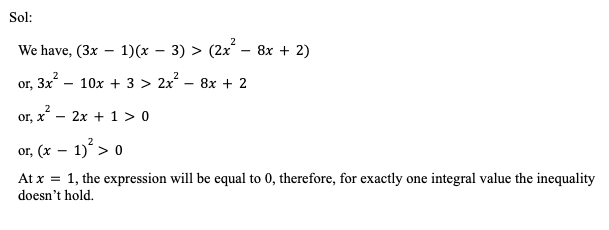
Q32. Number of integer values for which the inequality (3x – 1) (x – 3) > (2x2 – 8x + 2) does not hold true is/are:
0
1
2
More than 2
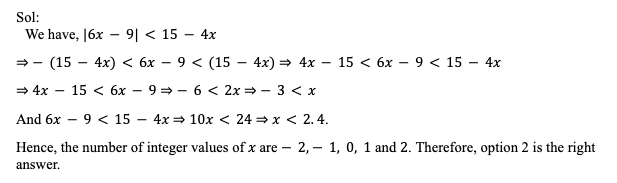
Q33. The number of integral values of x satisfying the inequality |6x – 9| < 15 – 4x is:
4
5
7
6
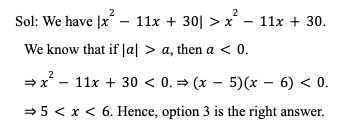
Q34. If |x2 – 11x + 30| > x2 – 11x + 30, then which of the following statements is true?
x cannot take value greater than 5.
x can take any real value.
x can take any value between 5 and 6.
x can take values either less than 5 or greater than 6.
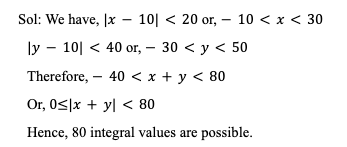
Q35. If |x – 10| < 20 and |y – 10| < 40, then the number of integral values |x + y| can take is:
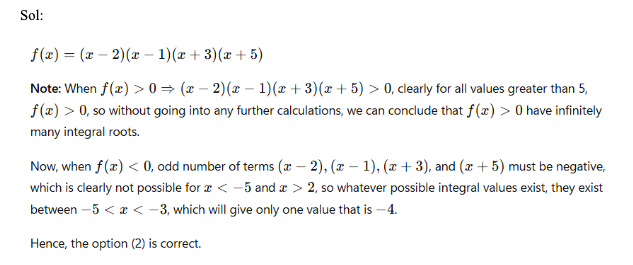
Q36. Let f(x) = (x – 2)(x – 1)(x + 3)(x + 5), then which of the following is true regarding the number of integral roots of f(x) > 0 and f(x) < 0 respectively?
Finitely many, Infinitely many
Infinitely many, Exactly 1
Infinitely many, Infinitely many
Finitely many, Exactly 1
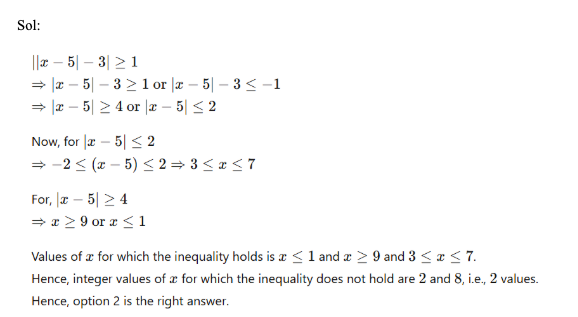
Q38. If ||x – 5| – 3| ≥ 1, find the number of integral values of ‘x’ which doesn’t satisfy the inequality.
1
2
3
4
Q39. What is the number of integer values that x can take for both the equations x2 – 6x – 72 < 0 and x2 – 20x + 100 > 0?
15
0
16
10
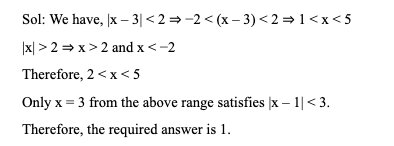
Q40. If |x – 3| < 2 and |x| > 2, for how many integers will |x – 1| < 3?
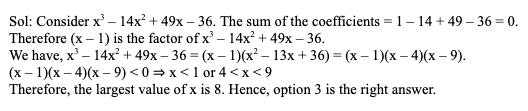
Q41. What is the highest value of ‘x’ for which x3 – 14x2 + 49x – 36 < 0?
4
6
8
10
Q42. If 6x2 + mx + 2 ≥ 0 for all real ‘x’, then how many integer values of can ‘m’ take?
10
11
12
13
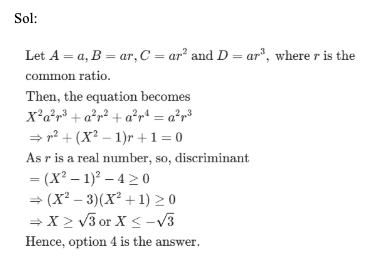
Q44. If A, B, C and D are distinct real numbers in geometric progression such that for every real X, (X2 CB)+(AC)+(BD)=AD, then X must satisfy which of the following conditions?
x ≤ √3
x ≥ √3
x ≤ - √3
Both (2) and (3)
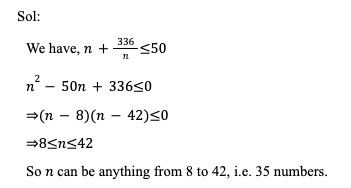
-3
6
8
10
15
34
19
35
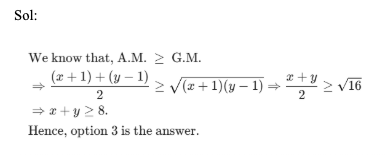
Q47. If (x+1)(y-1)=16, x > 0, y > 1, then:
x + y ≥ 16
x + y ≤ 16
x + y ≥ 8
x + y ≤ 8
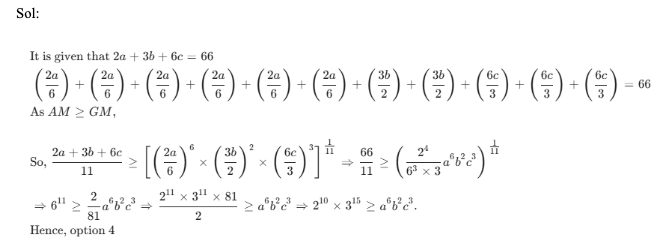
Q49. lf 2a + 3b + 6c = 66, where a, b and c are positive real numbers, then find the maximum value of a6 b2 c3.
215 × 312
214 × 38
212 × 314
210 × 315
We at Quantifiers understand and deliver on the personal attention each of our students requires. Whether it is through our pedagogy that enables non-engineers or non-math background students, our constant effort to proactively provide solutions, or our focus on our student’s goals.