Profit and Loss
Arithmetic
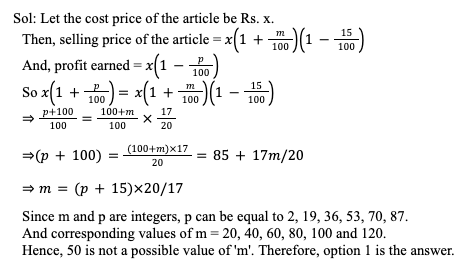
Q1. Ria gives a discount of 15% on an article, whenever a customer makes an online payment. If she marks-up the price of the article by m% in order to make the profit of p%, where m and p are integers and p < 100, then which of the following is not a possible value of ‘m’?
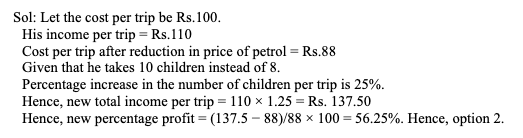
Q2. A school van driver takes 8 children per trip and makes a profit of 10% when the price of petrol is Rs.100 per liter. Find his profit percentage if he takes 10 children in the van and the price of petrol reduces to Rs.88.
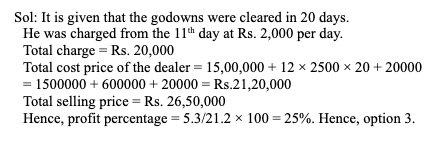
Q3. A cement trader bought cement for Rs. 15 lakhs from a cement factory. Each day, he transports 12 lorry loads of cement from the factory to his godown at Rs. 2,500 per lorry load. From the 11th day onwards, the factory charged him Rs.2,000 per day for using their godown. It took the trader 20 days to transport all the cement to his site. If the trader sold the cement to a retailer for Rs. 26.5 lakhs, then what was his profit percentage?

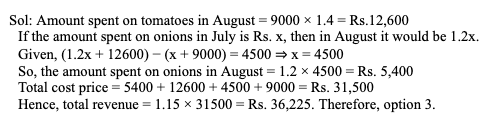
Q4. In August, Uttam purchased the same quantity of tomatoes and onions as he had purchased in July. However, he spent Rs.4,500 more in August due to a price increase of 40% and 20% for tomatoes and onions respectively. Uttam had spent Rs.9,000 on tomatoes in July. If he earned a profit of 15% by selling these two vegetables during July and August, then what was his total revenue (in Rs.) during the period?
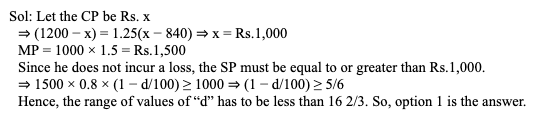
Q6. Profit earned on an article when it is sold for Rs. 1,200 is 25% more than the loss when it is sold for Rs. 840. If a person marked up the article by 50% on purchasing price and sold it after allowing two successive discounts of 20% and d%. Find the possible range of values of “d”, where d is an integer, if he does not incur any loss in this transaction.
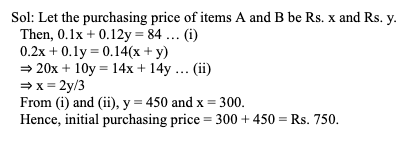
Q7. Biswa purchased two items A and B. If he earns profit of 10% on A and 12% on B, overall profit earned by him is Rs. 84. But if he earns 20% on A and 10% on B, overall profit earned by him is 14% of total price of items. Find initial total purchasing price (in Rs.) of both items.
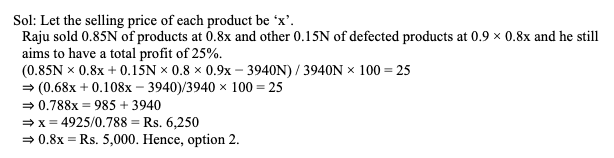
Q8. Raju purchases N identical products at wholesale for Rs.3,940 each and resells them for 20% discount. However, due to a manufacturing defect, 15% of the products sold were returned. Raju decides to sell the returned products at a further 10% discount. If he made a total profit of 25%, then what is the selling price (in Rs.) of a non-defective product?
Q10. Jugnu, a shopkeeper, normally makes a profit of 25% in a certain transaction. However, due to an issue with the weighing machine, he weighs 900 grams instead of 1 kilogram. If he charges 20% less than his regular price, what is his actual profit or loss percentage?
Q11. The manufacturer of a laptop sells it to a distributor at ₹ 36000. The distributor sells each laptop to a retailer at a profit of 12.5%. A customer purchases the laptop from a retailer who, as per the policy of the manufacturer, should earn a profit at least 35% and at most 40%. The policy of the manufacturer is that the ultimate selling price of the laptop should be a multiple of ₹ 100. How many distinct selling prices a retailer can ask from a customer?
Q12. A street food vendor sells Samosas at Rs. 10 per Samosa. On a festival day, he had planned to offer a flat discount of 30% on each Samosa. He would have earned a profit of 40% even after offering the discount. On that day, he prepared a total of 100 Samosas but could sell only 80 Samosas because the remaining 20 Samosas were spoiled. How much discount should the vendor now offer so that he will end up making the same amount of profit (in Rs.) that he would have made had he been able to sell all the 100 Samosas?
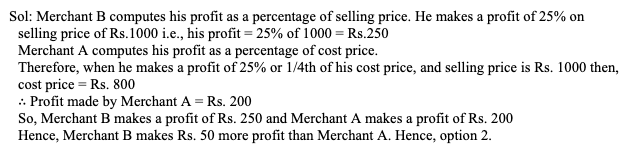
Q13. Two merchants – A and B – each sell an article for Rs.1000. If merchant A computes his profit on cost price while merchant B computes his profit on selling price, then both ended up on making an individual profit of 25%. By how much rupees, is the profit made by merchant B greater than that of merchant A?
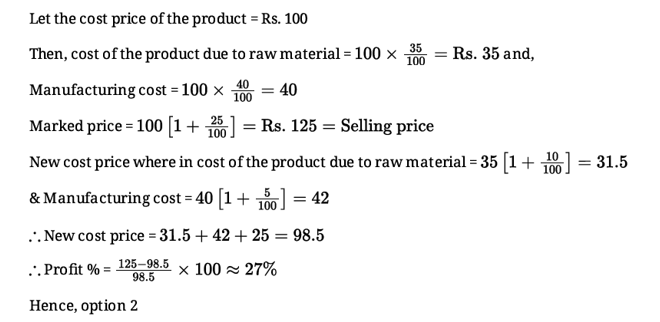
Q14. A shopkeeper manufactures a product. 35% of the cost of the product is due to the raw material used by him, and 40% of the cost is its manufacturing cost. Remaining costs are due to packaging, transportations, etc. He marked up the price by 25% while selling it in market. If the cost of raw material is decreased by 10% and that of the manufacturing increased by 5%, but other costs as well as the selling price remains the same, then what is the (approximate) profit earned by the shopkeeper?
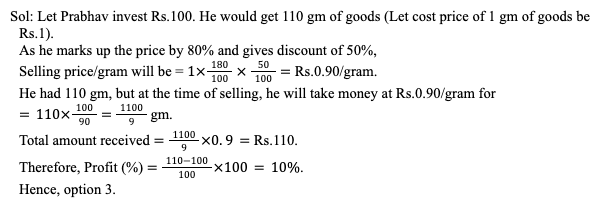
Q15. Prabhav, by means of his false balance, defrauds to the extent of 10% in buying goods. Then he marks up the price by 80% and gives discount of 50% while selling the goods, but defrauds to the extent of 10% with customer also. Find his gain percentage in this whole transaction.
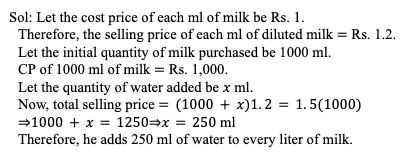
Q16. A dishonest milkman dilutes milk by mixing water in it and then sells the diluted milk at a price of 20% higher than the price at which he purchased the milk. If he makes an overall profit of 50% in this manner, then how many ml of water does he add to every litre of milk?
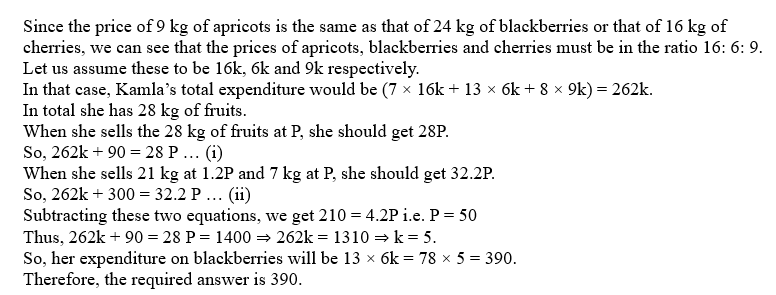
Q17. Kamla buys the following dried fruits: 7 kg of apricots, 13 kg of blackberries and 8 kg of cherries. The cost prices are such that the price of 9 kg of apricots is the same as that of 24 kg of blackberries or that of 16 kg of cherries. She mixes the fruits thoroughly and sets a price P per kg for the mixture so that she would make a total profit of Rs. 90 on selling the entire mixture. However, during the festive season she is able to sell 21 kg at 20% above P (and the rest at P), and consequently makes a profit of Rs. 300. How much did she spend on buying blackberries?
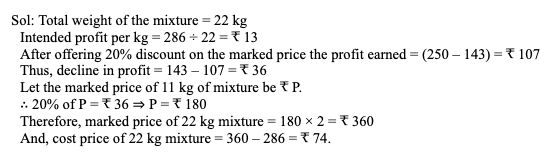
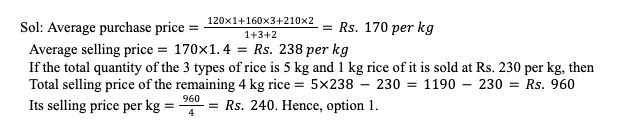
Q18. A rice trader mixes 3 different varieties of rice weighing 5 kg, 7 kg, and 10 kg. She mixes all the three varieties and marks a price for the mixture in order to make a profit of ₹ 286. She sells half of the mixture at this marked price and the remaining at a 20% discount on the marked price, thus making a total profit of ₹ 250. What is the total price (in ₹) the trader paid to purchase these 3 varieties of rice? (Assume that zero quantity of rice has been wasted in this process.)
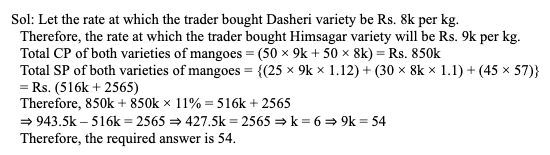
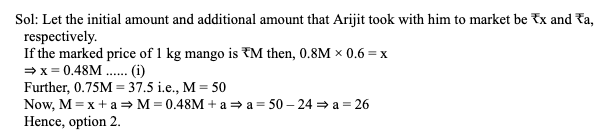
Q19. The Himsagar variety of mango is 12.5% costlier than the Dasheri variety. A trader bought 50 kg of mangoes of each variety, sold 25 kg of Himsagar at 12% profit and 30 kg of Dasheri at 10% profit. Rest of the mangoes, left with the trader, were sold at Rs. 57 per kg and a total of 11% profit was earned in the whole transaction. Find the rate (in Rs. /kg) at which the trader bought the Himsagar variety of mango if there was no wastage.
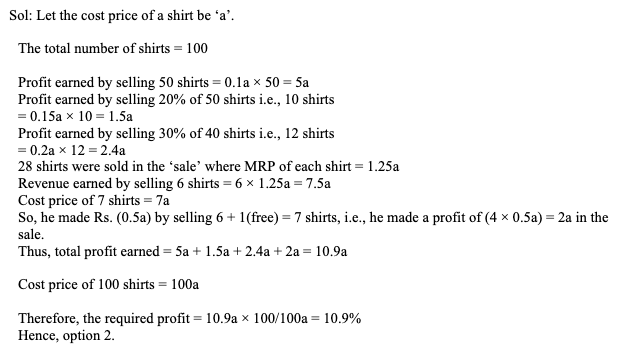
Q20. A shopkeeper purchased 100 shirts. He sold 50% of the shirts at 10% profit, 20% of the remaining shirts at 15% profit, 30% of the remaining shirts at 20% profit and sold the remaining shirts in a ‘sale’ at MRP which has a 25% markup. In the ‘sale’, he gave one shirt free if a customer purchased 6 shirts. How much profit (in percentage) did he earn by selling all 100 shirts if he had sold all the shirts in the ‘sale’ to a single customer?
Q21. A vegetable wholesaler bought 15 kg of cabbage and 16 kg of cauliflower from a farmer. The price the wholesaler paid for two kg cauliflower was three times the price he paid for one kg cabbage. He sold all these vegetables to a local trader – cabbage at 33 1/3% profit and cauliflower at 25% profit. Due to mishandling, 3 kg cabbage and 4 kg cauliflower was totally spoiled and could not be sold by the local trader. The trader sold the rest of the vegetables at ₹ 30 per kg and made a total 44% profit. At what price, in ₹ per kg, the wholesaler bought the cabbage?
Q22. Hardeep buys two types of mangoes viz. Chausa and Himsagar, in equal numbers. He bought each dozen of Chausa for ₹150 and each dozen of Himsagar for ₹180. He sells all for ₹170 a dozen and makes a total profit of ₹500. How many mangoes did he buy altogether if there was no wastage?
Q23. Manav imported a laptop after paying 5% customs duty on the value of the laptop in excess of Rs. 50,000. If the amount of customs duty that Manav paid was Rs. 575. At what price (in Rs.) should he sell the laptop to a customer such that he gets a profit of 25%?
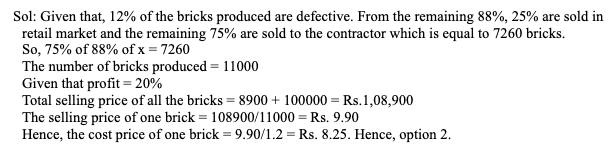
Q24. Out of the bricks produced in a kiln, 12% are defective, while 25% of the rest are sold in the retail market for Rs. 8,900. The remaining 7260 bricks are sold to a contractor for Rs.1 lakh. If there was a profit of 20% on the whole, then what is the cost (in Rs.) of production of one brick?
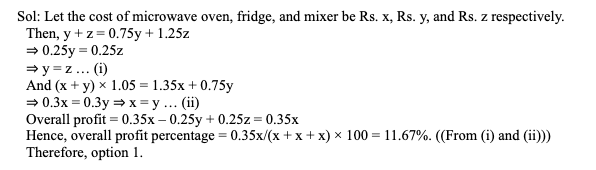
Q25. Geeta sold a few of her kitchen appliances before moving out of town. She sold her microwave oven for 35% profit, fridge for 25% loss and mixer for 25% profit. She made neither a profit nor a loss on the fridge and the mixer taken together. There was a net profit of 5% when the microwave oven and fridge are taken together. What is the overall profit or loss percentage on all the three items taken together?
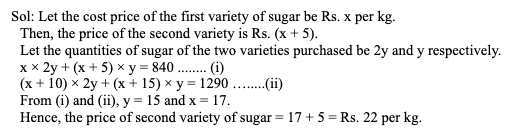
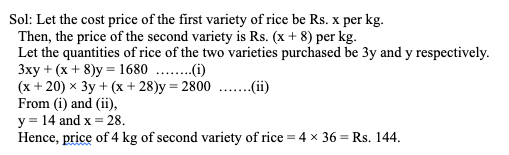
Q26. A trader spent a total of Rs.840 to purchase two varieties of sugar. If the selling price of each variety of sugar was Rs.10 per kg more than the cost price, then the profit would be Rs.450. If the cost price of the first variety is Rs.5 less than the second one and the quantities purchased are in the ratio 2: 1, what is the cost price (in Rs. per kg) of the second variety of sugar?
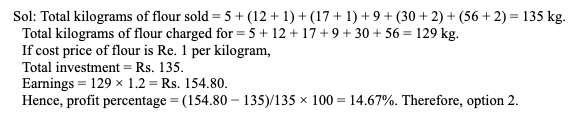
Q28. A shopkeeper sells flour at a mark-up of 20%. However, to all customers purchasing 10 kg of flour or more, he offers 1 kg of flour free and to all customers purchasing more than 20 kg he offers 2 kg of flour free. On a particular day, he has 6 customers walk in to purchase 5 kg, 12 kg, 17 kg, 9 kg, 30 kg and 56 kg. What is the shopkeeper’s approximate net profit percentage on this day?
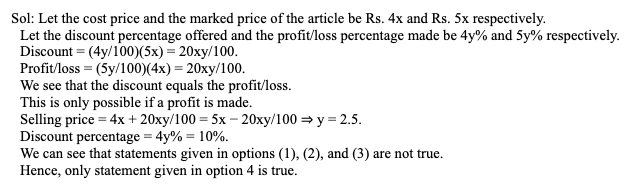
Q29. The cost price and the marked price of an article are in the ratio 4: 5. The article was sold after a discount. The discount percentage offered and the profit/loss percentage made on the article are in the ratio 4: 5. Which of the following statements is true?
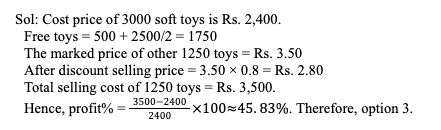
Q30. Tanuj wants to buy 15 bottles of Juice each of which costs Rs. 100 from the nearby market. Shop A has an offer of “buy 4 bottles get 1 Free” whereas Shop B has an offer “15% off if you buy 4 bottles or more “for the brand of Juice that Tanuj wants to buy. If Tanuj buys at least one bottle from each shop, then what is the minimum cost (in Rs.) at which he can buy the 15 bottles?
Q31. A shopkeeper sells 25 books such that after allowing a discount of 20%, he manages to make a profit which is equal to the marked price of 4 books. Find the percentage profit that he made in the entire transaction.
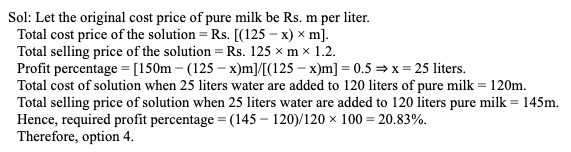
Q32. Gopal adds ‘x’ litres of water to pure milk to make a 125-liter milk-water solution. He sells this solution at a price that is 20% more than the cost price of pure milk and makes a profit of 50% on this transaction. If he adds ‘x’ litres of water to 120 litres of pure milk and sells the resulting solution at the cost price of pure milk, then what is his profit percentage in this transaction? (Assume that water comes free of cost.)
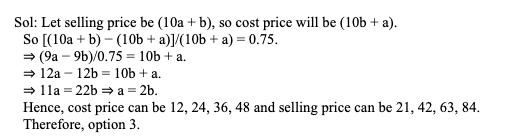
Q33. A trader marks up his goods in such a way that the selling price per item is obtained by reversing the digits of the cost price and he makes a profit of 75%. If his cost price is a two-digit number, then which of these can be the selling price of the item?
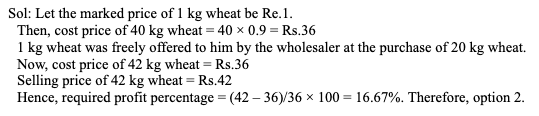
Q34. A retailer bought 40 kg wheat at a discount of 10%. Besides 1 kg wheat was freely offered to him by the wholesaler at the purchase of 20 kg wheat. Now he sells all the wheat at the marked price to a customer. What is profit percentage of retailer?
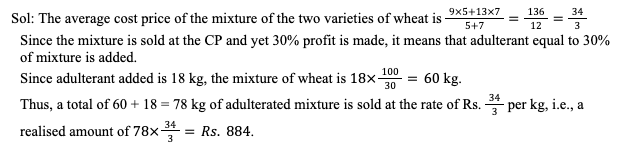
Q36. A dishonest shopkeeper has two varieties of wheat. One variety costs Rs. 9 per kilogram and the other variety costs Rs. 13 per kilogram. He mixes the two varieties in the ratio 5: 7. Further, he adds 18 kg of adulterant to the mixture to gain a higher profit percentage. If the shopkeeper makes a profit of 30% by selling the adulterated mixture at the average cost of the wheat mixture, what is the total amount (in Rs.) realised by selling the adulterated mixture?
Q37. The ratios of milk and water in two solutions A, B are 2: 1 and 3: 2 respectively. These two solutions are mixed in the ratio 6: 5 and the resulting solution is then sold at Rs. 56 per litre. If the cost price of pure milk is Rs. 55 per litre, then what is the profit or loss percentage? (Assume cost of water is zero)
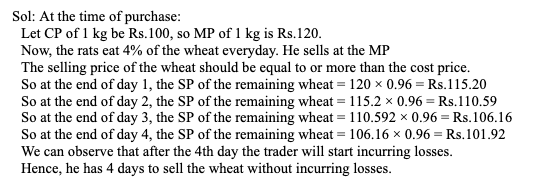
Q38. A trader purchases a bag of wheat at a certain price and marks it up 20% above its cost price. The rodents consume at the rate of 4% of the original contents of the bag each day, right from the moment the stock arrives in the warehouse. How many days after the purchase are available to the man for selling the bag of wheat without incurring any loss?
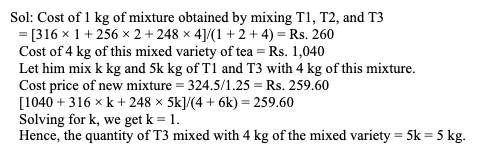
Q39. A tea merchant purchased three kinds of tea leaves at the rate of Rs. 420/kg, Rs. 360/kg and Rs.300/kg. He then mixed them, in the ratio 6: 7: 5 respectively by weight and sold the mixture to a customer at a 20% profit. The price (in Rs.) per kg at which he sold to the customer is:
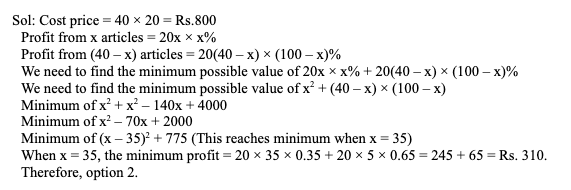
Q40. A shopkeeper buys 40 articles, each at Rs. 20. He sells ‘x’ of them at a profit of x% and the remaining at a profit of (100 – x)%. What is the minimum profit (in Rs.) the shopkeeper could have made on this trade?
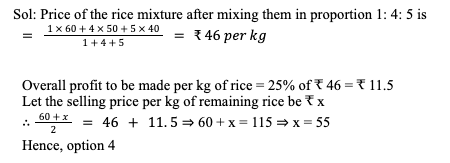
Q41. Shopkeeper purchased four varieties of Basmati rice at the rate of Rs. 150/kg, Rs. 100/kg, Rs. 75/kg and Rs. 60/kg. If he mixes them in the ratio 3: 1: 4: 2 in the given order, then at what price (in Rs.) should he sell the mixture to make a profit of 25%?
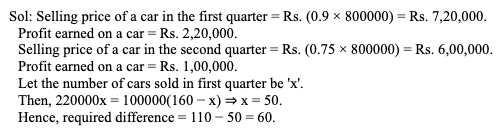
Q42. A car dealer purchased 160 cars from the manufacturer at Rs. 5,00,000 per car. He decides to mark the price of each car at Rs. 8,00,000. In the first quarter, he sold some cars at a 10% discount and the rest in the second quarter at a 25% discount. If the profit from the cars sold in both quarters was the same, what is the difference between the number of cars sold in the two quarters?
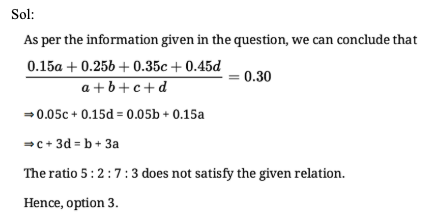
Q43. The cost price of four articles A, B, C and D are ‘a’, ‘b’, ‘c’ and ‘d’ respectively. A, B, C and D are sold at profits of 15%, 25%, 35% and 45% respectively. If the net profit on the sale of these four articles is 30%, ‘a’, ‘b’, ‘c’, and ‘d’ cannot be in the ratio:
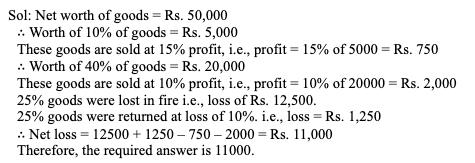
Q44. Rama had bought a stock of goods for Rs. 50,000. He sold 10% of the goods at 15% profit and 40% of the goods at 10% profit. 25% of the goods were damaged by fire and the remaining goods were sold back to the manufacturing company, at a loss of 10%. What is the total loss suffered by Rama (in Rupees)?
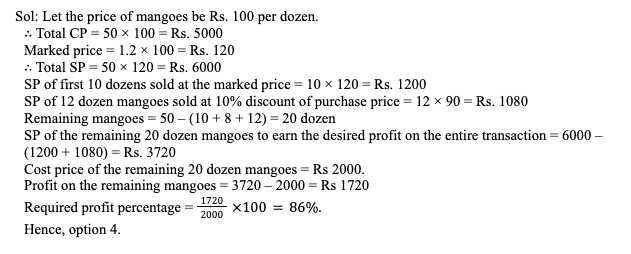
Q45. Harish purchased 50 dozen mangoes for sale in his fruit shop. He marked the price of mangoes up so as to earn a profit of 20%. He sold 10 dozen mangoes at this marked price. He found that 8 dozen of the remaining mangoes are rotten. Then he sold 12 dozen mangoes to his brother-in-law at a price 10% less than his purchase price. At what profit percentage should he sell the remaining mangoes to earn the desired profit on the entire transaction?
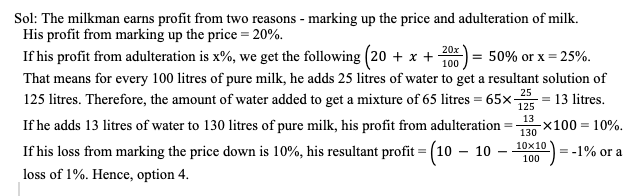
Q46. A milkman mixes some volume of water to pure milk and gets a water-milk mixture of 65 litres. He further sells this solution at a price that is 20% higher per litre than that of pure milk. He makes an overall profit of 50% in this process. If he mixes the same volume of water to 130 litres of pure milk and sells the resultant mixture at a price that is 10% lower than that of pure milk, what would be his resultant percentage profit/loss? (Assume water is available for free)