300+ Most Important Arithmetic Questions for CAT

Profit and Loss

Profit & Loss is one of the most important and most repeated topics in Arithmetic for CAT 2026, covering a wide range of exam-relevant problem types. Practice carefully designed CAT arithmetic important questions on marked price, discount, successive selling, and dishonest dealing concepts seen across multiple CAT exams. These questions reflect real CAT patterns and are curated for both accuracy and time efficiency.

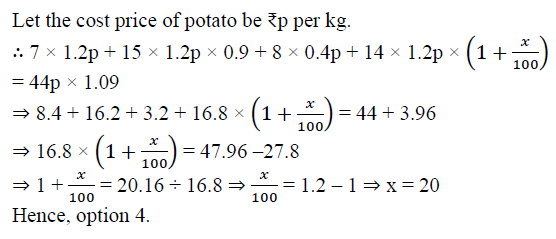
Q57. A trader bought 44 kg of potato and marked the price up by 20%. He sold 7 kg of potato at the marked price and 15 kg of potato at 10% discount. Unfortunately, 8 kg of potato was partly rotten in transit and hence had to be sold at a price which was 60% lower than the cost price. The remaining potatoes were sold by raising the marked price by x% so as to earn an overall profit of 9%. The value of x is:

40
37.5
25
20

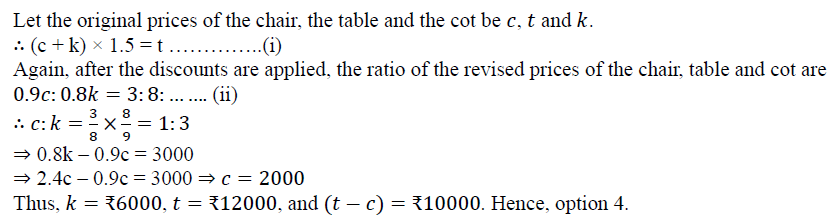
Q58. A furniture shop has a chair, a table and a cot on sale. The price of the table is 50% more than the combined price of the chair and the cot. The shop owner offers discounts of 10% on chair, 20% on cot and 25% on table. The revised prices of the chair and the cot are in the ratio 3: 8. If the difference of the revised prices of the chair and the cot is Rs 3000, then the difference of the original prices of the table and the chair, in Rs, is:

6500
7000
9000
10000

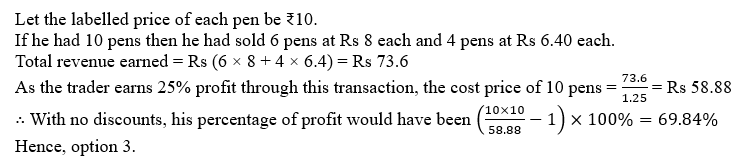
Q59. A trader sells identical pens. He sold 60% of his stock at 20% discount on the labelled price and sold the rest of the stock at an additional 20% discount on the discounted price. Overall, the trader makes a 25% profit. With no discounts, his percentage of profit would have been nearest to:

65
68
70
72

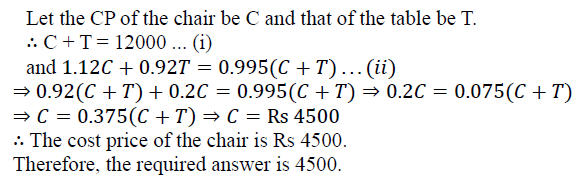
Q60. A carpenter manufactured a chair and a table. The cost of the chair and table together is Rs 12000. He sold the chair at 12% profit and the table at 8% loss. If overall he incurs a loss of 0.5% then find the cost price of chair (in Rs).       

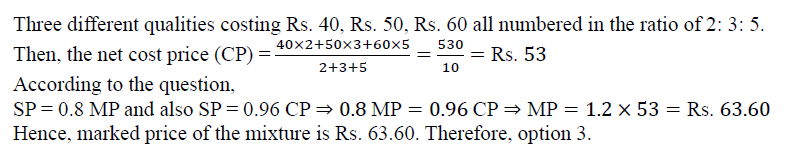
Q61. A person mixes coffee of 3 different qualities at prices Rs. 40, Rs. 50, Rs. 60 per kg in the ratio of 2: 3: 5. If he offers a discount of 20% on the marked price and incurs a loss of 4%. What is the marked price (in Rs.) of the mixture?

53
52.40
63.60
45

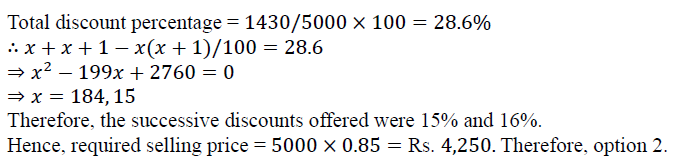
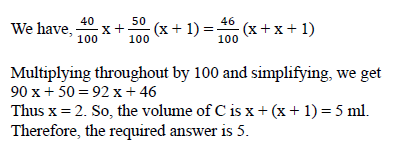
Q62. The marked price of an article is Rs. 5,000. If two successive discounts of x% and (x + 1)%, on the marked price is equal to a single discount of Rs. 1,430, then what will be the selling price (in Rs.) of the article if a single discount of x% is given on the marked price?

4500
4250
3750
3980

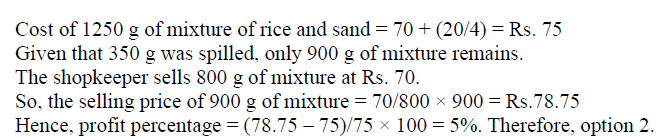
Q63. A dishonest shopkeeper mixes 250 grams of sand in 1 kilogram of rice. 350 grams of the mixture is spilled during transportation. He then uses a faulty balance that reads 1 kilogram for 800 gram while selling the mixture which is listed at the cost price of rice. If rice costs Rs. 70 per kg and sand costs Rs. 20 per kg, what is his overall profit/loss percentage during the entire transaction?

12.5% Profit
5% Profit
5% Loss
No profit, no loss

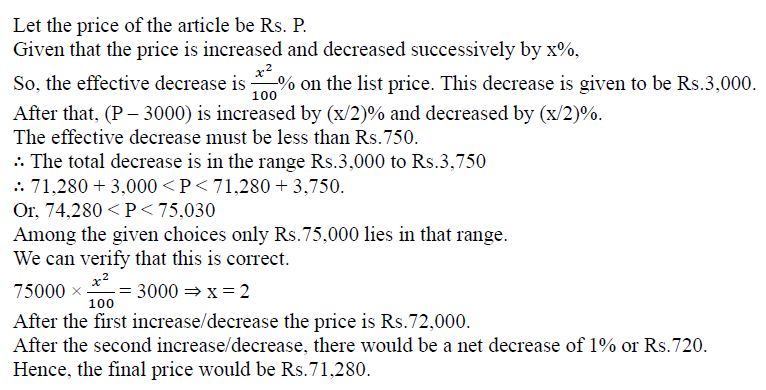
Q64. A shopkeeper hiked the price of an article by x% and then gave x% discount and the price of the article decreased by Rs.3,000. Once again, the price of the article was increased by x/2% and then decreased by x/2% and it was finally sold at Rs.71,280. What can be the initial price of the article? 

Rs.78,500
Rs.75,000
Rs.72,000
Rs.86,000

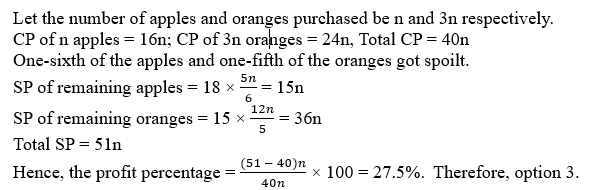
Q65. A fruit vendor bought some apples and some oranges. He bought some apples at the rate of Rs.192 per dozen and 3 times as many oranges at the rate of Rs.96 per dozen. One-sixth of the apples and one-fifth of the oranges got spoilt. He sold the remaining apples at Rs.216 per dozen and the remaining oranges at Rs.180 per dozen. Find his profit or loss percentage.

24.5%
16.5%
27.5%
18.25%

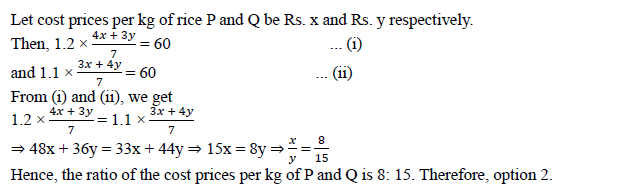
Q66. Two types of rice P and Q are mixed and then sold at Rs. 60 per kg. The profit is 20% if P and Q are mixed in the ratio 4: 3, and profit is 10% if this ratio is 3: 4. Find the ratio of cost prices per kg of P and Q.

9: 16
8: 15
7: 16
2: 5

Q67. Chinu, a fruit vendor, sold 12 coconuts, all of which are of the same cost price, such that profit percentage on no two coconuts is the same. The profits made on the given coconuts were in an arithmetic progression. If the profit percentage of the coconut with 5th highest and 8th highest selling price were 14% and 11% respectively, find the profit percentage on the whole.

12%
12.5%
13%
13.5%

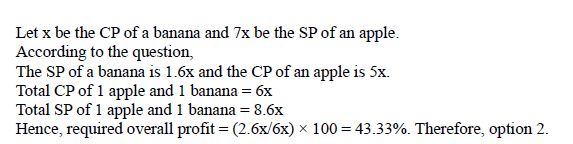
Q68. The selling price of one apple is equal to the cost price of 7 bananas. The fruit vendor gains 40% from sales of apples and 60% from sales of bananas. If he sells one banana and one apple, then find his overall profit%.

36.67%
43.33%
40%
45%

Q69. A milkman adds 10 litres of water to a can of milk that has 100 litres of pure milk. At what price per litre should he sell the mixture of milk and water so as to earn a profit of 32%, if he bought pure milk at Rs. 50 per litre and water is available for free?

Q70. A shopkeeper makes a loss of 2.5% if a discount of 25% on the Marked Price of the folder is offered. If the Cost Price of ‘n’ folders is the same as the Marked Price of 10 folders, what is the value of ‘n’?

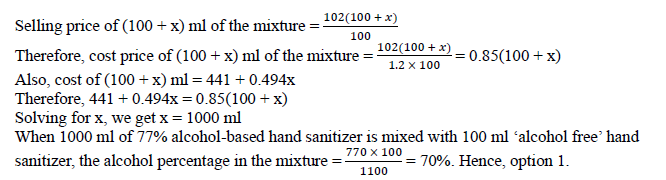
Q71. Ravi has 100 ml of ‘alcohol free’ hand sanitizer costing Rs. 441. He mixes ‘x’ ml of 77% alcohol-based hand sanitizer at Rs. 494 per litre. He now sells this mixture at Rs. 102 per 100 ml and thereby earns 20% profit. Find the alcohol percentage in the mixture.

70%
72%
74%
73%

Q72. A dishonest shopkeeper uses two different scales while buying and selling the goods. Both the scales are faulty. While buying he uses a scale that shows 900 gm per kg of the goods bought. Similarly, while selling, he uses a scale that shows 1100 gm per kg of the goods sold. What is his profit percent, if he claims to sell the goods at cost price?   
20%
22.22%
25%
16.67%

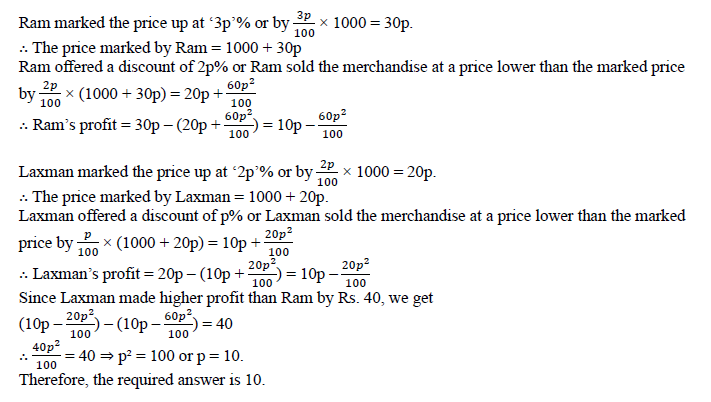
Q73. Both Ram and Laxman bought merchandise worth Rs. 1000. Ram marked the price up by ‘3p’% and offered a discount of ‘2p’%, while Laxman marked the price up by ‘2p’% and offered a discount of ‘p’%. If Laxman made a profit of Rs. 40 more than that made by Ram, what is the value of ‘p’, where p > 0?

Q74. A watch trader bought ‘n’ watches, which he intended to sell so as to earn 10% profit. However, four watches were damaged and hence could not be sold. If the trader hikes the Selling Price of each watch by 25%, he would still make 10% profit. What is the value of ‘n’?

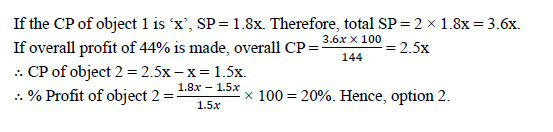
Q75. A shopkeeper sold two objects at the same price and made overall profit of 44% on the transaction. If he made a profit of 80% on one object, how much percent profit/loss did he make on the other?

Profit of 8%
Profit of 20%
Loss of 20%
Loss of 8%

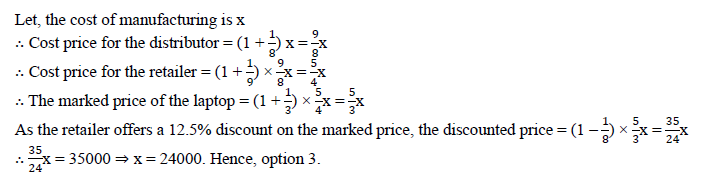
Q76. The manufacturer of a laptop sells it to a distributor at a profit of 12.5%. The distributor sells the laptop to a retailer at a profit of 11.11%. The retailer puts a price tag which increases the price of the laptop by 33.33%. The retailer offers a 12.5% discount on the marked price and ultimately sells it to its customer at Rs. 35000. What is the cost (in Rs.) of manufacturing of the laptop?

16000
20000
24000
32000

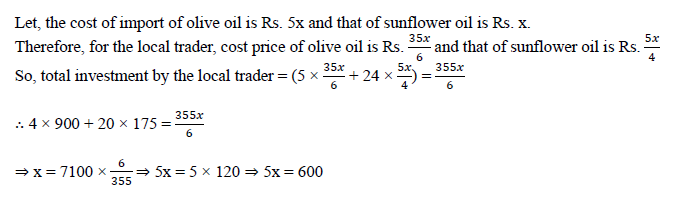
Q77. Importers import olive oil at a cost which is 5 times that of imported sunflower oil. They sell olive oil and sunflower oil to local traders at a profit of 1623% and 25% respectively. A local trader bought 5 liters of olive oil and 24 liters of sunflower oil. Due to storage problem, 1 litre olive oil and 4 liters sunflower oil was spoiled. The trader sold rest of olive oil at Rs. 900 per litre and sunflower oil at Rs. 175 per litre to just recover his total cost on buying two types of oils. What is the cost of olive oil per litre (in Rs.) at which it is imported?

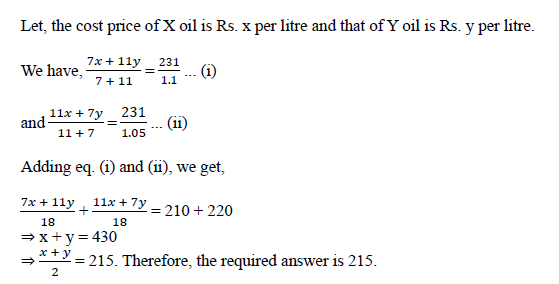
Q78. Two types of edible oil, X and Y, are mixed and sold at Rs. 231 a litre. If X and Y are mixed in the ratio 7: 11, the profit is 10%. On the other hand, if X and Y are mixed in the ratio 11: 7, the profit is 5%. Find the average of the cost price of oil X and that of oil Y (in Rs.).

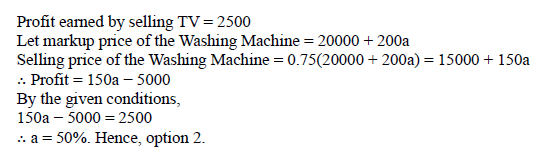
Q79. Ashish bought a TV and a Washing Machine for Rs. 10000 and Rs. 20000 respectively. He marks up the price of TV by 25% and sells it. On the marked-up price of the washing machine, he gave a discount of 25%. If the profit earned in both the transactions is equal, by how much percent does he mark up the price of the Washing Machine?

37.5%
50%
27.77%
44.44%

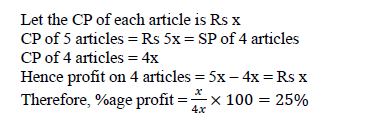
Q80. If the cost price of 5 identical articles is equal to the selling price of 4 articles, what is the percent profit made?

Q81. Henna purchased 18 bottles. She sold six of these bottles at a profit of 36%, half of the remaining at a profit of 20% and the rest at Rs. 160 per bottle. Her overall profit was 12%. How much amount was spent by Henna to purchase these 18 bottles?

Rs. 1,200
Rs. 2,400
Rs. 3,600
Rs. 4,800

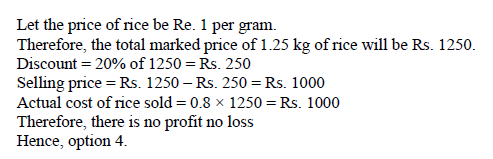
Q82. A shopkeeper claims that he sells rice at the cost price. However, he uses an 800 g weight for measuring 1 kg. On a particular day a customer bought 1.25 kg of rice at 20% discount. What is the shopkeeper’s overall profit/loss percentage on the whole transaction?

10% loss
10% profit
20% profit
None of these

Q83. Both Ajay and Vijay sold goods worth Rs. 9600 in a day. Both claimed that they made a profit of 20%. Ajay calculated his profit on his Cost Price while Vijay calculated his profit on his Selling Price. Who actually made more profit? By how many rupees?

Ajay made more profit by Rs. 320
Vijay made more profit by Rs. 320
Ajay made more profit by Rs. 240
Vijay made more profit by Rs. 240

Q84. A fruit seller bought 100 boxes of mangoes. Each box has 5 dozen of mangoes. The market price of the mangoes is Rs. 600 per dozen. However, he decided to offer a discount of 20% on the market price so as to earn a profit of Rs. 10 per mango. However, he realized that out of the mangoes bought, 20 dozen of mangoes were rotten and hence could not be sold. Therefore, he decided to offer a lower discount of x% instead of 20% so that he would still earn the desired profit of Rs. 10 per mango bought. Find the value of ‘x’.     

10%
12.5%
16.67%
25%

Q85. A vegetable vendor purchased 100 kg of lemons of type 1 and 60 kg of type 2. Cost price (per kg) of type 2 lemons is 20% less than that of type 1 lemons. After mixing the two types of lemons, he sold them at Rs. 95 per kg and thereby earns Rs. 400 after selling all the lemons. What must be the cost (per kg) of lemons of type 1?

Q86. A shopkeeper sold a mobile cover and a screen guard to Anant at 5% discount and 50% discount respectively and had a total loss of Rs. 300. Instead, had he given a discount of 10% on both the items, he would have had a total profit of Rs. 250. If the Marked Price of the screen guard is Rs. 500 more than that of the mobile cover, what must be the cost price (in Rs.) of both the items together?

2000
2250
2500
2200

best CAT Coaching

We at Quantifiers understand and deliver on the personal attention each of our students requires. Whether it is through our pedagogy that enables non-engineers or non-math background students, our constant effort to proactively provide solutions, or our focus on our student’s goals.